
-1.png?width=800&height=157&name=1-playwire-logo-primary-2021%20(1)-1.png)


Case Study
How NFL Perry Tripled Daily Revenue After Switching to Playwire
A football site where users stay inside one game for twenty minutes needed ads that survive navigation and a partner who would say which placements to try. One month after leaving Raptive, daily revenue is roughly triple.
- Sports
- Gaming
- RAMP Platform
.png?width=3386&height=1744&name=NFL-Perry-Pick-Em-09-21-2026_06_46_AM%20(1).png)
What changed
Daily ad revenue
Publisher-reported, one month after switching from Raptive
Revenue
Week four against week one with Playwire, after Yield Optimization
Pageview RPM
Week four against week one with Playwire, after Yield Optimization
Directional results as reported by NFL Perry.
The short version
- 3x Daily ad revenue: NFL Perry's daily ad revenue roughly tripled after switching from Raptive to Playwire.
- $1 Increase in RPM: Immediately upon switching providers, NFL Perry saw an increase in RPM.
- Direct earns 4.4× its share of inventory: Playwire's Direct Sales infused additional earning power into NFL Perry's revenue.
About the publisher
NFL Perry
NFL Perry is a football site built around games rather than articles. Users land on the homepage, find a trivia game, and stay there. Sessions routinely run 20 minutes as players run the same game over and over.
That user behavior means NFL Perry should be tracking session-revenue metrics, not just pageview metrics. It also makes ad strategy harder to get right, because the pages that hold attention longest are the ones you least want to clutter.
.png?width=3386&height=1744&name=NFL-Perry-Pick-Em-09-21-2026_06_50_AM%20(1).png)
The problem
Running Ads Without a Feedback Loop
Before Playwire, NFL Perry monetized through Raptive. The integration worked, and it got ads live on a site that had never carried them before. What they didn't do was tell Perry how to optimize.
Raptive was a good start, but there wasn't much strategic guidance. They gave me a list of many options I could try myself rather than being a hands-on partner, so it was on me to be my own experimenter.
The bigger cost was hesitation. Perry held back on changes he wasn't sure he could reverse, because a broken layout meant a day of waiting on a support queue.
The ad setup reflected that caution. Ads ran on a couple of static pages and died when a user navigated somewhere new, which meant the longest sessions on the site were the least monetized.
The switch
Switching to RAMP
Perry came to Playwire on a referral. He'd talked to publishers already on the platform, compared their returns to his own, and went looking through his inbox for an email from our team that had been sitting there for months.
Onboarding started with what he didn't want. Specific pages were off limits. Certain experiences weren't to be interrupted. Our team built the layout around those constraints instead of arguing with them.
I told them what pages I didn't want ads on, and they worked with me. Having a dedicated rep who responded immediately, instead of a support forum with a new person every time, was exactly what I was missing.
The outcome
Tripling Daily Revenue Against the Previous Setup
I've tripled my daily revenue since switching over. I'm extremely happy with the numbers.
Point blank, we served more ads because we were able to experiment and determine which placements worked for my audience, and I got a better understanding of the types of ads that worked. They gave me solutions for getting ads in places that wouldn't be disruptive, and offered more flexibility in placement.
The auction
The Gain Came From the Auction, Not the Audience
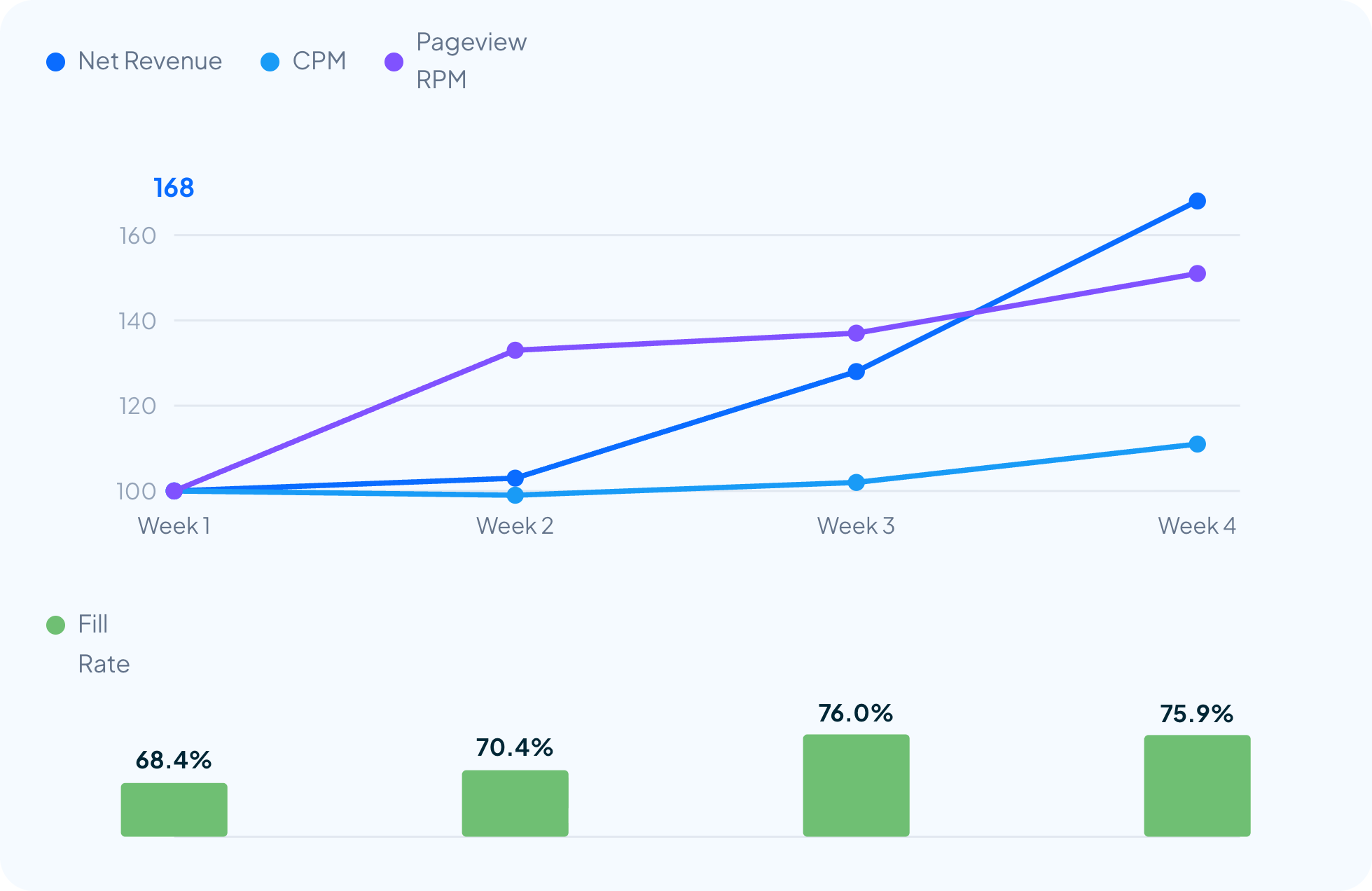
NFL Perry's trajectory over the first four weeks on Playwire shows the value of yield optimization practices on the auction: fill rate climbed from 68.4% to 76.0% week over week, and CPM rose 10.6% on top of that.
NFL Perry's ramp-up period was swift and effective.
The strategy
Building the Strategy Around the Session
RPS went up significantly with this holistic ad strategy. Now people get served ads across pages, not just a couple of static ones.
Reporting
Reporting That Keeps Up With Traffic
With Raptive it was daily. At Playwire, I get an hourly estimate, which makes it easy to track whether peak traffic is actually converting to ad revenue.
Perry left a provider that got his ads live and stopped there. One month in, he's calling it triple the daily revenue, and the RAMP data shows 68% growth on 12% more traffic, a 50% higher pageview RPM, and a direct demand line still climbing. The traffic did some of the work. The auction did most of it.
Accelerate your business and uncomplicate your ad tech stack, because you deserve a partner and a platform that demands more for you.