Let's be real - in-game advertising is hot right now. But before you rush to build your branded Fortnite world, there are some crucial things you need to know:
Don't have time to read this?
Take a copy with you
Select Your Chapter
Remember when "gaming advertising" meant slapping your logo on a pixelated billboard in the background of NBA 2K? Those days are long gone. Today's in-game advertising landscape is a whole new ball game, offering everything from custom-built branded worlds to programmatic placements that would make Don Draper's head spin.
Let's start with the obvious: gaming isn't just massive – it's mainstream. We're talking about an audience that spans demographics, devices, and continents. When brands like McDonald's, Nike, and Gucci are creating custom Roblox experiences, you know something big is happening.
But here's where it gets interesting (and where most brands get it wrong): The gaming audience isn't just sitting around waiting to explore your branded Minecraft world. They're sophisticated consumers who engage with content across multiple platforms and channels. Success means meeting them everywhere they are, not just inside their favorite games.
Today's in-game advertising landscape breaks down into three main categories:
Custom Experiences: Think branded Fortnite worlds, Roblox experiences, and Minecraft builds. These are the headline-grabbers that get everyone excited. They're creative, innovative, and... incredibly challenging to get right.
Traditional In-Game Placements: The evolution of those old-school billboard ads. Now we're talking programmatic placements, dynamic advertising, and integration with existing game environments. Less flashy, but often more practical.
Hybrid Solutions: The middle ground where traditional advertising meets gaming environments. Think banner placements in gaming hubs or sponsored items that feel native to the game world.
Here's the thing though – and this is where we're going to get real with you – success in gaming advertising isn't about picking one of these lanes and going all-in. It's about understanding how each piece fits into your larger strategy.
Before we dive deeper into the tactics and strategies, let's address the elephant in the room: measurement. Custom in-game activations can create incredible moments and generate serious buzz. But they come with some significant limitations:
This doesn't mean you shouldn't do them. It just means you need to be smart about how you approach them. The most successful gaming advertisers understand that these activations work best as part of a larger strategy that includes measurable, scalable media investments.
Think of it this way: Your gaming advertising strategy should be like a well-balanced portfolio. Sure, you might make some exciting high-risk investments (custom experiences), but you need a solid foundation of reliable performers (traditional media) to ensure consistent returns.
In the following sections, we'll break down exactly how to build that portfolio, including where to invest your budget, how to measure success, and when to go big with custom activations. But first, let's get clear on exactly who you're trying to reach and what makes them tick.
Let's start by shattering some stereotypes. If you're picturing a teenage boy in his parents' basement surviving on energy drinks and chip dust, it's time to update your mental image. Today's gaming audience is about as diverse as it gets – and understanding these segments is crucial for your advertising success.
Before we dive into the platforms and their unique audiences, let's get one thing straight: "gamers" isn't a monolithic group. Just like you wouldn't market to all "TV viewers" the same way, treating all gamers as one audience is a recipe for mediocre results.
Different gaming platforms attract distinct audiences. Here's the breakdown of where you'll find various segments:
Primarily young users (think elementary and middle school)
Highest concentration of Gen Alpha
Heavily moderated, brand-safe environment
Requires extra consideration for child safety and compliance
Broad age range, but sweet spot is tweens and young teens
Mix of casual and dedicated players
Strong educational/creative component
Active community engagement
Wider demographic band
Strong teen and young adult presence
Most sophisticated graphics and gameplay
Proven track record with brand integrations
Core 18-45 demographic
Highly engaged, dedicated player base
Significant disposable income
Long average session times
Primary 18-34 demographic
Mix of casual and hardcore gamers
Strong brand loyalty
High household income averages
Primary 18-34 demographic
Mix of casual and hardcore gamers
Strong brand loyalty
High household income averages
Tech-savvy 18-34 demographic
PC gaming enthusiasts
Multiple touchpoints during gameplay
Integration with popular competitive games
Here's something that might surprise you: the average age of a gamer is actually 35. While platforms like Roblox skew younger, gaming as a whole spans every age group. This means you need to think carefully about which segment of the gaming audience actually matters for your brand.
Each gaming platform comes with its own quirks and considerations. Let's break down what you really need to know:
Built on Unreal Engine, offering premium quality experiences
Strong creator ecosystem
Revenue sharing model similar to YouTube
Excellent for high-production-value activations
Complex discovery mechanics
More centralized control
Strict brand safety guidelines
Built-in audience measurement
Limited creative flexibility
Heavy compliance requirements for young audience
Open development environment
Server-based structure
Community-driven content
Variable quality control
Multiple entry points for brands
Highly controlled environments
Limited traditional ad inventory
Strict guidelines around brand integrations
Strong community emphasis
Potential for sponsored events and tournaments
Deep engagement metrics available
Structured advertising environments
Premium inventory with high viewability
Multiple ad format options (in-game, dashboard, etc.)
Strong first-party data capabilities
Cross-platform tracking challenges
Established measurement standards
Direct integration with popular PC games
In-game app overlay capabilities
Rich targeting options
Real-time performance metrics
Native-feeling ad experiences
Strong brand safety controls
Integration with existing programmatic platforms
The key difference with these mature gaming platforms? They've been in the advertising game longer (pun intended) and generally offer more standardized, measurable advertising solutions. While you might not get to build a virtual theme park, you'll get something potentially more valuable: reliable performance metrics and established user behaviors.
Think of it this way: custom activations in Fortnite are like throwing an expensive party – lots of flash, hard to measure the impact. Advertising on established gaming platforms is more like running a well-oiled machine – less exciting, maybe, but you know exactly what you're getting.
Here's where we need to have an honest conversation about numbers. While gaming platforms love to tout their massive user bases (we're looking at you, Roblox, with your "billions of engagements"), the reality of reach for brand activations is... complicated.
Remember that cool branded world you're thinking about building? Here's what you're up against:
This is why supporting media is crucial. Even the most amazing in-game activation needs help getting noticed. Think of it like opening a fantastic restaurant in a dark alley – without some serious promotion, nobody's finding you.
Understanding these audience dynamics should fundamentally shape your approach to gaming advertising. Here's how to think about it:
1. Match Platform to Purpose
2. Consider the Full Journey
3. Plan for Reality, Not Hype
Remember: success in gaming advertising isn't about being everywhere – it's about being in the right places with the right approach. Your audience is sophisticated, and they can smell inauthenticity from a mile away.
The key is matching your platform choice and activation strategy to your actual target audience, not just jumping on whatever platform is making headlines this week.
Let's cut through the hype and get real about your in-game advertising options. Think of this like choosing your weapons in a battle royale game – each option has its strengths, but you wouldn't want to drop into the arena with just a pistol, right?
When brands think about in-game advertising, this is usually what gets them excited. Custom experiences are the equivalent of building your own theme park inside a game. Sounds cool, right? Well, yes... and no. Let's break down what's actually possible and what you need to know before diving in.
Custom experiences represent the bleeding edge of what's achievable in gaming environments today. Here's what brands are building:
Before you get too excited about building your virtual brand paradise, there are some crucial considerations to keep in mind:
Think of it like opening a store in the middle of the desert. Sure, you could build the coolest shop ever, but if nobody knows how to find it, what's the point?
While everyone's getting excited about building virtual worlds, don't sleep on traditional in-game advertising. These are your bread-and-butter placements that actually deliver measurable results. They might not win awards for innovation, but they'll definitely win over your CFO.
These tried-and-true formats have been refined over years of implementation and optimization:
The beauty here? These placements come with actual metrics you can show your boss. CPMs, viewability, engagement rates – you know, the stuff that keeps the lights on.
Not ready to build a virtual theme park but want something more exciting than a billboard? Welcome to the sweet spot of in-game advertising. These solutions offer a balance of creativity and practicality that often delivers the best overall results.
These options give you the flexibility to stand out while maintaining some standardization in implementation:
Here's a framework we use to help brands decide which options make sense:
Here's the thing most agencies won't tell you: the flashiest solution isn't always the best one. Sometimes boring old programmatic ads in gaming environments will drive better results than that million-dollar custom world nobody can find.
We need to talk about the elephant in the room: discovery. This is the biggest challenge facing custom in-game activations, and it's why we're such sticklers about having a solid media strategy to support these initiatives.
Picture this: You've just spent six months and several hundred thousand dollars building an amazing branded world in Fortnite. It's got everything – amazing gameplay, perfect brand integration, killer rewards. But when you launch... crickets. Why? Because you're competing with literally thousands of other experiences, and the platforms don't exactly make it easy for users to find you.
This is why we're always pushing for a balanced approach. Custom activations can be incredible, but they need to be:
Remember: Just because you can build it doesn't mean they'll come. Success in gaming advertising requires thinking beyond just the in-game piece and considering the entire ecosystem of how you'll reach and engage your audience.
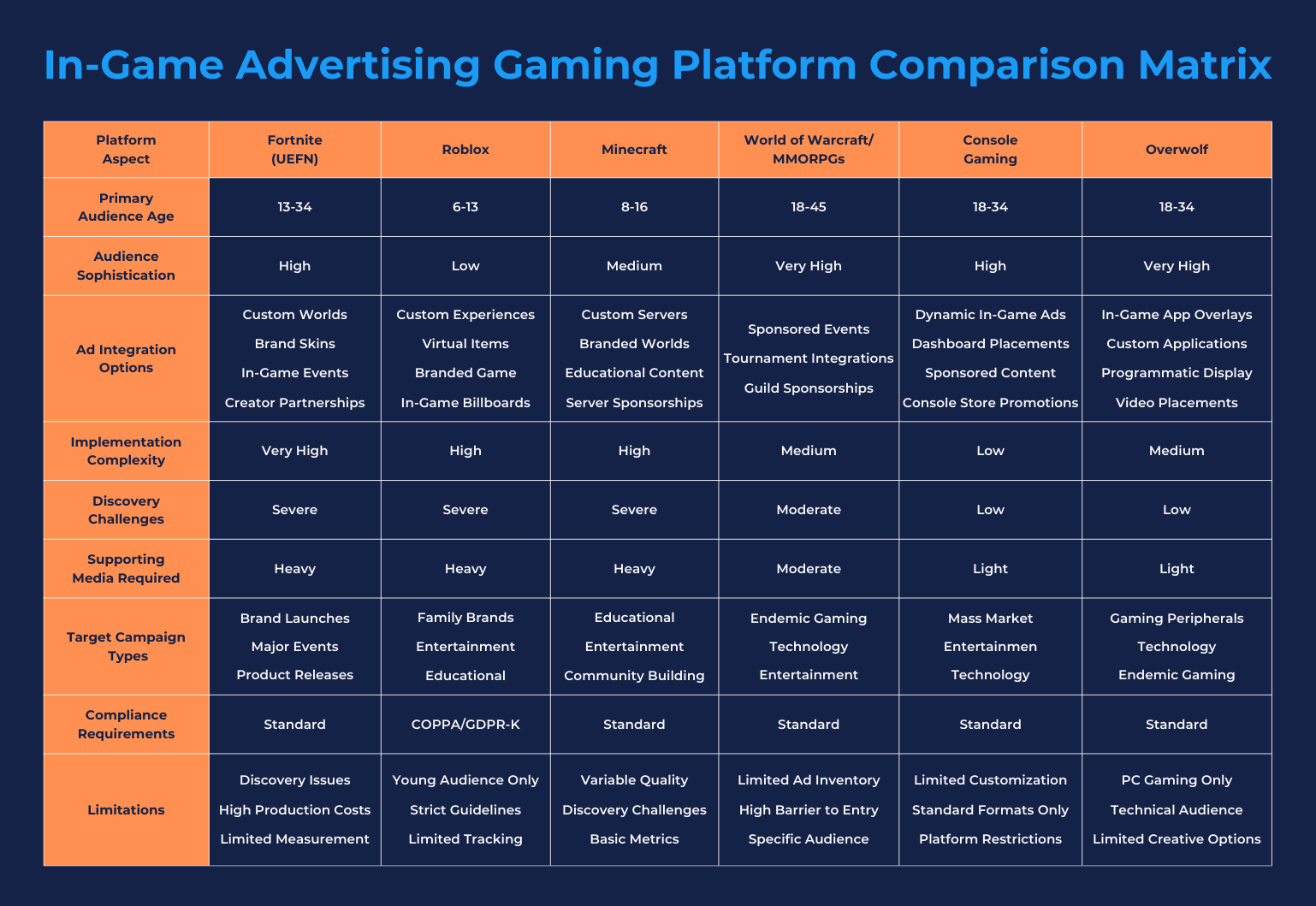
Not all gaming platforms are created equal, and choosing the right one for your in-game advertising campaign can make or break your results. Below, we've broken down the key characteristics of major gaming platforms to help you navigate where your ad dollars might be best spent.
Pay special attention to the audience demographics, measurement capabilities, and implementation requirements – these factors often have the biggest impact on campaign success. And remember: the "best" platform isn't always the flashiest one, but rather the one that aligns with your specific campaign goals and measurement needs.
Let's talk money. Not just how much you'll spend, but how to spend it smart. Because here's the truth: throwing a pile of cash at a flashy custom game experience without a solid media foundation is like building a mansion on quicksand. Impressive for a minute, sure, but not exactly a sound investment strategy.
Before we dive into specific campaign budgets, let's zoom out and look at your yearly gaming media strategy. Think of this like building a balanced investment portfolio – you need a mix of reliable performers and strategic opportunities.
Your foundation should be consistent, measurable media spending that reaches gamers where they already consume content. This is your bread and butter, typically accounting for 70-80% of your annual gaming budget. Here's how to think about it:
Why so much emphasis on traditional media? Simple: it works. While custom activations grab headlines, consistent media presence drives actual results you can track and optimize.
Let's be honest – standard display ads just don't cut it anymore. That's why we built the Flex Suite, our proprietary collection of high-impact ad formats that actually get noticed. This isn't your grandfather's ad tech – we're talking custom-built units like:
Powered by our advanced code-on-page technology, these formats deliver the holy trinity of advertising: breakthrough creative, guaranteed viewability, and premium performance metrics.
With benchmark CTRs, viewability rates, and video completion that make advertisers drool, the Flex Suite doesn't just serve impressions – it makes them. Want to stop blending in with the background? Let's flex those creative muscles.
Set aside 20-30% of your annual budget for strategic moments where custom activations make sense. These are your big swings – custom experiences, special events, major launches. But here's the key: never build these without supporting media dollars to drive discovery.
When it comes time to plan individual campaigns, especially those involving custom experiences, you need to think differently about budget allocation. Let's break down a typical custom activation budget:
The creative build is just the beginning. Here's what you need to budget for:
Here's where most brands go wrong: they blow their entire budget on the custom experience and leave nothing for promotion. Big mistake. For every custom activation, plan to spend at least 25% of your build budget on supporting media. So if you're spending $400K on a custom world, you need $100K minimum for promotion.
Why? Because even the coolest virtual experience is worthless if nobody finds it. Your supporting media budget needs to cover:
Time for some tough love: just because you can afford to build a custom gaming experience doesn't mean you should. Here's our framework for evaluating whether a custom build makes sense:
After years of watching brands succeed (and fail) in gaming advertising, here's what we know works:
Remember: in gaming advertising, sometimes the smartest budget decision is knowing when not to build that shiny custom experience everyone's excited about. Your CFO will thank you later.
Here's where we need to get real about implementation. Building and managing a gaming media strategy isn't like buying traditional digital ads. You need a partner who actually understands both the gaming audience and the technical complexities of gaming environments.
This is usually where we'd get all humble and subtle, but let's cut to the chase: we're really good at this stuff. Here's why smart gaming advertisers trust us with their media spend:
The best part? While you're running consistent, measurable media through our platform, you'll have the data and insights you need to make smart decisions about those bigger custom activations – if and when they make sense for your brand.
Look, we've seen enough gaming campaigns to know what works and what face-plants spectacularly. Let's skip the learning curve and get straight to the strategies that actually drive results – whether you're going all-in on custom experiences or keeping it strategic with traditional media.
Before you start dreaming up your branded metaverse, let's talk about what actually makes custom gaming activations successful. Spoiler alert: it's not just about building something cool.
Your amazing branded Fortnite world won't matter if nobody can find it. Here's how to solve the discovery puzzle:
Gaming influencers aren't just promotional channels – they're your secret weapon for driving discovery. Here's how to do it right:
Want to know why most branded gaming experiences fail? They forget they're making a game, not a commercial. Here's how to avoid that trap:
Now let's talk about what makes traditional gaming media actually perform. Because let's be honest – standard display ads in gaming environments can either be a gold mine or a money pit.
The gaming audience is sophisticated and diverse. Here's how to reach the right segments:
Gaming audiences have seen it all. Your creative needs to work extra hard to stand out:
If you can't measure it, you can't improve it. Here's what your measurement strategy needs:
Here's where the magic really happens – when you successfully integrate custom experiences with traditional media. Think of it as your gaming marketing symphony:
The biggest mistake we see? Bad timing. Here's how to get it right:
Let's learn from other people's expensive mistakes, shall we?
News flash: they won't come unless you tell them about it. Never launch a custom experience without a solid promotional plan.
Don't blow your entire budget on either custom or traditional. Balance is key.
Gaming campaigns need constant optimization. Plan for ongoing management and updates.
Remember: success in gaming advertising isn't about doing one thing perfectly – it's about orchestrating multiple elements into a cohesive strategy that actually delivers results. And if that sounds complicated, well... that's why partners like Playwire exist.
Let's get real about the obstacles you'll face in gaming advertising. Consider this your cheat code for avoiding costly mistakes and implementing solutions that actually work.
The Challenge: You've built an amazing branded experience, but nobody can find it. This is the number one reason custom gaming activations fail - discoverability in gaming platforms is notoriously difficult, with experiences often buried under thousands of other options.
The Solution: The key to solving the discovery challenge is starting early and attacking it from multiple angles. You need to build awareness before launch and maintain promotional momentum throughout your campaign. Think of it like launching a new restaurant – even the best cuisine needs marketing to get people through the door.
The Challenge: Custom experiences often lack standard tracking capabilities. You'll have limited access to third-party tracking, making ROI calculations feel like advanced calculus.
The Solution: While you can't get the same granular tracking you're used to with traditional digital media, you can build a measurement framework that gives you meaningful insights. The trick is combining multiple data sources to create a complete picture of performance.
The Challenge: The most common mistake we see? Brands frequently overspend on custom experiences and underspend on promotion. The result? Beautiful but empty virtual spaces that nobody visits.
The Solution: Success in gaming advertising requires thinking about your budget like a balanced investment portfolio. You need a mix of reliable performers and strategic opportunities. This balanced approach ensures consistent performance while leaving room for innovation.
Follow the 70/20/10 rule:
The Challenge: Too often, brands choose platforms based on what's trending rather than where their audience actually spends time. Just because Roblox is hot doesn't mean it's right for your adult-focused brand.
The Solution: Platform selection should always start with your audience, not the other way around. Taking time to understand where your target audience actually spends their gaming time will save you from expensive mistakes and missed opportunities.
The Challenge: Custom gaming experiences often take longer and cost more than initially planned. Technical requirements, platform approvals, and optimization can create significant delays.
The Solution: The key to managing implementation complexity is thorough planning and realistic timelines. Building in buffers and planning for contingencies isn't being pessimistic – it's being realistic about how these projects actually work.
The Challenge: Many brands treat custom experiences and traditional media as separate initiatives rather than parts of the same strategy. This creates disconnected campaigns with suboptimal results.
The Solution: The magic happens when you treat your gaming advertising as one cohesive strategy rather than separate initiatives. Think of traditional media and custom experiences as two instruments in the same orchestra – they need to play together to create something memorable.
After seeing these challenges play out repeatedly, here's what we know works:
Remember: The most common mistake isn't choosing the wrong solution - it's implementing the right solution poorly. Take the time to plan properly, budget realistically, and execute thoroughly.
Let's peer into our crystal ball – but instead of making wild predictions, let's focus on the trends and technologies that are actually shaping the future of gaming advertising. No metaverse hype or blockchain buzzwords here – just real talk about where this industry is headed.
The technical capabilities of gaming platforms continue to evolve, creating new opportunities for advertisers. But with every new capability comes both opportunities and challenges.
Gaming platforms are finally catching up to advertisers' need for better metrics. We're seeing development of:
The gap between traditional media and gaming experiences is narrowing, creating more opportunities for seamless brand integration:
The gaming landscape never stands still, and neither should your advertising strategy. Here's what's actually changing in the platforms that matter:
Gaming platforms are moving toward more standardized advertising solutions, making it easier to:
Platforms are finally addressing the discovery challenge with:
The future of gaming advertising isn't just about new technologies – it's about smarter implementation of existing ones. Here's what successful gaming advertisers will need to focus on:
The most successful brands will continue to balance:
As measurement improves, expect:
After diving deep into the world of gaming advertising, here's what you need to remember:
1. Balance is Everything Don't get caught up in the hype of custom experiences at the expense of proven media strategies. Your success in gaming advertising will come from finding the right mix of:
2. Measurement Matters The platforms that can provide clear, actionable metrics will increasingly win budget share. Focus your efforts where you can:
3. Strategy Before Platform Choose your platforms based on:
Ready to level up your gaming advertising? Start with these steps:
Audit your current gaming media spend
Identify opportunities for consistent presence
Plan strategic moments for custom activation
Ensure proper measurement frameworks
Partner with experts who understand both gaming and advertising
Remember: Success in gaming advertising isn't about jumping on every new trend or building the flashiest custom experience. It's about creating a sustainable, measurable strategy that actually delivers results.
We'll email you a downloadable PDF version of the guide and you can read later.