
-1.png?width=800&height=157&name=1-playwire-logo-primary-2021%20(1)-1.png)

Interstitial ads get treated one of two ways. Either they're a revenue cheat code you bolt on to fix a bad quarter, or they're a UX crime you refuse to touch. Both positions are lazy.
So: what the unit is, where it's allowed to fire, how to cap it, and how to tell whether it's working.
What an Interstitial Ad Is
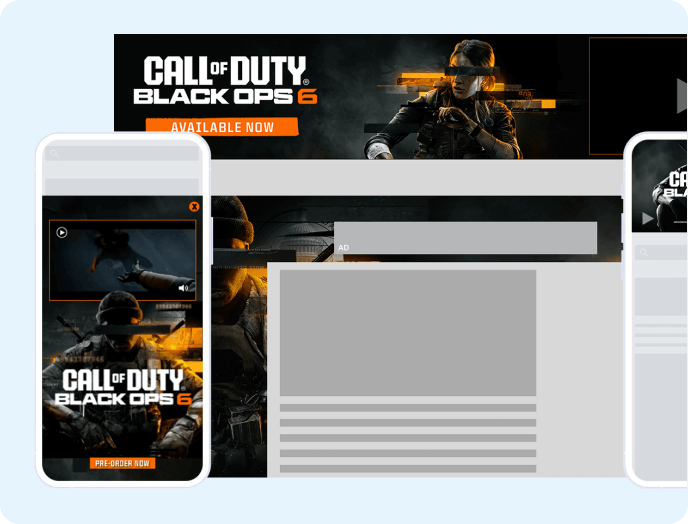
An interstitial is a full-screen ad that appears between two states of a user's session rather than inside the content itself. On the web, that's the moment between page A and page B. In an app, it's the moment between one screen or level and the next.
That distinction is what separates it from a pop-up. A pop-up loads after content has already begun rendering and blocks it. An interstitial fires at the transition itself, before the next content state has appeared, which is why the two formats carry different policy treatment even though both cover the screen.
In OpenRTB terms, the format is signaled with a single flag. The IAB OpenRTB 2.5 specification defines imp.instl as "1 = the ad is interstitial or full screen, 0 = not interstitial," with a default of 0. Google Authorized Buyers identifies the opportunity the same way, using BidRequest.imp.instl set to true.
Under the updated IAB Tech Lab video guidelines that migrated to OpenRTB 2.6 in March 2024, interstitial is also a distinct video plcmt type: full-screen takeover video played without supporting video content, which must be the primary focus of the page and cannot be scrolled out of view.
Static, Video, and Interactive Interstitials
Interstitial creative isn't one thing. It ranges from a static image, to a video that plays on load, to an interactive or gamified unit the user taps through.
Our ad unit breakdown describes the web interstitial's job as taking over the screen to display "a video, banner ad, or gamified unit" during a page transition. The creative type isn't cosmetic, either. Per our ad layout course, "the more interactive your creatives are, the more advertisers are going to have to pay for them," so a gamified interstitial and a static banner running in the same slot won't clear at the same CPM.
Web interstitials
On the web, the unit overlays the screen with an ad when a user navigates between pages, on both desktop and mobile. Our web interstitial is dynamically injected by script, served once per user per session, and available at 320x480, 300x250, and 336x280.
In-app interstitials
In apps, the unit takes the full screen between phases of the user journey. Our in-app interstitial is injected via SDK at a set frequency of once per session, in all standard full-screen sizes. Prebid lists the common ones as 320x480, 480x320, 768x1024, and 1024x768.
The mechanics are identical to the web. The context is not. App users have a much higher tolerance for full-screen ads, and app policy is much stricter about where they fire.
How interstitials differ from adjacent formats
Publishers conflate several full-screen formats that carry different policy risk and different demand. The distinctions matter because two of them are banned outright on mobile web.
| Format | When it fires | Policy status |
|---|---|---|
| Interstitial | Between two content states, after content has loaded | Permitted on web and app within frequency and placement rules |
| Prestitial | Before the requested content has loaded | Disallowed on mobile web with or without countdown, and on desktop web with countdown |
| Pop-up | After content begins loading, blocking the main content | Disallowed on desktop and mobile web |
| App open | On app launch or return to the foreground | Permitted, and recommended over interstitials for launch moments |
| Rewarded | User opts in for a benefit | Exempt from Google Play's Better Ads Experiences policy |
The prestitial and pop-up definitions come from the Coalition for Better Ads standards. The mobile prestitial is defined as an ad that appears before content has loaded and blocks the user from continuing to what they came for.
Why the Premium Exists
Our ecosystem data from September 2025 through August 2026 puts the web interstitial between 2.6 and 3.0 times the ecosystem's average CPM in every month sampled. In August 2026 it hit 2.84x while carrying 0.14% of impressions and returning 0.40% of revenue, close to three times its share of volume.
Three structural properties drive that, and they hold regardless of site or vertical.
- One advertiser owns the whole viewport: nothing competes for attention inside the slot, so a bid is priced against the entire impression rather than a share of a crowded page.
- It runs between page states, not inside content: the unit fires on a transition the reader is already making, so what it earns is added to page revenue instead of moved from an in-content slot.
- Scarcity is built into how it's served: at 0.14% of ecosystem impressions the format never floods its own auction, and the low frequency is the reason the price holds.
The multiple is durable
Volume across the twelve months sampled moved by more than a factor of two. The ratio didn't follow it.
| Month | Interstitial CPM as a multiple of ecosystem average |
|---|---|
| Sep 2025 | 3.02x |
| Mar 2026 | 2.72x |
| Apr 2026 | 2.73x |
| Jun 2026 | 2.57x |
| Aug 2026 | 2.84x |
Parity, where the unit earns the same as an average impression, sits at 1.0x. Nothing here comes close to touching it.
It's not a mobile effect
Interstitials get discussed as a mobile format, which leads publishers to exclude desktop from the plan by default. Split by device in August 2026, with each device indexed to its own ecosystem average, mobile interstitials ran at 2.68x and desktop at 2.76x.
Desktop holds the premium as firmly as mobile does. If your desktop traffic is meaningful, leaving it out of the interstitial plan costs you.
What advertisers see
The buy side reads the same unit differently. Our ad unit breakdown reports 100% viewability, an 81% VCR, and an average 2.5% CTR on web interstitials, the case direct sellers make when pitching the format.
That's advertiser-side performance, not publisher yield. It explains why demand is willing to pay, and why the unit is popular for direct sales with custom-built creative.
Where Interstitials Are Allowed to Fire
Three separate authorities govern this format, and they don't overlap cleanly. Getting one right doesn't protect you from the other two.
Coalition for Better Ads
The CBA's Better Ads Standards are built on consumer research and enforced through Chrome's ad filtering, which has removed ads from repeatedly non-compliant sites since February 2018. Over 150,000 consumers have participated in the research to date, per betterads.org.
For mobile web, prestitials are disallowed with or without a countdown, and postitials with a countdown are disallowed. Desktop web disallows prestitials with a countdown. A between-pages interstitial that fires after content has loaded is not on the disallowed list.
The mobile app standard, announced in November 2021 and based on research with 45,000+ consumers across seven countries, is more specific. Interstitials during gameplay or during a content segment fell beneath the acceptability threshold. Interstitials at the end of gameplay, at the end of a content segment, after a score screen, or as static ads when opening an app did not.
Google Search
Google Search Central defines intrusive interstitials as elements that obstruct the user's view of content, and states they may lead to poor search performance. The 2016 announcement that took effect in January 2017 carved out legal obligations like cookie consent and age verification, login dialogs for non-public content, and easily dismissible banners using a reasonable amount of screen space.
The signal targets the moment a user arrives from search results. Interstitials that fire between pages on a site, on desktop, or on exit intent are generally not what this signal is looking for.
Google Play
The Better Ads Experiences policy took effect September 30, 2022 and applies only to interstitial ad units. Rewarded ads and formats that don't interfere with normal app use are out of scope.
Two prohibitions matter operationally. Full-screen interstitials that show unexpectedly are banned, meaning at the start of a level, at the start of a content segment, or before the loading screen. Interstitials of any format that are not closeable after 15 seconds are also banned, with exceptions for opt-in ads and non-interrupting placements like a post-score-screen ad.
AdMob adds its own operational rules on top. Interstitials on app load or app exit are disallowed, app open ads are the recommended alternative for launch moments, and failing the guidelines can lead to invalid activity flags or disabled serving.
Frequency Capping
Frequency is where publishers destroy the format. Our ad layout course puts it plainly: how often this unit serves will heavily impact user experience, and you should serve absolutely no more than once every 10 minutes during a session.
Different providers expose different controls, so a single number doesn't travel. Session-based caps and time-based caps are separate mechanisms. Here's how we'd tier it.
Web frequency tiers
Start conservative and treat the middle tier as a ceiling, not a target.
| Tier | Cap | Mechanism |
|---|---|---|
| Low (default) | 1 per user per session | Session-based cap, how our RAMP unit ships |
| Medium (ceiling) | No more than 1 per 10 minutes | GAM/GPT default, AdSense vignette configurable range |
| High (test only) | Between 1 per 10 minutes and the provider minimum of 1 per minute | GAM/GPT or AdSense custom cap |
Triggers and caps are separate levers. Adding trigger types doesn't change how often the unit serves, because the cap governs regardless of how many eligible actions a user fires.
In-app frequency tiers
App tiers are defined by placement more than by clock time, which matches how Google Play's "unexpected" test works.
| Tier | Cap and placement |
|---|---|
| Low (default) | 1 per session, only at a full-screen transition between app screens |
| Medium | Multiple per session, each at a natural break such as end of level, after a score screen, or after task completion |
| High (test only) | More than one per few minutes of active use |
Our guidance for in-app is to limit interstitial use to points where the user would expect a full-screen change, and to choose the natural break rather than forcing one. Users are accustomed to interstitials in apps. They are not accustomed to being interrupted mid-task.
AdMob lets you cap at the app level or per ad unit, across interstitial, rewarded, and app open units together, with changes taking up to 24 hours to apply. Whichever cap is reached first governs.
Implementation Mechanics
The technical setup differs enough between environments that a plan built for one won't transfer to the other. Here's what each stack expects.
Google Ad Manager and GPT
GAM web interstitials are GPT-managed and create their own ad slot, so there's no <div> to place. You define them with googletag.defineOutOfPageSlot(path, googletag.enums.OutOfPageFormat.INTERSTITIAL).
Six triggers are available. Anchor element clicks are enabled by default and not configurable. End of article, 30-second inactivity followed by interaction, desktop nav bar clicks, tab return, and a GPT-created "View ad to continue" button are all disabled by default and configurable in Ad Manager.
Several implementation details bite publishers who skip the docs.
- Local storage is required: TCF v2 publishers need Purpose 1 consent, and since November 4, 2024 non-consented users are served by default unless you set
interstitial: { requireStorageAccess: true }, per Ad Manager help. - Some links are ineligible: interstitials won't fire on non-HTTP/HTTPS links or links opening in a new window, and you can suppress specific links with
data-google-interstitial="false". - Top window only: GPT must run in the top window, and
defineOutOfPageSlot()may return null on unsupported pages. - SRA timing matters: with single-request architecture, don't call
display()before your static slot divs exist or quality signals degrade. - SPAs are supported: as of June 2, 2025, GAM web interstitials work in single-page apps without full page reloads.
AdSense vignettes
AdSense calls its full-screen format a vignette, with configurable frequency from 1 minute to 1 hour since October 2023. In February 2026 Google announced additional vignette triggers under a new control, auto-activating March 9, 2026 for publishers who took no action. Opting out also disables the existing tab-switching and window-unhiding triggers, so it's an all-or-nothing switch, and frequency caps continue to apply across every trigger regardless of which are enabled.
Prebid and header bidding
In Prebid.js, the interstitial flag is set at the ad unit level via ortb2Imp: { instl: 1 }, mirroring OpenRTB. Since Prebid 7.0 you no longer set it per bidder, and adapters read it from the ad unit.
Check bidder support before you launch. Prebid warns that bidders without specific interstitial support may produce unexpected results.
Billing deferral is the underused piece. Setting deferBilling: true fires onBidWon without firing onBidBillable until you call pbjs.triggerBilling(bid), which lets you bill when the interstitial is displayed rather than when it's won.
Price floors
Interstitials clear at roughly triple your average CPM, so they should carry their own floor rather than inherit one tuned for standard display. Unified pricing rules in GAM let you build a rule around inventory format, with interstitial as a selectable option, and skipping that step leaves the premium on the table on every impression.
Benchmarks and What to Measure
Every vendor blog wants to hand you an exact CPM number for interstitials. Don't take it at face value. The figures below disagree with each other by a wide margin, most come from vendor blogs with unclear methodology, and even the more credible ones are grouped by geography and device in ways that won't match your traffic.
| Source | Figure | Scope |
|---|---|---|
| Business of Apps via Liftoff | ~$4.80 interstitial eCPM vs. ~$2.80 banner, ~$10.50 rewarded video | 2024 global averages |
| RevenueLab | $9 to $14 interstitial, $14 to $22 rewarded video, $0.30 to $0.80 banner | US, aggregated 2025 to 2026 mediation reports |
| Adnimation via Adapty | $14.32 iOS and $14.08 Android interstitial eCPM | US mobile, Q4 2024 |
| Mediavine | CPMs above $20 after ramp-up, potential to add $2+ to mobile session RPM | Mobile web, vendor-reported |
The disagreement isn't noise, it's structure. Interstitial CPM moves with vertical, demand density, consent rates, and device mix, so a number that's accurate for a US gaming app tells you nothing reliable about a European news site. RevenueLab reports that missing ATT or TCF consent alone cuts eCPM by 60% to 80%, and recommends tracking ARPDAU over eCPM. That instinct is right, and it extends past the specific metric RevenueLab is measuring.
Our own multiple, 2.6x to 3.0x over the twelve months sampled, is a reference point for what a durable premium looks like, not a target to import into your own reporting. Run the same math on your own numbers before deciding whether the format is underperforming or simply running in a different vertical than whatever the benchmark was built on.
Measure the interstitial on revenue per session across the whole page, not on its own fill rate. A format serving one impression per 246 page views will always look small in isolation and still move your total RPS.
Watch the counter-signals alongside it. Declining CTR, post-impression uninstalls, and shorter sessions are the early warnings that your cap is too aggressive.
Frequently Asked Questions
What is an interstitial ad?
An interstitial ad is a full-screen ad that appears between two states of a user's session, such as between two web pages or between two app screens, rather than inside the page or app content itself.
How is an interstitial ad different from a pop-up ad?
An interstitial fires at a transition the user is already making, like a page or level change, typically after content has finished loading. A pop-up loads while content is rendering and blocks it before the user reaches it, which is why the Coalition for Better Ads disallows pop-ups outright on both desktop and mobile web.
Where should interstitial ads be placed?
Interstitial ads should run at natural transitions: between pages on a website, between levels in a game, or after a content segment ends in an app. Google Play's Better Ads Experiences policy prohibits interstitials that show unexpectedly, such as mid-level or before a loading screen.
How often should interstitial ads be shown?
On the web, a session-based cap of one interstitial per user per session is the conservative default, with no more than one per 10 minutes as the outer limit recommended in Playwire's ad layout course. In apps, frequency should follow placement at natural breaks rather than a fixed clock interval.
Do interstitial ads hurt SEO?
Google Search Central penalizes intrusive interstitials that obstruct content immediately after a user arrives from a search result. Interstitials that fire between pages during a session, rather than on arrival from search, generally fall outside that ranking signal.
What CPM can interstitial ads generate?
Across Playwire's ecosystem, the web interstitial format returned a 2.84x CPM premium over the ecosystem average in August 2026, and held between 2.6x and 3.0x every month sampled over the prior year. Third-party benchmarks vary widely by source and geography, so treat any single figure as directional.
Where We Fit
We run 5,577 active interstitial units across 2,911 websites, which is where the ecosystem data in this article comes from. That configuration count is also why we're comfortable saying the premium is structural rather than site-specific.
The web interstitial ships in RAMP with a session-based cap and dynamic script injection, so there's no tag to place and no <div> to maintain. It participates in the same choreographed layout logic as every other unit on the page, meaning it knows what else is running and when.
For app publishers, RAMP for App delivers interstitials alongside rewarded, native, app open, and playable formats through a single SDK integration with 15+ demand partners. That matters because the right answer to "we need more full-screen impressions" is usually a different format, not a looser cap.
The interstitial is a price instrument. Plan it next to your floor and demand-quality decisions, not next to your decisions about how many slots to add, and it will pay for the restraint.
Want us to look at whether your layout has room for one? Apply now.