
-1.png?width=800&height=157&name=1-playwire-logo-primary-2021%20(1)-1.png)


August 20, 2026

Editorial Policy
All of our content is generated by subject matter experts with years of ad tech experience and structured by writers and educators for ease of use and digestibility. Learn more about our rigorous interview, content production and review process here.
Key Points
- A defensible AI assistant content moderation policy requires more than a prohibited content list: it needs documented governance structure, defined enforcement timelines, and clear escalation paths.
- Demand partners like Amazon Publisher Services evaluate publishers on policy completeness and operational evidence, not just intent.
- Poorly defined AI assistant content policies don't just create user risk. They suppress programmatic bid density and create measurable CPM drag.
- Takedown windows and audit cadences are the most commonly missing components in publisher moderation submissions.
- Human-in-the-loop escalation isn't optional: AI flags content, but a named human role must own the final call on ambiguous cases.
Most publisher moderation policies read like they were written to satisfy a checkbox, not to govern anything. A list of prohibited content categories, a vague reference to "our review process," and a signature field. That's not a policy.
When Amazon Publisher Services or a comparable demand partner evaluates your submission, they're not scanning for the right vocabulary. They're looking for operational evidence that your policy will hold up when something goes wrong. That means governance structure, enforcement timelines, audit trails, and escalation ownership. The difference between getting approved and getting a revise-and-resubmit is usually not what your policy prohibits. It's whether your policy demonstrates that someone is running the system.
Here's how to build one that holds up.

What AI Assistant Content Moderation Policies Mean for Publisher Revenue
AI assistants embedded on publisher pages introduce a content moderation problem that most policy templates weren't designed to handle. The AI isn't generating text in a sandbox. It's generating text on a page that DSP brand safety classifiers are reading and scoring in real time.
When an AI assistant produces output that triggers inaccurate semantic classification by a demand-side platform, the result isn't a content warning. It's a bid suppression event. Demand partners quietly deprioritize inventory that consistently produces brand safety flags, and publishers rarely see the direct connection between their AI assistant's content behavior and the CPM erosion showing up in their reporting. Understanding content moderation AI and its direct effects on brand safety and revenue is the first step toward closing that gap.
A documented, operationally credible AI assistant content moderation policy signals to premium advertisers and demand partners that your inventory is safe to buy. The absence of one signals the opposite.
Define Prohibited Content With Operational Precision
Vague categories create enforcement gaps. "Harmful content" and "inappropriate material" mean different things to different reviewers, and that ambiguity is exactly what demand partners are trying to screen out.
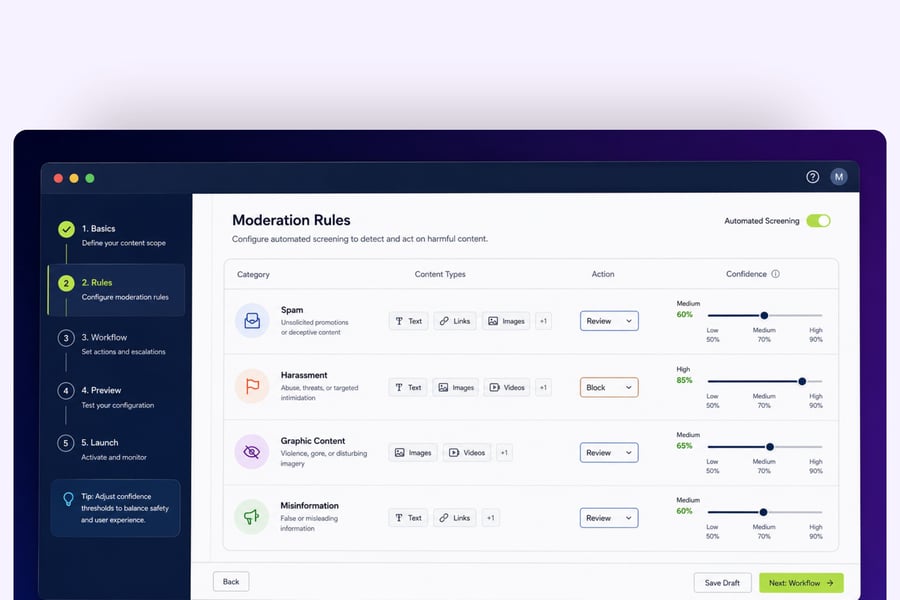
Your prohibited content categories need to be specific enough that a human reviewer or an AI classifier can make a consistent call without interpretation. That means defining not just what's prohibited, but the threshold at which something crosses the line.
A workable category structure looks something like this:
| Content Category | Prohibited Threshold | Notes |
|---|---|---|
| Adult/Sexual Content | Any depiction or strong implication | Applies to text, imagery, and video thumbnails |
| Hate Speech | Targeted attacks on protected characteristics | Include examples in your internal reference guide |
| Misinformation | Demonstrably false claims on health, elections, or safety | Requires source-based verification step |
| Violence/Gore | Gratuitous depictions without journalistic context | Journalistic carve-outs must be documented |
| Illegal Activity | Facilitation or promotion of regulated or criminal acts | Includes financial fraud, controlled substances |
| AI-Generated Deception | Synthetic media presented as factual without disclosure | Emerging category; flag for quarterly review |
Demand partners want to see that you've thought about edge cases, not just obvious violations. AI-generated deception is a category many publishers are still treating as an afterthought. It shouldn't be. Publishers wrestling with setting the rules their AI content moderation system will need to enforce often find that the prohibited content table is the easy part. The threshold definitions are where the real work is.
Essential Background Reading:
- AI-Based Content Moderation: How It Works: A foundational breakdown of how automated classifiers evaluate content, assign confidence scores, and route decisions. The mechanics every publisher policy needs to account for.
- Content Moderation AI: Brand Safety and Revenue: What publishers need to understand about how moderation decisions connect directly to programmatic demand access and CPM performance.
- AI Content Moderation Guidelines: How to define the rules your moderation system will enforce, including threshold-setting and category scoping before you write a word of policy.
- AI Content Farms Are Growing Fast: The advertiser-side view of why brand safety policy documentation is under increasing scrutiny from demand partners evaluating publisher inventory.
Document Your AI Tooling and Its Limitations
If you're using AI-assisted moderation, name the tools. Describe what they classify, what signals they use, and what their known failure modes are. This isn't a technology pitch. It's a transparency requirement.
A policy that says "we use AI to review content" is meaningless. A policy that says "we use [Tool X] to classify content against [specific taxonomy], with a confidence threshold of [Y], and route anything below that threshold to human review" is defensible. The difference is specificity about the decision boundary. Understanding how AI-based content moderation works at the classifier level is what lets you write that second version instead of the first.
You also need to document what your AI tools don't catch. Every classifier has coverage gaps. Common ones include:
- Contextual ambiguity: Content that is benign in isolation but harmful in combination with surrounding material
- Language and dialect coverage: Most classifiers underperform on non-standard dialects and low-resource languages
- Emerging violation types: Novel harmful content patterns that predate the model's training data
- Satire and irony: High false-positive risk in humor-heavy verticals like gaming and entertainment
Documenting these gaps doesn't weaken your policy. It shows you understand your tooling well enough to build compensating controls around it, which is exactly what a serious compliance review looks for. If you're evaluating which tools belong in your stack, a structured look at the best content moderation tools for publishers is a useful starting point for mapping capabilities against those known gaps.
AI-Generated Content vs. User-Generated Content
Publisher sites now face a moderation category that standard compliance templates don't address: AI assistant responses appearing within the publisher's own content environment. This is distinct from traditional UGC moderation.
With UGC, the publisher receives third-party content and applies filters. With an embedded AI assistant, the publisher's own infrastructure is generating content in real time, under the publisher's domain. The compliance exposure is different. The brand safety classification risk is different. And the policy documentation requirement is different. The disadvantages of AI content moderation that most publishers underestimate tend to cluster right here: the assumption that a UGC-era policy covers AI-generated output on the same domain.
If your site uses a third-party AI assistant tool, your policy needs to explicitly address where moderation responsibility sits: what the vendor controls, what you control, and who owns escalation when the AI generates something problematic. Most publishers deploying third-party AI tools haven't answered that question in writing. That's a gap demand partners will find.

Set Timelines That Are Enforceable
Takedown windows are where most publisher policies fall apart. "We review content in a timely manner" is not a timeline. It's a statement of aspiration that will fail on its first real test.
Demand partners expect to see specific SLAs tied to severity levels. A tiered structure keeps your team focused on what matters most:
| Severity Tier | Definition | Takedown Window |
|---|---|---|
| Tier 1: Critical | Illegal content, CSAM, direct threats | Immediate / under 1 hour |
| Tier 2: High | Hate speech, graphic violence, severe misinformation | Under 4 hours |
| Tier 3: Medium | Policy-adjacent content, context-dependent violations | Under 24 hours |
| Tier 4: Low | Borderline content requiring editorial review | Under 72 hours |
The windows above are illustrative, but they reflect realistic operational expectations for a publisher running AI-assisted workflows. Your actual SLAs need to be calibrated to your team size, traffic volume, and tooling throughput, and they need to be documented alongside the staffing model that makes them achievable.
An SLA without a staffing plan attached is just a promise you haven't stress-tested yet. How automated content moderation tools are changing the scale problem for publishers is directly relevant here: the tools that make aggressive SLAs achievable today are not the same tools that were available three years ago.
Related Content:
- The Best Content Moderation Tools for Publishers: A structured comparison of moderation platforms, covering classifier capabilities, coverage gaps, and integration requirements.
- AI Content Moderation Software: Manual vs. Automated: The tradeoffs between human-led and automated moderation workflows, mapped to team size, traffic volume, and SLA requirements.
- UGC Tools with AI-Driven Content Moderation: How leading UGC platforms handle AI-assisted moderation and where policy amendment support differs across tools.
- Customized AI Content Moderation: Why generic moderation frameworks fail publishers in specialized verticals, and how to scope policy to your actual content environment.
- Disadvantages of AI Content Moderation for Publishers: The coverage gaps, false positive risks, and classifier drift issues that belong in your tooling documentation section.
Build an Escalation Path With Named Roles
AI moderation flags content. Humans decide what happens to it. That distinction matters, and your policy needs to make it explicit.
Escalation paths fail when they're written as process flowcharts without named ownership. Every tier in your enforcement structure should map to a specific role, and that role should have documented authority to act. When an AI system surfaces an ambiguous case at 11 PM on a Friday, the policy answer can't be "it depends."
A functional escalation structure covers:
- AI classifier output: Automated flag with confidence score and category
- First-level reviewer: Human review of flagged content against policy definitions; authority to dismiss or escalate
- Policy owner: Second-level review for Tier 1 and Tier 2 cases; authority to issue takedown or make exception
- Legal or compliance escalation: Mandatory for content involving potential legal exposure, regulatory risk, or law enforcement referral thresholds
- External escalation: Defined protocol for reporting to platform partners, law enforcement, or regulatory bodies when required
The external escalation step deserves particular attention. Amazon Publisher Services and similar partners want to know you have a process for notifying them when a significant violation occurs on your properties. If that process isn't documented, their compliance teams will find the gap. What AI-powered content moderation looks like in reality versus what policy documents describe is often exactly where that gap lives.
Next Steps:
- How to Build an AI Assistant Content Moderation Policy That Holds Up: Step-by-step guidance on drafting a policy document that passes demand partner compliance review, including the components most submissions are missing.
- Choosing a Content Moderation Tool: 7 Questions to Ask: The evaluation framework for selecting moderation tooling that can actually support the SLAs and audit cadences your policy commits to.
- How Automated Content Moderation Tools Are Changing the Scale Problem: What current-generation automated tools make achievable for publisher teams that couldn't sustain manual review at scale.
- AI-Powered Content Moderation in Reality: What operational AI moderation actually looks like day-to-day versus what policy documents typically describe.
- Content AI Strategy: Human Creativity Meets Machine Intelligence: How publishers are building broader AI content strategies that keep moderation policy aligned with evolving content production methods.
Establish an Audit Cadence and Keep Records
A policy that exists only in a document is not a policy. It's a draft. What turns a draft into an enforceable governance framework is evidence that the policy is being applied, reviewed, and updated on a defined schedule.
Audit requirements vary by demand partner, but a defensible baseline includes:
- Monthly: Review AI classifier performance metrics against human review outcomes; identify drift or coverage gaps
- Quarterly: Full policy review against current enforcement data; update prohibited content categories as needed; review emerging violation types
- Annually: Comprehensive external review of policy completeness; update tooling documentation; recertify escalation role assignments
Every audit cycle should produce a dated record. Not a formal report necessarily, but something that documents what was reviewed, what changed, and who signed off. That paper trail is what a demand partner's compliance team is asking for when they request "evidence of your ongoing review process."
The audit cadence also forces a useful discipline: it requires you to look at your AI classifier's actual performance, not just its theoretical capabilities. Classifiers drift. Training data becomes stale. A quarterly review cycle is the minimum for catching that drift before it becomes a material enforcement gap. AI content moderation software and the tradeoffs between manual and automated processes shapes how achievable that quarterly cadence is for your team.
Write the Policy as If a Compliance Team Will Read It
Because one will. That doesn't mean writing in legal boilerplate. It means writing with enough specificity that a reviewer who has never seen your platform can understand how your moderation system works.
The structural elements that reviewers look for most consistently are:
- Scope definition: what content types and surfaces the policy covers
- Prohibited content categories with defined thresholds
- Tooling documentation with confidence thresholds and known limitations
- Enforcement SLAs by severity tier
- Escalation path with named roles and authorities
- Audit cadence with documentation requirements
- Amendment process: how the policy gets updated when violations evolve
That last point is underappreciated. Demand partners want to see that your policy has a defined process for staying current, not just that it was complete on the day you submitted it. Emerging content categories like AI-generated synthetic media are moving faster than annual review cycles can track. Building a defined amendment trigger into your governance structure shows you've thought past the submission date. Publishers evaluating UGC tools with AI-driven content moderation will find that amendment cadence support varies significantly across platforms, and that gap matters when violation categories are evolving quarterly.
See It In Action:
- AI Content Moderation: Building a Governance System That Protects Advertising Demand: The full governance framework for publishers who need their moderation infrastructure to hold up under real demand partner scrutiny.
- Generative AI Content Moderation: Brand Safety and CPMs: How generative AI output on publisher pages interacts with DSP brand safety classification and what that means for bid density.
- Mill Media Faces £250K Libel Suit After AI Content: A real-world example of the legal exposure that follows when AI-generated content on a publisher's domain isn't governed by a defensible moderation policy.
- Anthropic's $1.5B Copyright Settlement: What Publishers Need to Know: The landmark AI content rights case and its implications for how publishers document AI tool usage and moderation responsibility.
Frequently Asked Questions
What is an AI assistant content moderation policy?
An AI assistant content moderation policy is a documented governance framework that defines what content an AI tool deployed on a publisher's site is permitted to generate or display, how that content is reviewed and classified, what enforcement actions apply when violations occur, and who holds operational responsibility at each stage. For publishers, it also addresses how AI-generated content interacts with programmatic brand safety classification and demand partner compliance requirements.
How does AI content moderation work for publishers?
AI content moderation uses automated classifiers to evaluate content against defined policy categories, including hate speech, adult content, and misinformation, and assigns confidence scores. Content above a set confidence threshold is flagged for enforcement action or routed to human review. The classifier's output is only as reliable as its training data and defined thresholds, which is why publisher policies must document both the tooling configuration and the human-in-the-loop escalation structure that handles edge cases.
What are the main risks of AI content moderation for publishers?
The primary risks fall into five categories: contextual misclassification (content that is benign in isolation but problematic in context), coverage gaps in non-standard dialects or emerging violation types, false positives in satire-heavy or humor-driven content, training data staleness as new violation patterns emerge, and brand safety misclassification that suppresses programmatic bids without the publisher receiving a direct signal. The last category is the most financially consequential and the least visible. A detailed breakdown of these disadvantages of AI content moderation for publishers maps each risk to its operational source.
What is human-in-the-loop (HITL) content moderation?
Human-in-the-loop moderation is a hybrid approach in which AI classifiers handle initial content triage at scale, and human reviewers handle escalated cases that fall below the AI's confidence threshold or involve ambiguous policy interpretation. For publishers, HITL is not optional. It's a requirement that demand partners expect to see documented in moderation policy submissions, including named role assignments and defined escalation triggers.
How do content moderation policies affect publisher revenue?
A documented, operationally credible moderation policy directly supports access to premium programmatic demand. Demand partners evaluate policy completeness as part of publisher onboarding and ongoing compliance reviews. Publishers without sufficient governance documentation are denied or delayed access to higher-CPM demand channels. On the other side, AI assistant content that triggers brand safety misclassification by DSPs can suppress bid density on inventory that is otherwise clean, creating revenue drag that isn't always traceable back to its source without deliberate monitoring. Generative AI content moderation and its effects on CPMs covers this mechanism in detail.
What regulations apply to AI content moderation for publishers?
The most directly applicable frameworks for publishers are COPPA (Children's Online Privacy Protection Act) for sites with minor audiences, which imposes additional requirements on AI-generated interactions and data handling; Section 230, which provides liability protection for publisher moderation decisions but does not eliminate the need for documented policy; and GDPR for publishers with European traffic, which intersects with AI assistant data processing and user consent requirements. Demand partner compliance standards effectively function as a parallel regulatory layer, with their own documentation and audit requirements. Publishers navigating these layers should also be tracking the IAB's AI accountability framework for content scraping, which is shaping how compliance obligations are evolving.
How We Approach This Problem
Content moderation governance is one of the less glamorous parts of monetization strategy, but it has a direct line to revenue. Publishers who fail demand partner compliance reviews don't get access to premium programmatic demand. The CPM impact of that access gap is measurable.
Our platform and ops teams have worked through these submissions with publishers across gaming, education, sports, and news verticals. The patterns that create rejection are consistent, and they're fixable: missing escalation ownership, SLAs without operational backing, and AI tooling documentation that stops at "we use AI." Building the AI content moderation governance system that protects your advertising demand is the work that separates publishers with stable premium access from those perpetually stuck in re-review.
We help publishers build the governance infrastructure that holds up under real compliance review, not just the policy language. Our RAMP platform gives publishers full visibility into every setting driving their ad revenue, and our OPS team handles the campaign-level compliance and QA that keeps premium demand relationships intact. If your current moderation framework wouldn't survive a demand partner audit, that's the right place to start. Talk to our team about where your policy stands and what it takes to get it there.
