
-1.png?width=800&height=157&name=1-playwire-logo-primary-2021%20(1)-1.png)


February 13, 2026

Editorial Policy
All of our content is generated by subject matter experts with years of ad tech experience and structured by writers and educators for ease of use and digestibility. Learn more about our rigorous interview, content production and review process here.
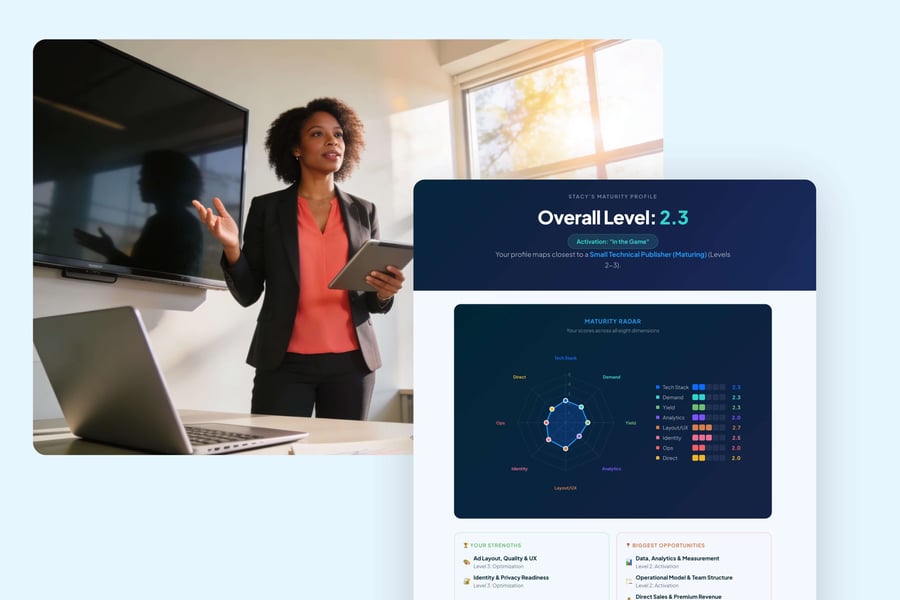
This article is part of our Publisher Ad Revenue Maturity Model (PARMM) series. PARMM is Playwire's framework for measuring publisher monetization maturity across eight dimensions: from your ad tech stack and demand strategy to your team structure and direct sales capability. Most publishers aren't stuck at one level across the board. They're advanced in some areas and leaving money on the table in others. That's kind of the whole point. Take the free PARMM assessment to see where you stand.
The Real Math Behind Demand Diversification
Demand diversification sounds straightforward on paper. Add more SSPs. Create more competition. Watch CPMs go up. And that's true, to a point. The problem is that most advice about demand strategy stops right there, which leaves publishers either underinvested (running 2-3 partners and leaving money on the table) or overextended (running 15+ partners and drowning in latency without proportional revenue gains).
The reality is more nuanced. Demand diversification is about building a strategy that maximizes auction pressure while managing the operational costs of complexity. It's about understanding which demand sources actually deliver incremental value for your specific inventory versus which ones just add bid requests without winning auctions.
This article covers the full demand maturity curve, from single ad network dependency through AI-optimized supply path intelligence, so you can evaluate where your strategy stands today and identify the moves that will have the biggest revenue impact.
This article is part of the Publisher Ad Revenue Maturity Model (PARMM), an eight-dimension framework for assessing and improving publisher monetization maturity. This article covers Dimension 2: Demand Strategy & Diversification.
Five Stages of Demand Maturity
Demand strategy evolves in recognizable stages. Each level unlocks new revenue capabilities while introducing new operational considerations.
Level | Demand Profile | Typical Revenue Impact | Key Risk |
1: Foundation | Single demand source (AdSense or one ad network). Zero auction competition. | Baseline. Revenue ceiling determined entirely by one buyer. | Total dependency on a single partner's pricing decisions |
2: Activation | 2-4 demand partners. Basic header bidding. Still heavily reliant on one source. | Meaningful CPM lift from initial competition | Primary source still controls the majority of revenue |
3: Optimization | 5-10+ SSPs. Open bidding and/or header bidding. Beginning to evaluate supply path optimization. | Consistent competitive pressure. Bid density per impression increases. | Adding partners yields diminishing returns. Latency risk grows. |
4: Advanced | Strategic partner selection based on performance data. Active SPO. Mix of programmatic, PMP, and some direct. | Premium CPMs from curated deals. Revenue mix diversified beyond open auction. | Operational complexity requires dedicated attention or partner support |
5: Mastery | Full-spectrum demand. AI-optimized supply path per auction. Deep SSP relationships. Direct demand contributing meaningful premium revenue. | Maximum revenue extraction from every impression. | Requires sophisticated infrastructure (Level 4+ ad tech stack) to execute |
The jump from Level 1 to Level 2 delivers the largest percentage revenue increase of any transition in the demand maturity curve. The jump from Level 3 to Level 4 delivers the most strategically valuable one.
Why Single-Source Dependency Is a Revenue Tax
Running a single demand source means every impression you serve gets priced by a single buyer. There's no competitive pressure, no price discovery, and no mechanism for understanding what your inventory is actually worth on the open market.
This is a tax on your revenue, and it compounds over time. As your traffic grows, that single demand source captures all the value of your increased scale. You generate more impressions. They set the prices. The economics work great for them.
The fix is conceptually simple. Add competing demand sources so buyers have to bid against each other. The execution, however, requires making deliberate choices about which partners to add, how to integrate them, and when you've reached the point of diminishing returns.
Related Content for This Transition:
- What Is Header Bidding and Why Should Publishers Be Doing It: Understand the fundamentals before adding your first demand partners
- How a Header Bidding Integration Works: The mechanics of getting header bidding running on your site
- Top 10 SSPs: Evaluate the leading supply-side platforms for your first integrations
- Best Ad Networks for Website Monetization: A publisher's guide to choosing the right networks for maximum revenue
- Increase CPMs by Incorporating More Demand Sources: Why auction competition from multiple demand sources drives higher prices

Learn more about the PARMM framework.
The Diminishing Returns Curve: Finding Your Optimal SSP Count
Every demand partner you add creates two things: incremental competition and incremental complexity. The revenue curve from adding partners follows a diminishing returns pattern that's critical to understand.
The first 2-3 partners after your initial setup create the most dramatic CPM lifts. You're introducing competition where none existed. The next 3-5 partners continue to add value, but at a decreasing rate. Each new SSP brings some unique demand, but there's increasing overlap with your existing partners.
Beyond 10 partners, the math gets tricky. Each additional SSP adds latency to your page load, increases the number of bid requests your ad server processes, and creates another integration to maintain. The incremental unique demand from SSP number 12 is almost certainly less valuable than the cumulative performance cost of running it alongside 11 others.
Practical guidelines for SSP count by publisher scale:
- Under 1M monthly sessions: 3-5 SSPs provides sufficient competition without overwhelming your infrastructure or your ability to monitor performance
- 1M-10M monthly sessions: 5-8 SSPs is typically the sweet spot, giving you broad demand coverage while maintaining manageable complexity
- 10M+ monthly sessions: 8-12+ SSPs makes sense, but only with active supply path optimization to ensure each partner justifies its slot
- Enterprise scale (50M+ sessions): the partner count matters less than the sophistication of your demand management, including PMP deals, programmatic guaranteed, and direct relationships layered on top of your programmatic base
The right number for you depends on your vertical, traffic geography, content type, and ad format mix. A gaming publisher with highly engaged users in Tier 1 geos will attract different demand dynamics than an education publisher with global traffic. There's no universal magic number.
Related Content for This Transition:
- Best Practices for Getting Approved on SSPs: What programmatic demand sources look for in publisher applications
- Open Bidding vs Prebid vs OpenRTB: Compare demand integration approaches to find the right mix
- Exchange Bidding vs Header Bidding: Understand the tradeoffs between exchange bidding and client-side header bidding
- What Is Supply Path Optimization: Learn the fundamentals of SPO before you start your first audit
- The Future of SSPs: Where supply-side platforms are headed and how to position your demand strategy
Supply Path Optimization: The Revenue Lever Most Publishers Ignore
Here's something most publishers don't think about enough. A single DSP (demand-side platform) can reach your inventory through multiple SSPs simultaneously. The same buyer can bid on the same impression through three or four different paths, and the economics of each path are different.
Supply path optimization (SPO) is the practice of analyzing these paths and ensuring that buyers reach your inventory through the most efficient and highest-value routes. For publishers, this means understanding which SSPs actually deliver winning bids versus which ones just add noise to the auction.
SPO matters because the ad tech supply chain adds fees at every step. Each intermediary between the advertiser's budget and your ad revenue takes a cut. Shorter, more direct supply paths mean more of the advertiser's dollar reaches your pocket. Redundant paths mean you're paying intermediary fees multiple times on what's effectively the same demand.
How to run a basic SPO audit:
- Analyze win rates by SSP: which partners actually win auctions versus which ones just participate? An SSP with a 2% win rate on your inventory is adding latency without proportional value.
- Check for demand overlap: use your ad server reporting to identify when the same DSP is reaching you through multiple SSPs. Evaluate which path delivers the highest net revenue.
- Review SSP fees and take rates: all SSPs are not created equal when it comes to how much of the advertiser's bid reaches you.
- Monitor latency contribution: each SSP adds load time. Partners that consistently respond slowly or add significant page weight without strong win rates should be reconsidered.
- Evaluate unique demand: some SSPs provide access to advertisers and buying platforms that others don't. This unique demand is the real value proposition of maintaining multiple partners.
Related Content for This Transition:
- Supply Path Optimization — Key Trends: Stay current on the SPO practices that affect your demand routing
- Benefits of Direct Sales for Publishers: Why layering direct deals delivers CPMs open auction can't match
- 4 Programmatic Advertising Channels to Use: Expand beyond open auction into PMP, programmatic guaranteed, and more
- How to Make Your Website Attractive for Direct Sales: Position your inventory to command premium direct-sold pricing
- How Independent Publishers Can Win in the Curation Era: Leverage curation strategies to unlock premium demand access
Moving Beyond Open Auction: PMP and Programmatic Guaranteed
The open auction is the default for most publisher revenue, but it's also the most commoditized channel. Every impression competes at market rates, and buyers treat your inventory as interchangeable with similar publishers.
Private marketplace (PMP) deals change this dynamic. PMPs create curated auctions where selected buyers get priority access to your inventory at premium prices. The buyer gets reduced competition and first-look pricing. You get CPMs that open auction can't match, because the buyer is paying for exclusivity and audience quality.
Programmatic guaranteed goes a step further. It's a committed deal where a specific buyer agrees to purchase a set volume of impressions at a fixed price, executed through programmatic pipes. It combines the premium pricing of direct deals with the operational efficiency of programmatic delivery.
The CPM differential between open auction and PMP/programmatic guaranteed deals is substantial. Direct deals through Playwire's sales team consistently deliver 10-20x+ CPM premiums over open auction for the same inventory. That's not a typo. The same impression, sold through a different channel, can generate an order-of-magnitude revenue increase.
Letterboxd experienced this directly. The addition of direct sales deals sourced through Playwire's team, combined with in-app header bidding across 10 mediation partners, drove a 243% YoY revenue increase and a 50% CPM increase.
The Full-Spectrum Demand Stack
Level 5 demand maturity means operating a complete spectrum of demand channels, each serving a specific purpose in your revenue strategy.
Open auction remains your volume base, handling the bulk of impressions with competitive bidding across multiple SSPs. PMP deals layer premium pricing on top of your most valuable inventory segments. Programmatic guaranteed provides revenue predictability and committed spend from key buyers. Direct sales delivers the highest CPMs through custom activations, sponsorships, and creative formats that programmatic simply can't replicate.
The most sophisticated publishers run all four channels simultaneously, with AI-optimized supply path intelligence making per-auction decisions about which channel serves each impression best. The system evaluates user signals, content context, device type, geographic data, and time-of-day patterns to route each impression through the highest-value path.
This isn't theoretical. It's the operational reality for publishers running on platforms like Playwire's RAMP, where AI and machine learning technology make these decisions across millions of daily auctions.
Related Content for This Transition:
- Ad Revenue Growth Using AI and Machine Learning: How AI drives per-auction supply path decisions at scale
- Traffic Shaping and QPS Optimization: Advanced techniques for intelligent bid request routing
- Traffic Shaping Revolution: Real results from ML-driven traffic shaping across publisher inventory
- Build vs. Outsource: Direct Sales Team: Evaluate whether to build direct sales in-house or partner for premium demand
- Increasing Ad Revenue with Revenue Intelligence: How Revenue Intelligence® optimizes demand routing per impression
Evaluating Your Demand Partners: The Metrics That Matter
Adding SSPs is easy. Knowing which ones are actually earning their slot in your stack requires looking at the right data.
Metric | What It Tells You | Red Flag Threshold |
Win Rate | How often the SSP wins auctions on your inventory | Below 3-5% suggests minimal unique demand |
Bid Density | Average number of bids per impression from this partner | Consistently below the partner average |
Net CPM Contribution | Revenue per impression after accounting for SSP take rate | Declining over 90 days without seasonal explanation |
Latency Impact | Average response time and page load contribution | Consistently above 200ms timeout threshold |
Unique Demand % | Percentage of winning bids from DSPs not accessible through other SSPs | Below 10% suggests high overlap with existing partners |
Fill Rate | Percentage of ad requests where the SSP returns a bid | Below 20% on inventory they're supposed to serve |
Review these metrics quarterly at minimum. Monthly is better. The goal isn't to maximize partner count. It's to maximize the revenue contribution of every SSP in your stack while minimizing the complexity and latency cost.

Common Demand Strategy Mistakes
Even publishers with solid demand fundamentals make avoidable errors that cap their revenue potential.
Treating all SSPs as equal is the most common mistake. Giving every partner the same timeout, the same inventory access, and the same priority means your best partners are competing on the same terms as your worst ones. Your demand strategy should give preferential treatment to partners that consistently deliver value.
Ignoring the latency tradeoff runs a close second. Every SSP you add increases your page's time-to-interactive. At some point, the latency cost exceeds the incremental revenue. Track the relationship between partner count, page speed, and net revenue (not just CPMs) to find your optimal balance.
Measuring demand success purely by CPM misses the full picture. A partner with lower CPMs but a 95% fill rate might generate more total revenue than one with higher CPMs but a 30% fill rate. Session-level revenue metrics (like session RPM) capture the complete picture better than per-impression CPMs alone.
Neglecting direct and PMP channels is the biggest strategic miss. Publishers who build their entire demand strategy around open auction are leaving the most lucrative revenue channels on the table. The gap between programmatic open auction CPMs and direct deal CPMs is where the real revenue opportunity lives.
The Demand and Tech Stack Connection
Your demand strategy is constrained by your ad tech infrastructure. A Level 1 tech stack running a single ad network can't execute a Level 3 demand strategy. Server-side bidding (Level 4 infrastructure) enables demand configurations that client-side header bidding can't support, like running 15+ partners without browser-side latency costs.
This is why the PARMM framework measures these dimensions independently. A publisher might have Level 2 demand on a Level 4 tech stack, which means the infrastructure is ready for a demand expansion that the strategy hasn't caught up to yet. Understanding where each dimension stands reveals these asymmetries and helps prioritize where to invest.
Building Your Demand Diversification Roadmap
Here's the practical progression for upgrading your demand strategy, regardless of where you're starting.
From Level 1 to Level 2: Add 2-4 header bidding partners through Prebid or an equivalent wrapper. Prioritize SSPs known for strong performance in your vertical. Track which partners actually win auctions from day one.
From Level 2 to Level 3: Expand to 5-8+ SSPs based on performance data from your existing stack. Implement both open bidding and header bidding if you haven't already. Begin evaluating supply path optimization to identify redundant demand paths.
From Level 3 to Level 4: Shift focus from adding partners to optimizing existing paths. Start SPO audits. Develop or partner for PMP deal access. Build stronger relationships with your top-performing SSPs to unlock curated deal opportunities.
From Level 4 to Level 5: Enable AI-optimized supply path decisions on every auction. Integrate direct sales alongside programmatic channels. Develop deep SSP partnerships that provide exclusive deal access and preferential auction dynamics.
Amplify Your Demand Strategy
Playwire manages demand diversification across thousands of publisher sites. The RAMP platform connects publishers to premium demand partners, Playwire's direct sales team, and AI-optimized supply path intelligence, all in a single integration.
Chess.com built its entire advertising revenue stream through this approach, seeing an immediate ~130% boost in revenue with sustained ~30% year-over-year increases. The combination of programmatic demand, direct sales, and rewarded video (achieving 4x higher CPMs than traditional video) created a full-spectrum demand strategy that continues to grow.
Your inventory is worth more than open auction alone can capture. Discover what full-spectrum demand looks like →
