
-1.png?width=800&height=157&name=1-playwire-logo-primary-2021%20(1)-1.png)


September 8, 2026

Editorial Policy
All of our content is generated by subject matter experts with years of ad tech experience and structured by writers and educators for ease of use and digestibility. Learn more about our rigorous interview, content production and review process here.
.png?width=900&name=Breaking%20News%20Placeholder%20(1).png)
Key Points
- Google reports that in 75% of cases, users don't click through the source links in AI Overviews, according to a Centre for International Governance Innovation essay by Susie Alegre.
- Zero-click search shifts the publisher math from traffic volume to revenue per session, because the sessions you still get have to carry more weight.
- Blocking AI crawlers is one lever among several, and the decision depends on whether your traffic mix leans on search referrals or direct and app audiences.
- Publishers should audit crawler access, measure AI-referred sessions separately, and rebuild yield strategy around fewer, deeper visits.
- Our AI Crawler Protection Grader shows which bots currently have access to your site, free, in under a minute.
What the CIGI Essay Says
Susie Alegre published an essay at the Centre for International Governance Innovation arguing that AI search is closing the open web's doors. Her framing is historical: the web was proposed in 1989 as an information commons, and AI-powered search is enclosing it the way English landowners enclosed common land.
The number that matters to publishers sits in the middle of the piece. Alegre cites Google's own figure that in 75% of cases, people do not click through the links AI Overviews provide.
She also documents a failure mode worth understanding. Searching for a UK court case, she got an AI Overview that confidently told her she meant a US case on a different subject, and every organic result below reinforced the wrong answer.
The Publisher Problem Underneath the Philosophy
Alegre writes as a rights and information researcher, so her conclusion is cultural. The operational consequence lands on your P&L.
Clicks were the delivery mechanism for every monetization model on the open web. Display, video, affiliate, subscription funnels, newsletter signups. All of it assumed a human arriving on your page.
An AI Overview that answers the question ends the session before it starts. Your content still did the work. The impression happened somewhere you can't monetize.
The failure mode Alegre describes compounds this. When an AI Overview decides what the user meant, it also decides which publishers are relevant to that reframed question. You can rank perfectly for the query a user typed and still be invisible for the query the model substituted.
Essential Background Reading:
- AI in Ad Tech, Explained: A foundational primer on how AI shows up across search, content, and monetization for publishers.
- Generative AI and Publisher Revenue: Background on how generative AI models intersect with content, traffic, and ad revenue.
- AI and Content Ownership: Context on how AI systems use publisher content, a prerequisite for understanding the crawler debate.
- Blocking AI Access to Your Site: The basics of what blocking AI crawlers actually does before you decide whether to do it.
What Changes in Your Reporting
Aggregate sessions stop being a useful health metric once AI search is in the mix. Two publishers can lose the same 20% of sessions and land in completely different revenue positions depending on which sessions went away.
Segment your traffic before you draw conclusions. The sessions AI search removes tend to be shallow informational visits with low ad density and low engagement. What survives skews toward direct, app, social, and branded search.
Here's how the metrics shift when volume falls and intent concentrates:
| Metric | Pre-AI-search behavior | What to track now |
|---|---|---|
| Sessions | Primary growth indicator | Segment by referral source, isolate AI-referred traffic |
| Pageviews per session | Secondary engagement stat | Leading indicator of monetizable depth |
| RPS (revenue per session) | Derived metric | Primary yield KPI |
| Viewability | Compliance threshold | Optimization target in the 70-90% range |
| Crawler access | Rarely audited | Quarterly audit, per-bot policy |
RPS tells you whether you're compensating. Sessions can fall while RPS climbs, and that's a survivable position. Sessions falling while RPS holds flat is the one that ends badly.
Related Content:
- Google Search Console for Publishers: How to use GSC to monitor the same search-referral erosion this article covers.
- Google Search Console Analyzer Tool: A tool for pulling the search performance data that informs your AI-referral segmentation.
- Ad Load and Traffic Stability: Why traffic stability, not just volume, is becoming the metric that matters for yield.
- Reader Revenue Manager Guide: How reader identity and engagement data help publishers extract more from fewer sessions.
Your Options on AI Crawlers
Blocking is a business decision with tradeoffs in both directions. Publishers whose traffic depends heavily on search referrals face a different calculation than publishers with app audiences or direct-loyal readers.
Work through these before you touch robots.txt:
- Audit what has access today: most publishers can't name every crawler currently indexing their content, and default configurations tend to be permissive.
- Separate training crawlers from retrieval crawlers: blocking training access protects your archive. Blocking retrieval access removes you from AI answers entirely, including the citations.
- Model the referral dependency: calculate what share of monetizable sessions arrive from search before you decide what a citation is worth.
- Decide by content type, not sitewide: evergreen reference content and time-sensitive original reporting face different exposure.
- Revisit quarterly: crawler user agents change, policies change, and a robots.txt written eighteen months ago is describing an internet that no longer exists.
Our AI Crawler Protection Grader runs the first step for you and returns a per-bot picture of your current access. The AI crawler resource center covers the implementation detail for the rest.
Next Steps:
- AI Crawler Resource Center: Implementation detail for auditing and managing crawler access across your site.
- AI Crawler Protection Grader: Run a free, per-bot check of which crawlers currently have access to your content.
- Why You Need a Blocking Strategy: The case for a deliberate, documented approach to blocking decisions instead of ad hoc calls.
- Building a Blocking Strategy: A step-by-step approach to setting blocking rules by content type and crawler category.
- Managing Blocking Over Time: How to keep a blocking strategy current as crawler behavior and policies change.
Rebuilding Yield Around Fewer Sessions
Traffic recovery isn't the plan. The plan is extracting more from each session you keep.
Start with layout density on your highest-intent pages. Publishers running conservative ad layouts designed for a high-volume traffic environment are leaving yield on pages that now represent a larger share of total revenue.
Test aggressively and measure the user experience cost. A/B testing layout changes against both RPS and engagement metrics tells you where the ceiling sits for your audience today, rather than where you assumed it sat three years ago.
Video deserves a specific look. Higher CPM formats do more work per session when session counts fall, and outstream and in-content video units expand inventory without adding display clutter.
Direct demand matters more in this environment. Programmatic yield tracks impression supply. Direct deals price your audience quality, which is the asset that survives the traffic shift.
See It In Action:
- Entertainment Content Website Case Study: How one entertainment publisher approached monetization under shifting traffic conditions.
- Publishers as Partners: What a partnership model looks like when a publisher's traffic environment changes underneath them.
Where We Land on This
Alegre's essay ends on culture. We'll end on math.
The open web's economics assumed abundant traffic and thin monetization per visit. That assumption is breaking, and the publishers who adapt are the ones treating each remaining session as worth more operational attention than it got when traffic was cheap.
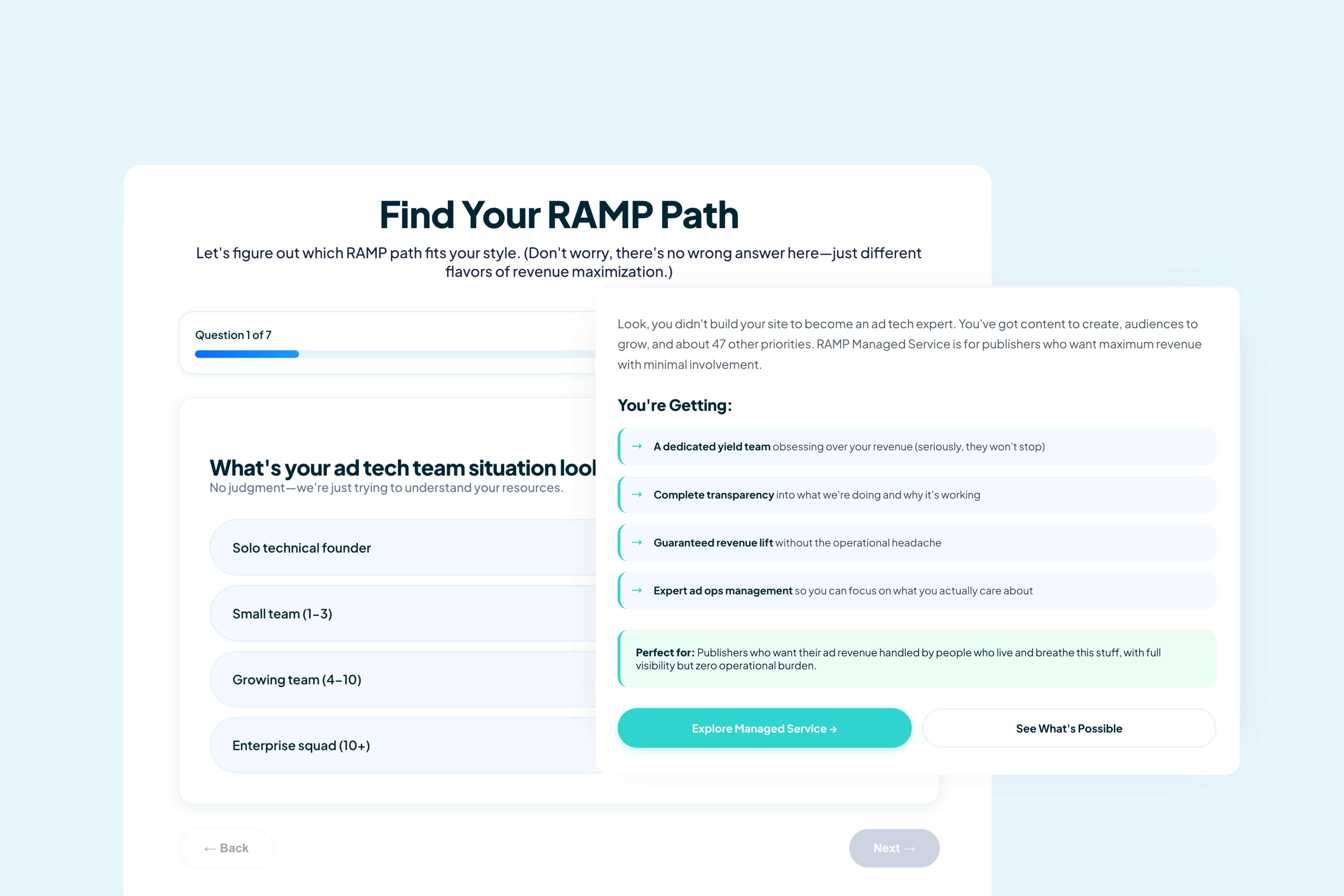
We built our RAMP platform for this problem. Managed Service handles yield optimization, layout testing, and demand stack management for publishers who'd rather not staff a yield ops team. Self-Service gives technical publishers direct control over floors, timeouts, and layout configuration with full visibility into what every change did. Both run on the same demand stack, and both report at the session level, because that's the level where this fight is now happening.
Our DIRECT team supplements programmatic with direct-sold campaigns that price your audience rather than your impression count. OPS covers the implementation work. STUDIOS builds custom high-impact formats when standard units cap out.
Quality, Performance, Transparency. No black box, no mystery fees, and no pretending the traffic is coming back.
Get in touch if you want to see what your current inventory is worth at the session level. We've got the data to back it up.
