
-1.png?width=800&height=157&name=1-playwire-logo-primary-2021%20(1)-1.png)

February 13, 2026

Editorial Policy
All of our content is generated by subject matter experts with years of ad tech experience and structured by writers and educators for ease of use and digestibility. Learn more about our rigorous interview, content production and review process here.
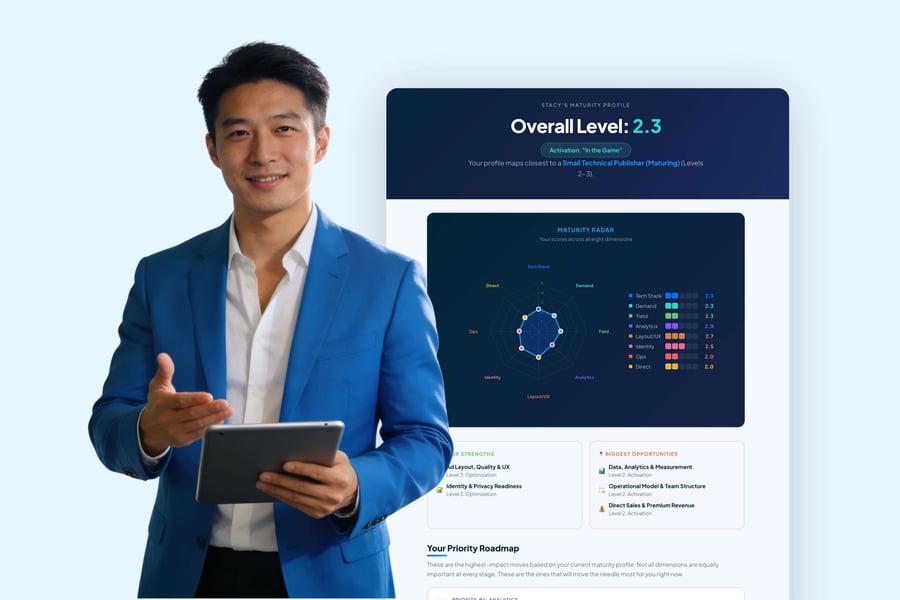
This article is part of our Publisher Ad Revenue Maturity Model (PARMM) series. PARMM is Playwire's framework for measuring publisher monetization maturity across eight dimensions: from your ad tech stack and demand strategy to your team structure and direct sales capability. Most publishers aren't stuck at one level across the board. They're advanced in some areas and leaving money on the table in others. That's kind of the whole point. Take the free PARMM assessment to see where you stand.
The Operational Model That Matches Your Maturity
Your team structure should match your current scale and ambitions. A solo publisher managing one site doesn't need the same operational model as an enterprise portfolio managing 20+. Running ahead of your scale burns cash. Running behind it burns revenue.
The challenge most publishers face is figuring out where they are on this spectrum and what operational model actually makes sense. The ad tech industry doesn't offer a clean playbook for this, partly because every publisher's situation is different and partly because ad monetization partners, Playwire included, have a commercial interest in how you answer the question.
So let's be direct about the tradeoffs. This article covers the real costs, capabilities, and limitations of in-house, outsourced, and hybrid operational models at every publisher scale. You'll find actual cost comparisons, role-by-role breakdowns, and an honest assessment of where partnership makes sense versus where in-house investment pays off.
This article is part of the Publisher Ad Revenue Maturity Model (PARMM), an eight-dimension framework for assessing and improving publisher monetization maturity. This article covers Dimension 7: Operational Model & Team Structure.
Five Levels of Operational Maturity
The progression from "one person does everything" to "operations are a competitive advantage" maps cleanly to publisher scale and revenue maturity.
Level | Team Structure | Key Capability | Limitation |
1: Foundation | One person does everything. Ad monetization gets attention when there's time. | Basic setup and maintenance | Zero optimization capacity. Revenue stagnates. |
2: Activation | Publisher owner has some ad ops knowledge. One technical resource touches ads occasionally. Partner-dependent for most decisions. | Basic troubleshooting and partner coordination | No proactive optimization. Dependent on partner initiative. |
3: Optimization | Dedicated person or shared resource focused on monetization. Regular performance reviews. Active partner collaboration. Clear escalation process. | Consistent monitoring. Ability to test and iterate. | Limited specialization. Can't pursue yield, demand, and analytics simultaneously. |
4: Advanced | In-house ad ops capability or deeply embedded partner. Dedicated roles for yield, operations, and/or sales. Defined processes for testing and optimization. Cross-functional collaboration. | Specialized expertise. Systematic experimentation. Multi-dimensional optimization. | Significant cost commitment. Retention risk for specialized talent. |
5: Mastery | Full ad operations function (internal, outsourced, or hybrid). Strategic partnership extending capabilities. Every revenue function has clear ownership. Operations are a competitive advantage. | Operations drives revenue growth, not just supports it. | Requires sustained investment and executive commitment. |
The Real Cost of Building In-House
Let's talk numbers. Building an in-house ad ops team is the dream for many publishers who want complete control over their monetization. The financial reality often tells a different story.
A basic in-house team consists of four core roles: an ad operations manager, a yield analyst, a senior ad tech engineer, and a junior engineer. Based on 2024 market data, here's what that looks like annually.
Role | Base Salary | With Benefits (30%) | Year 1 Including Recruiting ($25K) & Training ($8K) |
Ad Operations Manager | $85,000 | $110,500 | $143,500 |
Yield Analyst | $75,000 | $97,500 | $130,500 |
Senior Ad Tech Engineer | $140,000 | $182,000 | $215,000 |
Junior Engineer | $95,000 | $123,500 | $156,500 |
Total | $395,000 | $513,500 | $645,500 |
And that's before infrastructure costs ($18K/year for servers, monitoring, and tooling), ad tech platform costs (Google Ad Manager at $36K/year, custom Prebid implementation at $60K/year, analytics at $36K/year), and the opportunity cost of pulling existing engineering resources into ad tech work.
The ramp-up cost is the one most publishers forget to account for. Building a new ad ops team typically results in a 15-20% revenue drop during the 3-12 months it takes to hire, onboard, build infrastructure, and reach operational maturity. For a publisher earning $600K annually, a 6-month ramp at 20% revenue loss means $60K in lost revenue on top of the team costs.

The Outsourced Model: What You Get and What You Give Up
Fully outsourced monetization through a managed service partner means zero internal headcount dedicated to ad ops. The partner handles everything: tech stack management, yield optimization, demand partner relationships, analytics, and troubleshooting.
What you gain with outsourcing:
- Immediate expertise: access to specialized yield, demand, and engineering talent without recruiting or training
- Speed to value: managed services typically reach full operation within one week, versus 3-12 months for an in-house build
- No staffing risk: no recruiting costs, no retention concerns, no knowledge loss when team members leave
- Network-wide insights: managed partners optimize across hundreds or thousands of sites, bringing pattern recognition and best practices that a single-site team can't replicate
- Technology included: the partner's platform, tools, and AI capabilities are part of the service
What you trade for outsourcing:
- Revenue share: managed services typically operate on a revenue share model (the specific percentage varies by publisher and is determined during partnership discussions)
- Reduced direct control: optimization decisions are made by the partner's team, though transparent partners like Playwire give you full visibility into every setting and change
- Dependency: your monetization operation depends on the partner's competence, attention, and priorities
The economics of managed service compare favorably for publishers below a certain revenue threshold. When the all-in cost of building an in-house team exceeds the revenue share cost and the managed service delivers equal or better optimization, the math is clear.
ConvertCase.net provides a clean example. As a site built and maintained by a single person, outsourcing monetization to Playwire made obvious sense. The partnership nearly doubled ad revenue without requiring Jason Gillyon to develop ad ops expertise, hire a team, or divert attention from his core business. "Integration was simple. Playwire just gave me a script that worked seamlessly, and the platform did everything else."
Moving from Level 1 to Level 2? Start here:
- An Overview of Ad Ops: What ad operations actually involves and the functions you need to understand
- What Is Ad Monetization? Foundational concepts before you invest in people or partners
- When Is the Right Time to Work with Playwire: How to know when a monetization partner makes more sense than going it alone
- What Your First 6 Months with Playwire Look Like: Setting expectations for the partner onboarding timeline
-1.svg?height=300&width=650)
Learn more about the PARMM framework.
The Hybrid Model: The Best of Both Worlds
The hybrid operational model is increasingly where sophisticated publishers land. It combines internal resources focused on strategic decision-making with an embedded partner relationship that handles specialized execution.
This model works because not all ad ops functions benefit equally from being in-house. Strategic decisions about ad layout, content-to-revenue alignment, and brand standards benefit from internal ownership. Yield optimization, demand management, bidder configuration, and real-time monitoring benefit from specialized expertise and advanced tooling that partners provide.
Hybrid model structures by publisher scale:
- Small publishers (under 5M monthly sessions): no internal ad ops headcount. Fully managed partner with the publisher maintaining strategic input on layout preferences and brand standards.
- Mid-size publishers (5M-25M sessions): 1-2 internal staff (ad ops manager, possibly a data analyst) working alongside a managed or self-service partner that handles yield, demand, and infrastructure.
- Large publishers (25M-100M sessions): 3-5 internal staff covering yield, analytics, and strategic planning. Partner provides platform infrastructure, advanced optimization (AI-driven flooring, identity management), and direct sales capabilities.
- Enterprise publishers (100M+ sessions): full internal team for day-to-day operations with the partner providing Level 5 technology, network-wide insights, and direct sales access that would require significant investment to replicate.
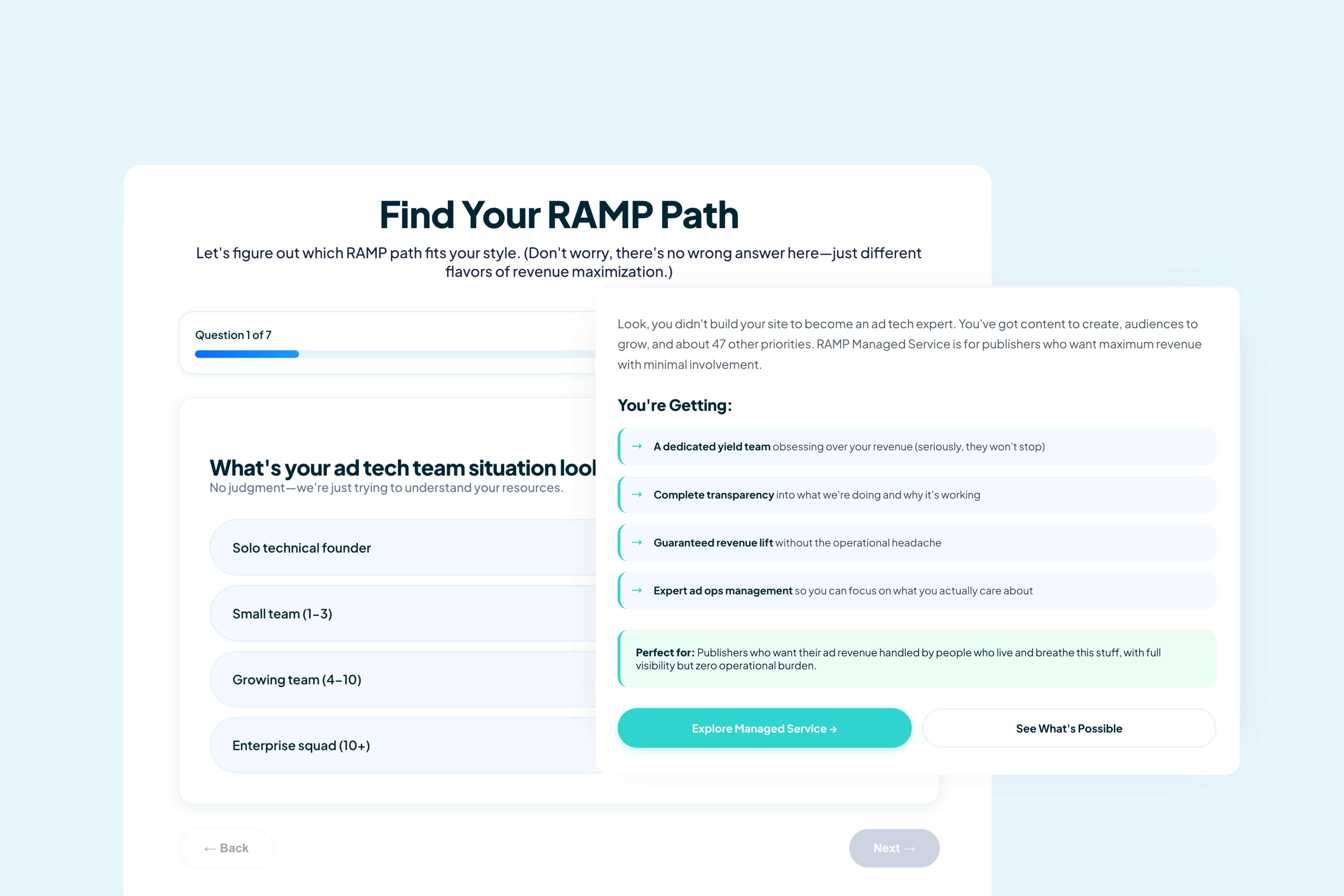
Playwire's RAMP platform supports this spectrum natively. RAMP Self-Service gives publishers with internal teams full control over every aspect of their ad monetization, with AI-powered optimization available for the areas they choose not to manage manually. RAMP Managed Service handles everything for publishers who prefer a hands-off approach. The architecture supports any hybrid configuration between these endpoints.
Moving from Level 2 to Level 3? Read these next:
- Playwire vs. Building an Ad Ops Team: The real cost comparison that most publishers don't run until it's too late
- Should You Build or Buy Your Ad Tech Stack? Framework for deciding which capabilities to own vs. outsource
- How to Troubleshoot Common Ad Ops Issues: Building the troubleshooting skills your team needs for daily operations
- Digital Ad Performance Metrics: The KPIs your dedicated monetization person should review daily
The Functions That Need Ownership
Regardless of your operational model, seven core functions must have clear ownership for ad monetization to operate effectively. Who owns each function, internally or through a partner, defines your operational structure.
Function | What It Covers | Typical Owner |
Yield management | Price floors, bidder optimization, experimentation, revenue monitoring | Partner (managed) or internal yield analyst (hybrid) |
Demand management | SSP relationships, supply path optimization, demand partner evaluation | Partner for most publishers; large publishers may co-manage |
Ad layout & UX | Placement strategy, viewability optimization, format mix | Internal for brand/UX decisions; partner for technical optimization |
Analytics & reporting | Revenue reporting, performance analysis, anomaly detection | Shared. Partner provides data infrastructure; internal interprets and acts. |
Identity & privacy | CMP management, identity solution deployment, compliance | Partner for technical management; internal for compliance oversight |
Technical operations | Ad tag management, integration maintenance, troubleshooting | Partner for platform-managed stack; internal for custom implementations |
Direct sales | Advertiser relationships, deal negotiation, custom activations | Partner's sales team for most publishers; enterprise may have in-house complement |
The key question for each function isn't "should we own this?" It's "do we have the expertise, tools, and sustained attention to execute this function better than a specialist partner?"

Making the Build vs. Buy Decision
The build vs. buy decision for ad operations comes down to three variables: your current revenue, your realistic growth trajectory, and your operational complexity.
Build when: Your annual ad revenue exceeds $5M+, giving you the revenue base to absorb team costs while still generating strong net margins. Your operational complexity requires deep customization that a managed partner can't provide. You have the executive commitment to sustain a multi-year investment in ad ops talent and technology.
Buy (outsource) when: Your annual ad revenue is below the threshold where a full in-house team makes economic sense. Your team's core competency is content, product, or technology rather than ad operations. You want Level 4-5 optimization without the multi-year build timeline.
Hybrid when: You have the scale to justify some internal investment but not the scale to replicate everything a specialist partner provides. You want strategic control over monetization decisions while leveraging a partner's technology and specialized execution.
For most publishers in the mid-market, the hybrid model with a platform like Playwire's RAMP provides the best economics. You get Level 5 technology and optimization from day one, with the flexibility to add internal resources as your revenue grows.
Moving from Level 3 to Level 4? Level up with these:
- Build vs. Outsource: Yield Ops Team: When to invest in dedicated yield management talent
- Build vs. Outsource: Engineering & Dev Team: The engineering investment required for advanced ad tech infrastructure
- Build vs. Outsource: Creative Team: Custom creative capabilities for direct deals and premium activations
- Best Practices for Running Yield Optimization Tests: Building the systematic experimentation process your team needs
The Partner Evaluation Framework
If you're evaluating monetization partners, whether for a fully managed or hybrid relationship, these are the criteria that separate partners who drive value from those who just collect a revenue share.
- Transparency: can you see every setting, every tool, and every change your partner makes? If the answer is no, you don't have a partner. You have a black box.
- Technology depth: does the partner's platform provide capabilities you can't replicate in-house, like AI-driven yield optimization, dynamic ad injection, or automated experimentation?
- Direct sales access: does the partner bring demand you can't access on your own, particularly premium direct deals and PMP opportunities?
- Data access: do you retain full access to your monetization data in real time, or does the partner gate your own data behind delays or restricted dashboards?
- Flexibility: can the partnership evolve as your needs change? A partner who only offers managed service with no path to self-service or hybrid creates dependency rather than capability.
Playwire's QPT initiative (Quality, Performance, Transparency) is built around these principles. Full visibility into every aspect of your monetization, real-time data access, and a platform architecture that supports any operational model from fully managed to fully self-service.
Moving from Level 4 to Level 5? The frontier awaits:
- Build vs. Outsource: Direct Sales Team: Adding the sales function that unlocks 10-20x CPM premiums
- Understanding the Complete Picture of Your Monetization: Full visibility across every revenue-impacting function
- AI vs. Humans: When Machines Should Drive: Defining the right automation-to-human balance for mastery-level operations
- The Evolution of the Publisher Ad Tech Stack: How the most sophisticated publishers architect their operational model
Operations as a Competitive Advantage
At Level 5, your operational model stops being a cost center and becomes a competitive advantage. Every revenue-impacting function has clear ownership and defined KPIs. Your partner extends your capabilities rather than replacing them. Your team focuses on strategy while automation and specialized expertise handle execution.
The publishers who reach this level consistently generate higher revenue at lower relative cost. Their operational efficiency compounds over time as processes mature, automation handles routine optimization, and human attention concentrates on the highest-leverage decisions.
Find the Operational Model That Fits
Playwire works with publishers across the full operational spectrum, from solo operators who need a completely managed solution to enterprise teams who want self-service control with Level 5 AI optimization built in.
RAMP Self-Service puts you in the driver's seat with full control and transparency. RAMP Managed Service takes the operational burden off your plate entirely. And everything in between is a conversation away.
Your operational model should accelerate your revenue. Not consume your attention. Explore Playwire's partnership models →
