
-1.png?width=800&height=157&name=1-playwire-logo-primary-2021%20(1)-1.png)


September 8, 2026

Editorial Policy
All of our content is generated by subject matter experts with years of ad tech experience and structured by writers and educators for ease of use and digestibility. Learn more about our rigorous interview, content production and review process here.
.png?width=900&name=Breaking%20News%20Placeholder%20(1).png)
Key Points
- The Seattle Times and Newsday sued OpenAI and Microsoft in the Southern District of New York, alleging their paywalled articles were scraped for AI training datasets.
- The publishers are asking the court to destroy training datasets and models that incorporate their content, a remedy that would reach far beyond two newspapers.
- Gated content still gets pulled when your technical blocking layer isn't configured to stop it, paywall or no paywall.
- The DOJ filed a Statement of Interest in the parallel New York Times case arguing that a publisher win could hurt local newsrooms, which complicates the legal picture considerably.
- Litigation runs on a multi-year timeline. Your monetization strategy runs on a quarterly one. Plan accordingly.
What Happened
Two regional newspapers just escalated the AI copyright fight into paywall territory. According to Digital Trends' report on the lawsuit, The Seattle Times and Newsday filed suit against OpenAI and Microsoft, alleging both companies scraped paywalled articles and folded them into the training datasets behind ChatGPT, Microsoft Copilot, and AI-powered Bing. The publishers claim the resulting tools can reproduce full passages and closely paraphrase their journalists' work.
Seattle Times president and CEO Alan Fisco told employees the paper felt strongly about defending content it spends millions of dollars a year producing.
OpenAI disputes the premise, arguing it trains on publicly available material under fair use. Microsoft said it was surprised by the filing but signaled willingness to explore solutions.
Why the Paywall Angle Changes the Conversation
Most AI training lawsuits have focused on open web content. This one targets material behind a payment gate. The argument shifts from "was this fair use" to "how did you get past the door at all."
That distinction matters for anyone running a subscription or metered model. A paywall is a business mechanism. A robots.txt directive, a WAF rule, and a bot management layer are technical mechanisms. Publishers routinely assume the first implies the second. It doesn't.
Client-side paywalls are the worst offenders. If your gated article renders in the initial HTML response and gets hidden with JavaScript or CSS after load, a crawler reading the raw response sees the full text. Your subscribers hit a wall. Automated agents walk right through.
Then there's the remedy request. The publishers want existing copies destroyed, along with the training datasets and models incorporating the material. Courts rarely grant that relief, but the ask signals publishers have stopped negotiating for citation credit and started negotiating for leverage.
Essential Background Reading:
- AI and Ad Tech: The Basics: A grounding in how AI is reshaping monetization before you dig into the legal specifics.
- AI Content Info: What AI-generated and AI-crawled content means for publisher revenue and content rights.
- Generative AI Overview: Background on the generative models driving the training-data lawsuits publishers are now fighting.
- AI and Publishers Resource Center: A central hub for how AI intersects with publisher strategy and revenue.
The DOJ Statement of Interest
The legal backdrop got messier. The DOJ filed a Statement of Interest in the ongoing New York Times case against OpenAI, arguing that siding with the Times could harm local newsrooms and independent journalism.
The DOJ also suggested AI could help smaller publishers compete with larger news organizations. So two regional papers are suing for control and compensation, and the DOJ is arguing a publisher win would hurt papers like them. Both arguments will play out across years of litigation.
Related Content:
- Reader Revenue Manager Guide: How identity and engagement data intersect with paywall and subscription strategy.
- Content Monetization: How to balance gated content, ad revenue, and reader experience.
- Content Monetization Resources: A library of monetization strategy resources for publishers weighing paywall trade-offs.
- Google Search Console for Publishers: How to use GSC to spot crawler and indexing issues before they hit ad revenue.
What Publishers Should Do Now
Waiting for the Southern District of New York to sort this out is a strategy. It's a bad one. Here's what belongs on your list this quarter.
- Audit what your paywall serves to bots: curl your gated URLs with common AI crawler user agents and check whether the full article body appears in the response. Server-side gating is the only version that holds.
- Separate your crawler policy by purpose: search indexing crawlers, AI training crawlers, and AI retrieval agents are different traffic types with different value propositions. Blocking all three with one rule costs you referral traffic you probably want.
- Log and monitor agent traffic: you can't negotiate a licensing deal or file a claim without records of what was requested and when. Most publishers have no idea what their crawl logs look like.
- Document your terms of service position: a technical block paired with explicit contractual language gives you stronger footing than either one alone.
- Model the traffic loss before you block: run the numbers on what AI referral traffic contributes today, then decide whether the trade is worth it for your specific mix.
Here's how the main control layers compare in practice.
| Control layer | What it stops | Enforcement | Practical limitation |
|---|---|---|---|
| robots.txt directives | Compliant crawlers that honor the standard | Voluntary | Zero enforcement against non-compliant agents |
| Server-side paywall | Full content delivery to any unauthenticated request | Technical | Requires architecture change if currently client-side |
| WAF and bot management rules | Identified agents by user agent, IP range, or behavior | Technical | Needs ongoing maintenance as new agents appear |
| Terms of service language | Nothing technically, but establishes contractual position | Legal | Only useful alongside technical controls |
| Direct licensing agreement | Nothing, permits use on your terms | Contractual | Requires negotiating leverage most publishers lack |
Our AI Crawler Protection Grader will tell you which of these layers you have configured correctly and which ones you only think you have configured correctly. Those are frequently different lists. Our AI crawler resource center covers implementation detail for each control.
Next Steps:
- Block AI: A practical resource for implementing AI crawler blocking correctly.
- Google Search Console Analyzer Tool: Run your own site through an analyzer to catch crawler and indexing gaps.
- Data Management Platform Resources: How to structure agent and crawl log data so it's usable for licensing or legal claims.
- GA4 Training Guide: Set up traffic monitoring that actually surfaces bot and agent activity.
The Revenue Math Underneath the Legal Fight
Every publisher in this fight is arguing about the same underlying problem: content costs money to produce, and the traffic that historically paid for it is getting intercepted.
Litigation might eventually produce licensing revenue for the largest publishers. It won't produce anything for most sites this fiscal year. The sessions you have right now are the only variable you fully control. That moves the operational question from traffic volume to yield per session. Fewer sessions at higher RPS beats more sessions at flat RPS.
See It In Action:
- Entertainment Content Website Case Study: How an entertainment publisher grew revenue per session with the right monetization partner.
- Sports Content Website Case Study: How a sports publisher improved yield without sacrificing user experience.
Where We Fit
We're not going to tell you how to handle your copyright strategy. That's a conversation with your legal team, and it depends entirely on your content, your leverage, and your appetite for a multi-year fight.
The traffic reaching your pages needs to work harder than it did three years ago. Our RAMP platform handles that: header bidding infrastructure, price floor optimization, and direct demand from our global sales team working together to raise revenue per session on the inventory you already have.
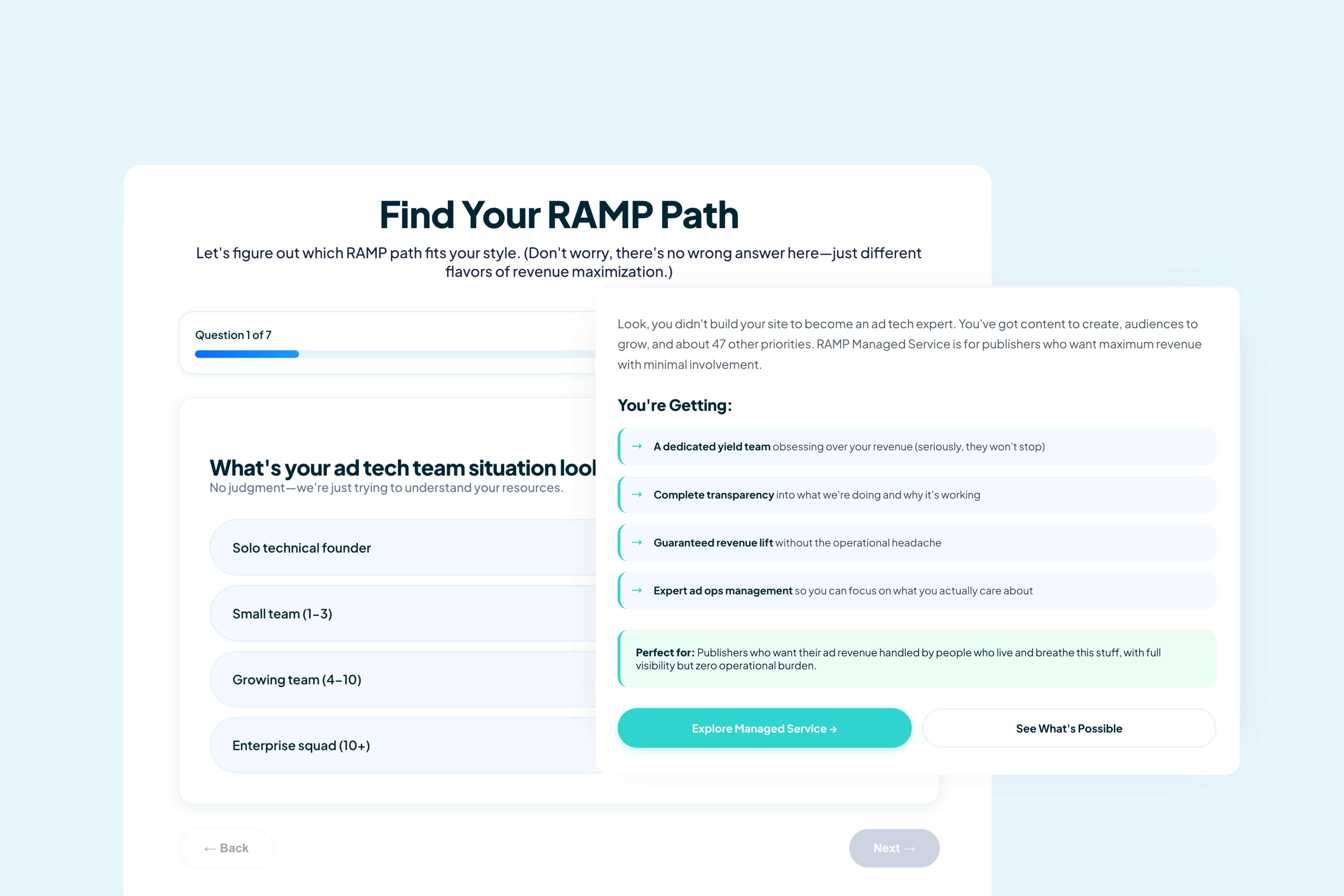
Publishers running our Managed Service get a yield ops team monitoring auction performance daily. Technical publishers running Self-Service get the same optimization engine with full configuration control and their own SSP seats intact. Both measure success the same way: what your sessions earn.
The court will decide who gets to turn journalism into training data. You get to decide what your remaining traffic is worth. Talk to our team about the second one.
