
-1.png?width=800&height=157&name=1-playwire-logo-primary-2021%20(1)-1.png)


March 23, 2026

Editorial Policy
All of our content is generated by subject matter experts with years of ad tech experience and structured by writers and educators for ease of use and digestibility. Learn more about our rigorous interview, content production and review process here.
The Revenue Opportunity You're Probably Miscalculating
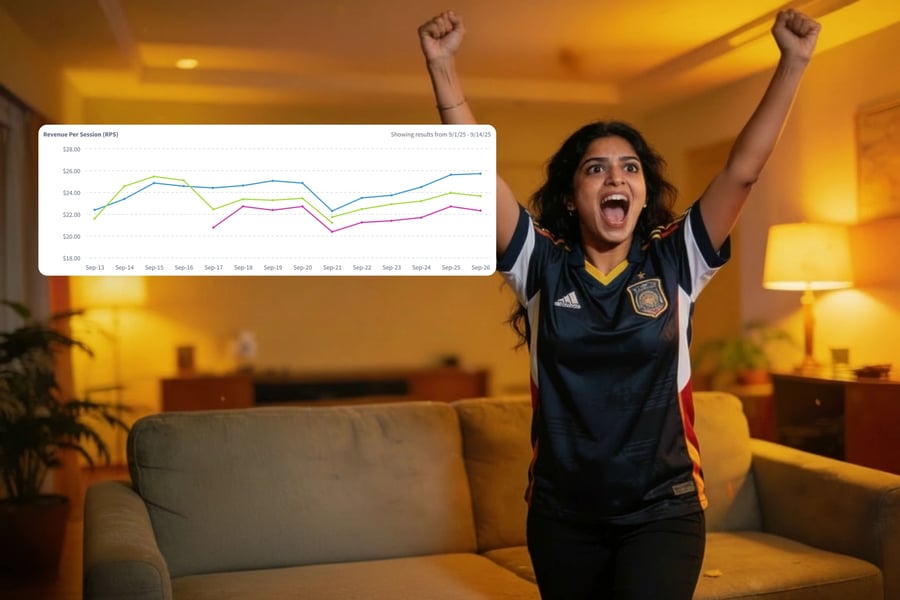
Here's the thing about major sporting events: the traffic is coming whether you're ready or not. The Super Bowl. The World Cup. March Madness. The Champions League Final. These aren't random spikes. They're scheduled, predictable explosions of audience demand that savvy publishers plan around months in advance.
Most publishers don't. They treat sports event traffic like an organic viral moment: show up, hope the ad stack holds, collect whatever revenue lands.
That's a costly habit, especially in an environment where total U.S. advertising spending is projected to approach $500 billion in 2026, fueled in part by marquee sports moments like the World Cup and the NFL season.
Sports event ad revenue optimization is a discipline, not a happy accident. It means building the infrastructure, demand relationships, floor strategies, and ad formats to capitalize on the exact moments when your audience is most concentrated and advertiser budgets are at their most aggressive.
Need a Primer? Read This First:
- Sports Website Ad Revenue: What Publishers Should Expect by Traffic Tier: Read this first to understand the foundational concepts this article builds on.
- Best Ad Monetization Platforms for Sports Publishers: Read this first to understand the foundational concepts this article builds on.
- Programmatic Advertising Seasonality: How Advertisers Spend: Read this first to understand the foundational concepts this article builds on.
Why Sports Events Are a Different Animal
Sports traffic doesn't behave like regular traffic, and it shouldn't be monetized like regular traffic either. Understanding what makes it unique is the foundation of any serious optimization strategy.
The audience concentration is extreme. During a major event, a sports publisher can see traffic volumes that dwarf their average day, compressed into a window of hours. Pages-per-session often increase dramatically as users refresh, check scores, and consume real-time analysis.
That engagement depth matters enormously to advertisers. Super Bowl LX drew an estimated 124.9 million viewers across broadcast and streaming, making it a demand environment unlike almost anything else in the digital advertising calendar.
The demand environment is also fundamentally different. Brands and agencies allocate significant portions of their media budgets specifically to sports moments. Automotive, beer, tech, and quick-service restaurant advertisers compete aggressively for sports inventory because the context is precisely what they're paying for.
That heightened demand pressure should translate directly into higher CPMs on your inventory. But only if your ad stack is calibrated to capture it.
And if your property spans both web and mobile, the optimization challenge doubles. Increasing app revenue with mobile video ad placements that match the moment is a separate but equally important lever for publishers operating across both environments during peak sports windows.

Infrastructure: Building for the Spike, Not the Average
The worst time to discover your ad tech stack can't handle concurrent sessions is when your traffic is three times its normal volume at kickoff. Infrastructure resilience is the unsexy foundation that everything else depends on.
Sports publishers need to stress-test their setups before events, not during. That means evaluating how your header bidding wrapper performs under load, whether your ad server can process the request volume without degrading, and whether your CDN configuration is appropriate for sudden traffic acceleration.
As BidsCube has noted, Super Bowl traffic creates short, intense peaks that compress hours of activity into minutes. Most digital systems rarely experience conditions at that scale.
Lazy loading is non-negotiable. Firing every ad request on page load when tens of thousands of users arrive simultaneously is a reliable path to performance degradation. That tanks both user experience and viewability, and viewability directly affects CPMs.
An ad unit that loads after the user has already scrolled past it doesn't command the same premium as one delivered cleanly in-view.
Server-side bidding deserves serious consideration for publishers expecting extreme traffic events. Moving the auction logic server-side reduces the client-side compute burden considerably. It trades some flexibility for stability at high volumes, which is often the right tradeoff when the alternative is a site that crawls during your highest-value traffic window.
Demand Strategy: Premium Inventory Deserves Premium Partners
Programmatic demand is the floor, not the ceiling. Sports event ad revenue optimization really starts when you stop treating your inventory as undifferentiated supply and start positioning it as the contextually premium environment it actually is.
Direct sales unlock the real ceiling during major events. Advertisers chasing the Super Bowl audience or World Cup traffic aren't primarily buying through the open auction. They're negotiating guaranteed placements, sponsorships, and private marketplace deals.
As Cynopsis has highlighted, direct publisher access remains paramount for milestone moments, even as streaming and programmatic pipes have matured. Publishers with direct sales capability can capture that demand directly, commanding CPMs that programmatic simply can't match.
Want a concrete example of what switching away from commodity programmatic can look like? See how TheJeopardyFan.com doubled its revenue by moving from AdSense to Playwire's full-stack monetization platform. That's the same demand infrastructure sports publishers tap into during major events.
Private marketplace (PMP) deals are the middle path worth building during event periods. A PMP gives you the efficiency of programmatic execution with the pricing control and buyer relationship of a direct deal. Sports-focused buyers will often participate in PMPs for premium sports inventory if you're proactive about making the invitation.
The table below summarizes the demand tier structure and its implications for sports event monetization:
Demand Tier | Pricing Control | Typical CPM Potential | Operational Lift |
Open Programmatic | Low | Baseline | Low |
Private Marketplace (PMP) | Medium | 2-4x baseline | Medium |
Programmatic Guaranteed | High | 4-8x baseline | Medium-High |
Direct Sales + High-Impact Formats | Highest | Up to 19x baseline | High |
Direct Sales combined with Flex Suite ad formats delivers up to 19x higher CPMs than programmatic alone based on Playwire entertainment publisher data.
Related Content:
- Maximizing CPMs During Movie Release Season: A Publisher's Playbook: Related coverage from across Playwire's content library.
- Increase CPMs by Incorporating More Demand Sources: Related coverage from across Playwire's content library.
- Header Bidding Solutions: Maximizing Revenue from Header Bidding: Related coverage from across Playwire's content library.
Price Floor Strategy: Dynamic Floors for Dynamic Demand
Static price floors are a bad idea in general. During major sports events, they're practically a revenue self-sabotage mechanism. The advertiser demand curve changes dramatically during high-profile sporting moments, and your floor strategy needs to move with it.
Price floors set the minimum CPM you'll accept for an impression. During the Super Bowl or a World Cup Final, a floor set to your normal weekday baseline is leaving money on the table. Advertiser competition for your inventory intensifies during these windows, and buyers will bid higher than your normal floor ceiling if you let them.
Event-aware floor management means pre-configuring elevated floors for known traffic spikes and adjusting them dynamically as auction data comes in. Playwire's Price Floor Controller handles this with AI-driven logic that maintains approximately 1.2 million unique price floor rules per website, factoring in device type, geography, ad unit, time of day, and dozens of other variables.
During a major event, that granularity is what separates smart yield management from blunt-instrument guessing.
Knowing which metrics to watch while those floors do their work is equally critical. Tracking the right KPIs to monitor ad performance in real time gives your ops team the signal clarity they need to make fast, informed floor adjustments during event windows without flying blind.
The risk of poorly tuned floors cuts both ways. Floors set too low mean you're selling premium event inventory at everyday prices. Floors set too high can push fill rate off a cliff, leaving impressions unfilled entirely. Dynamic, data-informed adjustments are the only way to find the right balance in real time.

Ad Formats: Matching Inventory to the Moment
Not every ad format performs equally during major sports events. Audience behavior during a live event, a recap, or a stat-check is different than during normal browsing, and your format choices should reflect that.
High-impact units generate outsized CPMs because they deliver outsized visibility. Formats like Flex Skin, which delivers 100% share-of-voice and 100% viewability, are precisely the kind of inventory that sports advertisers pay premium rates for. Playwire's entertainment and sports publishers see CPMs of $25-35 per pageview for Flex Skin placements, compared to standard display benchmarks.
Video is a consistent outperformer across sports contexts. Sports audiences are primed to watch video. They just spent three hours watching a game. A well-placed video unit in a post-match recap or live score environment has high contextual relevance and earns stronger CPMs to reflect it.
The key is ensuring your video player implementation doesn't degrade page performance, particularly during high-traffic spikes.
For publishers focused on engagement-first monetization in app environments, rewarded video ads represent a premium format for capturing audience attention and maximizing revenue per session. It's a format that translates particularly well in sports app contexts where users are actively invested in the content.
The following table outlines format performance characteristics for sports event contexts:
Format | Viewability | CPM Tier | Best Use Case |
Standard Display | Variable | Baseline | Score tickers, sidebars |
Flex Skin | 100% | $25-35 PV CPM | Event coverage, recaps |
Flex Video | High | 4x+ standard | Post-match video, highlights |
Flex Rail (Mobile) | High | Premium | Mobile score-checkers |
Rewarded Video | 80%+ VCR | Premium | Engagement-first contexts |
Advertiser Timing: The Pre-Event Window Is Where Deals Get Done
Sports event monetization doesn't start on game day. The advertisers willing to pay the most for your inventory are already committed to their buys weeks or months ahead of the event. If you're not in those conversations early, you're not in them at all.
The pre-event outreach timeline matters more than most publishers realize. As Super Bowl economics research confirms, brands plan months in advance, measure outcomes for quarters afterward, and repurpose content across multiple platforms. Agencies allocating digital budgets around the World Cup or March Madness are making placement decisions during upfront and scatter market cycles, not in real time.
Publishers with direct sales capability need to start building advertiser relationships in the weeks and months before peak events, not after the traffic arrives. A sports stats platform or fan community that proactively packages its World Cup audience for automotive or beverage brands at the start of a tournament cycle will command materially better rates than one that shows up to the open auction hoping for the best.
For app-first sports publishers, pre-event strategy also means having the right video ad implementation in place before demand peaks. Understanding how AdMob rewarded video ads work is exactly the kind of prep work that pays off when game-day traffic arrives and advertisers are bidding aggressively for engaged users.
Here's a simplified pre-event preparation timeline publishers should consider:
- 8-12 weeks out: Build and pitch premium direct sales packages to category-relevant advertisers. Define event-specific inventory including sponsorships and high-impact formats.
- 4-8 weeks out: Finalize programmatic guaranteed deals and PMP activations. Confirm technical integrations and ad serving configurations for event traffic.
- 2-4 weeks out: Stress test infrastructure. Validate floor configurations. Confirm demand activations and creative assets are in order.
- 1 week out: Final floor review against latest demand signals. Prepare real-time monitoring dashboards. Communicate with your yield ops partner on any last-minute adjustments.
- During the event: Monitor fill rates, viewability, and CPM performance in real time. Adjust floor logic as demand signal evolves throughout the event window.
- Post-event: Analyze performance data against historical baselines. Identify gaps in demand coverage and infrastructure. Build learnings into the next event cycle.
Next Steps:
- Take Control of Your Entertainment Site's Ad Strategy: A Technical Framework: The logical next step after mastering the concepts in this article.
- Apply to Work with Playwire: The logical next step after mastering the concepts in this article.
The Operational Reality: You Can't Do This Alone at Scale
Sports event ad revenue optimization requires tight coordination across demand, technology, yield management, and direct sales. For most publishers, running all of that simultaneously at the exact moments when your traffic is highest is a significant operational lift.
Most ad stacks aren't built for it. Most teams aren't staffed for it. That's not a criticism — it's just the reality of what peak sports monetization actually requires.
A managed monetization partner who understands the sports and entertainment vertical changes the equation considerably. The right partner brings demand relationships, yield ops expertise, and technical infrastructure that's already in place. You don't have to build all of it from scratch for every event cycle.
Playwire works with over 50 sports and entertainment publishers navigating these seasonal traffic events. The platform's AI algorithms are constantly analyzing inventory signals, demand patterns, and price floor performance across the network. That aggregate data creates optimization advantages an individual publisher managing their own ad stack simply can't replicate.

Frequently Asked Questions About Sports Event Ad Revenue Optimization
What is sports event ad revenue optimization?
Sports event ad revenue optimization is the practice of strategically preparing your ad infrastructure, demand partnerships, price floor settings, and ad formats to capture maximum revenue during high-traffic sports moments like the Super Bowl, World Cup, March Madness, or Champions League Final. It treats predictable traffic spikes as planned revenue opportunities rather than reactive situations.
How far in advance should publishers prepare for a major sports event?
Publishers should begin demand outreach and inventory packaging 8-12 weeks before a major event. Direct sales and programmatic guaranteed deals need to be locked well before game day. Infrastructure stress testing and floor configuration reviews should be finalized 2-4 weeks out.
Why is programmatic not enough for sports event monetization?
Programmatic demand operates through open auctions where prices are limited by floor settings and bid competition. Premium sports advertisers who want guaranteed placements, sponsorships, and brand-safe contextual environments are often buying through direct sales and private marketplace deals. Those are channels publishers need to build separately from their programmatic stack.
What ad formats perform best during sports events?
High-impact formats like Flex Skin (100% share-of-voice, 100% viewability) and video units consistently outperform standard display during sports events. Sports audiences have elevated engagement and page-per-session depth, which makes premium, visible formats worth the investment on both the publisher and advertiser side.
How should price floors be managed during sports events?
Static floors will either leave money on the table or kill fill rates. Event-aware dynamic floors — pre-configured for known demand windows and adjusted in real time as auction data comes in — are the correct approach. AI-driven floor management tools like Playwire's Price Floor Controller automate this at a scale and granularity that manual management can't match.
Maximizing Every Impression from Kickoff to Final Whistle
Sports event ad revenue optimization isn't a single tactic. It's a complete systems approach. Infrastructure resilience, premium demand activation, dynamic floor management, high-impact format selection, and pre-event advertiser outreach all have to work together.
Publishers who get this right don't just see higher revenue during the event itself. They build the demand relationships and technical capabilities that compound over time, creating durable competitive advantages in their vertical.
Playwire's RAMP platform and direct sales team are built for exactly this kind of optimization. Whether it's the Super Bowl, the World Cup, or the next major event driving traffic to your sports property, we're in the business of making sure you capture every dollar that audience deserves to generate.
Ready to build a sports event monetization strategy that actually performs? Talk to our team today.
