
-1.png?width=800&height=157&name=1-playwire-logo-primary-2021%20(1)-1.png)


March 23, 2026

Editorial Policy
All of our content is generated by subject matter experts with years of ad tech experience and structured by writers and educators for ease of use and digestibility. Learn more about our rigorous interview, content production and review process here.

Your Entertainment Site Has Unique Monetization Needs. Treat It That Way.
Most ad tech advice is written for publishers in general. Your entertainment site is not a publisher in general.
Your audience didn't arrive to be advertised to. They came to track their watchlist, find out if a film is worth their Friday night, or dive deep into an album they just discovered. The moment ads feel like interruptions instead of integrations, you hear about it — in your bounce rate, your session depth, and your comment section.
That tension between revenue and user experience is real. It's also solvable. But solving it requires something most publishers skip: an actual strategy with defined levers, a testing discipline, and a clear framework for what to automate versus what to control manually.
This is that framework. If you publish news content alongside entertainment coverage, the same control principles apply. See how they translate in our technical ad strategy playbook for news publishers.
Need a Primer? Read This First:
- Entertainment Publisher Yield Management: Metrics That Actually Matter: Read this first to understand the foundational concepts this article builds on.
- Best Ad Networks for Entertainment Websites: A Technical Publisher's Guide: Read this first to understand the foundational concepts this article builds on.
- A Guide to Header Bidding Technology: Read this first to understand the foundational concepts this article builds on.

The Four Levers That Drive Entertainment Ad Revenue
Running a reactive ad strategy is essentially driving with one hand on the wheel and your eyes on the rearview mirror. You're responding to what already happened, not steering toward what's possible.
Active management of specific, high-impact levers is what separates sites generating strong CPMs from sites perpetually leaving money on the table. The four levers below aren't the only factors in your revenue equation, but they're the ones with the highest return on your optimization attention.
Lever 1: Price Floors
Price floors are one of the most powerful and most frequently mismanaged tool in an entertainment publisher's arsenal. A price floor defines the minimum CPM you'll accept for an impression before it goes unsold.
Get the floor right and you command higher CPMs without sacrificing fill. Set it too high and you watch your fill rate crater while impressions go unsold — often without knowing why until the revenue report lands.
Most publishers manage price floors reactively, adjusting them only after revenue drops. That's roughly three weeks after the problem started costing them money. Sophisticated entertainment publishers instead build a comprehensive floor strategy that accounts for device type, geography, time of day, content section, and ad unit type simultaneously.
Playwire's Price Floor Controller manages approximately 1.2 million price floor rules per website using AI; a scale no human yield team can manually replicate.
Lever 2: Ad Layout and Unit Strategy
Entertainment content varies wildly in structure. A film database page looks nothing like a streaming news article. An album review page has different scroll depth and engagement patterns than a live sports score tracker.
Your ad layout needs to reflect those differences — not apply a generic template and hope for the best. Layout decisions affect more than just viewability. Ad density directly impacts your relationships with SSPs, your Core Web Vitals scores, and your audience's likelihood of returning.
Playwire's entertainment publishers consistently achieve 70%+ viewability across their layouts, a number that's nearly impossible to hit with a set-and-forget approach. Video is a high-leverage component of that layout mix. Outstream video ads on text-heavy entertainment pages can meaningfully lift pageview CPM by adding premium demand to impressions that would otherwise compete on display rates alone.
Incorporating high-impact ad units like our Flex Suite are hugely important for landing premium CPM direct deals and are loved by entertainment advertisers.

Lever 3: Header Bidding Configuration
Header bidding is where demand competition happens, and competition is what drives CPMs up. Your configuration choices determine who participates in that competition, how quickly they respond, and which auction pathway they use.
Both client-side and server-side bidding have roles to play depending on your traffic profile and page performance constraints. Timeout settings deserve specific attention. Too low and your higher-paying demand sources don't get a chance to bid. Too high and your page speed metrics take a hit that Core Web Vitals will flag.
There's a sweet spot for every site. Finding it requires testing, not guessing.
Lever 4: Identity Solutions
The post-third-party-cookie environment means identity strategy is now a yield lever, not just a compliance checkbox. Publishers who deploy the right identity solutions on the right impressions command meaningfully higher CPMs in cookieless environments.
Publishers who ignore it lose auction value with every cookieless impression they serve. That's a growing share of your inventory whether you're paying attention or not.
The identity landscape includes Universal ID solutions, hashed email capture, contextual targeting fallbacks, and first-party data activation. No single solution wins every impression. An effective strategy deploys multiple solutions and selects among them at the bid level based on what maximizes revenue.
The Control vs. Automation Decision Framework
The most common mistake entertainment publishers make with their ad strategy isn't under-optimizing. It's trying to manually optimize things that technology handles better, while ignoring the things that actually require human strategic judgment.
The table below maps common ad strategy decisions to the appropriate control model.
Decision Type | Control Model | Why |
Price floor strategy by segment | Human sets thresholds, AI executes | Strategic intent must be defined by the publisher |
Individual impression pricing | Automated (AI/ML) | Too many variables for manual management |
Ad layout per content section | Human-defined | Brand, UX, and content standards are editorial decisions |
Ad density enforcement | Platform-enforced rules | Protects UX and SSP relationships at scale |
Header bidding partner selection | Human decides, platform manages | Partner relationships require strategic oversight |
Timeout optimization | Automated testing with human review | Iterative, data-driven, but publisher approves thresholds |
Identity solution stack | Human-defined portfolio | Compliance and strategy decisions |
Bid-level identity matching | Automated | Real-time execution, too fast for manual intervention |
Seasonal floor adjustments | Human-initiated, platform-executed | Publisher holds context AI doesn't |
Direct deal prioritization | Human-negotiated | Relationship and brand decisions |
The pattern is clear. Human judgment handles strategic direction, standards, and partner decisions. Automation handles execution, optimization, and anything involving more combinations than a yield ops team can physically process.

Building a Testing Framework for Entertainment Sites
Testing is where entertainment site ad strategy control actually happens. Publishers who declare a strategy and never validate it are operating on assumptions.
Assumptions are fine for getting started. They're expensive over time.
A structured testing approach requires three things: a clean hypothesis, a controlled traffic split, and a defined success metric before the test starts — not after you've already decided the test "worked."
What to Test First
Entertainment sites have a natural testing advantage that most publishers underuse. Your content sections are often distinct enough to serve as natural control and test groups. A film database page and a streaming news page have fundamentally different user behaviors, which means different ad configurations can run simultaneously without contaminating your results.
The highest-leverage tests for entertainment publishers tend to fall into three categories:
- Ad unit positioning: Testing placement location within content sections where scroll depth and engagement time differ
- Price floor bands: Testing floor levels in specific traffic segments (geo, device, time of day) to find the revenue-maximizing balance of CPM and fill rate
- Video vs. display mix: Testing the revenue impact of adding outstream video to text-heavy pages where your audience has high time-on-page. Everything publishers need to know about video ads for web and app is a solid starting point if you're evaluating whether to expand your video unit strategy.
How to Read Results Without Fooling Yourself
The metric that matters most here is pageview CPM. It captures the combined effect of CPM and fill rate — which is exactly what layout and floor changes affect — making it the most useful single signal for entertainment publishers testing ad configurations.
Session RPM adds a second dimension. It tells you whether a configuration change that wins on a per-pageview basis actually translates to more revenue across a full visit. Entertainment audiences often multi-page, which means a change that looks neutral at the page level might be a meaningful win or loss at the session level.
Tracking these metrics consistently matters as much as the tests themselves. For app publishers running hybrid monetization, the six KPIs that matter most for measuring app ad performance provides a useful complement to the web metrics covered here.

Seasonal Monetization: Capitalizing on Entertainment's Natural Peaks
Entertainment is one of the few publisher verticals with genuinely predictable revenue peaks. Award season, major theatrical releases, streaming premiere weekends, and sports championship cycles all drive measurable traffic spikes. Your ad stack should be ready for them before they arrive — not scrambling to catch up after the spike already hit.
Most publishers are prepared for Q4 programmatic seasonality because everyone in ad tech talks about it constantly. What gets less attention is entertainment's vertical-specific cycle. An entertainment site covering a major film franchise might see its highest CPMs of the year during a release week in March, not in Q4.
Preparation for seasonal peaks has three components.
First, floor strategy adjustments that reflect the premium nature of your audience during these high-intent moments.
Second, direct sales relationships that give studios and streaming platforms a path to reach your audience when they're most activated. Playwire's direct sales relationships include major entertainment advertisers who specifically activate during release windows and premiere events.
Third, technical capacity planning that ensures your ad stack doesn't become the bottleneck when your traffic doubles overnight.
Related Content:
- Maximize Ad Revenue with Rules-Based Control: The Visual Configuration Advantage: Related coverage from across Playwire's content library.
- How to Set Custom Target CPM and Price Floor Rules in Google Ad Manager: Related coverage from across Playwire's content library.
- The Session Revenue Optimization Playbook: A Complete Framework for Publishers: Related coverage from across Playwire's content library.
- Dear Publisher: Your Site Needs an Ad Tech Health Check: Related coverage from across Playwire's content library.
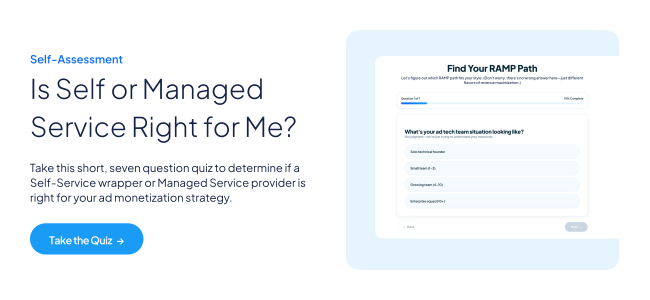
When to Lean on Managed Expertise vs. Running It Yourself
There's no universal right answer here. It depends on your team, your appetite for hands-on optimization, and where you want to spend your time.
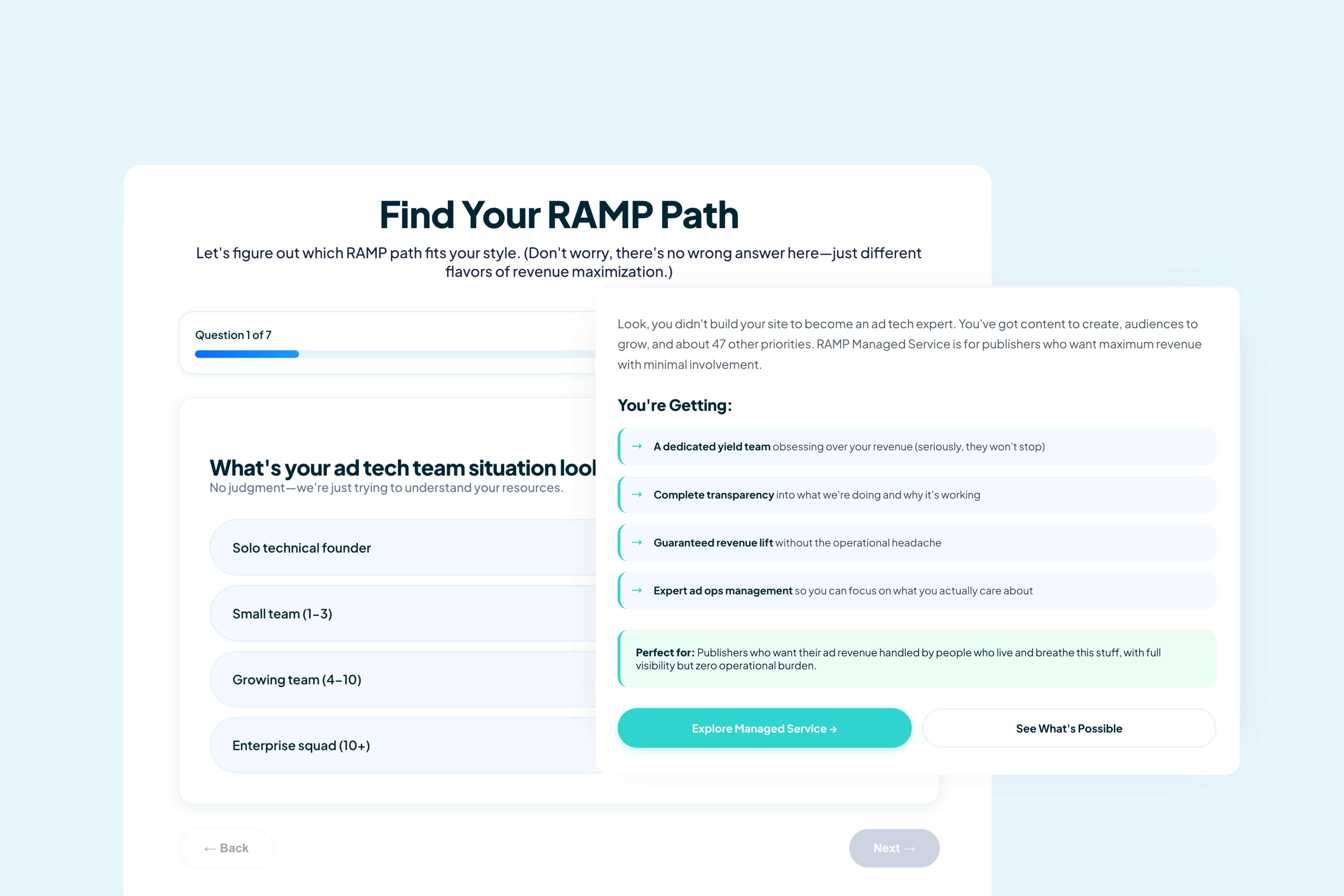
Entertainment publishers with dedicated technical teams can run a sophisticated self-service strategy using a platform like RAMP Self-Service. The control is real and granular: custom rules, traffic segmentation, bidder management, and identity strategy all configurable at the level a technical publisher wants.
Publishers who want premium results without building an internal yield operations function get that through a managed service approach. The tradeoff isn't really "control vs. no control." It's "where do I want to apply my team's time and attention."
Managed service doesn't mean handing over the keys with no visibility. It means having expert yield ops, ad ops, and partner success teams focused on your revenue while you focus on the content and audience relationships that actually differentiate your site.
The honest answer for most entertainment publishers is somewhere in between. Strategic direction stays internal. Execution, optimization, and the technically demanding work of managing millions of price floor rules gets handled by the platform.
If rewarded video fits your content model — particularly for gaming-adjacent or interactive entertainment. The complete guide to rewarded video ads for web and app publishers walks through implementation options and revenue considerations worth evaluating before you finalize your unit mix.
Putting Your Framework Together
An entertainment site ad strategy control framework isn't a document you write once and file away. It's a living operational model with defined owners for each lever, an active testing calendar, and clear criteria for when to escalate from automation to human intervention.
The framework components look like this:
- Lever ownership: Assign a clear owner for each of the four levers (floors, layout, header bidding, identity), even if that owner is your monetization partner
- Testing cadence: Define a minimum testing frequency — at least one active experiment per quarter at the layout or floor level
- Review triggers: Identify the metrics that trigger a manual review: a CPM drop of a defined percentage, a fill rate change, a viewability decline
- Seasonal readiness checklist: Build a pre-season checklist for your top three traffic events of the year, including floor adjustments, direct demand conversations, and technical validation
- Automation scope: Document which decisions your platform handles autonomously and which require your sign-off before execution
Entertainment publishers who work through this framework stop reacting to revenue changes and start anticipating them. That shift from reactive to proactive is the difference between an ad strategy that runs your site and one you actually control.
Next Steps:
- Apply to Work with Playwire: The logical next step after mastering the concepts in this article.
- RAMP Managed Service: The logical next step after mastering the concepts in this article.
Playwire Is Built for Entertainment Publishers Who Want Both Control and Results
Playwire's RAMP platform is the infrastructure this framework runs on. The RAMP Self-Service option gives technical teams the granular control described throughout this article: custom rules, traffic segmentation, bidder management, and AI-powered optimization that complements rather than replaces your strategic input.
RAMP Managed Service gives publishers the same underlying technology with Playwire's yield ops, ad ops, and partner success teams driving execution. Either way, you're not building the infrastructure from scratch.
Entertainment publishers on the Playwire platform also get access to direct sales relationships with major entertainment advertisers — including Disney, Netflix, and Amazon Prime Video — demand that simply isn't accessible through open programmatic alone. Combined with AI managing over 1.2 million price floor rules per site, the platform handles execution so your team can focus on strategy.
Entertainment publishers that have made the switch see real results:
- All Media Network consistently outperforms alternative partners on revenue.
- Lambgoat saw 50% revenue uplift within the first two months.
Your site has that potential too.
Ready to take control of your entertainment site's ad strategy? Apply now.

Frequently Asked Questions
What is an entertainment site ad strategy?
An entertainment site ad strategy is a structured framework for managing the specific ad revenue levers that matter most for media properties covering movies, TV, music, and sports. It defines how a publisher controls price floors, ad layout, header bidding configuration, and identity solutions, along with how to test changes and when to automate versus apply human judgment.
How do price floors affect entertainment publisher revenue?
Price floors set the minimum CPM an entertainment publisher will accept before an impression goes unsold. Setting floors too low leaves revenue on the table. Setting them too high sacrifices fill rate. Sophisticated publishers use AI-driven tools to manage floor rules dynamically across device type, geography, content section, and time of day simultaneously.
What metrics should entertainment publishers track for ad performance?
Entertainment publishers should focus on pageview CPM, session RPM, viewability rate, and fill rate as their primary ad performance indicators. Pageview CPM captures the combined effect of CPM and fill rate. Session RPM measures whether per-page gains translate to higher revenue across a full multi-page visit — which is especially important for entertainment audiences who browse multiple content pages per session.
When should entertainment publishers use managed service vs. self-service ad platforms?
Publishers with dedicated technical teams and a hands-on optimization appetite are strong fits for self-service platforms with granular control. Publishers who want expert-driven execution without building an internal yield operations function are better served by a managed service model.
Most entertainment publishers land somewhere in between, keeping strategic decisions in-house while delegating execution to a platform with AI-powered optimization and dedicated support teams.
How do seasonal traffic peaks affect entertainment site ad strategy?
Entertainment sites experience vertical-specific CPM peaks tied to award seasons, major film releases, streaming premieres, and sports championships. Publishers who prepare floor strategy adjustments, activate direct advertiser relationships, and validate technical capacity before these events drive meaningfully higher revenue during peak periods — compared to publishers who react after traffic spikes arrive.