
-1.png?width=800&height=157&name=1-playwire-logo-primary-2021%20(1)-1.png)


March 23, 2026

Editorial Policy
All of our content is generated by subject matter experts with years of ad tech experience and structured by writers and educators for ease of use and digestibility. Learn more about our rigorous interview, content production and review process here.
The TV Coverage Decision Nobody Told You Was a Revenue Decision
Most TV publishers think about content strategy in terms of what their audience wants to read. That's reasonable. But the content type you cover doesn't just determine your traffic. It determines the composition of that traffic, and composition is what advertisers actually pay for.
The choice to focus on streaming platforms like Netflix, Max, or Hulu versus covering traditional broadcast and cable networks isn't just editorial. It's a monetization decision with real CPM implications.
Understanding how those two content types behave differently in the ad market is the difference between leaving money on the table and extracting every dollar your audience is worth. If you're still working through the fundamentals, our guide to publisher monetization strategies for content creators across multiple revenue channels covers the core frameworks worth having in your toolkit.
Need a Primer? Read This First:
- TV Show Recap Sites: Ad Revenue Benchmarks and Monetization Strategies: Read this first to understand the foundational concepts this article builds on.
- The Complete Guide to Entertainment Website Ad Revenue: Read this first to understand the foundational concepts this article builds on.
Why Your Streaming TV Content Audience Profile Changes Everything
Publishers often treat CPMs as something that happens to them. In reality, CPMs are a reflection of who's showing up and what advertisers are willing to pay to reach them.
Streaming TV content attracts a meaningfully different demographic than traditional broadcast or cable coverage. Streaming audiences skew younger, tend to be more digitally native, and consume content on devices that support richer targeting signals. Advertisers chasing this demographic, particularly entertainment brands, consumer tech companies, and streaming platforms themselves, pay a premium to reach them.
Traditional TV coverage isn't without its advantages. Broadcast and cable audiences often index higher on household income, particularly in news-adjacent entertainment categories. Live event coverage, network drama premieres, and award season content can pull audiences that direct advertisers specifically want.
The CPM may be structured differently, but the demand is real.

How Streaming Content Shapes Publisher Traffic Behavior
Streaming content creates a distinct traffic pattern. Users come back repeatedly to check episode schedules, read recaps, follow season progression, and discover new shows. This session cadence gives publishers multiple ad impressions per user visit, and it tends to produce stronger return visitor rates than one-off broadcast event coverage.
Higher return visitor rates matter for a specific reason: return visitors are often cookieless targets. Publishers with strong first-party data capture can monetize these users at rates that dwarf what anonymous users command.
If your streaming content is bringing users back weekly and you're not capturing first-party signals during those visits, you're getting paid for only a fraction of your audience's actual value.
How Traditional TV Coverage Shapes Publisher Traffic Behavior
Broadcast and cable coverage operates on spikes. A season finale drives a traffic surge. A major award show generates enormous search volume. A cancelled show triggers a wave of outrage content that burns bright for three days and then disappears. These patterns aren't bad. They're just different.
The challenge is that spike-driven traffic is harder to monetize efficiently. CPMs during these surges can be strong, particularly if your audience is well-targeted, but the revenue concentration creates volatility. A poor award season, a show cancellation that doesn't generate the expected buzz, or a competitor that outranks you on a major premiere can meaningfully dent your quarterly performance.
CPM Dynamics Across Streaming and Broadcast Content Types
The CPM gap between streaming content and traditional TV coverage isn't fixed. It varies significantly based on advertiser demand cycles, content type, and how well your ad stack is positioned to capture that demand.
The numbers tell an interesting story.
According to Media Dynamics' 2025 upfront analysis, streaming's average CPM landed at $27.25 while prime-time broadcast reached $43.50 and cable came in at $19.35. Streaming ad revenue itself grew nearly 18% to $13.2 billion during the same period.
These aren't just market trends for TV platforms. They're direct signals about advertiser demand patterns that entertainment publishers covering these verticals should be reading and responding to.
How you translate those signals into actual revenue depends heavily on your programmatic monetization setup and whether your ad revenue is actually being maximized.
Factor | Streaming Content | Broadcast/Cable Content |
Average CPM (2025 upfronts) | $27.25 | $43.50 (prime-time broadcast); $19.35 (cable) |
CPM variance | Low — stable month-to-month | High — concentrated around events and premieres |
Traffic pattern | Steady, recurring | Spike-driven |
Audience age skew | 18-34, digitally native | Broader; indexes higher on household income |
Return visitor rate | High — episodic content drives repeat visits | Low — event-driven visits rarely repeat |
First-party data opportunity | Strong — repeat visitors are identifiable and capturable | Limited — one-time visitors are harder to capture |
Primary advertiser demand | Streaming platforms, consumer tech, entertainment brands | Studios, luxury brands, streaming platforms (award season) |
Video ad opportunity | High — streaming advertisers seek contextual video alignment | Moderate — strongest during live events |
Seasonal revenue peak | Consistent baseline with launch-driven spikes | Award season (Emmys, Golden Globes, SAG Awards) |
Revenue predictability | Higher — easier to forecast and plan against | Lower — dependent on content cycle and competitive coverage |
Neither content type is inherently superior for publisher ad revenue. Streaming content produces more stable, lower-variance CPMs. Traditional TV coverage can generate exceptional CPM peaks during the right moments. The publishers who win are the ones who understand which content type is working hardest for them at any given time.
Related Content:
- What Publishers Need to Know About Contextual Advertising: Related coverage from across Playwire's content library.
- Entertainment Audience Data Solutions: Related coverage from across Playwire's content library.
- CTV Creative Format: Related coverage from across Playwire's content library.
The Streaming Advertiser Advantage for Entertainment Publishers
Streaming platforms are among the most aggressive digital advertisers in the entertainment vertical right now. They're spending heavily to acquire subscribers, retain existing ones, and promote new content. That spend has to go somewhere, and a meaningful portion of it ends up targeting audiences on entertainment publisher sites.
This creates a specific opportunity for streaming-focused publishers.
When Netflix launches a major original, when a Disney+ series generates cultural conversation, or when Apple TV+ is pushing an award-season contender, the programmatic CPMs for streaming-adjacent content spike. Publishers with established streaming coverage can capture this elevated demand without doing anything differently.
The content relevance does the work. For publishers who haven't fully explored their video inventory options, understanding how rewarded video ads work across web and app placements to maximize video ad revenue is worth your time. Streaming audiences are primed for video formats in a way broadcast audiences simply aren't.
Playwire's global direct sales team has established relationships with major entertainment advertisers including Disney, Netflix, Amazon Prime Video, and HBO Max. For entertainment publishers on the RAMP platform, that means direct campaign access during the moments when streaming advertisers are spending most aggressively. Direct campaigns consistently outperform programmatic by significant margins, which matters most when advertiser demand is already elevated.

Award Season: Where Traditional TV Coverage Still Dominates Publisher Revenue
Broadcast and cable coverage earns its keep during award season. The Emmys, Golden Globes, SAG Awards, and similar events generate traffic spikes that are both predictable and addressable by advertisers who want to reach TV-engaged audiences at peak attention moments.
The CPM lift during these windows can be substantial. Award season content attracts a specific kind of advertiser: studios promoting for consideration, luxury brands associating with cultural prestige, and streaming platforms promoting their nominated content. That multi-advertiser competition drives floor prices up.
The publishers who monetize award season well aren't just the ones with the best coverage. They're the ones whose ad infrastructure can handle the traffic surge without latency issues, whose price floors are calibrated to capture elevated demand, and whose direct sales team has relationships activated before the nominations are announced. Preparation is the monetization strategy.

Content Mix Strategy: Why Pure-Play Bets Are Risky for Publisher Ad Revenue
Most successful TV-focused publishers cover both streaming and traditional TV content to some degree. This isn't just editorial hedging. It's revenue engineering.
Streaming content produces the consistent base traffic that keeps CPM floors stable. Traditional TV coverage creates the seasonal spikes that allow publishers to access premium demand during high-attention moments. A content strategy that leans exclusively in either direction creates vulnerabilities that are hard to hedge on the ad ops side.
Here are the key considerations for TV publishers thinking about content mix from a revenue perspective:
- Streaming coverage provides the foundation: Consistent traffic from ongoing series reduces month-to-month CPM variance and builds the return visitor base that supports first-party data strategies.
- Award season coverage is a revenue multiplier: Investing in award season content — even for predominantly streaming-focused publishers — unlocks access to premium demand segments that are largely inaccessible outside those windows.
- Franchise content bridges both worlds: Shows that originated on broadcast or cable and continued on streaming platforms attract audiences from both segments and can command demand from both advertiser categories.
- Cancellation and controversy content punches above its weight: Traditional TV generates outsized short-term traffic from cancellations, cast controversies, and network decisions. These are programmatic CPM opportunities worth capturing even if they're not core to your content strategy.
- Release cadence alignment matters: Weekly streaming releases create regular traffic pulses. Drop-all-at-once streaming releases create single-day spikes. Understanding your content calendar's relationship to these release patterns lets you optimize ad density settings proactively.
Can Your Ad Stack Handle Both Streaming and Broadcast Audiences?
This is where most entertainment publishers get tripped up. They optimize their content strategy for the right mix of streaming and traditional TV coverage, then run it all through an ad stack that treats every page impression the same way.
Streaming audiences and broadcast audiences have different value profiles. Serving them with identical configurations is leaving money on the table on both sides.
- Streaming audiences often support higher video CPMs given the category adjacency.
- Broadcast audiences during live event coverage can support aggressive direct deal placements.
An ad stack that can't differentiate and respond to these signals in real time isn't optimized. It's just running.
Playwire's AI manages over 1.2 million price floor rules per website. The system isn't applying blanket settings to your inventory. It's reading signals and responding to what your specific content, at that specific moment, can actually command in the market. For TV publishers covering multiple content types, that level of granularity directly impacts revenue.
Entertainment publishers also have a particular video opportunity worth noting. Streaming TV content naturally creates demand for video ad units from streaming platform advertisers who want contextual alignment.
If you're also running a mobile app alongside your web presence, the video opportunity extends further. Publishers who understand how to increase app revenue using mobile app video ads and contextual video formats can capture streaming advertiser budgets across both surfaces.
Playwire's Flex Video format captures video ad dollars even on text-heavy pages, generating additional revenue from audiences already primed for video content consumption. The format loads above content and collapses as users scroll, keeping user experience intact while reaching video budgets.
Building Your TV Publisher Ad Revenue Stack
TV-focused publishers need a monetization approach that reflects the actual complexity of their traffic. Here's what that looks like in practice:
- Price floor segmentation: Streaming content pages and traditional TV coverage pages should have different floor strategies. A one-size-fits-all approach undermonetizes your highest-value inventory.
- Video inventory development: Streaming-adjacent content gives you a credible argument for video ad spend. Make sure your stack is capturing it.
- First-party data capture: Return visitors from ongoing streaming coverage are a high-value segment. Hashed email capture and audience segmentation let you command premium CPMs for users you can actually identify.
- Direct sales access: Studios, streaming platforms, and entertainment brands spend significant budget targeting engaged TV audiences. Without a direct sales relationship, you're capturing only the programmatic slice of that demand.
- Seasonal floor adjustments: Award season is a known CPM opportunity. Your price floors during those windows should reflect the elevated demand, not yesterday's baseline.
How Playwire Serves Entertainment and TV Publishers
Entertainment publishers on the RAMP platform typically see ad revenue double after switching. Direct sales combined with the Flex Suite delivers 19x higher CPMs than programmatic alone. Those results reflect an ad tech stack built specifically for publishers whose audiences have high expectations and whose advertisers have high demands.
Playwire works with over 50 entertainment sites spanning film, TV, music, sports, and multimedia verticals. The combination of two distinct audience profiles, seasonal traffic volatility, and access to premium entertainment advertiser demand creates complexity that generic ad tech stacks aren't built to handle. RAMP is.
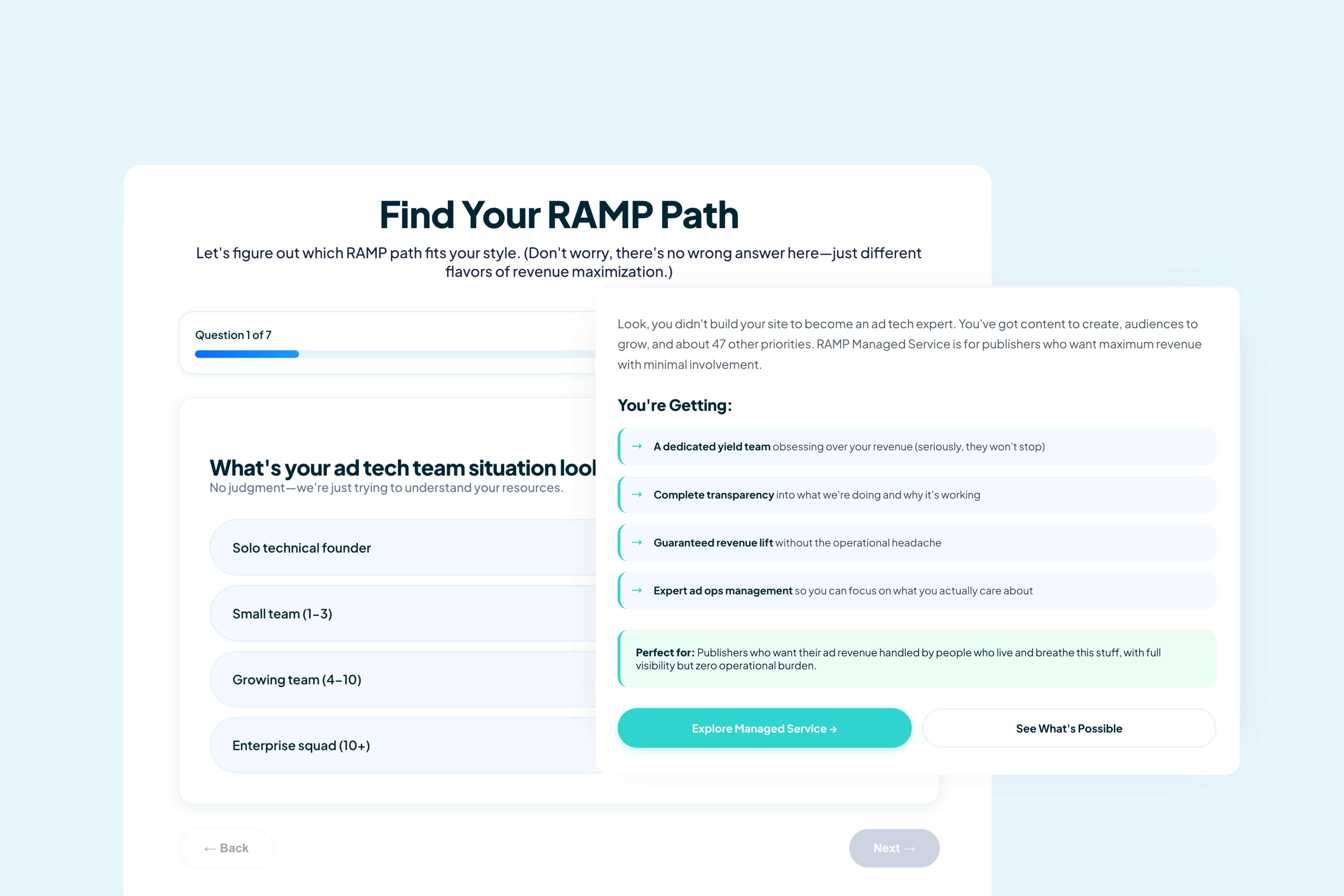
RAMP Managed Service gives TV publishers a dedicated team handling yield optimization while the publisher focuses on content. RAMP Self-Service gives technical publishers granular control over settings, segmentation, and floor strategies across their entire ad stack. Both options include access to Playwire's direct relationships with the entertainment advertisers that matter most to TV-focused audiences.
The content you cover shapes who shows up. The ad stack you run determines what you get paid for them. Both decisions deserve the same level of attention.
Next Steps:
- Entertainment Publisher Yield Management: Metrics That Actually Matter: The logical next step after mastering the concepts in this article.
- Video Ad Monetization for Entertainment Publishers: Technical Best Practices: The logical next step after mastering the concepts in this article.
Frequently Asked Questions About Streaming TV Content and Publisher Ad Revenue
Does streaming TV content generate higher CPMs than traditional broadcast coverage?
The answer isn't as simple as yes or no. Streaming content typically produces lower month-to-month CPM variance and stronger return visitor rates that support first-party data strategies.
Traditional broadcast coverage can generate significantly higher CPM peaks during award season and live events. According to Media Dynamics' 2025 upfront data, prime-time broadcast CPMs averaged $43.50 versus $27.25 for streaming, though both declined year-over-year. The better question is how your content mix captures demand from both cycles.
How does content type affect first-party data capture for publishers?
Streaming content creates repeat engagement patterns that give publishers multiple opportunities to capture first-party signals from the same users. Return visitors who follow ongoing series, read episode recaps, and check release schedules are far more identifiable than one-time visitors driven by a broadcast event.
Publishers who capture hashed email and audience data from these return visits can monetize them at premium rates versus anonymous user traffic.
What ad infrastructure does a TV publisher need to cover both streaming and broadcast content?
TV publishers covering both content types need price floor segmentation by content category, video inventory development to capture streaming advertiser budgets, first-party data capture systems for return visitor monetization, direct sales access to entertainment advertiser demand, and seasonal floor adjustment capability for award season windows.
An ad stack applying identical settings across streaming and broadcast content is undermonetizing one or both segments. On the SEO side, properly structured content pays dividends too.
Publishers who haven't implemented structured data yet should review the complete schema guide for website publishers and content creators to boost search visibility as part of their technical infrastructure review.
When is award season the most valuable window for TV publisher ad revenue?
Award season represents a concentrated window where streaming platforms, studios, and luxury brands compete aggressively for contextually relevant placements. The multi-advertiser competition during Emmy, Golden Globe, and SAG Award cycles drives floor prices up substantially.
Publishers who prepare their ad infrastructure, calibrate price floors, and activate direct sales relationships before nominations are announced capture a disproportionate share of the elevated demand.
Ready to find out what your streaming and TV content is actually worth? Apply to work with Playwire and see what optimized entertainment publisher monetization looks like.
