
-1.png?width=800&height=157&name=1-playwire-logo-primary-2021%20(1)-1.png)

September 8, 2026

Editorial Policy
All of our content is generated by subject matter experts with years of ad tech experience and structured by writers and educators for ease of use and digestibility. Learn more about our rigorous interview, content production and review process here.
.png?width=900&name=Breaking%20News%20Placeholder%20(1).png)
Key Points
- Publishers are splitting into two groups: those signing AI licensing deals and those filing lawsuits, with the dividing line running along scale and legal budget.
- Reported deal values run from roughly $1m to $5m per year for typical OpenAI agreements up to News Corp's $250m over five years. Licensing revenue tracks negotiating leverage more than content quality.
- Lawsuits are now hitting infrastructure players as well as model builders, with News Corp suing the Brave browser over alleged crawler disguising and content resale.
- Mid-market and independent publishers have no realistic path to a licensing deal or a multi-year copyright suit, which makes crawler control and on-site yield the only levers they control.
- Whatever you decide about AI crawlers, the traffic you keep has to earn more per session than it did last year.
What Press Gazette's Running Tally Shows
Press Gazette maintains a running list of publisher AI lawsuits and licensing deals, and the latest update covers Editorial Perfil and Wikihow suing OpenAI, plus News Corp's suit against Brave.
The list is long. Around a dozen claims have been brought against OpenAI since the end of 2023, led by The New York Times. Roughly six cases now target Perplexity. The signed-deal column is longer still, running from Axel Springer and the FT through to Reach's usage-based agreement with Amazon.
Read both columns together and the sorting logic is obvious.
Scale and Legal Budget Decide Who Gets a Deal
Publishers who sign deals tend to be large, globally recognized, and represented by counsel who can make a credible litigation threat. Publishers who sue tend to be large enough to fund the suit. Everyone else gets neither.
Editorial Perfil's own account makes this explicit. Perfil's director of digital Agustino Fontevecchia told Press Gazette the publisher spent over a year trying to reach OpenAI's teams to negotiate an agreement similar to the ones signed with Grupo Prisa in Spain and Folha in Brazil. The lawsuit came after that failed.
Folha's arc says the same thing from the other direction. Folha sued OpenAI in August 2025, then settled in May 2026 by signing a commercial agreement. The lawsuit was the negotiating position.
Here's what the reported deal economics look like across the tiers Press Gazette documented:
| Publisher | AI partner | Reported value |
|---|---|---|
| News Corp | OpenAI | $250m+ over five years |
| News Corp | Meta | Up to $50m per year for 3+ years |
| ~$60m per year | ||
| The New York Times | Amazon | $20m to $25m per year |
| Dotdash Meredith (People Inc) | OpenAI | At least $16m per year |
| Informa | Microsoft | $10m+ initial fee, plus three annual payments |
| Typical news org offer (2024 reporting) | OpenAI | $1m to $5m per year |
| Mid-market and independent publishers | None | No deal on offer |
The bottom row is the one that matters for most of the people reading this.
Essential Background Reading:
- AI and Publishers Resource Center: A starting point for how AI is reshaping publisher traffic, revenue, and content rights.
- AI Info: Baseline context on how AI models interact with publisher content and monetization.
- Generative AI: An overview of generative AI's impact on the publisher ecosystem.
- Publisher Ad Tech Stack: How the pieces of a modern ad tech stack fit together, including where crawler controls sit.
Lawsuits Are Now Targeting the Middle of the Stack
News Corp's suit against Brave moves the target. The complaint alleges Brave disguised its web crawlers to evade publisher blocks and then scraped and sold copyrighted News Corp content to AI companies, delivering what News Corp described as "verbatim or near verbatim" news summaries.
Brave's counter-argument, filed in February in response to a News Corp cease-and-desist, is that indexing website content is what "all search engine operators must do to exist."
The Reddit case pushes further into infrastructure. Reddit sued Perplexity alongside three data-scraping suppliers, SerpApi, Oxylabs, and AWMProxy, alleging industrial-scale bypassing of technical protections. On 31 July, a federal judge largely rejected the motions to dismiss, finding Reddit had plausibly pleaded that Perplexity conspired with at least one scraper to bypass access controls.
The implication for your robots.txt file is direct. Blocking GPTBot and PerplexityBot does nothing if content reaches those models through a third-party scraper, a proxy network, or a browser that misrepresents its user agent.
Related Content:
- Block AI: A closer look at blocking strategies for publishers who decide crawler access isn't worth the tradeoff.
- AI Content Info: Context on how AI crawlers interact with published content across the web.
- News Publisher Guide: Guidance built specifically for news publishers navigating AI-driven traffic shifts.
- Publisher Ad Revenue Maturity Model: A framework for evaluating where your monetization stack stands relative to the market.
What Mid-Market Publishers Should Do
Litigation and licensing are both off the table for most publishers. That leaves a narrower set of moves, and they're all operational.
Start with visibility into what's crawling you:
- Audit your actual crawler traffic: server logs tell you which agents are hitting your content, at what volume, and whether declared user agents match verified IP ranges.
- Block at the edge: robots.txt is a request. Cloudflare bot management, WAF rules, and IP-level blocks are enforcement.
- Watch for undeclared and disguised agents: the Brave and Reddit allegations both center on crawlers that didn't identify themselves honestly, which robots.txt cannot address.
- Decide per crawler: some AI crawlers drive citation traffic back to you. Others consume and return nothing. Treat them differently.
- Document your blocks: publishers who later negotiate or litigate benefit from a clear record of what they prohibited and when.
Our AI Crawler Protection Grader will tell you which AI crawlers currently have access to your site and where your controls have gaps. The AI crawler resource center covers the implementation detail behind each of those bullets.
Next Steps:
- Publisher Ad Revenue Maturity Model Assessment: Assess where your current yield operation sits and what to fix first.
- Yield Experiment Playbook: A structured approach to testing yield changes instead of guessing.
- 2026 State of Publisher Ad Revenue Report: Industry benchmark data on where publisher ad revenue is heading.
- Publisher Earnings Index: A reference point for how publisher earnings are trending across the market.
The Revenue Math Behind Traffic Compression
Penske Media's suit against Google contains one of the few concrete traffic figures in the entire Press Gazette roundup. Penske alleged that about 20% of Google search results linking to its sites feature an AI Overview, and that affiliate revenue from shopping links dropped by more than a third compared to the end of 2024.
Penske owns Rolling Stone, Variety, Deadline, and The Hollywood Reporter. If a portfolio that size is watching a third of its affiliate revenue evaporate, smaller publishers are absorbing proportionally similar hits without the option of a federal lawsuit.
Sessions are getting more expensive to acquire and harder to replace. Total pageviews stopped being the number that decides anything. RPS is what tells you whether your business survives the compression.
See It In Action:
- Study Circle Case Study: How one publisher restructured its yield approach to grow revenue.
- Serebii Case Study: A look at revenue optimization results for a niche content publisher.
- Our Publishers Are Partners, Not Just Customers: How the partnership model plays out for publishers working through revenue pressure.
Where We Come In
We can't get you a licensing deal with OpenAI. Nobody can, unless you own a masthead with a nine-figure legal budget attached.
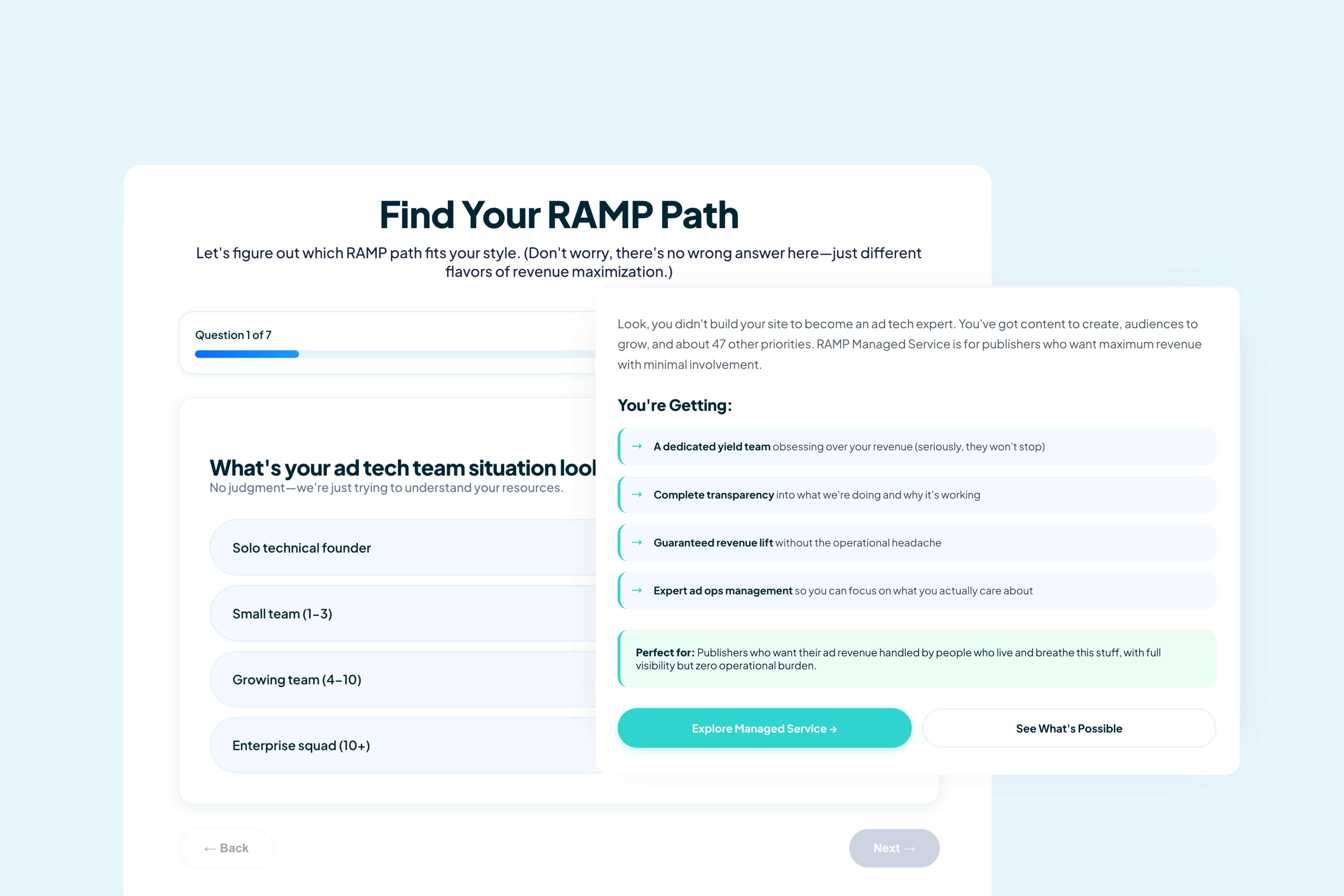
What we can do is make the sessions you still have worth more. Our RAMP platform handles the yield side: header bidding across a full demand stack, AI-driven price floor optimization, and format decisions that hold viewability in the 70-90% range without gutting user experience. Managed Service if you want our ad ops team running it. Self-Service if you'd rather keep your SSP seats and configure the rules yourself.
Our DIRECT team layers direct-sold demand at higher CPMs on top of programmatic, which matters more as programmatic session volume compresses. STUDIOS builds the high-impact formats that pull premium rates on the traffic you've fought to keep.
The AI licensing market will keep sorting publishers by size. Your yield stack is one of the few variables that doesn't care how big you are.
Talk to us about what your current RPS should look like.
