
-1.png?width=800&height=157&name=1-playwire-logo-primary-2021%20(1)-1.png)


May 5, 2026

Editorial Policy
All of our content is generated by subject matter experts with years of ad tech experience and structured by writers and educators for ease of use and digestibility. Learn more about our rigorous interview, content production and review process here.
Key Points
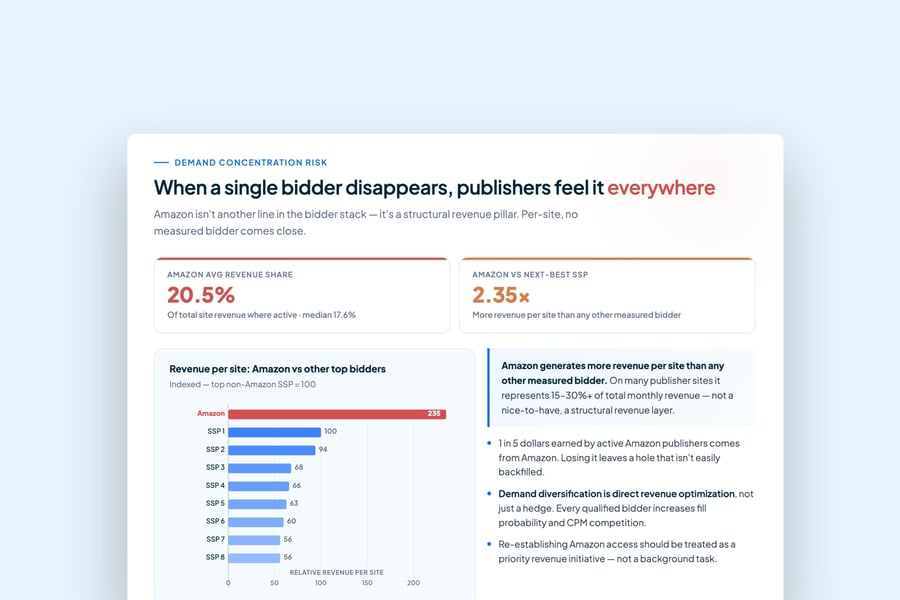
- Amazon averages 20.5% of total site revenue where it's active, making it a structural revenue pillar, not a marginal demand source.
- Recent access changes have left a significant share of publishers operating without Amazon as a bidder, creating a gap that other SSPs don't automatically fill.
- Demand concentration risk is real: when one bidder accounts for roughly one in every five dollars earned, losing it isn't a yield optimization problem. It's a revenue architecture problem.
- The fix isn't panic. It's understanding what Amazon actually does in your auction and building a demand stack deep enough to compensate when it's gone.
When Amazon is active and generating revenue on a publisher site, it accounts for an average of 20.5% of total site revenue, with a median of 17.6%. That's across thousands of publisher sites in the Playwire ecosystem. Not a cherry-picked outlier, not a gaming site that happens to run heavy commerce inventory. An average. A median.
One bidder. Roughly one dollar in every five.
That's not a demand partner. That's a structural revenue pillar. And a meaningful share of publishers are currently operating without it.
What Amazon Publisher Services Does in Your Auction
Understanding the gap starts with understanding what Amazon brings to the table that other SSPs don't replicate cleanly.
Amazon Publisher Services (APS) connects publishers to Amazon's demand pool through two primary mechanisms: Transparent Ad Marketplace (TAM), a server-side header bidding solution that runs alongside existing client-side setups, and Unified Ad Marketplace (UAM), a fully managed, server-side header bidding solution where Amazon handles the full auction. TAM is available to most publishers who apply. UAM is invitation-only and reserved for larger, established properties.
Amazon's bidding behavior is distinctive either way. Its demand pool draws from Amazon DSP, endemic retail advertisers, and a first-party data infrastructure that genuinely differentiates it from most programmatic buyers. When Amazon bids aggressively, it doesn't just win impressions. It raises the floor for every other bidder competing in the same auction. That competitive pressure lifts CPMs across the entire demand stack, not just on the impressions Amazon ultimately wins.
Take Amazon out of that auction, and two things happen simultaneously. You lose the revenue Amazon was directly contributing. You also lose the competitive pressure it was applying to every other bidder. Both effects hit your bottom line, and they compound.
This is why a 20% revenue share from a single bidder understates Amazon's actual contribution to publisher economics. The bidder you lose is rarely replaced dollar-for-dollar by redistributing its impression share across remaining partners.
The Access Problem
Recent shifts in Amazon's publisher access requirements have left a meaningful segment of publishers without Amazon as an active bidder. The specifics of those access changes matter less than the consequence: publishers who had been counting on Amazon's contribution are now operating with a structural gap in their demand stack.
This isn't a scenario where the shortfall is invisible. Publishers who track revenue with any granularity see it immediately in their dashboards. The CPM floor that Amazon was sustaining tends to soften. Fill on certain inventory types drops. The revenue per session that was tracking at one level lands somewhere lower, and the gap between where you were and where you are is frustratingly hard to close through standard yield optimization.
The standard playbook, activate another SSP, adjust floors, refresh demand connections, doesn't account for what made Amazon structurally different in the first place.
Essential Background Reading:
- 5 Ad Revenue Metrics Publishers Should Track that Might Surprise You: The metrics that actually predict revenue performance, and why the ones publishers obsess over often aren't them.
- Ad Density Is the #1 Predictor of Publisher Revenue Per Session: Why impressions per pageview is the strongest lever publishers control, backed by network-wide data.
- Fill Rate Is the Most Underrated Revenue Lever, Though Complex to Change: Understanding fill rate mechanics before a major demand partner disappears is considerably easier than diagnosing them after.
- Publisher Ad Revenue Maturity Model: Where Are You on the Revenue Curve?: A framework for assessing where your monetization stack stands, and what the next stage of optimization looks like.
Demand Concentration Risk, Quantified
Publishers think about demand concentration risk the same way most people think about earthquake preparedness: they know it's real, they just assume the big one won't happen to them.
The data makes that posture harder to defend. Consider what a 20.5% average revenue contribution means in practical terms across different revenue scales.
| Monthly Ad Revenue (Publisher) | Amazon Avg Contribution (20.5%) | Revenue at Risk Without Amazon |
|---|---|---|
| $5,000/month | ~$1,025/month | ~$12,300/year |
| $15,000/month | ~$3,075/month | ~$36,900/year |
| $50,000/month | ~$10,250/month | ~$123,000/year |
| $150,000/month | ~$30,750/month | ~$369,000/year |
These aren't projections. They're the straightforward application of a measured average to a range of publisher revenue scales. The dollar figure that disappears when Amazon access goes away scales directly with the size of your operation.
For enterprise portfolio publishers managing multiple sites, the concentration risk compounds. If Amazon represents 20% of revenue across a ten-site portfolio, you're not looking at one gap. You're looking at a systemic exposure across every property in the network.

Why Other SSPs Don't Just Fill the Hole
The instinct when a demand partner goes away is to activate replacements. More SSP connections, more demand diversification, more header bidding partners. That logic is sound in principle. In practice, it runs into a ceiling.
Bidder stack depth matters for fill rate, and fill rate does correlate with revenue per session. Publishers consistently hitting 90%+ fill tend to share the same characteristics: a well-configured header bidding setup, smart unified pricing rules, and ongoing yield management. Those things matter.
What they don't do is replicate the specific competitive pressure that Amazon's demand pool was generating. Amazon bids differently from most programmatic buyers. Its signals are different, its targeting logic is different, and its willingness to pay for certain audience types in certain verticals reflects a data infrastructure that other SSPs aren't currently matching at scale.
Adding five new SSP connections to compensate for Amazon's absence may improve fill. It won't restore the CPM floor that Amazon was sustaining. The gap is structural, not additive.
TAM vs. UAM: The Amazon Access Spectrum
Amazon Publisher Services isn't a single product. It's a tiered access model, and where you sit on that tier affects both what you can do and what you stand to lose.
| Feature | TAM (Transparent Ad Marketplace) | UAM (Unified Ad Marketplace) |
|---|---|---|
| Access model | Open application | Invitation-only |
| Auction type | Server-side, alongside client-side | Fully managed server-side |
| Publisher control | Higher, runs alongside existing setup | Lower, Amazon manages the full auction |
| Demand sources | Amazon DSP + TAM partners | Amazon DSP + broader managed demand |
| Best fit | Most mid-to-large publishers | Larger, established properties |
| Fee structure | Publisher transaction fee applies | Publisher transaction fee applies |
The practical implication: UAM publishers who lose access lose both the demand contribution and the managed infrastructure Amazon was running. TAM publishers losing access lose the demand contribution but retain their own header bidding infrastructure. Neither outcome is painless, but the architectural impact differs.
Related Content:
- How to Diagnose and Fix Your Fill Rate Problem: A systematic approach to identifying what's suppressing fill and what actually moves the number.
- How to Right-Size Your Price Floors Without Leaving Money on the Table: The floor price trap is quantifiable, here's how to calibrate floors to the demand actually in your auction.
- What Separates the Top 10% of Website Publishers from Everyone Else (Data-Backed): The structural differences between publishers who absorb demand disruptions and those who don't.
- The Amazon SSP Problem: Why So Many Publishers Now Have a Structural Revenue Gap: A deeper look at what the access changes mean and why the gap is harder to close than it looks.
What Losing Amazon Publisher Ad Revenue Actually Looks Like
The anxiety in the market right now is specific. Publishers who had Amazon active are trying to understand what the revenue hole looks like without it, and whether they can fill it.
The honest answer is that the hole is real, it's measurable, and the standard response of adding more SSPs won't close it completely. The immediate visible effects are CPM softening on inventory Amazon was winning, fill rate pressure on inventory types where Amazon had high win rates, and revenue per session dropping in a way that correlates cleanly with Amazon's previous contribution.
The harder-to-see effects are the indirect ones. Amazon's competitive pressure in the auction was lifting CPMs on impressions Amazon never won. When that pressure drops, every other bidder in your stack has less reason to bid as aggressively. That secondary drag is difficult to isolate in a dashboard, but it's real, and it means the gap is wider than your Amazon line items suggest.
Publishers who had Amazon configured to compete across all eligible inventory feel this most acutely. Publishers who had Amazon active but constrained, floor pricing that prevented Amazon from winning regularly, or format restrictions that limited eligible inventory, have a smaller direct gap. They were also leaving money on the table before the access change happened.
Next Steps:
- How to Recover Publisher Revenue After Losing Amazon as a Bidder: The specific steps publishers can take to diagnose the gap and rebuild demand stack depth after access changes.
- Publisher Revenue Optimization by Vertical: How to Maximize Ad Revenue in YOUR Vertical: Each vertical has a different primary lever, this guide maps the right optimization strategy to your content category.
- How to Build a Website Content Architecture That Earns More Ad Revenue: Session depth and page structure are revenue levers most publishers underuse, here's how to build for them deliberately.
- How to Increase Impressions Per Pageview Without Hurting User Experience: Practical guidance on adding ad density without the UX tradeoffs that erode audience quality over time.
The Vertical Dimension
Not every publisher feels the Amazon gap equally, and the data on vertical-specific revenue drivers helps explain why.
Gaming, entertainment, and education publishers are primarily inventory volume businesses. Their revenue per session is driven by impressions per session. For these publishers, Amazon's contribution is real, but the primary optimization lever is ad density, not demand quality alone. Losing Amazon hurts, and the right response includes both demand stack repair and continued focus on the volume variables that drive their vertical.
Sports, news, and technology publishers operate differently. These are audience quality businesses where CPM and demand pool depth are the primary revenue per session drivers. In these verticals, the loss of a high-value bidder like Amazon isn't partially offset by adding more ad units per page. It's a direct hit to the economics of a vertical where audience premium is the asset.
| Vertical | Primary RPS Driver | Amazon's Structural Importance |
|---|---|---|
| Gaming | Impressions per session (r = 0.79) | Meaningful, but volume optimization partially offsets |
| Education | Impressions per session (r = 0.93) | Meaningful, but session depth carries heavy weight |
| Sports | CPM / audience quality (r = 0.94) | High, demand quality is the primary lever |
| News | Ad Request CPM (r = 0.80) | High, demand pool depth determines the outcome |
| Technology | Ad Request CPM (r = 0.93) | High, geo-rich tech audiences have outsized exposure |
The implication is straightforward. If you're a news or sports publisher who's lost Amazon access, you're not just dealing with a 20% revenue reduction. You're dealing with a 20% reduction in the exact variable, demand quality, that your vertical depends on most.
What a Healthy Demand Architecture Looks Like
The response to demand concentration risk isn't to pretend it doesn't exist. It's to build a demand stack that doesn't have single points of failure.
A few things separate publishers who absorb demand partner disruptions without catastrophic revenue impact from those who don't:
- Demand depth across multiple SSPs: Running Amazon alongside eight other meaningfully active demand partners means Amazon's absence creates a gap, not a crater. Publishers running Amazon as their only premium bidder have nowhere to distribute that impression share.
- Dynamic, demand-aware floor pricing: Static floors that were calibrated around Amazon's bidding behavior will over-price inventory when Amazon is gone. Right-sizing floors to actual demand present in the auction, not historical peaks, is what keeps fill rate from collapsing.
- Active yield management: The publishers consistently above 90% fill share one characteristic beyond header bidding setup: ongoing management. Not set-and-forget. Active testing, floor adjustments, and demand monitoring allow a publisher to detect and respond to a demand disruption before it becomes a revenue disaster.
- Vertical-aware optimization: Chasing CPM improvements in a volume-driven vertical, or adding ad density in a CPM-driven vertical, doesn't compensate for demand partner losses. The right lever depends on what actually drives revenue per session in your content category.
None of these items eliminate the Amazon gap. But they determine whether that gap is a manageable shortfall or an existential revenue problem.
See It In Action:
- Gaming Publisher Revenue Guide: Why Ad Density Is Everything: How gaming publishers maximize revenue per session through inventory volume, and where Amazon fits in that picture.
- Sports Publisher Ad Revenue Optimization: Why the Sports Playbook Is Different: Why audience quality is the primary lever for sports publishers, and why losing a premium bidder hits harder here than anywhere else.
- News Publisher Ad Revenue Monetization Strategy: When More Ads Won't Save You: The demand pool is what drives news publisher revenue, which is exactly why Amazon's structural role matters most in this vertical.
- Technology Publisher Ad Revenue Optimization Guide: High ceiling, high variance, how tech publishers with geo-rich audiences can protect and grow their revenue even after demand disruptions.
Frequently Asked Questions About Amazon Publisher Ad Revenue
What is Amazon Publisher Services (APS)?
Amazon Publisher Services (APS) is Amazon's suite of programmatic advertising tools for publishers. It connects publisher inventory to Amazon's demand pool, including Amazon DSP and endemic retail advertisers, through two main products: Transparent Ad Marketplace (TAM), a server-side header bidding solution, and Unified Ad Marketplace (UAM), a fully managed server-side solution available by invitation only.
How much revenue does Amazon generate for publishers?
Across thousands of publisher sites in the Playwire ecosystem, Amazon accounts for an average of 20.5% of total site revenue where it's active, with a median of 17.6%. For most publishers running Amazon, it contributes roughly one dollar in every five to six earned. That makes it one of the single largest individual revenue contributors in a typical publisher's demand stack.
What is the difference between Amazon TAM and UAM?
TAM (Transparent Ad Marketplace) is a server-side header bidding solution that runs alongside a publisher's existing client-side setup. It's available to most publishers who apply. UAM (Unified Ad Marketplace) is a fully managed server-side solution where Amazon handles the full auction, reserved for larger, established publishers by invitation only. Both access Amazon's demand pool, but UAM offers less publisher control in exchange for more managed infrastructure.
What happens if I lose access to Amazon as a publisher bidder?
Losing Amazon access creates a direct revenue gap equivalent to its previous contribution, averaging 20.5% of total site revenue, plus an indirect gap from reduced competitive pressure in the auction. Other SSPs don't automatically fill this gap because Amazon's demand pool, first-party data infrastructure, and bidding behavior are structurally distinct. The standard response of activating replacement SSPs may improve fill but won't restore the CPM floor Amazon was sustaining.
Is Amazon Publisher Services free to use?
APS is not entirely free. Both TAM and UAM carry a publisher transaction fee. Publishers should account for this cost when evaluating net revenue contribution versus gross demand.
How does Amazon compare to Prebid and Open Bidding for publishers?
Amazon TAM runs server-side alongside Prebid (client-side) rather than replacing it, making them complementary rather than directly competing configurations for most publishers. Google Open Bidding is a server-side solution that competes more directly with TAM architecturally. The key distinction is demand source: Amazon brings its own DSP and retail advertiser demand that Prebid and Open Bidding don't replicate. Running all three in a well-configured stack typically produces better results than choosing between them.
How Playwire Addresses Amazon Publisher Ad Revenue Risk
This is where the problem connects to a specific capability, not a generic recommendation to diversify your demand stack.
This is where having a partner like Playwire is important. Playwire's scale and relationship with SSPs can demand a lot more attention than an individual publisher can. Working with a partner like Playwire gives you a greatly improved chance at getting back on with Amazon if they turned demand off for your site.
Playwire's RAMP platform is built around the premise that publisher revenue depends on both the quality of the demand pool and the infrastructure managing it. That means direct relationships with premium demand sources, a managed header bidding setup that includes meaningful SSP depth, and yield ops expertise that monitors demand contribution in real time rather than after the damage shows up in a monthly report.
When Amazon is active on a publisher's account, Playwire makes sure it's configured to compete effectively in every eligible auction. When access changes occur, the response isn't manual scrambling. It's a managed yield team that can identify the shortfall, adjust floor pricing to match actual demand, and activate demand alternatives in a controlled way.
The data from across the Playwire network is explicit: publishers running well-configured demand stacks with active management consistently outperform those operating on set-and-forget configurations, regardless of their geographic cohort or content vertical. Amazon's contribution is significant. The infrastructure around it determines whether losing it is a problem you manage or a problem that manages you.
Publishers who want to understand exactly where Amazon sits in their current revenue mix, and what their demand stack looks like without it, can start that conversation at playwire.com.
