
-1.png?width=800&height=157&name=1-playwire-logo-primary-2021%20(1)-1.png)



May 4, 2026

Editorial Policy
All of our content is generated by subject matter experts with years of ad tech experience and structured by writers and educators for ease of use and digestibility. Learn more about our rigorous interview, content production and review process here.
Key Points
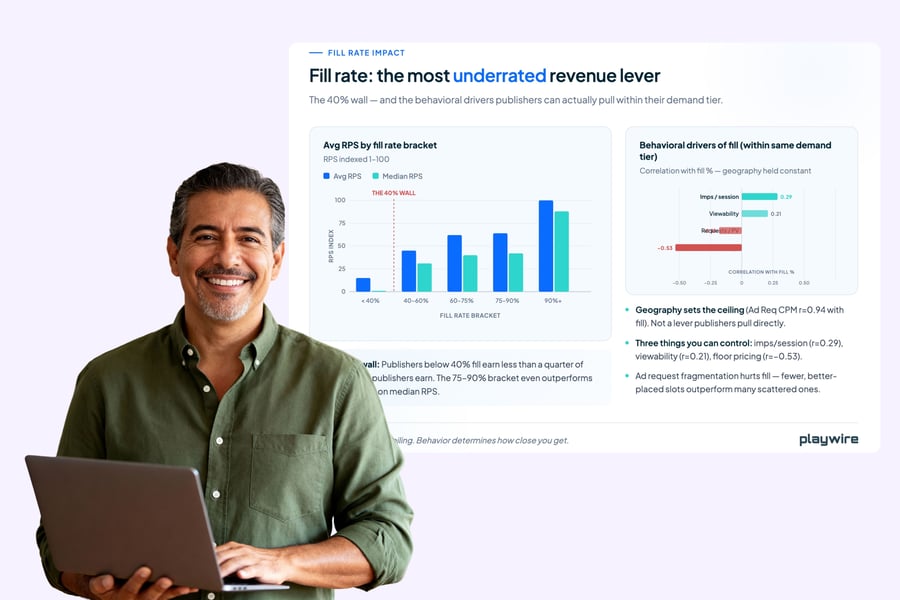
- Fill rate correlates with revenue per session at only 0.12 at the individual publisher level, but segment by fill bracket and publishers at 90%+ fill earn 5.3x more per session than those below 40%.
- Geography sets your fill ceiling. Audience location determines how much advertiser demand exists for your inventory, and no amount of optimization closes that gap entirely.
- Within any demand tier, three behavioral levers actually move fill rate: floor pricing calibration, viewability above 70%, and demand breadth across your bidder stack.
- The floor price trap is real: publishers with aggressive floors run at roughly half the fill rate of right-sized competitors, charge nearly 2x the CPM per impression, and still generate 18% less revenue per session.
- Fill rate is a means to RPS, not an end in itself, and optimizing for the wrong metric is one of the most common ways publishers leave money on the table.
Every publisher wants higher CPMs. It's the number everyone watches, the metric that shows up in every QBR deck, and the one that feels like proof that your inventory is worth something.
Fill rate is the number most publishers don't watch closely enough.
That's a problem, because the data tells a different story than the industry narrative. Fill rate is one of the sharpest levers you have. When publishers optimize for CPM while letting fill rate erode, they're often trading more total revenue for a more flattering per-impression number. The math doesn't favor that trade.
Here's what the data from our 2026 State of Ad Revenue Report shows, and what publisher fill rate optimization looks like when it's done right.

The Fill Bracket Effect: Why 0.12 Correlation Misses the Point
Publishers frequently look at fill rate correlations at the aggregate level and conclude the metric doesn't move the needle much. At the individual publisher level, the Pearson correlation between fill rate and revenue per session (RPS) is 0.12. That's weak. That's the number that gets fill rate dismissed in strategy conversations.
Segment by fill bracket, and the picture changes completely.
| Fill rate bracket | Avg RPS multiplier vs. <40% fill baseline |
|---|---|
| < 40% | 1.0x (baseline) |
| 40–60% | 2.5x |
| 60–75% | 3.4x |
| 75–90% | 3.5x |
| 90%+ | 5.3x |
Publishers consistently hitting 90%+ fill earn 5.3x more per session than those stuck below 40%. The step from under 40% fill to 40–60% fill alone is a 2.5x RPS lift. Each bracket up the ladder compounds.
The individual-level correlation looks weak because fill rate doesn't operate in isolation. It interacts with ad density, floor pricing, and demand configuration in ways that flatten the simple correlation. The bracket data makes the underlying relationship clear: fill rate is not a marginal variable. Publishers in the highest fill bracket aren't just squeezing a few extra percentage points out of their inventory. They're generating fundamentally more revenue per visitor.
One thing worth naming before getting to tactics: fill rate is a downstream metric. The actual optimization target is revenue per session. Publishers who chase 100% fill for its own sake can actually overshoot. The 80–90% viewability bracket outperforms the 90%+ bracket on median RPS in Playwire's dataset. Past a certain threshold, marginal fill improvements stop translating into meaningful RPS gains. The goal is calibrated fill within a demand-aware configuration, not maximum fill at any cost.
If your fill rate sits below 60%, this is probably your highest-leverage programmatic fill rate optimization target right now.

Geography Sets the Ceiling You're Actually Working Under
Before going further on what you can control, it's worth being honest about what you can't.
The strongest predictor of fill rate in Playwire's dataset is Ad Request CPM, which correlates with fill at 0.94. That number is almost entirely determined by audience geography. Publishers with predominantly US and Western European traffic sit in high-demand tiers. Publishers with large audiences in Southeast Asia or Latin America face structurally lower fill, not because their monetization stack is misconfigured, but because advertiser demand is concentrated in a few geographic markets.
| Ad Request CPM bracket | Avg fill rate index | Interpretation |
|---|---|---|
| < $0.10 | 1 | Low demand — predominantly international traffic |
| $0.10–$0.20 | 32 | Below-average demand pool |
| $0.20–$0.35 | 63 | Mid-tier demand |
| $0.35–$0.50 | 84 | Solid demand pool |
| $0.50–$0.75 | 93 | Strong demand — likely US/EU-heavy audience |
| $0.75–$1.00 | 100 | High-demand tier |
The 47-point fill rate gap between the lowest and highest demand tiers is not a monetization stack problem. It's an audience geography problem. Benchmarking your fill rate against publishers in a different geographic cohort produces misleading comparisons.
What this means practically: your optimization target is not some theoretical fill rate ceiling. It's maximum fill within the demand tier your actual audience puts you in. That's the meaningful benchmark. Everything else is noise.
Essential Background Reading:
- Ad Density Is the #1 Predictor of Publisher Revenue Per Session: The strongest RPS driver in the dataset, understand this before optimizing fill rate
- 5 Ad Revenue Metrics Publishers Should Track that Might Surprise You: Why the metrics most publishers watch aren't the ones that actually move revenue
- Publisher Ad Revenue Maturity Model: Where Are You on the Revenue Curve?: Understand where fill rate fits in your overall monetization progression
- What Separates the Top 10% of Website Publishers from Everyone Else (Data-Backed): The full profile of what high-performing publishers actually do differently
The Three Levers You Can Pull
Once geography is accounted for, what separates 40% fill from 80% fill within the same demand tier? Three behavioral signals drive the difference, and all three are publisher-controlled variables.
Floor Pricing Calibration: The Highest-Impact Lever
Floor pricing calibration is the highest-impact lever in header bidding fill rate optimization, and the one most commonly abused. Within the same demand tier, CPM and fill rate correlate at -0.53. Higher CPMs within a given demand band reliably predict lower fill. That's the signature of aggressive floor pricing.
Publishers holding out for premium CPMs through static, high floors win the per-impression battle and lose the revenue war. The comparison is stark: right-sized floors fill roughly twice as much inventory as aggressive floors. The high-floor publishers charge nearly 2.5x more per impression and still generate 19% less revenue per session. The math is unambiguous. A lower CPM with twice the fill beats a higher CPM with half the fill, every time.
Static floors don't account for geographic variation, time-of-day demand shifts, format-specific buyer pools, or seasonal spend patterns, all of which change what the demand pool will actually bear. The solution is demand-aware, dynamic floor pricing that matches current demand signals rather than a CPM target set months ago. It's not about lowering your standards. It's about not leaving revenue on the table by demanding prices current demand can't support.
Viewability: The Bidder Attraction Signal
Viewability is the second lever. Within a geographic cohort, viewability correlates with fill rate at 0.21. Higher viewability attracts more bidder competition. Buyers are more willing to pay for impressions they're confident will be seen, so publishers who consistently deliver strong viewability benefit from a larger pool of active bidders competing for their inventory.
The target threshold is 70%. Below that, fill efficiency degrades. Above 80%, there's a ceiling effect. Marginal viewability gains stop translating into fill or CPM improvements, and optimization priority should shift elsewhere. Chasing 95% viewability at the expense of fill rate is not a winning trade.
Demand Breadth: Fill Rate Is a Structural Decision
Demand breadth is the third lever, and the one most publishers treat as a one-time setup rather than an ongoing discipline. More demand partners competing for each impression means more fill opportunities. A shallow bidder stack means impressions go unfilled not because demand doesn't exist, but because you haven't connected to the buyers who would have purchased them.
The data on Amazon illustrates how much a single bidder can matter in ad fill rate optimization. When Amazon is active, it accounts for an average of 20.5% of total site revenue, roughly one dollar in every five. Publishers who've lost Amazon access are operating with a structural gap in their demand stack that no floor price adjustment can paper over.
Header bidding with genuine demand depth isn't just an infrastructure choice. It's a fill rate strategy. And it requires ongoing management as bidder relationships shift, not a configuration you set once and walk away from.
Related Content:
- How to Right-Size Your Price Floors Without Leaving Money on the Table: The full methodology for dynamic, demand-aware floor pricing calibration
- The Publisher's Guide to Viewability Optimization: Chasing Perfect isn't the Answer: Where the viewability ceiling effect kicks in and what to optimize instead
- The Amazon SSP Problem: Why So Many Publishers Now Have a Structural Revenue Gap: What's behind the Amazon bidder loss and how publishers are responding
- How to Build a Website Content Architecture That Earns More Ad Revenue: Session depth and page structure as monetization levers, the dimension fill rate can't address alone
- Session Duration Is a Lie. Page Depth Is the Signal.: Why the metric most publishers track for engagement has almost no correlation with revenue
Why Request Fragmentation Quietly Kills Fill
Most fill rate advice ends with "add more ad units." The data suggests a more complicated picture.
Requests per pageview correlates with fill rate at -0.18. Too many ad units on a single page actually fragments and reduces fill efficiency. When you fire more ad requests than your demand pool can realistically fill, you're diluting bidder competition across too many slots simultaneously. The result is lower fill on individual units, not higher fill overall.
The implication for publisher fill rate optimization isn't "add units until fill drops." It's: identify the density level where you're maximizing impressions per pageview within your demand pool's capacity to fill them. That threshold varies by vertical, audience geography, and bidder stack depth.
For most publishers, the right answer is fewer, better-configured units with strong viewability, rather than maximum units with inconsistent fill.
Fill Rate by Vertical: The Playbook Changes Completely
One of the largest gaps in generic fill rate advice is the assumption that the same optimization strategy applies to every publisher. It doesn't. The primary revenue lever differs sharply by vertical, and optimizing for the wrong one is actively counterproductive.
Playwire's dataset separates cleanly into two groups.
Volume-driven verticals (gaming, entertainment, education) are inventory volume businesses. Impressions per session is the dominant RPS driver, correlating at 0.79 for gaming and 0.93 for education. Fill rate barely predicts gaming revenue in isolation (r = -0.01). The optimization priority in these verticals is density per session: more ad-serving page loads, deeper session flows, and engagement structures that bring users back into the inventory loop. Education is the standout case. Lesson loops naturally drive page depth, session duration averages 8 hours, and top performers reach 28+ impressions per session.
Audience quality verticals (sports, news, technology) are demand pool businesses. CPM and Ad Request CPM are the dominant RPS drivers, correlating at 0.94 for sports and 0.93 for technology. Sports CPM runs 64% above the gaming average, but impressions per session is less than half (6.6 vs. 14.4 for gaming). The optimization priority here is protecting and developing the audience premium, not increasing ad density per page. Adding more slots on a sports or news page is unlikely to move RPS meaningfully.
| Vertical | Primary RPS driver | Correlation (r) | Imps/session |
|---|---|---|---|
| Gaming | Impressions per session | 0.79 | 14.4 |
| Entertainment | Impressions per session | 0.70 | 9.0 |
| Education | Impressions per session | 0.93 | — |
| Sports | CPM / audience quality | 0.94 | 6.6 |
| News | Ad Request CPM | 0.80 | — |
| Technology | Ad Request CPM | 0.93 | — |
A gaming publisher obsessing over CPM improvements is solving the wrong problem. A news publisher loading up additional ad units is doing the same. Vertical-aware fill rate strategy isn't a refinement. It's a different optimization conversation entirely.
Next Steps:
- How to Diagnose and Fix Your Fill Rate Problem: A step-by-step diagnostic framework for identifying exactly where your fill is leaking
- How to Increase Impressions Per Pageview Without Hurting User Experience: Practical approaches to density optimization that don't trade fill quality for volume
- How to Recover Publisher Revenue After Losing Amazon as a Bidder: Concrete demand diversification strategies for publishers with a structural gap in their stack
- Publisher Revenue Optimization by Vertical: How to Maximize Ad Revenue in YOUR Vertical: The full vertical-by-vertical breakdown of which levers to pull and which to ignore
Fill Rate in the Context of Everything Else
Fill rate deserves context in the broader optimization picture. Impressions per pageview (r = 0.59) and impressions per session (r = 0.55) are the two strongest predictors of revenue per session in Playwire's dataset. Fill rate at the individual level (r = 0.12) is weaker than both.
The hierarchy matters. Ad density, how many ads appear on each page load, is still the primary lever for most publishers. Fill rate optimization operates on the inventory that ad density creates. If you're serving three impressions per pageview and filling 60% of them, you're leaving both types of revenue on the table. Fix density first, then fill.
Fill rate becomes the diagnosis for publishers who've already solved the density problem and are wondering why RPS isn't where they expect. A publisher with good ad density and aggressive floors is systematically converting high potential into mediocre outcomes. That's exactly where fill rate becomes the critical variable.
The publishers consistently hitting 90%+ fill share a recognizable profile:
- Header bidding depth: Multiple demand partners competing for each impression, not a shallow stack padded with low-quality fill networks.
- Demand-aware floor pricing: Unified pricing rules calibrated to what the actual demand pool will pay, updated as demand conditions change.
- Format mix buyers want: Ad unit selection based on what programmatic buyers actively purchase, not what's easiest to implement.
- Ongoing yield management: Continuous calibration, not set-and-forget monetization that quietly drifts toward suboptimal configuration.
Set-and-forget monetization reliably drifts toward suboptimal floors, shallow demand stacks, and CPMs that look acceptable on a dashboard while actual RPS quietly declines.
See It In Action:
- Gaming Publisher Revenue Guide: Why Ad Density Is Everything: How gaming publishers specifically maximize fill and density within their vertical's primary lever
- Education Publisher Ad Revenue Monetization: The Lesson Loop Advantage: Why education outperforms nearly every other vertical and how the lesson loop drives fill depth
- Sports Publisher Ad Revenue Optimization: Why the Sports Playbook Is Different: Why sports publishers should protect audience quality over ad density, and what that looks like in practice
- News Publisher Ad Revenue Monetization Strategy: When More Ads Won't Save You: The demand pool argument for news publishers and why density optimization misses the point
Playwire's Approach to Fill Rate Optimization at Scale
Publisher fill rate optimization requires the kind of ongoing, data-intensive management that most publisher teams don't have the bandwidth to run in-house. It means continuous floor price calibration across demand tiers, ongoing bidder relationship management, viewability monitoring, and format strategy, simultaneously, across every page of your site.
Playwire's RAMP platform handles this across a network of 1,200+ publisher partners, processing 100 billion+ ad impressions annually. The demand stack includes header bidding depth alongside Playwire's own direct sales demand through Playwire DIRECT, which adds high-impact formats and direct CPMs that programmatic-only setups can't access.
The publishers in the 90%+ fill bracket aren't there because they got lucky with their audience geography. They're there because their demand infrastructure, floor configuration, and ongoing yield management are calibrated to extract maximum fill from the demand pool they actually have.
That's the standard to optimize toward. We've got the data to back it up.
Frequently Asked Questions
What is a good ad fill rate for publishers?
There is no universal benchmark. Fill rate is substantially determined by traffic geography. Publishers with predominantly US and Western European audiences structurally face higher fill rates than publishers with international traffic, regardless of how well their stack is configured. Within a given geographic demand tier, the goal is maximum fill relative to what your actual demand pool supports. According to Playwire network data, publishers achieving 90%+ fill earn 5.3x more revenue per session than those below 40% fill, but the 80–90% bracket can outperform the 90%+ group on median RPS, meaning ultra-high fill isn't always the optimal target.
Does a higher fill rate always mean more revenue?
No. Fill rate above roughly 80–90% stops reliably translating into higher revenue per session. The 80–90% viewability bracket outperforms the 90%+ bracket on median RPS in Playwire's dataset. Fill rate is a means to revenue per session, not an end in itself. Chasing maximum fill at the expense of CPM quality or viewability can reduce overall revenue. The goal is calibrated fill within a demand-aware configuration.
What is the relationship between fill rate and CPM?
Within the same demand tier, CPM and fill rate correlate at -0.53, a strong negative relationship. Higher CPMs within a given demand band reliably predict lower fill, which is the signature of aggressive floor pricing. Publishers with right-sized floors fill roughly twice as much inventory as those with high floors, and generate approximately 19% more revenue per session despite the lower per-impression CPM. The fill more than compensates for the CPM reduction.
How does floor pricing affect fill rate?
Floor pricing is the single most impactful publisher-controlled fill rate variable. Setting floors above what the actual demand pool will bear doesn't create more revenue. It creates unfilled impressions. Static floors that don't account for geographic variation, time-of-day shifts, format-specific buyer pools, or seasonal demand patterns are a persistent source of fill rate erosion. Dynamic, demand-aware floor pricing that adjusts to actual market signals consistently outperforms static floors on total revenue per session.
Why does adding more ad units sometimes reduce fill rate?
Requests per pageview correlates with fill rate at -0.18, meaning too many ad units on a single page can fragment and reduce fill efficiency. When ad requests exceed what the demand pool can realistically fill simultaneously, bidder competition dilutes across too many slots. The result is lower fill on individual units rather than higher fill overall. The optimal configuration is fewer, well-placed units with strong viewability, not maximum units with inconsistent fill.
