
-1.png?width=800&height=157&name=1-playwire-logo-primary-2021%20(1)-1.png)


May 5, 2026

Editorial Policy
All of our content is generated by subject matter experts with years of ad tech experience and structured by writers and educators for ease of use and digestibility. Learn more about our rigorous interview, content production and review process here.

Key Points
- Amazon contributes an average of 20.5% of total site revenue where it runs. Losing access isn't a rounding error; it's a structural hole.
- Demand diversification across multiple bidder types is the fastest path to partial recovery, but no single replacement bidder matches Amazon's revenue-per-site contribution.
- Ad density, fill rate, and floor calibration become the primary levers when a top bidder disappears. Publishers who optimize all three recover faster.
- Session depth and impressions per pageview are the two strongest predictors of revenue per session in Playwire's network data, and both remain fully in publisher control regardless of bidder access.
- Long-term, demand breadth is a risk management strategy, not just an optimization tactic. Amazon's departure exposed how dangerous single-bidder concentration really is.
There's a number sitting in your revenue dashboard right now, and if you've lost Amazon as a bidder, it's lower than it was six months ago. Probably significantly lower.
Playwire's ecosystem data puts the average Amazon revenue contribution at 20.5% of total site revenue, with a median of 17.6%. For most publishers who ran Amazon, that's roughly one dollar in every five to six dollars earned. That's not a marginal line item you can absorb quietly. That's a structural revenue pillar that just got pulled out.
The question isn't whether this hurts. It does. The question is what you do about it, and in what order.
How Much of Your Revenue Is Amazon?
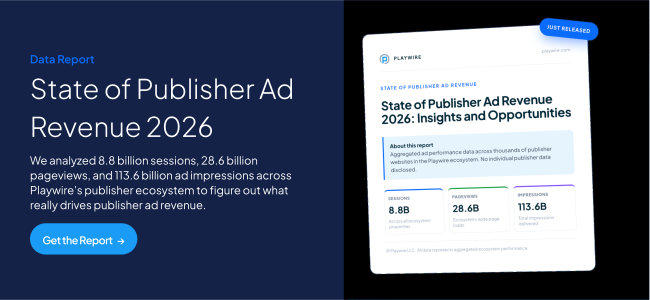
Most publishers don't know their actual Amazon dependency until it's gone. The Playwire State of Publisher Ad Revenue report quantifies it across thousands of publisher sites: Amazon averages 20.5% of total site revenue where it runs, with a median contribution of 17.6%.
That range matters. At the median, Amazon is one dollar in every six. At the average, it's closer to one in five. For publishers at the top of the dependency range, where Amazon accounts for 25–30% of monthly programmatic revenue, the access loss is closer to a revenue crisis than a revenue dip.
The data below shows how Amazon's contribution scales relative to what publishers are operating without:
| Amazon revenue contribution | Publisher situation |
|---|---|
| 15–20% of total revenue (median range) | Meaningful gap — recoverable with diversification |
| 20–25% of total revenue (average range) | Significant structural hole requiring active remediation |
| 25–30%+ of total revenue | Revenue crisis — demand stack was dangerously concentrated |
This is demand concentration risk in its most visible form. And it's the risk that competitors, SSPs, and most industry coverage almost entirely ignored, right up until publishers started losing access.
What Happens When Amazon Access Goes Away
Before you start chasing replacement demand, understand what Amazon was actually doing for your revenue. It wasn't just CPM contribution. Amazon's value came from the competitive pressure it put on every other bidder in your stack.
When a high-quality demand source competes aggressively in your header bidding auction, it raises clearing prices across the board. Bidders respond to competition. Remove a major competitor and the remaining bidders face less pressure to bid at the top of their range. Your fill rate may stay roughly intact, but your average CPM takes a quiet hit that doesn't always show up as obviously as the raw impression count suggests.
This is why publishers who've lost Amazon often feel the revenue impact more broadly than they expected. You're not just missing Amazon's direct revenue share. You're also missing the auction pressure that was lifting everyone else's bids.
There's a documented precedent worth noting. In September 2023, Amazon applied a 10% publisher transaction fee to Amazon DSP demand with approximately 30 days' notice. That's not a partnership move. That's a reminder that Amazon's terms are Amazon's to change, and publishers absorbed it. The access removals that followed in subsequent months carried the same dynamic: unilateral, fast, and with no appeal path for most affected publishers.
The lesson is structural. When a single demand source operates outside your control and represents 20% of your revenue, you are not running a diversified stack. You are running a concentrated bet.

Demand Concentration Risk
Single-source demand concentration is a risk that compounds silently. When it breaks, it breaks all at once.
The industry talks about demand diversification almost exclusively as a CPM optimization play: more bidders, more competition, higher clearing prices. That framing misses the more important point. Demand breadth is risk management. The publishers best positioned to absorb Amazon's access changes were the ones where Amazon was a meaningful contributor but not a structural dependency, where no single bidder held more than 10–12% of total revenue.
That architecture performs better in Playwire's data on every metric: fill rate, CPM, and revenue per session. It also performs better under disruption, because losing any single bidder becomes a bad quarter rather than an existential event.
A publisher doing $50,000 per month in programmatic revenue, with Amazon contributing at the average 20.5% share, absorbed a $10,250 monthly hole when access was removed. Replacing that through incremental CPM gains from remaining bidders alone is nearly impossible. The only real path is demand breadth plus inventory optimization, both simultaneously.
Essential Background Reading:
- The Amazon SSP Problem: Why So Many Publishers Now Have a Structural Revenue Gap: The full context on how and why Amazon access removals happened, and what the structural implications are for publisher revenue stacks.
- 5 Ad Revenue Metrics Publishers Should Track that Might Surprise You: The metrics that actually predict revenue performance, including several that most publishers aren't watching closely enough.
- Publisher Ad Revenue Maturity Model: Where Are You on the Revenue Curve?: A framework for assessing where your monetization stack stands and which gaps matter most.
- What Separates the Top 10% of Website Publishers from Everyone Else (Data-Backed): Network data on what top-performing publishers actually do differently, demand breadth included.
Demand Diversification: The Short-Term Recovery Path
No single programmatic buyer replaces Amazon one-for-one. What you can do is close the gap through meaningful demand breadth: adding high-quality bidders who compete across the same inventory types Amazon was winning.
The priorities look different depending on your vertical, your audience geography, and your current bidder stack depth. Across Playwire's publisher ecosystem, the categories of demand that tend to generate meaningful replacement value share a few characteristics: they operate at scale, they have direct access to brand budgets, and they compete actively in header bidding rather than passing on impressions.
The bidder additions worth prioritizing when rebuilding after Amazon access loss include:
- Demand-side platforms with direct brand budgets: DSPs connected directly to brand advertiser budgets, not just agency trading desk flow, tend to compete more aggressively on premium inventory. If your stack is heavy on SSP connections and light on direct DSP relationships, that's a gap worth closing.
- SSPs with strong vertical specialization: Vertical-specific SSPs often carry demand pools that general-purpose SSPs miss entirely. A gaming publisher who adds a gaming-specialized SSP often sees meaningful CPM lift in a category where generic demand underperforms.
- Retail media networks beyond Amazon: Other retail media players have expanded their programmatic footprints significantly. They don't match Amazon's scale, but they compete for some of the same inventory types and can contribute real fill.
- Private marketplace deals: If you have the traffic volume to support it, direct PMP deals with brand advertisers bypass auction dynamics entirely and lock in guaranteed CPMs. Slower to set up, but structurally more durable than spot market bidder relationships.
None of these fully replaces what Amazon was doing. Combined, demand breadth is where the recovery starts.
Worth noting for publishers who still have APS access: running Amazon inside Prebid rather than as a standalone integration lets you score Amazon demand alongside all other bidders in a unified auction. This reduces the "black box" dynamic that makes Amazon dependency so hard to quantify until it disappears. If you still have access, structuring it this way makes your stack more transparent and your dependency more measurable.
How to Build a Demand Stack That Doesn't Depend on Any Single Bidder
The right architecture isn't "add as many bidders as possible." SSP sprawl creates its own problems: request fragmentation, fill efficiency losses, and timeout pressure that hurts performance. The right architecture is deliberate demand breadth, enough bidder diversity that no single source represents an unhedgeable position.
Here's how different demand stack configurations compare on concentration risk and revenue ceiling:
| Stack configuration | Concentration risk | CPM ceiling | Fill efficiency | Recovery speed after bidder loss |
|---|---|---|---|---|
| Open auction only (1–3 SSPs) | Very high | Low | Moderate | Slow |
| Header bidding with 4–8 SSPs | Moderate | Moderate | High | Moderate |
| Full-stack: header bidding + direct + PMPs | Low | High | High | Fast |
| Full-stack + retail media + vertical SSPs | Very low | Highest | High | Fastest |
The full-stack configuration, header bidding infrastructure across a diversified set of SSPs, supplemented by direct sales and PMPs, is where top-performing publishers in Playwire's network consistently sit. It's not the easiest stack to build. It is the one that performs best under normal conditions and recovers fastest under disruption.
Related Content:
- Fill Rate Is the Most Underrated Revenue Lever, Though Complex to Change: Why fill rate matters more than most publishers realize, and what actually moves it.
- How to Diagnose and Fix Your Fill Rate Problem: A practical diagnostic framework for identifying why fill is underperforming and which fixes apply to your situation.
- Ad Density Is the #1 Predictor of Publisher Revenue Per Session: The full data story behind impressions per pageview as the dominant revenue driver across the Playwire network.
- How to Increase Impressions Per Pageview Without Hurting User Experience: Practical layout and density strategies that lift inventory without degrading the reader experience.
- Viewability is Important for RPS, but Chasing Perfect Viewability isn't Worth it: Where viewability actually moves revenue and where obsessing over it backfires.
The Levers That Are Fully in Your Control
Bidder stack depth is one part of the recovery equation. The other parts have nothing to do with who's bidding and everything to do with how much inventory you're making available and how efficiently you're clearing it.
Playwire's ecosystem data identifies impressions per pageview as the single strongest predictor of revenue per session, with a Pearson correlation of 0.59. Impressions per session sits right behind it at 0.55. What this means practically: the publishers who recover fastest from demand shocks aren't just the ones who add bidders. They're the ones who have enough inventory density per page that every bidder in their stack has more opportunities to win.
If you lost 20% of your revenue from Amazon's exit, increasing your impressions per pageview meaningfully compounds what every remaining bidder can contribute. The math is straightforward: more inventory requests against the same demand pool means more fill opportunities, and more fill means more revenue even if CPM stays flat.
| Impressions per pageview | Avg RPS (indexed 1–100) | Multiplier vs. baseline |
|---|---|---|
| < 1 impression/PV | 1 | Baseline |
| 1–2 impressions/PV | 9 | 2.6x |
| 2–4 impressions/PV | 20 | 4.9x |
| 4–8 impressions/PV | 35 | 8.1x |
| 8–15 impressions/PV | 49 | 11x |
| 15+ impressions/PV | 100 | 21x |
Publishers averaging 15+ impressions per pageview earn 21x the revenue per session of those averaging under one impression per page. Even the step from 2–4 to 4–8 impressions per page is a 1.6x lift. If your ad layout hasn't been reviewed recently, this is the fastest internal lever you have right now.
Next Steps:
- How to Recover Publisher Revenue After Losing Amazon as a Bidder: A step-by-step recovery guide specifically for publishers navigating the post-Amazon access gap.
- How to Right-Size Your Price Floors Without Leaving Money on the Table: Floor calibration strategies that protect CPM without killing fill, especially critical when demand pools shrink.
- Session Duration Is a Lie. Page Depth Is the Signal.: Why pageviews per session, not time on site, is the session metric that actually predicts revenue.
- How to Build a Website Content Architecture That Earns More Ad Revenue: Structural content decisions that drive deeper sessions and more ad impressions per visit.
- Publisher Revenue Optimization by Vertical: How to Maximize Ad Revenue in YOUR Vertical: Vertical-specific strategy breakdowns so your recovery plan matches your actual primary revenue lever.
Floor Pricing: Don't Make Your Situation Worse
Losing a major bidder creates a tempting but dangerous instinct: raise your floor prices to protect CPM. Don't.
Playwire's data documents the floor price trap clearly. Within the same demand tier, publishers with aggressive floors run at roughly half the fill rate of those with right-sized floors. The high-floor publishers charge approximately 2.5x more per impression, but generate 19% less revenue per session overall. Lower CPM with twice the fill wins. Every time.
When you lose a major demand source like Amazon, your effective demand pool shrinks. Setting floors that made sense when Amazon was competing in every auction means setting floors against a weaker competitive environment. The result is unsold inventory that compounds the revenue gap you're already managing.
The right move post-Amazon exit is to audit your floor pricing against your current actual demand, not your peak demand from when the stack was fully intact. Dynamic floor pricing calibrated to real-time bidder behavior is the standard that best-performing publishers operate at. Static floors set to historical peaks in a diminished demand environment will quietly accelerate the revenue decline.
Session Depth: The Recovery Multiplier Most Publishers Miss
Fill rate and floor calibration will stabilize your revenue floor. Session depth is how you build it back up.
Pageviews per session correlates with revenue per session at 0.27 in Playwire's network data. Session duration alone correlates at essentially zero. A user who spends ten minutes on one page is worth less than a user who spends four minutes across four pages, because every new page load is another set of ad impressions across your entire bidder stack. More inventory per visit means more revenue per visit.
The compound effect of combining ad density with session depth is significant. Publishers above the median on both impressions per pageview and page depth earn 17x more per session than those below the median on both. That gap exists regardless of who's bidding. It's a function of content architecture and ad layout, both publisher-controlled variables.
For publishers rebuilding after Amazon access loss, the internal optimization agenda matters as much as the external demand-sourcing agenda. Adding bidders gets more competition for your inventory. Building inventory depth through session engagement creates more inventory for those bidders to compete over.
See It In Action:
- Gaming Publisher Revenue Guide: Why Ad Density Is Everything: How gaming publishers maximize revenue per session through inventory volume, with data on what the top performers do differently.
- Education Publisher Ad Revenue Monetization: The Lesson Loop Advantage: How education publishers use content structure to generate deep inventory and high CPMs simultaneously.
- Sports Publisher Ad Revenue Optimization: Why the Sports Playbook Is Different: Why audience quality, not ad density, drives sports revenue, and how to protect the premium when demand shifts.
- Entertainment Publisher Ad Revenue: Why Volume and Geography Define Your Revenue Story: The geo-diversity challenge for entertainment publishers and how fill rate becomes the critical lever.
Vertical-Specific Considerations: Gaming, News, and Education Don't Rebuild the Same Way
Demand diversification strategy isn't one-size-fits-all. The primary revenue lever differs sharply by vertical, and that changes both how Amazon access loss hits and how you respond.
Gaming, entertainment, and education are inventory volume businesses. In gaming, impressions per session is the dominant RPS driver (r = 0.79). Fill rate is essentially uncorrelated with gaming revenue (r = −0.01). A gaming publisher rebuilding after Amazon should focus on ad density per session and bidder breadth across gaming-specialized demand, not CPM optimization.
Sports, news, and technology are audience quality businesses. Sports CPM runs 64% above the gaming average in Playwire's data, but impressions per session is less than half. News carries the highest average CPM of any vertical, yet visitors barely browse, at 1.52 pages per session on average. For sports and news publishers, Amazon's loss hits differently because these verticals depend on deep demand pools that price their premium audience correctly. The replacement play is demand quality, not demand volume.
Education sits in a category of its own. It has the highest average CPM of any vertical, the strongest impressions-per-session correlation (r = 0.93), and session durations that average eight hours due to lesson loops. Education publishers who lost Amazon have a structural advantage: the content format naturally generates deep inventory through multi-page lesson flows. The recovery lever is maintaining that depth while rebuilding demand breadth.
| Vertical | Primary RPS driver | Amazon replacement priority |
|---|---|---|
| Gaming | Impressions per session (r = 0.79) | Ad density + gaming-specialized SSPs |
| Entertainment | Impressions per session (r = 0.70) | Fill rate + geo-diverse demand |
| Education | Impressions per session (r = 0.93) | Demand breadth + floor calibration |
| Sports | CPM / audience quality (r = 0.94) | Premium DSPs + PMPs |
| News | Ad Request CPM (r = 0.80) | Audience quality + demand pool depth |
| Technology | Ad Request CPM (r = 0.93) | Geo-rich demand + vertical SSPs |
The implication: a gaming publisher chasing CPM improvements after Amazon's exit is still solving the wrong problem. A news publisher adding more ad slots per page is doing the same. Vertical context determines which levers actually move revenue.
Frequently Asked Questions
What percentage of publisher revenue comes from Amazon?
Across Playwire's publisher network, Amazon accounts for an average of 20.5% of total site revenue where it runs, with a median of 17.6%. For most publishers running Amazon Publisher Services, that's roughly one dollar in every five to six dollars earned. Individual publisher dependency varies, with some sites in the 25–30% range.
What is the difference between Amazon TAM and UAM?
Amazon Publisher Services offers two header bidding solutions with different eligibility requirements. TAM (Transparent Ad Marketplace) is designed for larger publishers who already have existing SSP relationships and seats, it adds Amazon demand alongside those existing partners in a unified auction. UAM (Unified Ad Marketplace) is structured for mid-size publishers who don't have their own SSP relationships, with Amazon managing the demand connections. TAM requires direct SSP relationships to participate; UAM does not.
What happens if I lose access to Amazon Publisher Services?
Losing Amazon Publisher Services access creates an immediate revenue gap averaging around 20% of total programmatic revenue. The impact compounds beyond direct revenue loss: Amazon's absence reduces auction competitiveness across all remaining bidders, which typically causes CPMs to soften across the full stack. Recovery requires demand diversification across multiple replacement bidders, ad density optimization to increase inventory per visit, and floor price recalibration to match the now-weaker demand environment.
How many demand partners should a publisher have?
There's no universal number, but the structural goal is ensuring no single demand partner represents more than 10–12% of total revenue. In practice, well-diversified publisher stacks typically run 6–10 SSP connections in header bidding, supplemented by direct sales and PMP relationships. SSP sprawl beyond that range can introduce request fragmentation and fill efficiency losses that hurt overall performance. Breadth matters; so does configuration quality.
How do I reduce dependency on a single ad demand partner?
Reducing single-partner dependency requires building across multiple demand categories simultaneously: programmatic SSPs with vertical specialization, direct DSP relationships, private marketplace deals with brand advertisers, and where volume supports it, a direct sales function for high-CPM placements. Dynamic floor pricing that adjusts to actual demand conditions, rather than static floors optimized for a single major bidder, is also essential for maintaining fill efficiency across a more distributed demand stack.
Does adding more SSPs always increase publisher revenue?
No. Adding SSPs increases competitive pressure on your inventory, which can lift CPMs, but beyond a certain point, SSP additions fragment your ad requests across too many demand sources, reducing fill efficiency per partner. The optimization target is the right SSP stack: enough breadth to prevent concentration risk, enough depth in each relationship to maintain fill quality. Header bidding timeout configuration and unified pricing rules become increasingly important as stack size grows.
What Playwire Does in This Situation
Publishers on Playwire's RAMP platform have the full managed demand stack working for them: deep header bidding infrastructure across a diversified set of demand partners, AI-powered yield optimization that responds to real demand conditions (not yesterday's floors), and a direct sales team closing brand deals that supplement programmatic entirely.
Additionally, they have access to Playwire's negotiating power in relationships with SSPs. A partner with the scale that SSPs listen to can create a lot more incentive to help with approvals.
The data behind this report comes from 100 billion-plus impressions annually. The patterns are clear. Revenue recovery after a demand shock comes from three places: better demand breadth, higher inventory density per page, and floor pricing calibrated to what the current market will actually clear.
Working through this manually takes time. If you want a team that's already seen this pattern and knows which levers to pull in what order, that's exactly what Playwire's yield operations team is built for.
Revenue gaps are recoverable. The publishers who recover fastest are the ones who stop waiting for Amazon to come back and start building the stack that doesn't depend on any single bidder to hold together.
Learn more about what Playwire can do for your monetization at playwire.com.
