
-1.png?width=800&height=157&name=1-playwire-logo-primary-2021%20(1)-1.png)



May 5, 2026

Editorial Policy
All of our content is generated by subject matter experts with years of ad tech experience and structured by writers and educators for ease of use and digestibility. Learn more about our rigorous interview, content production and review process here.
Key Points
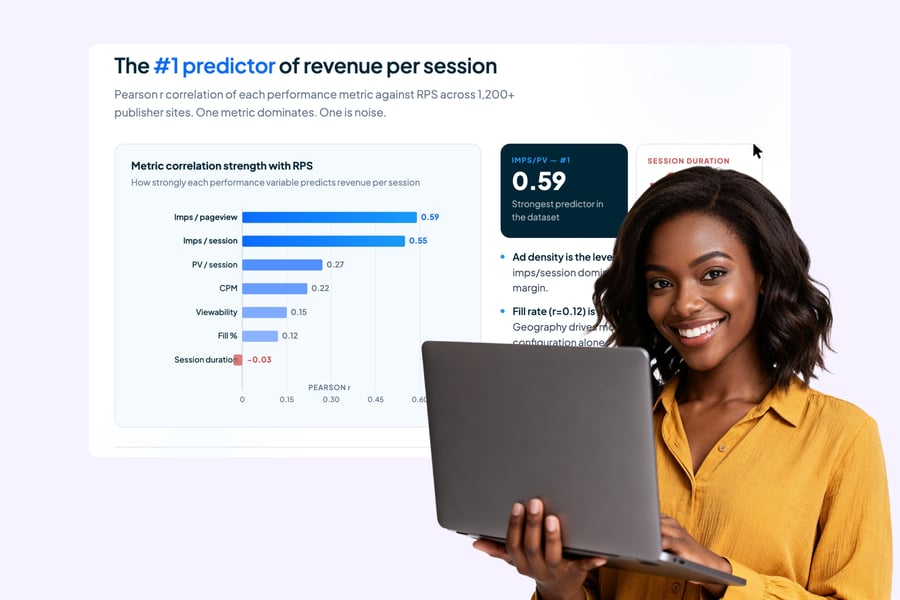
- Session duration correlates with revenue per session at r = −0.03, making it a relatively unimportant metric from a monetization standpoint.
- Impressions per pageview is the single strongest publisher revenue metric in Playwire's dataset, with a correlation of r = 0.59 against revenue per session.
- Publishers above the median on both page depth and ad density earn 17x more per session than those below on both.
- Viewability has a ceiling effect: the 80–90% bracket outperforms the 90%+ bracket, meaning chasing perfect viewability costs you fill rate for no gain.
- The publisher ad metrics most teams obsess over (fill rate, session duration, viewability) are downstream of the ones that actually drive revenue.
Your ad revenue analysis process may be missing important metrics.
That's not a hot take. It's a finding from Playwire's analysis of aggregated ad performance data across thousands of publisher websites. When every available performance metric was correlated against revenue per session, the results inverted most of what the industry treats as conventional wisdom.
Here's what the data says.

The Publisher Ad Metrics You're Probably Watching
Publishers spend enormous energy optimizing for metrics that are easy to see and report cleanly. The problem is that "easy to measure" and "actually predictive of revenue" are not the same thing.
Session Duration: r = −0.03
Session duration is the metric that feels like it should matter. Users spending more time on your site sounds like engagement. Engagement sounds like value. Value should translate to revenue.
It doesn't always.
The correlation between session duration and revenue per session (RPS) is −0.03. Not weak. Flat. A user who has your site open in a background tab for 40 minutes generates the same incremental revenue from that time as a user who bounces after 90 seconds: essentially nothing.
Here's why. A session can stay open indefinitely on a single page. Browser games, utility tools, ambient content. These inflate duration numbers while generating no new ad inventory. Duration without depth is just an open tab. Session duration is a lie, and page depth is the signal that actually correlates with what you earn.

Viewability: r = 0.15 (With a Ceiling)
Viewability does matter, but it has a hard ceiling that most publishers don't know about.
The data shows a clear pattern across viewability brackets:
| Viewability Bracket | Avg RPS (Indexed 1–100) | vs. Lowest Bracket |
|---|---|---|
| < 60% | 35 | Baseline |
| 60–70% | 75 | 2.1x |
| 70–80% | 80 | 2.3x |
| 80–90% | 100 | 2.9x |
| 90%+ | 81 | 2.3x — ceiling effect |
The 80–90% viewability bracket outperforms the 90%+ group. Past 80%, incremental viewability gains don't translate to higher RPS. Buyers at that level shift their differentiation to fill rate, inventory volume, and audience quality, not whether you squeezed from 91% to 94%.
Chasing perfect viewability at the expense of fill rate is a losing trade. The data says so directly.
Fill Rate: r = 0.12
Fill rate feels the most directly connected to revenue, and it's not wrong. Every unfilled request is lost revenue. But its correlation with RPS at the individual publisher level is just 0.12, weaker than most assume.
That's partly because fill rate is heavily constrained by geography. A publisher with predominantly Southeast Asian or Latin American traffic will structurally face lower fill than one with a US-heavy audience, regardless of how well-configured their monetization stack is. Ad Request CPM, the best proxy for audience geography, correlates with fill rate at r = 0.94. That's the variable doing most of the work.
Fill rate is the most underrated revenue lever, but it's also complex to change. Benchmarking fill rate against publishers with very different audience geographies produces comparisons that mislead more than they inform.
The Publisher Revenue Metrics That Really Move the Needle
The correlations that matter aren't subtle. The gap between the strongest predictors of RPS and the ones that don't is wide enough to drive a bus through.
Impressions per Pageview: r = 0.59
This is the single strongest predictor of revenue per session in the entire dataset. Not CPM. Not fill rate. Not session duration. How many ads appear on each individual page load.
The bucket data makes the scale of the effect concrete:
| Impressions per Pageview | Avg RPS (Indexed 1–100) | Multiplier vs. Baseline |
|---|---|---|
| < 1 impression/PV | 1 | Baseline |
| 1–2 impressions/PV | 9 | 2.6x |
| 2–4 impressions/PV | 20 | 4.9x |
| 4–8 impressions/PV | 35 | 8.1x |
| 8–15 impressions/PV | 49 | 11x |
| 15+ impressions/PV | 100 | 21x |
Publishers averaging 15+ impressions per pageview earn 21x more RPS than those averaging under one. Even the step from 2–4 to 4–8 impressions per pageview is a 1.6x lift. Every additional ad unit on every page load compounds at scale.
Ad density is the #1 predictor of publisher revenue per session, and ad layout decisions aren't just user experience decisions. They're revenue decisions, full stop.
Impressions per Session: r = 0.55
Impressions per session is the second-strongest predictor, measuring the same underlying dynamic at the session level. More ads per visit means more inventory. More inventory means more revenue.
| Impressions per Session | Avg RPS (Indexed 1–100) |
|---|---|
| < 5 impressions | 1 |
| 5–10 impressions | 14 |
| 10–20 impressions | 25 |
| 20–35 impressions | 39 |
| 35–60 impressions | 61 |
| 60+ impressions | 100 |
The step-change pattern here is not gradual. Publishers in the 60+ impressions per session bracket index at 100 against a baseline of 1 for those under five impressions per session.
Pageviews per Session: r = 0.27
Pageviews per session ties it all together, and it's nearly 10 times stronger than session duration as a predictor of RPS.
A user who spends 10 minutes on one page is worth less than a user who spends four minutes across four pages. Every page a visitor loads is another opportunity to serve fresh inventory. Session depth is a monetization lever, and most publishers aren't building for it deliberately. How you build your website content architecture determines how much of that compounding effect you actually capture.
The data is clear on what happens when you combine page depth with ad density:
| Publisher Segment | Avg RPS (Indexed 1–100) |
|---|---|
| Low page depth + Low ad density | 1 (baseline) |
| Low page depth + High ad density | 69 |
| High page depth + Low ad density | 56 |
| High page depth + High ad density | 100 |
High ad density per page and high page depth each get you partway there on their own. Combine both and you reach the top of the range. Publishers above the median on both earn 17x more per session than those below on both.
Essential Background Reading:
- 5 Ad Revenue Metrics Publishers Should Track that Might Surprise You: The metrics most dashboards miss — and why the ones that predict revenue aren't the ones you're probably watching.
- Publisher Ad Revenue Maturity Model: Where Are You on the Revenue Curve?: A framework for understanding where your monetization strategy sits relative to what's possible — and what the next step looks like.
- What Separates the Top 10% of Website Publishers from Everyone Else (Data-Backed): The structural decisions that put top publishers at the top of the RPS range — grounded in real network data.
Why the Right Ad Revenue KPIs Differ by Vertical
The most important revenue metric is not the same across content categories. Gaming and entertainment are inventory volume businesses. Sports, news, and technology are audience quality businesses. Optimizing for the wrong primary lever doesn't just waste effort, it actively moves you in the wrong direction.
The data from Playwire's publisher ecosystem makes this split unusually clear:
| Vertical | Primary RPS Driver | Correlation (r) |
|---|---|---|
| Gaming | Impressions per session | 0.79 |
| Entertainment | Impressions per session | 0.70 |
| Education | Impressions per session | 0.93 |
| Sports | CPM / audience quality | 0.94 |
| News | Ad Request CPM | 0.80 |
| Technology | Ad Request CPM | 0.93 |
A gaming publisher chasing CPM improvements is solving the wrong problem. Fill rate correlates with gaming RPS at essentially zero (r = −0.01). Ad density per session is the only lever worth pulling for gaming publishers. Education publishers have the strongest imps/session correlation in the entire dataset (r = 0.93): lesson loops naturally drive multi-page sessions, which is why top education publishers show 5x+ the network average RPS.
Sports and news are the inverse. Sports CPMs run 64% above the gaming average, but impressions per session are less than half. For news publishers, the path to more revenue isn't more ad units per page, it's protecting the audience premium that drives CPM in the first place. Page depth averages just 1.52 pageviews per session for news sites, so density additions have little to compound against.
If your optimization strategy treats a gaming site and a news site the same way, you're leaving revenue on the floor in both places. Publisher revenue optimization varies significantly by vertical, and the right lever in one category is the wrong one in another.
Related Content:
- Ad Density Is the #1 Predictor of Publisher Revenue Per Session: A deeper dive into why impressions per pageview outperforms every other metric, and what publishers can do about it.
- How to Increase Impressions Per Pageview Without Hurting User Experience: Practical layout and configuration strategies for adding ad density without degrading the user experience that keeps visitors coming back.
- Session Duration Is a Lie. Page Depth Is the Signal.: Why the metric that shows up on every report is the one least correlated with revenue, and what to track instead.
- The Publisher's Guide to Viewability Optimization: Chasing Perfect isn't the Answer: How to find the viewability sweet spot that maximizes revenue without sacrificing fill rate.
- How to Right-Size Your Price Floors Without Leaving Money on the Table: The floor price trap explained, and a practical approach to dynamic, demand-aware floor pricing.
What This Means for How You Optimize
The pattern across all three high-signal metrics points to the same structural conclusion.
Ad layout is a monetization decision, not just a UX decision. The number of impressions per pageview is the single strongest lever in the dataset, and it's entirely within a publisher's control. Increasing impressions per pageview without hurting user experience is a solvable problem. If you're running two ad units per page when you could be running five with a well-designed layout, you're leaving a significant revenue multiple on the table.
Content architecture drives session depth. The publishers who earn the most per session aren't just running more ads. They're building content structures that move users from page to page. Gaming publishers do this through level progressions. Education publishers do it through lesson loops. News publishers who crack it use related articles and topic clusters. The mechanism doesn't matter. The outcome does: more pages per session means more inventory per visitor.
Floor pricing calibration belongs in this conversation too. Within the same demand tier, publishers with aggressively high floors run at roughly half the fill rate of those with right-sized floors. Despite charging nearly 2x the CPM per impression, they generate 18% less revenue per session. The math isn't complicated: lower CPM with twice the fill wins. Right-sizing your price floors without leaving money on the table isn't about chasing the lowest possible floor, it's about matching the floor to what the actual demand pool will pay.
Next Steps:
- How to Diagnose and Fix Your Fill Rate Problem: A systematic approach to identifying what's actually suppressing your fill rate and which levers will move it within your demand tier.
- How to Build a Website Content Architecture That Earns More Ad Revenue: The structural content decisions that drive pageviews per session, and compound your ad density advantage across every visit.
- How to Recover Publisher Revenue After Losing Amazon as a Bidder: Amazon represents roughly one dollar in every five to six earned by publishers where it runs. Here's how to close the gap if you've lost access.
- Publisher Revenue Optimization by Vertical: How to Maximize Ad Revenue in YOUR Vertical: The vertical-specific optimization playbook, because the right lever for gaming is not the right lever for news.
The Complete Publisher Revenue Metrics Scorecard
Here's how the five metrics stack up against each other and against the ones most publishers currently prioritize:
| Metric | Correlation with RPS | Publisher Control | Commonly Tracked? |
|---|---|---|---|
| Impressions per pageview | r = 0.59 | High | Rarely |
| Impressions per session | r = 0.55 | High | Sometimes |
| Pageviews per session | r = 0.27 | Medium | Sometimes |
| CPM | r = 0.22 | Low–Medium | Yes |
| Viewability | r = 0.15 | Medium | Yes |
| Fill rate | r = 0.12 | Medium | Yes |
| Session duration | r = −0.03 | Low | Yes |
The three publisher ad metrics with the highest predictive value for revenue are among the least commonly tracked. The two with the weakest predictive value are universally reported. That's not a coincidence. It's the result of an industry that built its dashboards before it had the data to know which numbers actually matter. What separates the top 10% of publishers from everyone else often comes down to which metrics they're actually optimizing against.
See It In Action:
- Gaming Publisher Revenue Guide: Why Ad Density Is Everything: How gaming publishers apply the impressions-per-session playbook in practice, with data from Playwire's network.
- Education Publisher Ad Revenue Monetization: The Lesson Loop Advantage: Why education publishers lead the dataset on impressions per session, and how lesson loop architecture does the heavy lifting.
- Sports Publisher Ad Revenue Optimization: Why the Sports Playbook Is Different: How premium audience quality rather than ad density drives revenue in sports, and what that means for optimization strategy.
- News Publisher Ad Revenue Monetization Strategy: When More Ads Won't Save You: Why the highest-CPM vertical in the dataset has the lowest page depth, and how news publishers should actually be optimizing.
- Entertainment Publisher Ad Revenue: Why Volume and Geography Define Your Revenue Story: The dual volume-and-fill challenge that makes entertainment monetization different from any other vertical.
Frequently Asked Questions About Publisher Revenue Metrics
These are the questions publishers ask most often about ad revenue KPIs, answered directly using data from Playwire's publisher network.
What is the most important metric for publisher ad revenue?
Impressions per pageview is the single strongest predictor of publisher revenue per session, with a Pearson correlation of r = 0.59 in Playwire's aggregated dataset. Publishers averaging 15 or more impressions per pageview earn 21x more revenue per session than those averaging under one impression per page. CPM, fill rate, and viewability all rank lower in predictive strength.
What is the difference between CPM, RPM, and eCPM?
CPM (cost per mille) is the price an advertiser pays per 1,000 ad impressions, a demand-side metric that reflects what buyers are willing to pay. RPM (revenue per mille) measures a publisher's actual revenue per 1,000 pageviews, accounting for fill rate and ad density. eCPM (effective CPM) is the blended effective rate across all impressions served, including unfilled inventory, a useful yield efficiency metric. Publishers should track RPM and eCPM as operational metrics, since CPM alone doesn't account for how much of your inventory actually fills.
What is a good fill rate for publishers?
Fill rate above 75% is where revenue per session begins to reach competitive levels, and publishers at 90%+ fill index at 5.3x the RPS of those below 40% fill. However, fill rate is heavily constrained by audience geography: publishers with predominantly US and Western European traffic structurally face higher fill because advertiser demand is concentrated in those regions. A meaningful fill rate benchmark compares publishers within the same geographic demand tier, not across widely different audience geographies.
How do you calculate revenue per session?
Revenue per session (RPS) is calculated by dividing total ad revenue by total number of sessions in a given period. It's a more complete yield metric than RPM or CPM alone because it captures both ad density (impressions per pageview) and session depth (pageviews per session) in a single number. Publishers optimizing for RPS should focus on increasing impressions per pageview and pageviews per session, which are the two strongest individual correlates of RPS.
What is the difference between page RPM and session RPM?
Page RPM measures revenue per 1,000 pageviews and reflects how well a single page load is monetized. Session RPM (or revenue per session) measures revenue across an entire visit, capturing both per-page monetization and how many pages a user loads. Session RPM is a more complete picture of monetization efficiency because it accounts for session depth. A publisher with strong page RPM but low pageviews per session may still underperform a publisher with moderate page RPM but high session depth.
How does ad viewability affect publisher revenue?
Viewability improves RPS up to the 80–90% bracket, which is the highest-performing range in Playwire's dataset. Above 90% viewability, RPS actually declines — the 90%+ bracket underperforms the 80–90% group. Past 80%, buyers differentiate on fill rate, audience quality, and inventory volume rather than marginal viewability improvements. Optimizing for viewability above 90% at the cost of fill rate is not a net positive for publisher revenue.
What metrics should publishers track in Google Ad Manager?
The highest-priority metrics for revenue optimization are impressions per pageview, impressions per session, and pageviews per session. These are the three strongest correlates of revenue per session based on Playwire's publisher network data. Beyond these, publishers should monitor Ad Request CPM (a proxy for demand pool strength and audience geography), floor price performance relative to fill rate, and bid density per auction. Fill rate and viewability are useful diagnostic metrics but should be interpreted in context, not optimized in isolation.
How do you increase publisher fill rate?
Fill rate increases most reliably through four levers: a header bidding setup with multiple active demand partners competing per impression, floor pricing calibrated to actual demand rather than aspirational CPM targets, ad unit formats that attract broad buyer interest, and ongoing yield management. Within any geographic demand tier, the publishers running at the highest fill rates consistently combine these four elements. Publishers with aggressive price floors run at roughly half the fill rate of those with right-sized floors, and still generate less total revenue despite the higher per-impression CPM.
What is impressions per pageview and why does it matter?
Impressions per pageview (imps/PV) measures how many ad impressions are served on each individual page load. It's the single strongest predictor of revenue per session in Playwire's publisher dataset, with a Pearson correlation of r = 0.59. Publishers averaging 15+ impressions per pageview earn 21x more revenue per session than those averaging under one. Every additional ad unit on each page load compounds at scale, which is why ad layout decisions are fundamentally monetization decisions.
How do content verticals affect which revenue metrics matter most?
The primary revenue lever differs significantly by content vertical. Gaming, entertainment, and education are inventory volume businesses where impressions per session is the dominant RPS driver. Sports, news, and technology are audience quality businesses where CPM and demand pool depth drive revenue, regardless of ad density. A gaming publisher optimizing for CPM and a news publisher obsessing over impressions per page are both optimizing the wrong variable for their vertical. The correlation between impressions per session and RPS in education is r = 0.93; for news, the primary driver is Ad Request CPM at r = 0.80.
How Playwire Approaches Publisher Revenue Metrics
Playwire's RAMP platform is built on the premise that ad layout and configuration decisions are monetization decisions. The yield ops team uses data from across the publisher network, including the correlations in this analysis, to configure ad density, floor pricing, and demand connections in ways that drive RPS, not just CPM.
Advanced Yield Analytics within RAMP gives publishers page-level visibility into exactly what's driving revenue. As one publisher put it: "The page level data is like gold. It allows me to truly understand how my business makes money and optimize the design, structure, and content on the site to maximize revenue."
That's what tracking the right publisher revenue metrics actually looks like in practice. Not a cleaner dashboard. A different set of decisions.
If you're ready to start optimizing against the numbers that matter, apply to work with Playwire.
