
-1.png?width=800&height=157&name=1-playwire-logo-primary-2021%20(1)-1.png)


May 4, 2026

Editorial Policy
All of our content is generated by subject matter experts with years of ad tech experience and structured by writers and educators for ease of use and digestibility. Learn more about our rigorous interview, content production and review process here.
Key Points
- Session duration correlates with revenue per session at r=−0.03. It predicts nothing.
- Pageviews per session correlates with RPS at r=0.27, nearly 10x stronger than duration alone.
- Publishers averaging 10+ pageviews per session earn roughly 80x more per session than those averaging under one.
- The compound effect of high page depth plus high ad density delivers 17x more RPS than low scores on both.
- Content architecture, the structures that move users from one page to the next, is a monetization decision, not just a UX one.
Many publisher analytics dashboards puts session duration front and center. It feels like the right metric. More time on site means more engaged users, which means more revenue. The logic is intuitive.
It's also can be misleading.
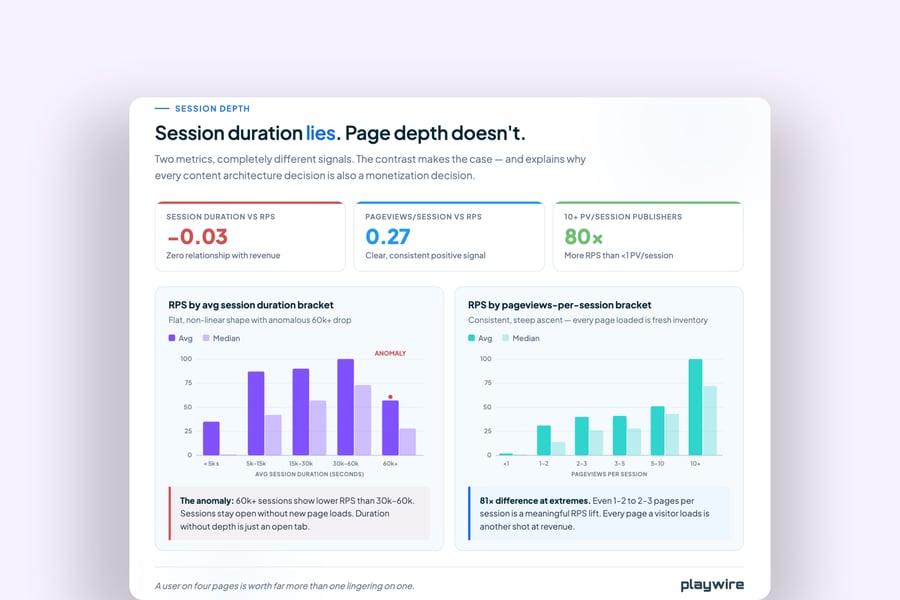
Playwire's State of Publisher Ad Revenue data, drawn from aggregated performance across thousands of publisher sites, produces a result that's hard to ignore: session duration alone correlates with revenue per session at r=−0.03. That's not a weak signal. That's no signal. The industry has been optimizing for a metric that contributes essentially nothing to the outcome it claims to predict.

What Your Analytics Dashboard Is Getting Wrong About Session Depth and Revenue
Publishers are not wrong to care about engagement. The mistake is using session duration as the proxy for it.
A user who spends 25 minutes on a single article page generates one set of ad impressions on page load, possibly a few refreshes, and then leaves. A user who spends 12 minutes across five pages generates five distinct page loads, five fresh ad inventory opportunities, and a compounding revenue total. Duration without depth is just an open tab.
The data confirms this sharply. Here's how session duration actually maps to revenue per session across the publisher ecosystem:
| Avg session duration | RPS (1–100 index) | Median RPS (1–100 index) |
|---|---|---|
| < 5,000 seconds | 1 | 52 |
| 5,000–15,000 seconds | 80 | 51 |
| 15,000–30,000 seconds | 85 | 72 |
| 30,000–60,000 seconds | 100 | 100 |
| 60,000+ seconds | 34 | 37 |
Notice what happens at the 60,000+ second bracket. Average RPS drops sharply below the 30,000–60,000 group. Sessions that stay open indefinitely, browser-based games, utility tools, ambient apps, can show enormous session durations while serving almost no new ad inventory. No new page loads means no new impressions. Duration without depth is economically inert.
This is the "open tab" problem. A user who leaves a browser game running in the background for six hours looks like a highly engaged session in your analytics. They're not. They're a single page load that happened to stay technically active. Session duration, in those cases, actively misleads you about what's generating revenue.
Session Depth vs. Session Duration: The Metric That Really Drives Publisher Revenue
Pageviews per session tells a completely different story. The correlation with RPS is r=0.27, nearly 10x stronger than session duration. The bucket-level data makes the gap visceral.
| Pageviews per session | RPS (1–100 index) | Median RPS (1–100 index) |
|---|---|---|
| < 1 pageview | 1 | 1 |
| 1–2 pageviews | 31 | 18 |
| 2–3 pageviews | 39 | 34 |
| 3–5 pageviews | 41 | 38 |
| 5–10 pageviews | 50 | 58 |
| 10+ pageviews | 100 | 100 |
Publishers averaging 10+ pageviews per session earn roughly 80x more per session than those averaging under one. Even the step from 1–2 pages to 2–3 pages per session produces a meaningful RPS lift. Every page a visitor loads is another shot at ad inventory. Every piece of inventory is another shot at revenue.
Session depth and revenue have a direct, measurable relationship. Session duration and revenue do not. That distinction is not subtle: r=0.27 vs. r=−0.03 in predictive power. This is not a marginal optimization. It's a structural difference in how much a visit is worth.
Essential Background Reading:
- Ad Density Is the #1 Predictor of Publisher Revenue Per Session: The data behind why impressions per pageview outranks every other metric in the RPS dataset, including CPM, fill rate, and viewability.
- 5 Ad Revenue Metrics Publishers Should Track that Might Surprise You: The metrics dashboards don't highlight that actually predict revenue performance, and why session duration isn't one of them.
- Publisher Ad Revenue Maturity Model: Where Are You on the Revenue Curve?: A framework for understanding where your monetization strategy stands relative to the top-performing publishers in the ecosystem.
- What Separates the Top 10% of Website Publishers from Everyone Else (Data-Backed): The behavioral and structural patterns that define the publishers sitting at the top of the RPS index.
Why This Matters at the Page Level Too
Page depth explains the session-level pattern, but a second variable amplifies it: how many ads actually load on each of those pages. Impressions per pageview is the single strongest RPS predictor in the entire dataset at r=0.59, edging out even impressions per session at r=0.55.
Both metrics measure the same underlying thing from different angles. More pages per session creates more inventory opportunities. More impressions per page maximizes revenue from each of those opportunities. When both are high, the effects compound.
Here's what that compound effect looks like when publishers are split above and below the median on both dimensions:
| Publisher segment | Avg RPS (1–100 index) | Median RPS (1–100 index) |
|---|---|---|
| Low page depth + Low ad density | 1 | Baseline |
| Low page depth + High ad density | 69 | 72 |
| High page depth + Low ad density | 56 | 5x baseline |
| High page depth + High ad density | 100 | 100 |
High ad density alone gets you most of the way there. High page depth alone does too. Combining both is where the real step-change lives. Publishers above the median on both dimensions earn 17x more per session than those below on both. Ad layout decisions and content architecture decisions are, functionally, the same decision.
Related Content:
- How to Increase Impressions Per Pageview Without Hurting User Experience: Tactical approaches to lifting ad density per page load while keeping the user experience intact.
- How to Build a Website Content Architecture That Earns More Ad Revenue: The structural decisions — internal linking, content sequencing, page templates — that drive session depth and compound revenue.
- Fill Rate Is the Most Underrated Revenue Lever, Though Complex to Change: Why fill rate quietly determines how much of your inventory opportunity actually converts to revenue.
- How to Right-Size Your Price Floors Without Leaving Money on the Table: The floor price trap explained, and how to calibrate floors to the demand actually present, not the demand you wish were there.
- Viewability is Important for RPS, but Chasing Perfect Viewability isn't Worth it: Where viewability stops moving the needle, and what to focus on instead once you've crossed the 80% threshold.
What Drives Session Depth
Session depth doesn't happen by accident. It's the product of deliberate content architecture, the structures that give users a reason to load the next page. This is where most publishers leave money on the table, because they treat site structure as a UX decision and handle monetization separately. The data says those are the same decision.
Some content types produce session depth naturally. Gaming publishers see users complete levels, each of which loads fresh inventory. Education publishers benefit from lesson loops that pull students from one page to the next. Playwire's data shows education sites averaging 4.81 pageviews per session, with session durations averaging 8 hours and some top performers showing 28+ impressions per session. The content structure does the monetization work.
Most publishers don't build for this deliberately. Here's what session depth actually requires:
- Multi-page content structures: Series, related articles, course-style progressions, or level-based formats that give users a logical next destination.
- Strong internal linking: Recommendations that are contextually relevant, not just algorithmically generated filler. Users follow links that make sense.
- Engagement loops: Challenges, progression systems, quizzes, or lesson sequences that bring users back into the ad-serving flow rather than exiting after one page.
- Per-page ad density: Each page in the session needs to carry enough ad impressions to monetize the visit effectively. A five-page session with one impression per page earns far less than a five-page session with six.
The GTPlanet case study illustrates this precisely. Jordan Greer, the site's owner, described Playwire's Advanced Yield Analytics as page-level data that is "like gold," because it let him understand which content types and page structures were actually driving revenue, and redesign his site architecture accordingly. That's not just ad optimization. That's content strategy becoming revenue strategy.

Session Depth Strategy by Vertical: Not All Publishers Optimize the Same Way
Page depth doesn't pay off equally across every content category. This is where most generic advice about session depth falls apart. Gaming, entertainment, and education are inventory volume businesses: impressions per session is the primary RPS driver in all three, with education showing the strongest correlation in the entire vertical dataset at r=0.93.
Sports, news, and technology work differently. CPM and audience quality drive the outcome there, not inventory density. News publishers average just 1.52 pageviews per session, and the primary revenue lever isn't pushing that number up. It's deepening the demand pool that monetizes each visit.
This vertical split matters because the wrong optimization strategy is actively counterproductive. A gaming publisher chasing CPM improvements is solving the wrong problem. A news publisher obsessing over ad density is doing the same.
Here's the breakdown by vertical:
| Vertical | Primary RPS driver | Correlation (r) | Avg pageviews/session |
|---|---|---|---|
| Gaming | Impressions per session | 0.79 | ~1.5–2 pages (single-session, multi-ad) |
| Entertainment | Impressions per session | 0.70 | Geo-constrained fill |
| Education | Impressions per session | 0.93 | 4.81 |
| Sports | CPM / audience quality | 0.94 | Low — audience premium drives revenue |
| News | Ad Request CPM | 0.80 | 1.52 |
| Technology | Ad Request CPM | 0.93 | High variance |
Page depth is a critical lever in volume-driven verticals. In quality-driven verticals, you protect audience premium first. Knowing which kind of business you're running is the prerequisite for knowing which metric to chase. The publisher revenue optimization strategy that works for one vertical can actively mislead publishers in another.
Next Steps:
- How to Diagnose and Fix Your Fill Rate Problem: A structured diagnostic for identifying what's capping your fill rate and what to do about each cause.
- The Publisher's Guide to Viewability Optimization: Chasing Perfect isn't the Answer: How to approach viewability improvement in a way that doesn't trade fill rate or session depth for marginal gains.
- Publisher Revenue Optimization by Vertical: How to Maximize Ad Revenue in YOUR Vertical: Vertical-specific strategy breakdowns for gaming, education, news, sports, entertainment, and technology publishers.
- How to Recover Publisher Revenue After Losing Amazon as a Bidder: If demand concentration risk is cutting into your RPS, this is the starting point for rebuilding your bidder stack.
The Metric Swap That Changes Publisher Revenue Performance
Here's the practical implication. If your team is currently optimizing for session duration, celebrating long time-on-site numbers, building content strategies around keeping users on a single page, the data says you're measuring the wrong thing.
The swap is straightforward in principle: move pageviews per session into the position of prominence that session duration currently occupies. Report on it. Build content structures around improving it. Test internal linking strategies against it. Measure ad layout changes by how they affect impressions per page load, not just aggregate CPM.
Session duration may go down in the process. That's fine. A 6-minute session across four pages is worth dramatically more than a 15-minute session on one. The ad revenue metrics that actually predict publisher performance aren't always the ones your dashboard puts front and center. The pageviews per session to ad revenue relationship is direct and measurable. The session duration to ad revenue relationship is not.
See It In Action:
- Gaming Publisher Revenue Guide: Why Ad Density Is Everything: How gaming publishers translate session structure and ad density into the highest imps/session numbers in the network.
- Education Publisher Ad Revenue Monetization: The Lesson Loop Advantage: How lesson loops produce 4.81 pageviews per session and why education is the strongest volume-vertical in the dataset.
- Entertainment Publisher Ad Revenue: Why Volume and Geography Define Your Revenue Story: The fill rate and geographic constraints that shape entertainment publisher RPS, and how top-quartile publishers work around them.
- Sports Publisher Ad Revenue Optimization: Why the Sports Playbook Is Different: Why CPM and audience quality dominate sports revenue while page depth optimization plays a secondary role.
Frequently Asked Questions
What is session depth and how is it different from session duration?
Session depth measures how many pages a user visits in a single session, expressed as pageviews per session. Session duration measures how long the session lasts in total time. Session depth correlates with publisher revenue per session at r=0.27. Session duration correlates at r=−0.03, which is statistically indistinguishable from zero. Depth measures inventory opportunities. Duration measures time, and time without additional page loads generates no additional ad impressions.
Does session duration actually correlate with higher RPM?
No. Across Playwire's publisher ecosystem dataset, session duration correlates with revenue per session at r=−0.03. That is effectively no relationship. Publishers with very long average sessions (60,000+ seconds) actually earn less per session than those in the 30,000–60,000 second bracket, because extended sessions often reflect single-page-load environments like browser games or utility tools where no new ad inventory is served.
How do pageviews per session affect ad revenue?
Every additional page a user loads creates a new set of ad impression opportunities. Publishers averaging 10+ pageviews per session earn roughly 80x more per session than those averaging under one pageview. The step from 1–2 pages to 2–3 pages per session alone produces a meaningful RPS lift. Pageviews per session is the cleanest behavioral lever publishers can influence through content architecture and internal linking strategy.
Why is my session duration high but my ad revenue low?
The most common cause is a single-page-load dynamic: users are staying on one page for a long time without navigating to additional pages. Browser games, long-form tools, and ambient media experiences all produce this pattern. High session duration with low pageviews per session means you're serving one set of ad impressions per visit regardless of how long the user stays. The fix is content architecture: create structures that give users a reason to load additional pages.
What is a good pages-per-session benchmark for publishers?
Based on Playwire's dataset, the RPS step-changes are most pronounced above 5 pageviews per session, with publishers at 10+ pageviews earning at the top of the index. For reference, education publishers average 4.81 pageviews per session, and news publishers average 1.52. The right benchmark depends on your vertical. Gaming and education have structural advantages for page depth, while news publishers generate revenue through CPM quality rather than session depth volume.
How do gaming publishers optimize session depth differently from news publishers?
Gaming publishers operate in an inventory volume business where impressions per session is the primary RPS driver (r=0.79). The optimization focus is maximizing ad impressions served per session, through level completion flows, dense per-page ad layouts, and engagement loops that bring users back into the ad-serving flow. News publishers operate in an audience quality business where Ad Request CPM is the primary driver (r=0.80). Adding more pages per session or more ad slots per page barely moves the needle. The priority is protecting and deepening the demand pool that monetizes a typically shallow browsing session.
How Playwire Approaches Session Depth and Revenue Optimization
Playwire's RAMP platform connects ad performance data to session-level and page-level behavior in ways that most publisher analytics setups don't. Advanced Yield Analytics shows detailed ad revenue data, giving publishers the per-page, per-content-type visibility to understand exactly which structures are driving revenue, and which ones just look good in the standard dashboard.
The publishers on Playwire who hit the upper end of the RPS range aren't getting there by accident. They're running dense ad layouts on pages that users actually load, with content architectures designed to push sessions deeper. The yield ops team knows which levers to pull. The data infrastructure makes it visible.
Session duration feels like a proxy for value. Pageviews per session actually is one. The difference, at scale, is the difference between the bottom and top of that 80x RPS gap. That's not a rounding error. That's the business.
Ready to see where your pages stand? Start at playwire.com.
