
-1.png?width=800&height=157&name=1-playwire-logo-primary-2021%20(1)-1.png)


January 20, 2026

Editorial Policy
All of our content is generated by subject matter experts with years of ad tech experience and structured by writers and educators for ease of use and digestibility. Learn more about our rigorous interview, content production and review process here.

The AI Dilemma Publishers Face Today
You've spent years understanding your audience. You know which ad placements work on your homepage versus your article pages. You've developed an intuition for when to push harder on monetization and when to pull back for user experience.
Now everyone's selling AI solutions that promise to "optimize everything." The pitch sounds great until you realize they want you to hand over the keys completely.
Here's the uncomfortable truth about most AI ad tech: it treats your expertise as noise to be filtered out rather than signal to be amplified. These systems assume the algorithm always knows best. Spoiler alert: it doesn't.
Read all blogs in the AI Ad Tech series:
What AI Ad Tech Actually Means
The term "AI ad tech" encompasses several distinct technologies working together to optimize digital advertising operations. Understanding what's under the hood helps you evaluate whether a solution will respect your strategy or steamroll it.
Machine learning in the ad tech context refers to algorithms that analyze patterns across millions of data points to make predictions about auction outcomes, user behavior, and optimal pricing. These systems learn from historical data and continuously refine their models.
Playwire's proprietary approach to AI-driven optimization: The system analyzes factors like time of day, user geography, device type, content category, and hundreds of other variables to maximize the value of each impression. The key difference? It works within boundaries you establish.
The following table breaks down the core components of modern AI ad tech systems:
Component | Function | Publisher Control Level |
Price Floor Optimization | Dynamically sets minimum bid thresholds based on real-time demand signals | High: Set parameters and override thresholds |
Bidder Selection | Determines which demand partners to call for each impression | Medium to High: Approve partners, set rules |
Traffic Shaping | Routes impressions to optimal demand sources | Medium: Define priorities and exclusions |
Timeout Management | Balances page speed against revenue capture | Medium: Set acceptable ranges |
Machine Learning That Follows Your Lead
The ideal relationship between AI and publisher strategy resembles a skilled assistant more than an autonomous agent. You provide the direction. The machine learning handles the execution at a scale no human could manage.
Consider price floor management. Playwire's Price Floor Controller calculates and maintains approximately 1.2 million different price floor rules per website. No yield ops team, regardless of size, could manually manage that complexity. The AI handles the tactical execution while you set the strategic parameters.
This approach works because machine learning excels at pattern recognition and rapid iteration. It can test thousands of micro-variations simultaneously, identifying opportunities humans would never spot. Your value comes from understanding context the algorithm can't perceive: brand relationships, seasonal content patterns, audience sensitivities, and business objectives.
Flexible Implementation: Choose Your Automation Level
One-size-fits-all AI creates one-size-fits-none results. Publishers operate across different verticals, audience types, and business models. Your automation preferences should reflect your unique situation.
The RAMP Platform provides a config-based architecture that lets you decide where machine learning makes sense. Some publishers want AI handling everything from bidder selection to refresh rates. Others prefer manual control over layout decisions while automating price floors.
Areas where AI optimization typically excels:
- Price floor management: The bid-by-bid complexity makes human management impractical
- Bidder timeout optimization: Real-time adjustments based on network conditions
- Identity solution selection: Choosing which identity signals to include on each bid
- Traffic shaping: Routing impressions to highest-value demand sources
Areas where publisher judgment often adds value:
- Ad layout decisions: Your understanding of user experience and brand standards
- Demand partner relationships: Strategic partnerships that transcend pure CPM metrics
- Content category settings: Nuanced understanding of your audience sensitivities
- Seasonal strategy adjustments: Anticipating market shifts before data shows them
The power comes from combining these approaches. Let machine learning handle the high-frequency tactical decisions while you maintain strategic oversight.

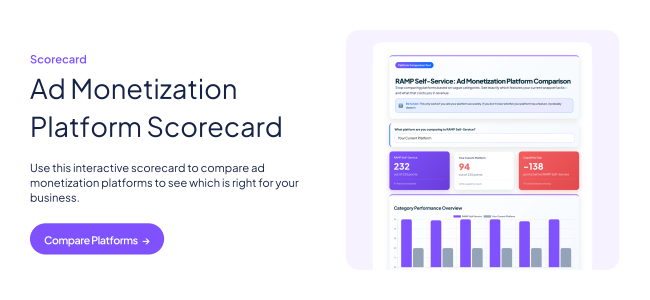
Read our Guide to Ad Monetization Platforms.
Override When Needed: Your Strategy Always Wins
Any AI system that doesn't let you override its recommendations isn't a tool. It's a replacement.
The best AI ad tech treats your input as the highest-priority signal. When you make a strategic decision, whether adjusting a price floor, excluding a demand partner, or changing an ad placement, the system should execute immediately rather than "optimizing around" your choice.
This matters practically in several scenarios:
- Direct sales campaigns: You've closed a deal at a specific rate. The AI shouldn't second-guess your pricing.
- Brand safety events: Breaking news or sensitive content requires immediate ad adjustments. You can't wait for the algorithm to learn.
- Partner negotiations: You're testing a new SSP and want to ensure they get meaningful volume. Manual allocation overrides algorithmic traffic shaping.
- User experience initiatives: You've decided to reduce ad density for a specific content type. That decision stands regardless of revenue impact.
Playwire's platform implements this through rules-based controls that layer over AI optimization. You define the parameters. Machine learning works within them. Override rules take precedence, always.
The Difference Between AI Partner and AI Replacement
Not all AI ad tech operates the same way. The fundamental architecture determines whether you're gaining a partner or losing control.
Signs of an AI replacement approach:
- Limited visibility into optimization decisions
- Minimal configuration options for automation levels
- Override requests require support tickets
- "Trust the algorithm" messaging when you question results
- Aggregated reporting that obscures individual decisions
Signs of an AI partnership approach:
- Transparent reporting on results obtained by AI algorithms
- Granular control over automation scope
- Immediate override capability at the publisher level
- Real-time data accessible via API or dashboard
The following table compares these approaches across key operational dimensions:
Dimension | AI Replacement Model | AI Partnership Model |
Decision Visibility | Black box algorithms | Transparent logic, viewable rules |
Configuration Depth | Limited presets | Granular, rules-based control |
Override Speed | Support ticket required | Immediate, self-service |
Strategic Input | Algorithm determines strategy | Publisher sets parameters |
Learning Source | Cross-network patterns only | Your data plus network learnings |
Exit Complexity | Dependency lock-in | Portable configurations |

View the Ad Monetization Platform Resource Center.
Building Your AI-Augmented Strategy
Implementing AI ad tech effectively requires intentional planning. Throwing machine learning at your ad stack without strategic direction produces unpredictable results.
Start with clear objectives. What specific outcomes matter most? Revenue maximization? User experience preservation? Operational efficiency? AI optimization targets whatever you measure, so choose metrics carefully.
Identify your non-negotiables. Which decisions must remain in your hands? Competitive exclusions? Floor pricing for premium inventory? Layout standards? Define these before enabling automation.
Establish monitoring cadences. AI doesn't eliminate the need for oversight. It changes what you monitor. Shift from individual transaction review to pattern analysis and exception handling.
Plan for override scenarios. When will you intervene? Document the circumstances that warrant manual adjustment so you're prepared to act quickly.
The following checklist helps structure your implementation approach:
- Objectives defined: Revenue target, UX standards, operational goals documented
- Automation scope set: Which functions to automate, which to retain
- Rules established: Non-negotiable parameters encoded in platform
- Monitoring configured: Dashboards and alerts for relevant metrics
- Override procedures ready: Decision criteria and execution process documented
- Review schedule planned: Regular cadence for strategic assessment
Real-Time Intelligence Without Real-Time Anxiety
AI-powered analytics transform how you understand your ad monetization. Real-time data means catching issues before they become expensive and spotting opportunities before competitors.
Playwire's real-time analytics gives you data without a delay, enabling analysis previously impossible for most publishers. You can see exactly which content types drive the most revenue, understand the ROI of individual writers, and optimize site structure based on actual performance.
This intelligence augments rather than replaces your editorial judgment. The data shows what's working financially. You decide whether that aligns with your broader content strategy.
When AI Gets It Wrong
No algorithm is infallible. Machine learning systems make mistakes, especially in novel situations or edge cases.
The question isn't whether AI will occasionally err. It's whether the system design allows you to catch and correct errors quickly. Partnership-oriented AI provides the transparency and control necessary for rapid intervention.
Common AI optimization errors:
- Overfitting to short-term patterns: Chasing yesterday's performance instead of sustainable improvement
- Ignoring context: Missing seasonal factors, breaking news, or audience behavior shifts
- Conflicting with direct sales: Algorithmic decisions that undermine negotiated deals
- Latency in adaptation: Slow response to market changes or new demand sources
Your expertise catches these errors. Your override capability fixes them. The AI then learns from the correction, improving future performance.
Amplify Your Expertise with Playwire
Machine learning should make your job easier, not replace your judgment. The RAMP Platform was built on this principle: AI that operates as your strategic partner, handling tactical complexity while you maintain control.
What sets Playwire's AI approach apart:
- Built-in AI and machine learning: Proprietary algorithms trained on billions of impressions, working within parameters you define
- Rules-based control: Set the boundaries, let machine learning optimize within them
- Real-time transparency: See results of manual and automated decisions immediately
- Immediate override: Your strategic decisions take precedence, always
The result? Publishers who work with Playwire maintain their strategic authority while gaining optimization capabilities no in-house team could match.
Your expertise built your audience. The right AI amplifies what you've already achieved. No black boxes, no surrendering control, no trusting algorithms blindly.
Ready to see AI that actually respects your strategy? Apply now to learn how Playwire's approach differs from the rest.
