
-1.png?width=800&height=157&name=1-playwire-logo-primary-2021%20(1)-1.png)


January 20, 2026

Editorial Policy
All of our content is generated by subject matter experts with years of ad tech experience and structured by writers and educators for ease of use and digestibility. Learn more about our rigorous interview, content production and review process here.

The AI Ad Tech Hype Problem
The ad tech world drowns in "AI-powered" solutions promising miraculous revenue boosts. Every platform claims machine learning capabilities. Few actually deliver meaningful optimization.
Here's the uncomfortable truth: most AI ad tech implementations force publishers into a false choice. Either hand over complete control to algorithms you don't understand, or stick with manual optimization that can't keep pace with programmatic complexity. Neither option serves publishers well.
The real question isn't whether to use AI in your ad monetization strategy. The question is where AI should make autonomous decisions and where it should inform your decisions instead.
Read all blogs in the AI Ad Tech series:
Understanding AI's Role in Modern Ad Monetization
Effective AI ad tech operates across a spectrum of automation levels. Some optimizations demand machine-speed execution. Others require human strategic oversight with algorithmic support.
The distinction matters because your ad monetization strategy directly impacts user experience, brand perception, and long-term revenue sustainability. Getting that balance wrong costs real money.
What is AI Ad Tech?
AI ad tech refers to machine learning systems that analyze advertising data and either recommend or execute optimization decisions. These systems process variables like user behavior, time of day, device type, content category, and historical performance patterns.
The best platforms distinguish between tactical and strategic decisions. Tactical optimizations happen at impression speed. Strategic choices require context that algorithms struggle to understand.

Where AI Should Execute Autonomously
Certain ad monetization tasks exceed human cognitive capacity. The math simply doesn't work for manual management at scale.
Dynamic Price Floor Optimization
Price flooring represents AI ad tech at its most valuable. Traditional unified pricing rules in Google Ad Manager allow a maximum of 200 rules. Publishers managing inventory across multiple ad units, geographies, device types, and time periods quickly exhaust that limit.
Machine learning systems analyze hundreds of variables per impression to set optimal floor prices. Playwire's Price Floor Controller manages approximately 1.2 million dynamic price floor rules per site on average.
No human team could identify optimal floor prices across that many permutations. The AI executes these adjustments in milliseconds, balancing fill rate against CPM to maximize total revenue.
Optimization Type | Manual Capability | AI Capability | Recommendation |
Price Floors | 200 rules maximum | 1.2M+ dynamic rules | AI Execution |
Traffic Shaping | Basic filtering | Real-time pattern analysis | AI Execution |
Bidder Selection | Static preferences | Per-impression optimization | AI Execution |
Layout Changes | Full control | Recommendations only | Human Decision |
Brand Safety Rules | Full control | Pattern detection | Human Decision |
Traffic Shaping
Traffic shaping uses machine learning to filter bid requests before they reach SSPs. The algorithm identifies which requests are likely to generate revenue and suppresses low-value requests that waste server resources.
This optimization type improves relationships with demand partners by increasing bid quality scores. Publishers using AI-driven traffic shaping typically see higher Revenue Per Session while reducing total bid requests. The QPT initiative case study demonstrated 76% revenue growth while reducing ad requests by 61%.

Read our Guide to Ad Monetization Platforms.
Smart Bidder Management
Determining which SSPs to call for each impression involves analyzing patterns across geographic regions, device types, time periods, and historical performance. AI systems identify which demand sources consistently deliver value for specific inventory types.
The algorithms continuously adjust bidder selection based on performance feedback. This type of optimization runs on every impression without requiring publisher intervention.
Where AI Should Recommend (Not Execute)
Strategic decisions require context that algorithms cannot reliably interpret. These areas demand human judgment supported by AI-generated insights.
Ad Layout and User Experience
Your ad layout affects user experience, page performance, and long-term audience retention. While AI can analyze viewability patterns and suggest placement changes, the final decision belongs to publishers who understand their audience expectations.
Machine learning might identify that adding another ad unit would increase short-term revenue. Human judgment recognizes that degrading user experience could damage the brand and reduce traffic over time.
The strategic value lies in AI surfacing the data while humans make informed decisions. Predictive analytics show potential outcomes before implementation, but publishers retain override authority.
Brand Safety Parameters
AI can detect patterns in ad creative that might pose brand safety risks. However, brand safety standards vary dramatically across publishers. A gaming site might accept creative that an education publisher would reject.
Machine learning systems should flag potential issues and provide data for human review. Autonomous blocking decisions risk filtering legitimate revenue while potentially missing edge cases that humans would catch.
Revenue Model Strategy
Decisions about subscription tiers, ad-free experiences, and revenue stream balance require business context that AI cannot evaluate. Publishers understand their competitive position, audience willingness to pay, and long-term strategic direction.
AI analytics inform these decisions by modeling revenue scenarios. The actual strategic choice remains human territory.
The Hybrid Approach: Rules-Based Control Meets Machine Learning
The most effective AI ad tech platforms don't force binary choices. They let publishers define which elements they want to manage manually and which they want to automate.
How Rules-Based Control Works
Publishers set conditional triggers based on any input they choose. These rules might specify different ad strategies for specific page sections, traffic sources, or user geographic locations.
When a rule condition is met, the specified action executes. Publishers maintain complete visibility into which rules are active and can modify them at any time.
Rules-based control works well for areas where publishers have strong strategic opinions. Premium content sections might warrant different ad density than user-generated content areas. Geographic markets with direct sales relationships might require different floor strategies than programmatic-only regions.
How Machine Learning Fills the Gaps
For the millions of micro-decisions that don't warrant manual rules, machine learning algorithms optimize automatically. These systems learn from every impression across the entire publisher network.
The AI handles optimization tasks that would take human teams dozens of hours per day. Dynamic timeout adjustments, bidder participation decisions, and identity solution selection happen algorithmically while publishers focus on strategy.
Choosing Your Automation Boundaries
Publishers should evaluate each component of their ad monetization stack and decide where automation makes sense.
The following framework helps guide those decisions:
High Automation Candidates:
- Price flooring: Too many variables for manual management
- Bidder optimization: Requires impression-level decisions
- Traffic shaping: Pattern complexity exceeds human analysis
- Identity solution selection: Bid-by-bid cost optimization
Human Control Priorities:
- Ad layout structure: Direct UX impact
- Brand safety rules: Publisher-specific standards
- Content category blocking: Strategic positioning decisions
- Revenue model design: Business strategy territory

View the Ad Monetization Platform Resource Center.
Implementing AI Ad Tech Without Losing Control
Publishers evaluating AI ad tech solutions should prioritize transparency and override capability alongside performance promises.
Questions to Ask AI Ad Tech Providers
Before committing to any platform, publishers should understand exactly how automation works and where human oversight remains possible.
Critical evaluation criteria include:
- Visibility: Can you see the results of every setting and algorithm driving your revenue?
- Override capability: Can your strategic decisions always take precedence over AI recommendations?
- Granular control: Can you choose which specific elements to automate versus manage manually?
Starting Point Recommendations
Publishers new to AI ad tech should begin with high-impact, low-risk automation areas. Price flooring and traffic shaping deliver measurable results without affecting user experience decisions.
As comfort with AI-driven optimization grows, publishers can expand automation boundaries or pull back control based on results. The goal is finding the right balance for your specific situation, not maximizing automation for its own sake.

The Publisher-First AI Philosophy
AI ad tech works best when it amplifies human expertise rather than attempting to replace it. Publishers bring irreplaceable context about their audience, brand, and strategic direction.
Machine learning brings computational power that humans cannot match. The combination produces better outcomes than either approach alone.
The publishers seeing the strongest results treat AI as a strategic partner. They use algorithmic optimization for data-intensive tactical decisions while maintaining firm control over strategic direction. Override authority isn't a backup feature. It's the foundation of effective AI implementation.
Maximizing Your Revenue with AI That Works for You
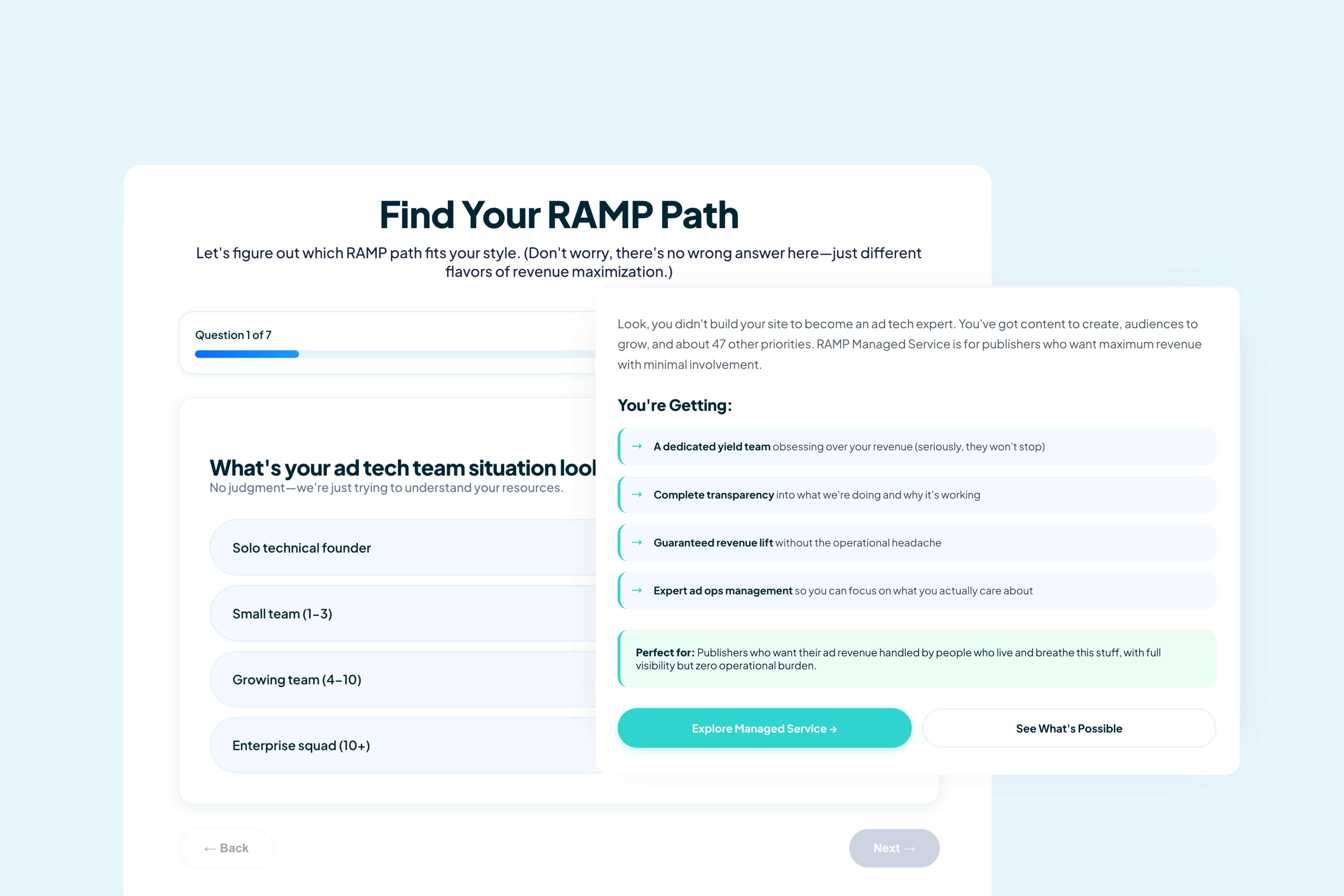
Playwire's RAMP Self-Service Platform embodies this balanced approach to AI ad tech. Publishers get full visibility into every setting and algorithm. AI and machine learning algorithms handle the computational heavy lifting while publishers retain strategic control.
The platform supports both rules-based manual control and machine learning automation. Publishers choose their boundaries based on their specific needs and expertise levels.
Key capabilities include:
- Full transparency: See the result of every optimization decision in detailed analytics
- Granular control: Manage any aspect of your monetization manually if you choose
- Override authority: Your strategic decisions always take precedence
- Expert support: Access yield ops professionals who understand your challenges
Ready to see AI ad tech that actually works for publishers? Contact Playwire to learn how RAMP Self-Service can amplify your ad revenue while keeping you in the driver's seat.
