
-1.png?width=800&height=157&name=1-playwire-logo-primary-2021%20(1)-1.png)


May 5, 2026

Editorial Policy
All of our content is generated by subject matter experts with years of ad tech experience and structured by writers and educators for ease of use and digestibility. Learn more about our rigorous interview, content production and review process here.
Key Points
- Ad density is the dominant revenue driver for gaming publishers: impressions per session correlates with revenue per session at r=0.79, the strongest relationship in the entire vertical.
- Fill rate is nearly irrelevant for gaming: the correlation between fill rate and RPS in gaming is r=−0.01, meaning chasing fill won't move your revenue needle.
- Top-performing gaming publishers average 14.4 impressions per session: if you're under that, you're leaving money on the table with every visit.
- The floor price trap hits gaming publishers especially hard: aggressive floors reduce fill without delivering enough CPM premium to compensate, and gaming is a volume game.
- Layout decisions are monetization decisions: every additional ad unit you serve on every page load compounds at scale across millions of sessions.
Gaming Ad Revenue Optimization Works Differently Than You Think
Most publishers approach optimization the same way regardless of vertical. More fill, higher CPMs, better viewability. Reasonable checklist. For gaming publishers, particularly web and browser-based gaming, it's largely the wrong one.
Playwire's publisher ecosystem data tells a surprisingly clean story. In gaming, impressions per session correlates with revenue per session at r=0.79. That's the strongest single metric-to-revenue relationship in the vertical. Fill rate correlates with gaming RPS at r=−0.01. Essentially zero.
That's not a rounding error. It's a structural finding. Gaming is a volume business, and the publishers who win are the ones who optimize accordingly.

The Metric That Drives Gaming Publisher Revenue
When you correlate every available performance metric against revenue per session, impressions per session comes out on top for gaming publishers. Not CPM. Not viewability. Not fill. The number of ads your users actually see.
The benchmark among top-performing gaming publishers is 14.4 impressions per session. That number reflects both how many ads appear on each page load and how many pages a user visits. Both levers feed the same outcome: more inventory per session, more revenue.
Here's what the impressions-per-session curve looks like across the entire ecosystem:
| Impressions per Session | Avg RPS (Indexed 1–100) |
|---|---|
| < 5 impressions | 1 |
| 5–10 impressions | 14 |
| 10–20 impressions | 25 |
| 20–35 impressions | 39 |
| 35–60 impressions | 61 |
| 60+ impressions | 100 |
Every step up this table is a meaningful revenue jump. Going from under 5 impressions per session to the 10–20 range is a 25x lift. The curve doesn't flatten at the top, either. Publishers hitting 60+ impressions per session are in a different performance category entirely.
Why Fill Rate Is the Wrong Thing to Optimize for Gaming Websites
Gaming diverges sharply from other verticals here. In sports or news publishing, fill rate matters. Audience quality is the primary lever in those verticals, and fill is part of capturing it. Gaming doesn't work that way.
With a fill-to-RPS correlation of r=−0.01, fill rate in gaming is essentially noise. A gaming publisher could go from 40% fill to 80% fill and might not see predictable change in revenue per session. Counterintuitive, but it follows logically once you understand the volume dynamic.
Gaming audiences are enormous, sticky, and return frequently. The monetization ceiling isn't set by how efficiently you fill each request. It's set by how many requests you're generating in the first place. A publisher generating twice as many impressions per session will outperform a publisher with a higher fill rate almost every time.
This doesn't mean fill rate is irrelevant at a surface level. Unfilled impressions are wasted inventory, and a well-configured demand stack does matter. The point is that optimizing fill rate as a primary KPI for gaming is solving the wrong problem. The problem worth solving is impression volume.
Essential Background Reading:
- Ad Density Is the #1 Predictor of Publisher Revenue Per Session: The network-wide data behind why impressions per pageview beats every other metric, essential context for understanding gaming's volume dynamics.
- 5 Ad Revenue Metrics Publishers Should Track that Might Surprise You: Why the metrics most publishers prioritize often aren't the ones that predict revenue, including why session duration misleads more than it informs.
- Publisher Ad Revenue Maturity Model: Where Are You on the Revenue Curve?: A framework for understanding where your current optimization strategy sits and what the next level looks like.
- Fill Rate Is the Most Underrated Revenue Lever, Though Complex to Change: What fill rate actually predicts across the publisher network, and why gaming is the one vertical where it behaves differently.
The Floor Price Trap (and Why Gaming Publishers Fall Into It)
Aggressive price floors feel like protection. Set a hard floor, only let quality bids through, maintain CPM quality. The logic makes sense in theory. In practice, the data shows it backfires.
Within the same demand tier, publishers with aggressive floors run at roughly half the fill rate of those with right-sized floors. The high-floor publishers charge nearly 2x the CPM per impression, but they end up generating 18% less revenue per session. More revenue per impression, less revenue overall, because volume collapses.
For gaming publishers, this trap is particularly damaging. Gaming revenue is built on volume. When floor pricing kills half your fill, you're cutting the core mechanism that drives your RPS. The math is unambiguous:
- Right-sized floors fill twice as much inventory: the fill rate gap between aggressive and calibrated floors within the same demand tier is dramatic.
- High-floor publishers charge more per impression: roughly 2.5x more CPM than publishers with right-sized floors.
- Right-sized floors generate more total revenue: 19% more revenue per session, despite the lower per-impression price, because fill more than compensates for the CPM gap.
The correct approach for gaming publishers is dynamic, demand-aware floor pricing. Set floors based on what your actual demand pool will pay, not what you wish buyers would spend. A floor that clears 80% of your inventory at a moderate CPM will outperform a floor that clears 40% at a premium CPM virtually every time in a volume vertical.
Related Content:
- How to Increase Impressions Per Pageview Without Hurting User Experience: Practical layout strategies for adding ad density without degrading the experience that keeps gaming audiences coming back.
- How to Build a Website Content Architecture That Earns More Ad Revenue: How page structure and navigation flows drive session depth, the multiplier that compounds ad density into real revenue.
- Session Duration Is a Lie. Page Depth Is the Signal.: The full data breakdown on why time-on-site is nearly uncorrelated with revenue and pageviews per session is the number to watch.
- How to Right-Size Your Price Floors Without Leaving Money on the Table: The floor price trap explained in full, including how to calibrate floors to what your actual demand pool will pay.
- Viewability is Important for RPS, but Chasing Perfect Viewability isn't Worth it: Why the 80–90% bracket outperforms 90%+ on median RPS, and what gaming publishers should optimize instead.
Page Depth Compounds the Effect
Ad density per page and pages per session multiply each other. Gaming publishers who understand this build their content experience around both.
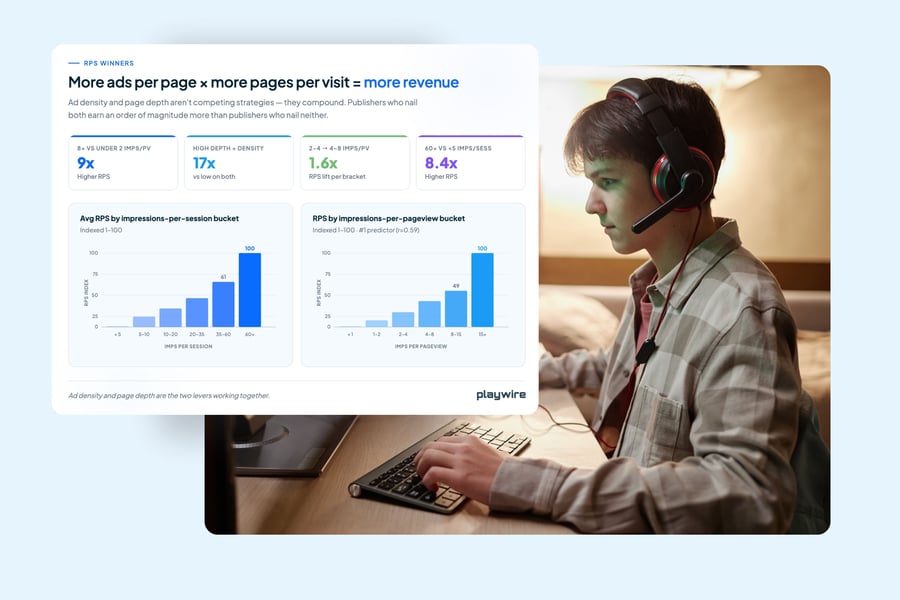
Impressions per pageview (r=0.59 network-wide) is the single strongest predictor of revenue per session in the entire dataset. How many ads load on each individual page matters as much as how many pages a user visits. Combine deep per-page density with multi-page session flows and you're in the highest revenue tier.
The compound effect is not subtle:
| Publisher Segment | Avg RPS Index |
|---|---|
| Low page depth + Low ad density | 1 (Baseline) |
| Low page depth + High ad density | 69 |
| High page depth + Low ad density | 56 |
| High page depth + High ad density | 100 |
Publishers above the median on both dimensions earn 17x more per session than those below on both. Gaming content is naturally suited to this. Level completions, match endings, stats pages, leaderboards: each one is a page load, and each page load is a fresh inventory opportunity.
The gaming publishers extracting the most revenue aren't just loading more ads per page. They're engineering content flow to create more natural page transitions, each of which serves fresh ad inventory and resets the impression count for that visit.

Session Duration vs. Page Depth: Which One Matters More
A user who plays a single browser game for 45 minutes on one page is not worth as much as a user who spends 20 minutes across four pages. That's what the data shows.
Session duration correlates with revenue per session at r=−0.03 across the network. Pageviews per session correlates at r=0.27, nearly 10x stronger. Duration without depth is just an open tab generating no new inventory.
For web gaming publishers, this distinction matters enormously. A session pinned to a single game page is not accumulating additional ad serving opportunities. A session that moves through match results, leaderboards, player profiles, and content pages is. Publishers who build navigation flows around natural gaming session breaks, between levels, after matches, at score screens, are capturing page depth that translates directly into revenue. Publishers who don't are leaving that inventory on the floor.
Next Steps:
- What Separates the Top 10% of Website Publishers from Everyone Else (Data-Backed): The specific behaviors and configurations that define top-performing publishers across the network, and how to close the gap.
- Publisher Revenue Optimization by Vertical: How to Maximize Ad Revenue in YOUR Vertical: How gaming's volume playbook compares to the audience quality approach required in sports, news, and technology.
- How to Diagnose and Fix Your Fill Rate Problem: For gaming publishers who want to ensure their demand stack is functional enough to fill the inventory volume a well-configured layout generates.
- How to Recover Publisher Revenue After Losing Amazon as a Bidder: Amazon accounts for roughly 20% of total site revenue where it runs, here's how to address the gap if you've lost access.
What This Means for Your Ad Layout on a Gaming Website
If gaming publisher ad revenue optimization comes down to impression volume, your ad layout is your most important monetization decision. Not your demand partner selection. Not your floor settings, though those matter. Your layout.
Publishers averaging 15+ impressions per pageview earn 21x more revenue per session than those under 1 impression per page. Even the step from 2–4 to 4–8 impressions per pageview produces a 1.6x lift. Every additional unit you place on every page load compounds across the full scale of your traffic.
A few things to get right:
- Ad density per page: gaming audiences are highly engaged and tolerant of ad-supported content, especially in exchange for free access to the game content they came for. Use that tolerance thoughtfully. More units, placed well, outperform fewer premium units nearly every time in this vertical.
- Format mix: rewarded video is one of the strongest-performing formats in gaming environments. Chess.com saw 4x higher CPMs with rewarded video versus traditional video units. That's a format that fits how gaming audiences already think about exchanging attention for value.
- Refresh and adhesive units: an adhesive unit that refreshes on a defined interval generates multiple impressions from a single ad slot across a long gaming session. For publishers with sticky, long-session gaming audiences, this is a straightforward way to increase impressions per session without cluttering the page.
- Content architecture: every natural break in a gaming session is an opportunity for a page transition. Stats between rounds, leaderboard checks, content browsing after a match. Design for these transitions and you're adding impression inventory without degrading the experience.
See It In Action:
- Chess.com Case Study: How Chess.com achieved a ~130% immediate revenue boost and sustained ~30% year-over-year growth, including 4x CPM lifts from rewarded video.
- Raider.IO Case Study: How this WoW rankings site with 30 million monthly pageviews achieved a 50% revenue increase by switching monetization partners.
The Vertical-Specific Mistake Gaming Publishers Make
The biggest error gaming publishers make is applying optimization logic borrowed from other verticals. Chasing CPM lifts through aggressive floors. Obsessing over viewability above 80% when incremental gains there don't reliably translate to RPS. Evaluating monetization partners based on fill rate promises.
None of those strategies match the actual revenue mechanics of gaming. You win on volume. Impressions per session is your north star. Page depth is how you build it. Ad density per page is how you maximize it. Floor pricing calibrated to your actual demand pool is how you protect it.
Sports and news publishers live in a different world. Their CPM premiums are the primary lever. Adding more ad units to a news page matters far less than protecting the audience quality that commands those CPMs. A gaming publisher who copies that playbook is solving a problem they don't have while ignoring the one they do.
The viewability trap is worth naming directly. Once viewability crosses 80%, incremental improvement doesn't reliably translate to higher revenue per session. The 80–90% viewability bracket actually outperforms the 90%+ bracket on median RPS. Chasing 95% viewability at the expense of fill rate is not a winning trade for any publisher. For gaming publishers, where volume is the lever, it's an actively counterproductive one.
How Playwire Approaches Gaming Publisher Ad Revenue Optimization
Playwire doesn't treat all publishers with the same strategies. We focus on building the tools and team that can evaluate and maximize individual publisher earnings, and understanding vertical dynamics is an important part of that strategy.
That means AI-driven yield optimization calibrated to gaming demand dynamics, not generic floor pricing logic. Ad layout recommendations grounded in actual gaming publisher data, not best guesses. A demand stack deep enough to fill the inventory volume that a well-configured gaming publisher actually generates.
Chess.com saw an immediate ~130% revenue boost after joining Playwire, followed by sustained ~30% year-over-year growth. Raider.IO achieved a 50% revenue increase after switching partners. GTPlanet's owner described the Advanced Yield Analytics as data he'd "always wanted" that finally let him understand which content and layout decisions actually drive revenue.
The common thread across those outcomes isn't a single magic tactic. It's an optimization approach aligned to how gaming revenue actually works. Volume first. Layout as a monetization decision. Floor pricing that clears inventory rather than strangling it.
If your impressions per session are below 14.4, you know what to work on.
Frequently Asked Questions
What is the best way to increase ad revenue on a gaming website?
The single most effective lever for gaming publisher ad revenue optimization is increasing impressions per session. Data from Playwire's publisher network shows that impressions per session correlates with revenue per session at r=0.79 for gaming publishers, the strongest metric-to-revenue relationship in the vertical. That means serving more ads on each page and building content flows that drive users through multiple pages per visit. Ad layout, page structure, and session depth matter more than CPM optimization or fill rate management for web gaming publishers.
What CPM should gaming publishers expect?
Gaming publisher CPMs vary significantly based on traffic geography, ad format, and demand stack configuration. Gaming as a vertical runs lower average CPMs than sports or news, because it is a volume business rather than an audience quality business. Rewarded video is the standout exception: Chess.com reported 4x higher CPMs with rewarded video compared to traditional video units. Rather than benchmarking against a CPM target, gaming publishers typically see better results focusing on impressions per session, where the RPS impact is more direct and more controllable.
How many ads should I put on a gaming page?
The data consistently shows that more ad units per page drives more revenue per session for gaming publishers, with impressions per pageview showing a strong positive correlation with RPS (r=0.59 network-wide). Publishers averaging 15+ impressions per pageview earn 21x more per session than those under 1 impression per page. The practical ceiling depends on user experience and ad quality, but gaming audiences are generally more tolerant of ad-supported content than audiences in other verticals. The key is placing units at natural content breaks rather than forcing them into the experience.
Does fill rate matter for gaming publishers?
For gaming publishers, fill rate is nearly irrelevant as a primary optimization target. The correlation between fill rate and revenue per session in gaming is r=−0.01, which is effectively zero. Impression volume, not fill efficiency, drives gaming RPS. That said, unfilled impressions are still wasted inventory, so a functional demand stack is important. Spending significant optimization effort on fill rate improvement produces minimal return for gaming publishers compared to focusing on impressions per session and page depth.
Is rewarded video better than banner ads for gaming publishers?
Rewarded video typically outperforms standard banner ads on CPM for gaming publishers. Chess.com, one of the world's largest browser-based gaming destinations, reports 4x higher CPMs from rewarded video compared to traditional video units. The format also fits gaming audience psychology: users are accustomed to exchanging attention for in-game value. That said, rewarded video alone doesn't solve the volume equation. A mix of formats that maximizes total impressions per session, including refresh-enabled adhesive units and well-placed display, will generally outperform a strategy built around any single format.
What is the difference between RPM and RPS for gaming publishers?
RPM (revenue per mille, or per 1,000 pageviews) and RPS (revenue per session) measure related but different things. RPM reflects how efficiently a publisher monetizes individual pageviews. RPS captures total revenue across an entire user visit, including all pages that user loads. For gaming publishers, RPS is the more useful metric because it captures the full value of session depth and ad density across a visit. A publisher with moderate RPM but high page depth can dramatically outperform a publisher with high RPM and shallow sessions. Playwire's publisher data uses RPS as the primary revenue performance metric for this reason.
