
-1.png?width=800&height=157&name=1-playwire-logo-primary-2021%20(1)-1.png)


May 5, 2026

Editorial Policy
All of our content is generated by subject matter experts with years of ad tech experience and structured by writers and educators for ease of use and digestibility. Learn more about our rigorous interview, content production and review process here.
Key Points
- Impressions per session is the dominant revenue driver for gaming, entertainment, and education publishers, not CPM.
- CPM and demand pool depth determine outcomes for sports, news, and technology publishers. Ad density is largely irrelevant.
- Optimizing for the wrong lever doesn't just underperform. It actively misleads your entire strategy.
- Data from across the Playwire publisher network shows the primary RPS driver differs sharply by vertical, with correlation coefficients strong enough to treat as directional fact.
- Knowing which lever is yours is the first step to building a monetization strategy that actually moves revenue.
Most publisher optimization conversations start in the wrong place. Someone pulls up the dashboard, sees CPM trending down, and immediately starts talking about demand partners and floor pricing. Or they notice fill rate slipping and starts adding ad units.
Both moves can be exactly right. Both can also be a complete waste of time, depending on what kind of content you publish.
The data from the 2026 State of Publisher Ad Revenue Report is clear: the primary revenue driver is not the same across verticals. Gaming publishers and news publishers are not solving the same problem. Running the same optimization playbook across both doesn't just fail to help, it can actively hurt. Publisher revenue optimization by vertical isn't a nuance. It's the whole game.

The Clean Split: Volume vs. Quality
Data across the Playwire publisher ecosystem reveals a clear divide between two types of monetization businesses.
Gaming, entertainment, and education publishers are inventory volume businesses. More impressions per session drives more revenue per session. That's the primary lever, and the correlation data backs it up decisively.
Sports, news, and technology publishers are audience quality businesses. CPM and demand pool depth determine the outcome. Adding more ad units per page matters far less than protecting the audience premium that makes advertisers pay a premium in the first place.
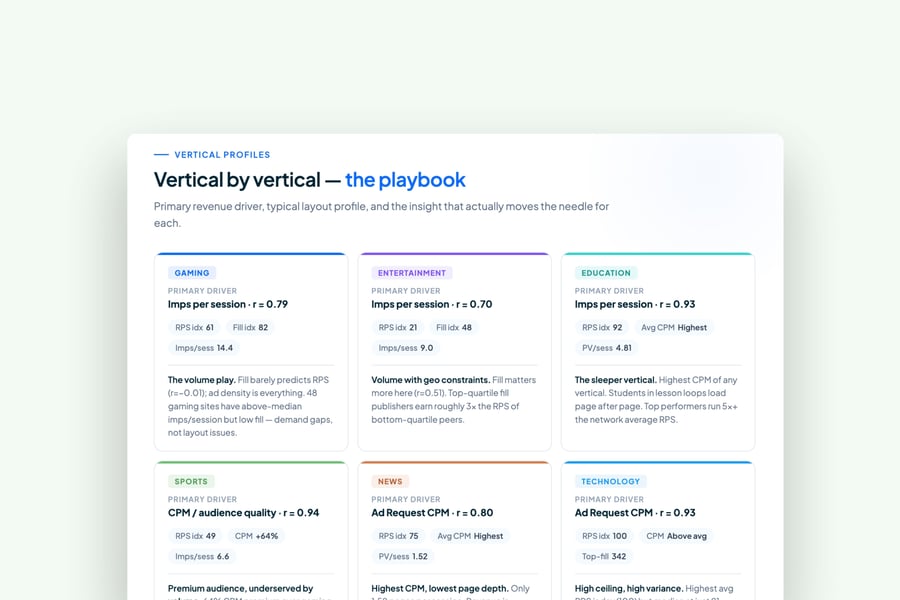
| Vertical | Primary RPS Driver | Correlation (r) | Avg RPS Index (1–100) |
|---|---|---|---|
| Gaming | Impressions per session | 0.79 | 61 |
| Entertainment | Impressions per session | 0.70 | 21 |
| Education | Impressions per session | 0.93 | 92 |
| Sports | CPM / audience quality | 0.94 | 49 |
| News | Ad Request CPM | 0.80 | 75 |
| Technology | Ad Request CPM | 0.93 | 100 |
The correlation numbers here aren't marginal. An r of 0.93 between impressions per session and RPS in education means that metric explains nearly all the revenue variance in that vertical. A gaming publisher chasing CPM improvements is solving the wrong problem. A news publisher adding more ad slots is doing the same.
This volume vs. quality split is the organizing principle behind every vertical-specific monetization strategy worth running. Everything else flows from it.
The Volume Verticals: Gaming, Entertainment, and Education
For these three verticals, the monetization question is essentially the same: how many impressions can you serve per visit? The tactics differ by vertical, but the primary lever is consistent across all three.
Gaming Publisher Revenue Optimization
Gaming has the clearest volume signal in the dataset. Impressions per session correlates with RPS at r = 0.79, and fill rate is essentially uncorrelated at r = −0.01. That last number matters. Gaming publishers who obsess over fill rate optimization are working on a variable that barely registers.
Gaming publishers average 14.4 impressions per session across the Playwire network. The publishers sitting above that average outperform those below by a margin that makes every other variable look like noise. Ad layout decisions, how many units are on the page, how they're structured to load as a user plays, are monetization decisions in this vertical.
The floor price trap is also worth flagging for gaming specifically. Because demand depth tends to be strong for gaming inventory, aggressive floors can seem like a rational move. The data shows that right-sized floors consistently generate more revenue per session than inflated ones, even when the CPM per impression is lower. Fill more inventory at a sensible price and you win. Fill half your inventory at an aspirational price and you don't.

Entertainment Publisher Revenue Optimization
Entertainment follows the same volume logic, with one additional wrinkle. Fill rate matters more here than in gaming, r = 0.51, which suggests entertainment audiences carry more geographic diversity. More international traffic means lower advertiser demand in some segments, and that structural ceiling can't be engineered away entirely.
Entertainment publishers average 9.0 impressions per session, lower than gaming. Top-quartile fill publishers in this vertical average 3x the RPS of their bottom-quartile peers. The primary lever is still inventory volume, but fill rate optimization plays a meaningful supporting role that gaming publishers can largely ignore.
Education Publisher Revenue Optimization
Education is the most striking vertical in the entire dataset. Impressions per session correlates with RPS at r = 0.93, the strongest relationship in the table, and average session durations run extraordinarily long. Students in lesson loops load page after page, naturally generating the kind of session depth that most other verticals have to engineer deliberately.
Education publishers also carry the highest average CPM of any vertical. The combination of deep session engagement and strong advertiser interest in student audiences creates real upside. Top performers show what the ceiling looks like: high fill, 28+ impressions per session, and RPS multiples well above the network average.
The content structure is doing part of the work automatically. Lesson-to-lesson progression creates natural page loads. Publishers who recognize this and build ad layouts around it, rather than fighting the structure, are the ones hitting the upper end of the range.
Essential Background Reading:
- Ad Density Is the #1 Predictor of Publisher Revenue Per Session: The data behind why impressions per pageview and impressions per session dominate every other metric in the RPS correlation table.
- 5 Ad Revenue Metrics Publishers Should Track that Might Surprise You: Why the metrics most publishers watch aren't the ones that actually predict revenue, and what to track instead.
- Session Duration Is a Lie. Page Depth Is the Signal.: A deep look at why time-on-site is a misleading proxy for monetization performance and what pageviews per session actually tells you.
- Publisher Ad Revenue Maturity Model: Where Are You on the Revenue Curve?: A framework for understanding where your current optimization strategy sits relative to publishers hitting the top of their vertical range.
The Quality Verticals: Sports, News, and Technology
For these three verticals, the question flips entirely. Adding more ad units won't move the needle in any meaningful way. What matters is the quality of the audience and the depth of the demand pool competing for access to it.
Sports Publisher Revenue Optimization
Sports CPM runs 64% above the gaming average. Impressions per session sits at 6.6, less than half of gaming's 14.4. These two numbers tell the whole story.
Sports publishers monetize a premium audience that advertisers pay a real premium to reach. CPM / audience quality correlates with RPS at r = 0.94 in this vertical. The optimization question isn't how to get more ad units on the page. It's how to protect and deepen the demand pool that makes those impressions worth so much.
A majority of sports publishers already run at high fill rates. The work in this vertical is on the demand side: maintaining strong bidder competition, avoiding floor pricing that suppresses fill without improving revenue, and ensuring the programmatic stack reflects the actual quality of the audience.
News Publisher Revenue Optimization
News carries the highest average CPM of any vertical in the dataset. It also has the lowest page depth: 1.52 pageviews per session. A news reader comes in, reads one article, and leaves.
That behavioral pattern makes ad density almost irrelevant as a lever. You can load eight ad units on that single article page, but you're still only getting one page load per visit. Revenue here is almost entirely a demand pool story. Ad Request CPM correlates with RPS at r = 0.80, meaning geography and audience quality dominate.
Viewability and fill rate both correlate meaningfully with RPS in news, which makes sense. When you have one page to monetize per visit, every impression on that page needs to count. The headline insight remains: a news publisher building strategy around adding more ad slots is building strategy around the wrong variable.
Technology Publisher Revenue Optimization
Technology shows the highest average RPS index in the dataset at 199, but with a median of 91. A handful of top performers are doing heavy lifting. The ceiling is real, top-quartile fill technology publishers reach an RPS index of 342, but the variance signals that most technology publishers haven't figured out how to reach it.
Ad Request CPM / demand quality correlates with RPS at r = 0.93 in this vertical. Technology audiences with US-heavy readership, developer tools, science content, technical reference sites, carry outsized demand depth. Geographic audience composition is a bigger factor here than in almost any other vertical.
Related Content:
- How to Increase Impressions Per Pageview Without Hurting User Experience: Tactical guidance on building ad density for volume verticals without the UX trade-offs that kill engagement and return visits.
- How to Build a Website Content Architecture That Earns More Ad Revenue: How content structure drives session depth, and why that matters more than almost any other monetization decision for volume publishers.
- How to Right-Size Your Price Floors Without Leaving Money on the Table: The floor pricing trap explained in detail, with a data-backed framework for calibrating floors to actual demand rather than aspirational CPM targets.
- Fill Rate Is the Most Underrated Revenue Lever, Though Complex to Change: Why fill rate matters differently across verticals and what drives the gap between 40% fill and 90% fill publishers in the same demand tier.
- How to Diagnose and Fix Your Fill Rate Problem: A diagnostic framework for identifying whether your fill rate problem is geographic, structural, or a floor pricing issue, and what to do about each.
What the Wrong Lever Costs You
Optimization targeting the wrong variable doesn't just fail to produce results. It burns time, budget, and attention that could go toward the thing that actually moves revenue.
A gaming publisher spending six months trying to improve CPM through floor adjustments is ignoring the one metric, impressions per session, that has a 0.79 correlation with their revenue. A news publisher A/B testing ad density configurations is working on a variable that barely registers while their demand pool depth sits unexamined.
The cost isn't just the effort going into the wrong strategy. It's the opportunity cost of not running the right one.
A few signals suggest you might be optimizing the wrong variable for your vertical-specific monetization strategy:
- Stagnant RPS despite CPM improvement: In a volume vertical, CPM gains without fill volume don't move total revenue. You're optimizing a numerator while the denominator stays flat.
- Low impressions per session in gaming or education: If your session depth is below network averages for your vertical, ad layout and content structure are the first places to look.
- Declining RPS in sports or news despite stable traffic: In quality verticals, this usually points to demand pool erosion: fewer bidders, aggressive floors killing fill, or geographic traffic shifts that lower the demand tier.
Next Steps:
- What Separates the Top 10% of Website Publishers from Everyone Else (Data-Backed): The specific behaviors and configurations that separate top-performing publishers from the rest of the network, across all verticals.
- Viewability is Important for RPS, but Chasing Perfect Viewability isn't Worth it: Why the 80–90% viewability bracket outperforms the 90%+ group, and where the ceiling effect starts to cost publishers fill rate.
- The Publisher's Guide to Viewability Optimization: Chasing Perfect isn't the Answer: A fuller treatment of viewability strategy, when it moves revenue and when optimizing further is actively counterproductive.
- How to Recover Publisher Revenue After Losing Amazon as a Bidder: Amazon accounts for roughly one in every five to six dollars for publishers where it runs. Here's how to address the gap when that bidder disappears.
- The Amazon SSP Problem: Why So Many Publishers Now Have a Structural Revenue Gap: The structural context behind Amazon demand access changes and what the revenue math looks like for publishers operating without it.
Frequently Asked Questions
What is the best ad revenue optimization strategy for gaming publishers?
Gaming publishers should focus on maximizing impressions per session, not CPM. Data from the Playwire publisher network shows impressions per session correlates with revenue per session (RPS) at r = 0.79 for gaming, while fill rate correlation is effectively zero (r = −0.01). The primary tactic is ad layout density: more ad units per page, structured to load naturally as users play. Floor pricing should be calibrated to actual demand. Aggressive floors reduce fill without compensating through CPM gains.
How do news publishers increase ad revenue per session?
News publishers should focus on demand pool depth and audience quality, not ad unit count. News averages only 1.52 pageviews per session, which limits the value of adding more ad slots. Ad Request CPM correlates with RPS at r = 0.80 for news, meaning geography and audience quality are the dominant variables. Optimizing viewability and fill rate on existing inventory matters more than expanding ad density.
Why does fill rate matter more for entertainment than gaming publishers?
Entertainment audiences carry more geographic diversity than gaming audiences, which creates a structural fill rate ceiling in segments with international traffic. Fill rate correlates with RPS at r = 0.51 for entertainment publishers, compared to essentially zero for gaming. Top-quartile fill entertainment publishers average 3x the RPS of bottom-quartile peers, making fill rate optimization a meaningful lever. Unlike in gaming, where it barely registers.
What is revenue per session (RPS) and why does it matter?
Revenue per session (RPS) measures total ad revenue earned per user visit, combining impressions served, fill rate, and CPM into a single output metric. It's a more complete picture of monetization performance than CPM or fill rate in isolation, because it captures the actual revenue yield of each visit. Across the Playwire network, impressions per pageview and impressions per session are the two strongest predictors of RPS.
Does session duration affect ad revenue?
Session duration alone has essentially no relationship with ad revenue. It correlates with RPS at −0.03 across the Playwire publisher network. A user who spends 10 minutes on a single page generates no more ad inventory than one who spent two minutes there. What matters is pageviews per session (r = 0.27), not time spent. Session duration only drives revenue when it comes with multiple page loads that each serve fresh ad inventory.
How does content vertical affect programmatic CPM?
Content vertical affects CPM primarily through audience quality and advertiser demand concentration. Sports CPM runs 64% above the gaming average. News and technology carry the highest average CPMs in the Playwire dataset, driven by premium audience demographics and US-heavy traffic. Volume verticals like gaming and entertainment tend toward lower CPMs but compensate through higher impression density per session.
What floor pricing strategy should publishers use?
Floor pricing strategy should be calibrated to actual demand, not aspirational CPM targets. Data from the Playwire network shows that publishers with aggressive floors run at roughly half the fill rate of those with right-sized floors, and despite charging nearly 2x the CPM per impression, generate 18% less revenue per session. Right-sizing floors to match the demand pool present clears more inventory and produces higher RPS. This applies across verticals, but the impact is most acute in volume verticals where impression count drives revenue.
See It In Action:
- Gaming Publisher Revenue Guide: Why Ad Density Is Everything: A detailed look at how gaming publishers can build ad density into their content experience without compromising the gameplay loop.
- Education Publisher Ad Revenue Monetization: The Lesson Loop Advantage: How education publishers turn lesson-to-lesson progression into a natural impressions-per-session engine — and what the top performers look like.
- Sports Publisher Ad Revenue Optimization: Why the Sports Playbook Is Different: Why sports publishers with 64% CPM premiums over gaming need a completely different optimization strategy — and what protecting that premium actually looks like.
- Entertainment Publisher Ad Revenue: Why Volume and Geography Define Your Revenue Story: The geographic fill ceiling that makes entertainment different from gaming — and why fill rate optimization is a meaningful lever here when it isn't elsewhere.
How Playwire Approaches Vertical-Specific Optimization
Playwire's RAMP platform is built around the premise that publisher monetization isn't one-size-fits-all. The managed service offering includes yield ops teams who understand that a gaming publisher and a news publisher require fundamentally different strategies, and who have the network data to know which lever matters in each vertical.
For volume verticals, that means ad layout configuration that maximizes impressions per session without degrading user experience, dynamic floor pricing calibrated to actual demand rather than aspirational CPMs, and header bidding setups deep enough to fill the inventory.
For quality verticals, it means protecting the audience premium through brand-safe inventory, maintaining the demand depth that makes high-CPM impressions achievable, and avoiding the floor price trap that inflates apparent CPM while quietly destroying fill.
The data in this report represents what's possible across the publisher network. Publishers on Playwire consistently see meaningful revenue increases within the first 90 days, not because the platform applies a generic optimization layer, but because the strategy starts with understanding which lever actually moves revenue for your specific vertical.
If you want to know exactly where your site sits relative to others in your vertical, that's the conversation worth having. Start at playwire.com.
