
-1.png?width=800&height=157&name=1-playwire-logo-primary-2021%20(1)-1.png)


May 5, 2026

Editorial Policy
All of our content is generated by subject matter experts with years of ad tech experience and structured by writers and educators for ease of use and digestibility. Learn more about our rigorous interview, content production and review process here.
Key Points
- The 80–90% viewability bracket outperforms the 90%+ bracket on median revenue per session, meaning perfect viewability actively costs publishers money.
- Above 80% viewability, buyers stop differentiating on viewability scores and start differentiating on fill rate, inventory volume, and audience quality.
- Chasing 95% viewability typically requires trade-offs that reduce fill, and lower fill generates less total revenue than the CPM premium from ultra-high viewability recovers.
- Impressions per pageview (r = 0.59) and impressions per session (r = 0.55) are far stronger predictors of revenue per session than viewability (r = 0.15), yet viewability gets the obsession.
- The right target is the 80–90% bracket: enough viewability to command premium CPMs, with enough fill to actually monetize the inventory.
Viewability has become the gold standard signal in programmatic advertising. Buyers demand it. Publisher dashboards highlight it. Ad ops teams spend real hours chasing it higher.
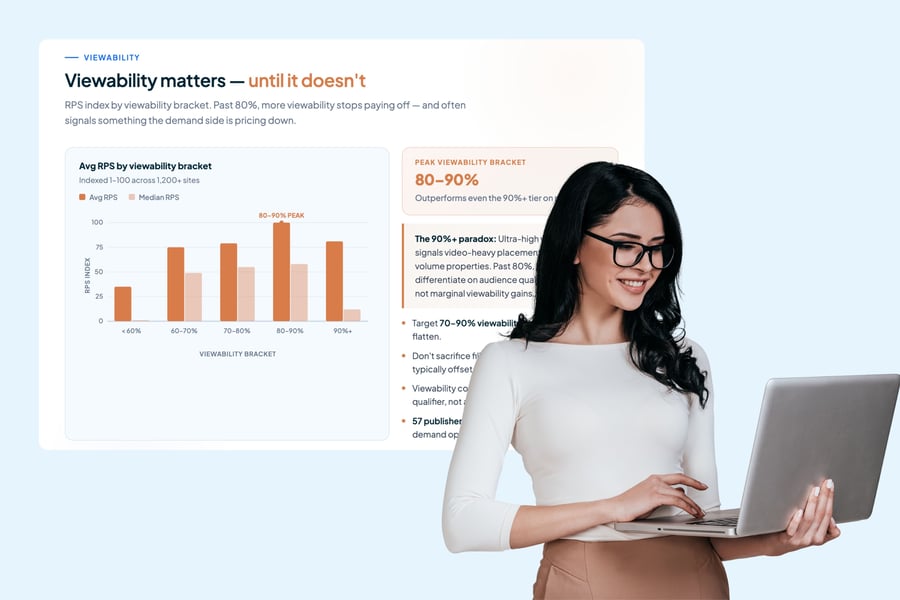
Here's what the data from our 2026 State of Ad Revenue Report shows: publishers in the 80–90% viewability bracket outperform those in the 90%+ bracket on median revenue per session. The publishers most committed to maximizing viewability are earning less than the ones who stopped short of perfection.
This is not a quirk in the dataset. It's a ceiling effect, and understanding it will change how you think about viewability publisher revenue optimization entirely.
How Viewability Ranks Against Every Other Revenue Lever
Before getting into the ceiling effect, put viewability in its proper rank order. Playwire's publisher ecosystem data correlates every major performance metric against revenue per session (RPS), and the results are instructive.
| Metric | Correlation with RPS (Pearson r) | Interpretation |
|---|---|---|
| Impressions per pageview | 0.59 | Strong positive, #1 predictor |
| Impressions per session | 0.55 | Strong positive, #2 predictor |
| Pageviews per session | 0.27 | Moderate positive |
| CPM | 0.22 | Moderate positive |
| Viewability | 0.15 | Weak positive |
| Fill rate | 0.12 | Weak positive |
| Session duration | −0.03 | No relationship |
Viewability correlates with RPS at 0.15. Impressions per pageview correlates at 0.59, nearly four times stronger. The industry obsesses over viewability while the actual revenue levers sit underoptimized.
That context matters for everything that follows. Viewability is an important signal. It's just not the strongest one.

What the Numbers Say
The revenue per session data across the Playwire publisher network tells a consistent story through most of the viewability range. Higher viewability correlates with better revenue, right up until it doesn't.
| Viewability Bracket | RPS (1–100 Index) | Relative to Lowest Bracket |
|---|---|---|
| < 60% | 35 | Baseline |
| 60–70% | 75 | 2.1x baseline |
| 70–80% | 80 | 2.3x baseline |
| 80–90% | 100 | 2.9x baseline |
| 90%+ | 81 | 2.3x baseline, underperforms 80–90% |
The pattern through the 60–80% range is clean and predictable: every bracket earns more than the one below it. Then the 80–90% bracket hits peak RPS. The 90%+ bracket drops back to the same level as the 70–80% bracket.
That's not noise. That's a structural ceiling.
Essential Background Reading:
- Ad Density Is the #1 Predictor of Publisher Revenue Per Session: Why impressions per pageview outranks every other metric in the dataset, and what that means for how you structure your ad layout.
- 5 Ad Revenue Metrics Publishers Should Track that Might Surprise You: The metrics that actually predict revenue per session, and which familiar ones are misleading you.
- Fill Rate Is the Most Underrated Revenue Lever, Though Complex to Change: How fill rate compounds across your full impression volume, and why it matters more than viewability above the 80% threshold.
- Publisher Ad Revenue Maturity Model: Where Are You on the Revenue Curve?: Benchmark your current optimization approach against what top-performing publishers are actually doing.
Why Ultra-High Viewability Doesn't Pay Off
The ceiling effect has a real explanation. Publishers who reach 90%+ viewability often get there by making trade-offs that quietly hurt monetization in other dimensions.
The most common path to ultra-high viewability involves restricting ad placement to only the most premium, above-the-fold inventory and cutting lower-viewability units that still generate meaningful revenue. The result looks great on a viewability dashboard. It looks worse on a revenue report.
Past 80% viewability, three things are happening:
- Buyer behavior shifts: Above 80%, programmatic buyers stop differentiating meaningfully on viewability scores. Fill rate, inventory volume, and audience quality become the signals that move the needle instead.
- Fill rate compression: Restricting inventory to only ultra-viewable placements typically reduces total ad calls, which reduces fill opportunities and leaves revenue on the table.
- Inventory mix distortion: Very high viewability often indicates video-heavy or mobile app placements with different monetization dynamics, or very low-volume publishers where small absolute impression counts inflate the metric without contributing much to total revenue.
The summary: 80–90% viewability earns the CPM premium that high viewability delivers. Above that threshold, the CPM premium flattens, but the cost in fill rate and inventory volume keeps climbing.
The Fill Rate Side of This Trade-Off
Fill rate is the mechanism that makes the ceiling effect hurt. When you sacrifice fill to chase viewability, you're not trading one metric for another of similar weight. You're trading a metric with diminishing returns for one with enormous compounding impact.
The fill rate data from the same publisher network makes the stakes clear.
| Fill Rate Bracket | RPS Multiplier vs. < 40% Fill Baseline |
|---|---|
| < 40% | 1.0x (baseline) |
| 40–60% | 2.5x |
| 60–75% | 3.4x |
| 75–90% | 3.5x |
| 90%+ | 5.3x |
Every unfilled impression is revenue that simply never materializes. A publisher at 90%+ fill earns more than 5x the RPS of one running below 40% fill. The step changes at each bracket are steep and consistent.
Consider what happens when a publisher optimizes layout to push viewability from 87% to 93%. If that change involves cutting lower-viewability ad units that were contributing real fill, total impressions drop. Fill rate may hold, but impressions per session fall, and impressions per session is the second-strongest predictor of RPS in the entire dataset (r = 0.55). Impressions per pageview, at r = 0.59, is stronger still.
The arithmetic almost never works in favor of the viewability chase above 80%.
Related Content:
- How to Right-Size Your Price Floors Without Leaving Money on the Table: The mechanics of floor pricing calibration, and why the fill advantage from right-sized floors consistently beats the CPM premium from aggressive ones.
- How to Diagnose and Fix Your Fill Rate Problem: A systematic approach to identifying what's suppressing fill rate and which fixes actually move the revenue needle.
- How to Increase Impressions Per Pageview Without Hurting User Experience: Practical ad layout strategies that add inventory density without the UX trade-offs publishers fear.
- Publisher Revenue Optimization by Vertical: How to Maximize Ad Revenue in YOUR Vertical: Why the primary revenue lever differs by content category, and how to identify which one applies to your audience.
- The Publisher's Guide to Viewability Optimization: Chasing Perfect isn't the Answer: A deeper look at viewability strategy, including how to protect the premium that matters without compressing fill.
What Buyers Care About Past 80%
Programmatic buyers care about viewability, but they care about it in a threshold model, not a continuous optimization model. Understanding that distinction explains why the ceiling exists.
Most demand-side platforms apply viewability filters at defined cutoffs, typically around 70% or 75%. Publishers above those thresholds qualify for demand that publishers below them cannot access. That's where the RPS jump from the below-60% bracket to the 60–70% and 70–80% brackets comes from. Clearing the threshold unlocks demand.
Above 80%, most buyers have already qualified your inventory. Additional viewability gains don't unlock additional demand tiers in most programmatic pipelines. What determines which buyer wins the impression at that point shifts to other signals: audience quality, contextual relevance, floor pricing calibration, and available inventory volume.
A publisher at 84% viewability and 80% fill is a more attractive buy than a publisher at 93% viewability and 55% fill. More inventory to buy. Better economics across the full campaign footprint. The high-viewability publisher with compressed fill simply doesn't have enough available impressions to support meaningful campaign scale.
The Floor Pricing Connection Most Publishers Miss
There's a second mechanism in the viewability optimization trap that rarely gets discussed: floor pricing. Aggressive floors and aggressive viewability targets often travel together, and the combination compounds the damage.
Publishers chasing ultra-high viewability frequently pair that strategy with high floor prices, reasoning that premium inventory deserves premium rates. Within the same demand tier, that logic produces a predictable result: publishers with right-sized floors fill twice as much inventory as high-floor peers, earn 19% more revenue per session, and do it at a lower CPM per impression.
Same demand tier. Lower CPM. More total revenue. The fill advantage more than compensates for the CPM gap.
The actionable read: if you're pushing viewability upward and floor prices upward simultaneously, you're compressing fill from two directions at once. The resulting RPS hit is larger than either factor produces in isolation.
Next Steps:
- Session Duration Is a Lie. Page Depth Is the Signal.: Why the metric most publishers watch for engagement has almost no correlation with revenue, and which one to watch instead.
- How to Build a Website Content Architecture That Earns More Ad Revenue: How content structure drives page depth, session impressions, and the compound revenue effect that follows.
- What Separates the Top 10% of Website Publishers from Everyone Else (Data-Backed): The specific behaviors and configurations that define the highest-earning publishers in the network.
- How to Recover Publisher Revenue After Losing Amazon as a Bidder: Demand concentration risk is real, here's how to rebuild bidder depth and protect revenue when a structural pillar disappears.
Viewability Strategy by Vertical
Not all publishers should optimize viewability the same way. The data makes the vertical split unusually clear.
Volume Verticals: Gaming, Entertainment, Education
In gaming, entertainment, and education, impressions per session is the primary RPS driver, not CPM or viewability. Gaming shows an r of 0.79 between impressions per session and RPS. Education reaches r = 0.93. For these publishers, layout decisions that add ad inventory, even at lower viewability, typically generate more total revenue than restricting to ultra-viewable placements.
A gaming publisher averaging 14.4 impressions per session is operating in a volume business. Cutting ad units to push viewability from 85% to 92% reduces the inventory that drives revenue in this vertical. That's optimizing the wrong variable.
Audience Quality Verticals: Sports, News, Technology
Sports, news, and technology are different. CPM and demand pool depth are the primary RPS drivers in these verticals. Sports CPM runs 64% above the gaming average. News carries the highest average CPM of any vertical. For these publishers, maintaining viewability standards protects the audience premium that commands those rates.
These publishers are closer to the buyer threshold model: viewability is a qualifying signal that protects access to premium demand, not a lever that compounds with volume. Optimizing viewability here is more defensible, but the ceiling effect still applies. Even news and sports publishers don't benefit from chasing 95%+ at the expense of fill.
The Right Target Is a Range, Not a Number
The practical conclusion from this data is that viewability optimization has a genuine sweet spot: the 80–90% bracket. Get there. Stay there. Stop.
Getting below 80% is a real problem. Buyers are filtering you out of demand tiers you should qualify for, and the RPS data shows the penalty is steep. The gap between the below-60% bracket and the 80–90% bracket represents a 2.9x revenue difference. That gap is worth chasing.
Getting above 90% through trade-offs that hurt fill rate and impression volume is a different kind of problem. It looks like success on one dashboard while eroding the metrics that actually drive revenue.
Once you're solidly in the 80%+ range, here's where to focus:
- Fill rate: The moment you're above 80% viewability, fill rate becomes a more productive optimization target. Every percentage point of fill above your current baseline generates compounding RPS gains across your full impression volume.
- Impressions per session: More ad opportunities per visitor, across both page depth and ad density, drives revenue harder than any incremental viewability gain.
- Floor pricing calibration: Right-sized floors that match actual demand in your geographic tier fill more inventory at competitive CPMs. Aggressive floors hold out for CPMs the demand pool won't pay and end up generating less total revenue.
- Demand depth: More bidders competing for each impression raises clearing prices without requiring viewability to do the heavy lifting.
These are the levers that move revenue past the 80% viewability threshold. Viewability itself isn't one of them at that point.
See It In Action:
- Gaming Publisher Revenue Guide: Why Ad Density Is Everything: How gaming publishers use impression volume rather than viewability perfection to drive revenue per session.
- Education Publisher Ad Revenue Monetization: The Lesson Loop Advantage: How education publishers achieve 5x network average RPS by combining page depth with high impression density.
- Sports Publisher Ad Revenue Optimization: Why the Sports Playbook Is Different: Why audience quality, not impression volume or viewability maximization, is the primary driver in premium sports inventory.
- Entertainment Publisher Ad Revenue: Why Volume and Geography Define Your Revenue Story: How entertainment publishers navigate the intersection of geographic demand constraints and inventory volume to maximize RPS.
The Viewability Trap in Practice
The trap is easy to fall into because viewability is a clean, visible number that reports well internally and resonates with buyers when you're selling direct. A 92% viewability rate is a credible headline in an RFP. An 87% viewability rate with 80% fill and 12 impressions per session is harder to explain in a slide deck.
But the data doesn't care about the slide deck. The 87% publisher earns more.
Publishers tend to manage toward metrics that are easiest to communicate, not always toward the metrics that drive the most revenue. Viewability is a clean, defensible number in partner conversations. RPS, impressions per session, and fill rate by demand tier are more complex to explain but far more directly tied to the revenue line.
Frequently Asked Questions
What is a good viewability rate for publishers?
The 80–90% viewability bracket produces the highest median revenue per session in Playwire's publisher network data. Publishers in the 90%+ bracket earn less per session than those in the 80–90% bracket, because ultra-high viewability typically requires inventory trade-offs that reduce fill rate and total impression volume. The practical target for most publishers is 80–90%: high enough to qualify for premium programmatic demand, without the fill penalties that come from chasing scores past that threshold.
Does higher viewability always mean higher CPM?
Higher viewability correlates with higher CPM up to a point, but the relationship is not linear. Programmatic buyers apply viewability filters at defined thresholds, typically 70–75%, to qualify inventory. Publishers above those thresholds access premium demand; publishers below them don't. Above 80% viewability, most buyers have already qualified your inventory, and incremental viewability gains produce diminishing CPM returns. Fill rate, audience quality, and inventory volume become the primary buyer signals at that point, not viewability scores.
How does viewability affect fill rate?
Viewability and fill rate trade off against each other when publishers restrict ad placement to only high-viewability positions. Cutting lower-viewability ad units reduces total ad calls, which reduces fill opportunities. Playwire's network data shows publishers with right-sized floors fill twice as much inventory and generate 19% more revenue per session than high-floor peers, even at a lower CPM per impression. The fill advantage consistently outweighs the CPM premium from ultra-high viewability.
Is 70% viewability good for a publisher?
A 70% viewability rate is approaching the range where premium programmatic demand becomes accessible, but it's below the 80–90% bracket that produces peak revenue per session in Playwire's data. Publishers in the 70–80% bracket earn 2.3x more per session than those below 60%, so there is real revenue at stake in moving from 70% toward 80%. The priority should be reaching 80%, not because 70% is catastrophic, but because the 80–90% bracket is where the highest-earning publishers consistently land.
What Playwire Does Differently Here
Playwire's yield ops team doesn't optimize for viewability in a vaccuum. They optimize for long term revenue production, with viewability as lever, and the distinction matters.
The RAMP platform runs continuous analysis across the metrics that actually predict RPS: impressions per pageview, impressions per session, fill rate, floor pricing calibration, and demand depth. Viewability is one input in that analysis, but it's treated as a threshold signal, not a maximization target. Get above 80%. Protect it. Then turn the attention to the levers that compound.
That means when there's a conflict between adding an ad unit that would lower average viewability from 91% to 87% but generate meaningful additional impressions, the answer is usually to add the unit. Because 87% is still solidly in the peak RPS bracket, and the additional impression volume contributes directly to revenue.
This is what it looks like to optimize for revenue instead of dashboard metrics. Publishers consistently see meaningful revenue increases because the optimization decisions are pointed at the right targets. Not the most visible ones. The ones that actually move the number that matters.
If your viewability score is already above 80% and your revenue isn't where you expect it, the ceiling effect might be the least of your problems. The more likely issue is fill rate, inventory density, or a demand stack that isn't deep enough to compete effectively for your audience.
We've got the data to back it up. And we're happy to show you exactly where the opportunity is.
