
-1.png?width=800&height=157&name=1-playwire-logo-primary-2021%20(1)-1.png)



May 4, 2026

Editorial Policy
All of our content is generated by subject matter experts with years of ad tech experience and structured by writers and educators for ease of use and digestibility. Learn more about our rigorous interview, content production and review process here.
Key Points
- Impressions per pageview (r = 0.59) is the single strongest predictor of revenue per session in Playwire's publisher dataset, outranking fill rate, viewability, CPM, and session duration.
- Publishers averaging 15+ impressions per pageview earn 21x more revenue per session than those under 1 impression per page.
- Session duration alone correlates with RPS at essentially zero. Page depth and ad density are what actually move the needle.
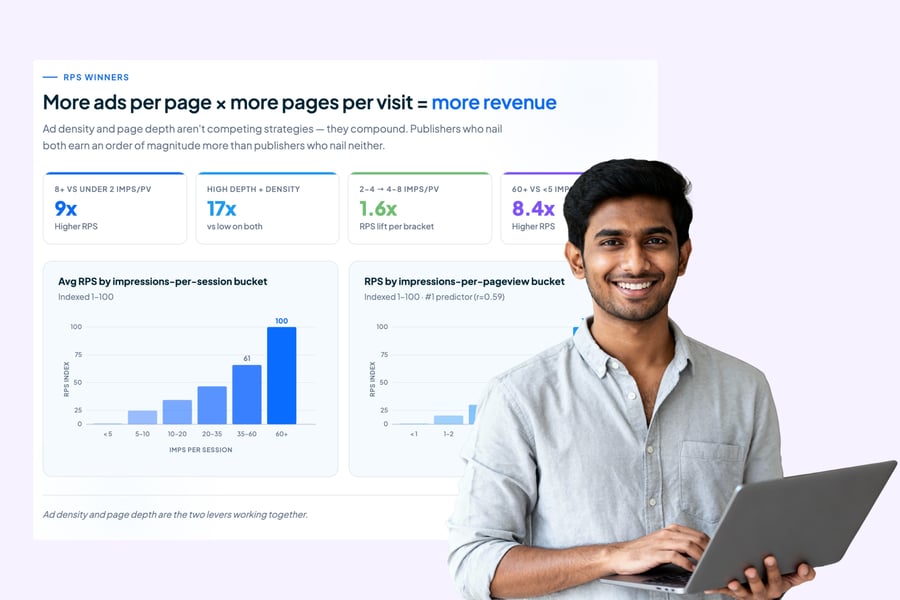
- Combining high ad density with high page depth creates a 17x RPS multiplier versus publishers below the median on both.
- Optimizing for the wrong metric isn't neutral. It costs money.
Ad density is the count of ad impressions served relative to page content or page loads. Most industry coverage treats it as a ceiling to manage: a UX risk, a compliance checkbox, something to keep under control. The data from the 2026 State of Publisher Ad Revenue Report tells a completely different story.
Across thousands of publisher sites in the Playwire ecosystem, impressions per pageview (r = 0.59) is the single strongest predictor of revenue per session, ahead of fill rate, viewability, CPM, and session duration. The publishers leaving the most money on the table aren't the ones with too many ads. They're the ones running under 2 impressions per pageview who haven't recognized it as a structural revenue problem.
The common framing gets it backwards. Under-density is a far more expensive mistake than over-density for most publishers. The gap between low-density and high-density publishers is not marginal.

What the Data Shows
Playwire's State of Publisher Ad Revenue 2026 report correlates every available performance metric against revenue per session across thousands of publisher sites. The hierarchy that emerges is unusually clear.
| Metric | Correlation with RPS (Pearson r) | Interpretation |
|---|---|---|
| Impressions per pageview | 0.59 | Strong positive — #1 predictor |
| Impressions per session | 0.55 | Strong positive — #2 predictor |
| Pageviews per session | 0.27 | Moderate positive |
| CPM | 0.22 | Moderate positive |
| Viewability | 0.15 | Weak positive |
| Fill rate | 0.12 | Weak positive |
| Session duration | −0.03 | No relationship |
Impressions per pageview edges out impressions per session at the top, which tells you something important: how many ads appear on each individual page load is a sharper lever than the cumulative session total. Every page that loads is an independent monetization event. Configure it accordingly.
Session duration sitting at −0.03 is worth a pause. The industry treats time-on-site as a proxy for audience quality. For ad revenue, it's noise. A user parked on a single page for an hour isn't generating new impressions. They're just an open tab.
The 21x Gap Is Not a Typo
The per-page numbers get dramatic fast. The indexed RPS data by impressions per pageview bracket makes the case better than any strategic argument.
| Impressions per pageview | Avg RPS (indexed 1–100) | Multiplier vs. baseline |
|---|---|---|
| < 1 impression/PV | 1 | Baseline |
| 1–2 impressions/PV | 9 | 2.6x |
| 2–4 impressions/PV | 20 | 4.9x |
| 4–8 impressions/PV | 35 | 8.1x |
| 8–15 impressions/PV | 49 | 11x |
| 15+ impressions/PV | 100 | 21x |
Publishers averaging 15+ impressions per pageview earn 21 times more per session than those under 1 impression. Even the step from 2–4 to 4–8 impressions per pageview is a 1.6x lift. These aren't marginal gains from testing headline variants. This is structural revenue difference, baked into how pages are built.
The step-change between each bracket is consistent enough to suggest a near-linear relationship. More impressions per page compounds at scale. If you're running a high-traffic site at 1–2 impressions per pageview, the math on what you're leaving behind is uncomfortable.
Essential Background Reading:
- 5 Ad Revenue Metrics Publishers Should Track that Might Surprise You: The metrics most publishers watch aren't the ones that actually predict revenue, find out which ones do.
- Publisher Ad Revenue Maturity Model: Where Are You on the Revenue Curve?: Understand where your current monetization strategy sits relative to the top performers in the dataset.
- What Separates the Top 10% of Website Publishers from Everyone Else (Data-Backed): A data-backed look at the structural differences between high-earning publishers and the rest of the field.
Does Higher Ad Density Always Increase Revenue?
Not automatically. But for most publishers, the answer is closer to yes than conventional wisdom suggests. The risk of over-density is real: too many ad calls per page fragments demand and correlates negatively with fill efficiency (r = −0.18 for requests per pageview). Buyer competition gets diluted across too many simultaneous auctions, and fill on individual units drops.
The practical ceiling isn't "as many ads as will physically fit." It's the point where adding units stops generating net-new revenue and starts cannibalizing existing fill. For most publishers in the dataset, that ceiling is well above where they're currently operating. The more common constraint is under-density: publishers who've added one or two units and stopped, leaving the majority of the density curve untouched.
The right question isn't "how many ads is too many?" It's "what density level maximizes RPS for my vertical, audience, and page architecture?" Those answers differ. The section below on verticals covers why.

A Note on the 30% Rule
The Coalition for Better Ads standard, often summarized as "keep ads below 30% of page heightm" is a compliance floor, not a revenue optimization target. It establishes the minimum threshold for acceptable user experience by Google's definition. It does not tell you what density maximizes revenue.
Publishers can run above 30% ad-to-content ratios in ways that remain fully compliant. Below-fold units, in-content formats, sticky placements, and interstitials used appropriately all operate outside the simple viewport density calculation. Treating the 30% rule as a strategic ceiling is a misread of what it actually governs.
Compliance and optimization are separate problems. The 30% rule answers the first one. Your RPS data answers the second.
Related Content:
- Session Duration Is a Lie. Page Depth Is the Signal.: Why the metric most publishers use to measure engagement has almost no relationship with ad revenue, and what to watch instead.
- Fill Rate Is the Most Underrated Revenue Lever, Though Complex to Change: Fill rate sits below ad density in the correlation rankings, but the gap between 40% fill and 90% fill is anything but marginal.
- How to Right-Size Your Price Floors Without Leaving Money on the Table: The floor price trap is real and quantifiable, here's how to calibrate floors to the demand actually present, not the demand you wish were there.
- The Publisher's Guide to Viewability Optimization: Chasing Perfect isn't the Answer: The 80–90% viewability bracket outperforms the 90%+ bracket, this guide explains why and what to do instead.
Session Depth Makes It Compound
Ad density per page is the sharpest lever, but it doesn't operate in isolation. Pageviews per session (r = 0.27) is the third strongest RPS predictor in the dataset. More pages per visit means more page loads, which means more impressions, which means more revenue.
Session duration alone doesn't help. A user who spends 40 minutes on a single article page isn't serving fresh ad inventory. Duration without new page loads is just an open tab.
The combined effect of page depth and ad density is where things get genuinely significant.
| Publisher segment | Avg RPS (indexed 1–100) |
|---|---|
| Low page depth + Low ad density | 1 (baseline) |
| Low page depth + High ad density | 69 |
| High page depth + Low ad density | 56 |
| High page depth + High ad density | 100 |
High ad density alone gets you to 69x the baseline. High page depth alone gets you to 56x. Combining both pushes to 100 on the index, a 17x multiple over publishers below median on both dimensions.
That's the compound effect. A publisher building for multi-page sessions with dense per-page ad layouts is playing a fundamentally different revenue game than one focused on CPM. Content architecture, the structures that move users from one page to the next, is one of the most underleveraged monetization levers in the dataset. Education publishers understand this intuitively because lesson loops do it naturally. Most others don't build for it deliberately.
Next Steps:
- How to Increase Impressions Per Pageview Without Hurting User Experience: A practical guide to moving up the density curve without sacrificing the page depth that makes density valuable in the first place.
- How to Build a Website Content Architecture That Earns More Ad Revenue: Content architecture is one of the most underleveraged monetization levers in the dataset, here's how to build for multi-page sessions deliberately.
- How to Diagnose and Fix Your Fill Rate Problem: Once your density is right, fill rate is the next lever, this guide walks through diagnosing exactly where fill is breaking down.
- Publisher Revenue Optimization by Vertical: How to Maximize Ad Revenue in YOUR Vertical: The primary revenue lever isn't universal, this guide covers the right optimization strategy for each content vertical.
What "Optimization" Means
Most publishers treat optimization as a CPM problem. Find better demand partners. Tighten floors. Chase higher viewability. Real gains are available in all of those places, but the correlation data is clear about where the ceiling is.
CPM correlates with RPS at 0.22. Viewability at 0.15. Fill rate at 0.12. These levers matter, but they're downstream of the primary structural question: how many impressions are you serving per page, and how many pages are your visitors loading?
Ad layout decisions are monetization decisions. They just don't always get treated that way. The choice of how many ad units to put on a page, where to put them, and how to architect content for multi-page sessions isn't an editorial or UX question with revenue implications on the side. It's a revenue decision with UX constraints to manage.
Publishers who internalize this tend to approach their ad layout with more intentionality. Instead of asking "where can we fit one more unit," they ask "what's the right density to maximize RPS without degrading the user experience that drives page depth in the first place." That's the actual optimization problem.
The Viewability Trap
Viewability does correlate positively with RPS (r = 0.15), but there's a ceiling effect the data makes explicit. The 80–90% viewability bracket outperforms the 90%+ bracket on median RPS.
| Viewability bracket | RPS (indexed 1–100) |
|---|---|
| < 60% | 35 |
| 60–70% | 75 |
| 70–80% | 80 |
| 80–90% | 100 |
| 90%+ | 81 |
Chasing 95% viewability at the expense of fill rate is a losing trade. Past 80%, buyer differentiation shifts to fill rate, inventory volume, and audience quality, not marginal viewability improvements. If you're sacrificing fill to hit a viewability benchmark, you're optimizing in the wrong direction.
See It In Action:
- Gaming Publisher Revenue Guide: Why Ad Density Is Everything: How gaming publishers specifically can apply the ad density findings from the dataset to move RPS meaningfully.
- Education Publisher Ad Revenue Monetization: The Lesson Loop Advantage: Education has the strongest impressions-per-session correlation in the dataset, here's why lesson loops are the structural reason.
- How to Recover Publisher Revenue After Losing Amazon as a Bidder: Demand breadth matters as much as density, this covers the structural revenue gap created when a major bidder disappears.
Ad Density by Vertical: Different Levers for Different Publishers
One finding in the data deserves its own section: the primary RPS driver isn't universal — it's vertical-specific, and the split is clean.
Gaming, entertainment, and education are inventory volume businesses. Impressions per session drives RPS in those verticals with correlations as high as r = 0.93 for education. Sports, news, and technology are audience quality businesses, where CPM and demand pool depth dominate. Adding more ad units per page moves the needle very little when audience premium is the primary variable.
Gaming: Impressions per session is the primary driver (r = 0.79). Fill rate correlates with gaming RPS at essentially zero (r = −0.01). Ad density per session is what drives gaming revenue, not CPM, not fill. The 48 gaming sites with above-median impressions per session but below-average fill suggest demand gaps rather than layout problems.
Entertainment: Also a volume business (r = 0.70), but with a geographic constraint. Fill rate matters meaningfully here too (r = 0.51), suggesting entertainment audiences have more geographic diversity that caps demand pool depth. Top-quartile fill entertainment publishers average 3x the RPS of bottom-quartile peers.
Education: The strongest impressions-per-session correlation in the dataset (r = 0.93). Session duration averages 8 hours, but it's page depth and ad density that convert that time into revenue. Top performers show 5x+ the network average RPS, with high fill and 28+ impressions per session.
Sports: CPM runs 64% above the gaming average, but impressions per session is less than half (6.6 vs. 14.4). Audience quality drives everything in sports. More ad units per page matters far less than protecting the audience premium.
News: Highest average CPM of any vertical, but visitors barely browse at 1.52 pages per session. Revenue here is almost entirely a demand pool story. Adding more ad units per page won't move the needle the way audience quality optimization will.
Technology: Highest average RPS index of any named vertical (199), but with massive variance. A few outliers are doing heavy lifting. Top-quartile fill technology publishers reach an RPS index of 342. Geo-rich tech audiences have outsized upside.
A gaming publisher chasing CPM improvements is solving the wrong problem. A news publisher obsessing over ad density is doing the same. Knowing which lever is primary in your vertical is the starting point for any rational optimization strategy.
Frequently Asked Questions About Ad Density and Publisher Revenue
These are the questions publishers most commonly ask when they start taking ad density seriously as a revenue lever.
What is a good impressions per pageview ratio for publishers?
Based on Playwire's dataset, publishers averaging 4–8 impressions per pageview earn roughly 8x more per session than those under 1 impression per pageview. Publishers at 15+ impressions per pageview earn 21x more. There's no single "good" ratio — it depends on vertical, content type, and audience — but most publishers in the dataset are operating well below the levels where density begins to optimize revenue.
How many ads per page is too many?
The practical ceiling is where additional ad units stop generating net-new revenue and start cannibalizing existing fill through request fragmentation. Requests per pageview correlates negatively with fill efficiency (r = −0.18), meaning too many simultaneous ad calls dilute buyer competition. For most publishers, that ceiling is higher than where they currently operate — but the right number depends on format mix, page layout, and demand configuration, not a universal rule.
Does higher ad density always increase revenue?
Not automatically. Density that fragments demand or degrades the user experience to the point where it reduces page depth will hurt RPS. But for the majority of publishers in the dataset, the relationship between density and revenue is positive, and the bigger risk is running too few impressions per page. The data shows a near-linear step-change in RPS as impressions per pageview increases.
How does ad density affect CPM?
Within a fixed demand pool, adding more inventory can put downward pressure on CPMs. That's the core tension. But the fill and impression volume gains typically more than compensate. Publishers with right-sized floors and adequate demand breadth see RPS improve even when per-impression CPMs flatten, because total inventory served increases. The aggregate revenue math usually favors density over CPM protection.
What metrics should I track alongside ad density?
Impressions per pageview is the primary metric. Track it alongside pageviews per session, revenue per session, fill rate by ad unit, and viewability at the unit level. The interaction between impressions per pageview and pageviews per session is where the compound effect appears. Both metrics together are more predictive of RPS than either alone.
How Playwire Approaches This
Playwire's RAMP platform is built around the insight that ad layout and session architecture are revenue decisions, not afterthoughts. The yield ops team works with publishers to configure ad density that maximizes RPS within their specific vertical, audience geography, and user experience constraints.
The Advanced Yield Analytics in RAMP give publishers page-level visibility into exactly which content types and layouts are driving revenue. GTPlanet owner Jordan Greer put it plainly: "I can't overstate how important the data provided by RAMP's Advanced Yield Analytics is for me as a publisher. It is something I've never seen before but always wanted. Now that I have it, I feel like I have been flying blind for the past 21 years."
That's not a feature pitch. That's what happens when you can finally see which pages, content types, and layouts are actually earning.
The publishers who move up the RPS curve fastest aren't the ones who find a slightly better SSP. They're the ones who rebuild their ad layouts to serve more impressions per page, architect content for multi-page sessions, and use data to verify that the changes are working. That's the work. We do it with you.
If you're ready to find out what your RPS ceiling actually looks like, apply to work with Playwire and we'll show you where you stand.
