
-1.png?width=800&height=157&name=1-playwire-logo-primary-2021%20(1)-1.png)


August 13, 2026

Editorial Policy
All of our content is generated by subject matter experts with years of ad tech experience and structured by writers and educators for ease of use and digestibility. Learn more about our rigorous interview, content production and review process here.
.png?width=900&name=Breaking%20News%20Placeholder%20(1).png)
Key Points
- Ad tech's Q2 earnings season exposed a deepening structural problem: revenue growth no longer satisfies Wall Street if investors doubt long-term positioning outside Big Tech.
- Amazon, Google, and Meta now account for roughly 56% of U.S. advertising spend, and that share is projected to climb, shrinking the slice available to independent ad tech.
- The Trade Desk's 3% growth and 22% stock drop, alongside AppLovin's 53% growth and 20% stock drop, show that the market is pricing future trajectory, not current performance.
- Consolidation is accelerating. DoubleVerify, IAS, and LiveRamp are all exiting public markets, and more take-private deals are expected.
- Publishers operating on the open web need to treat revenue diversification and yield optimization as urgent priorities, not long-term planning items.
What Happened
Digiday's Q2 ad tech earnings roundup laid out the current landscape of the ad tech industry. The numbers from Q2 weren't uniformly bad. AppLovin posted 53% revenue growth. The Trade Desk grew 3%. Taboola was up 2.4%. Several companies were making money. Wall Street punished them anyway.
AppLovin dropped nearly 20% after earnings. The Trade Desk fell 22%. Taboola and Teads each dropped over 24%. Criteo's stock fell 24% after an 11% revenue decline, with its AI narrative appearing to lose investor confidence.
A handful of companies came out ahead. PubMatic rose 20.8% post-earnings. Magnite climbed 8.6%. Zeta Global gained 13% after reporting 44% revenue growth. But even those wins feel contextual. The overall message from investors was clear: posting revenue growth is no longer sufficient to justify valuations.
See It In Action:
- Playwire Partners With Enthusiast Gaming: How a large publisher network built monetization depth and drove revenue growth through a full-stack partnership.
Why Wall Street Is Losing Patience With Independent Ad Tech
The core issue isn't quarterly performance. It's structural positioning.
Madison & Wall analyst Luke Stillman told Digiday that Q2 ad growth is running ahead of expectations, but the beneficiaries are concentrated. Amazon, Google, and Meta captured roughly 56% of U.S. advertising last year. Stillman's firm expects that figure to reach about 58% this year, with further increases likely after that.
Independent ad tech companies aren't failing to grow. They're competing for a smaller relative share of a market that is itself expanding. Madison & Wall projected a 1.4% decline across the broader open internet ecosystem, even as overall digital advertising is forecast to grow 12.2% in 2026.
The walled gardens are growing faster, investing heavily in AI-driven optimization, and their data advantages compound over time. Independent platforms, meanwhile, are asked to justify premium take rates against platforms like Amazon's DSP, which can price aggressively because ad revenue isn't its only business model.
The Trade Desk's situation illustrates this clearly. CEO Jeff Green acknowledged that some advertisers have shifted toward "buying cheap media rather than the best media." That's not a temporary blip. It reflects a real change in buyer behavior that advantages scale platforms over best-of-breed alternatives.
Essential Background Reading:
- Publisher Ad Tech Stack: A breakdown of the technology layers publishers need to understand before evaluating their monetization exposure.
- Publisher Ad Revenue Maturity Model: Where does your monetization stack actually sit on the maturity curve? Start here before optimizing anything.
- Ad Tech Glossary Resource Center: DSPs, SSPs, take rates, walled gardens: a reference for every term in this conversation.
- Advertising Terms: Core definitions for the programmatic concepts underpinning the structural shifts discussed here.
The Consolidation Signal
The public market exits tell the same story through a different lens.
DoubleVerify is being acquired by Nielsen for $2.15 billion. Integral Ad Science went private via Novacap for $1.9 billion. Publicis is acquiring LiveRamp, taking it off the NYSE. Criteo faces ongoing take-private speculation.
Analyst commentary, including observations from Ciarán O'Kane of First Party Capital cited by Digiday, suggests these aren't pure distress sales. The thesis is that combining complementary data assets creates a stronger equity story than any of those companies could build alone in the current public market environment. Nielsen's TV reach data plus DoubleVerify's verification and activation capabilities is a more coherent pitch than either company makes independently.
Stillman's read on the consolidation trend is pragmatic: valuations are depressed, making acquisitions easier to finance. Buyers are pursuing proprietary datasets and capabilities that differentiate otherwise commoditized technology. The companies being acquired aren't necessarily broken. They're easier to buy now, and the strategic rationale is more compelling when the market is skeptical about standalone growth stories.
More take-private deals are expected before the end of the year.
Related Content:
- DSPs Are Coming for the Supply Chain: How buy-side consolidation is reshaping publisher leverage in the programmatic stack.
- Omnicom Wants Fewer Middlemen: What agency consolidation pressure means for publishers who rely on intermediary demand.
- Agentic AI Promises Are Not a Revenue Strategy Yet: Why AI narratives aren't translating into publisher revenue, and what actually moves the needle.
- Ad Revenue Growth Using AI and Machine Learning: Where AI optimization creates real yield improvements versus where it's still hype.
What This Means for Publishers
The structural shift happening in ad tech doesn't affect all publishers equally, but open web publishers are directly in the path of it.
If walled garden share continues to increase, advertiser dollars concentrate further in closed ecosystems. Programmatic CPMs on the open web face downward pressure. Publishers who rely on a single monetization approach or a thin demand stack are most exposed.
The right response isn't panic. It's operational discipline, applied now.
Here's what publishers should be focused on:
- Demand stack depth: A narrower demand stack means more exposure to any single platform's pricing behavior. Breadth across SSPs and direct demand matters more as programmatic dynamics shift.
- Revenue per session: CPM optimization is necessary but not sufficient. RPS across your full session, including format mix, viewability, and user experience, determines actual yield.
- Direct demand: Programmatic open auction revenue is the most volatile component of a publisher's monetization stack. Direct relationships provide a floor.
- Viewability and quality: Advertiser scrutiny increases as budgets concentrate. Publishers with strong viewability metrics (targeting 70-90%) and clean inventory are better positioned for direct deals and premium programmatic demand.
The consolidation happening at the ad tech infrastructure level creates uncertainty. Publishers who have built yield resilience into their stack are insulated from that uncertainty. Publishers who haven't are more dependent on whatever pricing dynamics emerge from a more consolidated market.
Next Steps:
- Publisher Ad Revenue Maturity Model Assessment: Benchmark your current monetization stack and identify where structural vulnerabilities exist.
- Yield Experiment Playbook: A practical framework for testing yield changes without blowing up your existing revenue.
- Publisher Ad Revenue Maturity Model Guide: The full guide to moving up the maturity curve, from single-stack dependency to diversified yield.
- The Publisher's Guide to Viewability Optimization: How to hit the viewability thresholds that unlock premium demand without sacrificing user experience.
The Playwire Perspective
We run monetization infrastructure for publishers across gaming, education, news, and entertainment. We see the open web demand dynamics that Stillman describes. Programmatic revenue is real, but it's not immune to structural pressure.
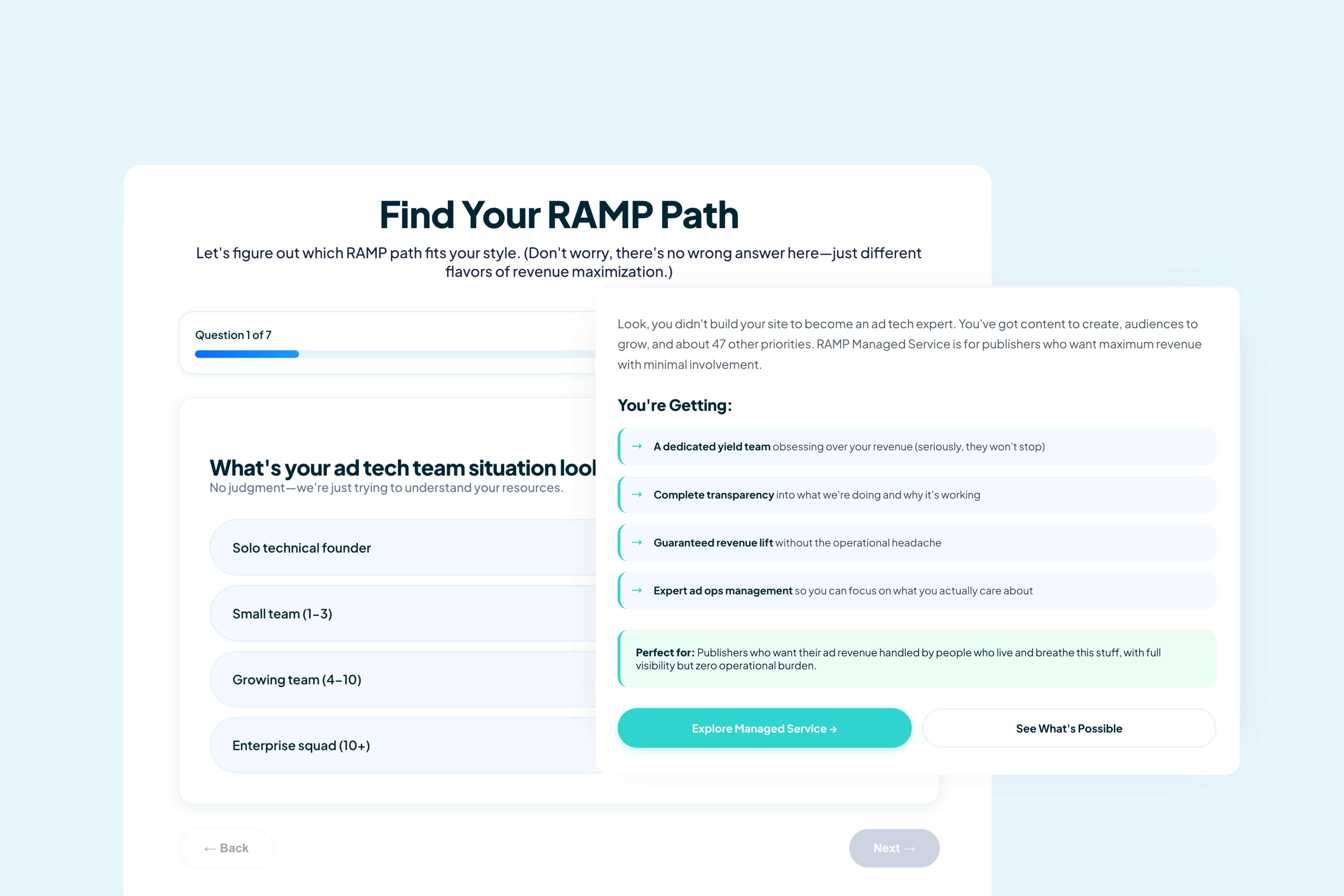
What we build for publishers is depth: a full demand stack, direct sales capabilities, and yield optimization that works across formats and sessions. Our RAMP platform is designed to ensure publishers aren't dependent on any single revenue channel or auction type.
If the broader ad tech market is telling publishers anything this quarter, it's that single-point dependencies are a risk. Amplify Your Ad Revenue means building a monetization stack that holds up regardless of where walled garden share ends up in 2026.
