
-1.png?width=800&height=157&name=1-playwire-logo-primary-2021%20(1)-1.png)


January 19, 2026

Editorial Policy
All of our content is generated by subject matter experts with years of ad tech experience and structured by writers and educators for ease of use and digestibility. Learn more about our rigorous interview, content production and review process here.
.jpg?width=900&name=Beyond%20AdSense%20Smart%20Alternatives%20for%20Publishers%20Ready%20to%20Amplify%20Revenue%20(1).jpg)
Google AdSense is a popular advertising platform that allows publishers to earn money by displaying ads on their websites, but it's not the only option available. As publishers seek higher revenue and more control over their monetization strategy, AdSense alternatives like header bidding platforms and managed monetization services have emerged as powerful ways to maximize ad revenue while maintaining user experience.
For publishers earning at least $1,000 per month from ads, switching from AdSense to a comprehensive header bidding solution can increase revenue by 50-200% on average. The key is understanding which alternative matches your technical capabilities, traffic profile, and revenue goals.
Need a Primer? Read this first:
- What is Header Bidding?: Understand the technology that creates real competition for your ad inventory
- What is Ad Yield Management?: Learn the fundamentals of optimizing your ad monetization setup
Why Publishers Outgrow AdSense
Google AdSense deserves credit for making ad monetization accessible to publishers of all sizes. Slap some code on your site, watch the pennies roll in, and focus on creating content. For new publishers building traffic, this simplicity holds genuine appeal.
The problem emerges as your site matures. AdSense operates as a closed auction where Google controls both the demand and the rules. You get one buyer (Google's ad network) bidding against itself, with limited transparency into what's actually happening with your inventory.
This model leaves serious money on the table. Publishers with substantial traffic need real competition for their ad impressions, not a single buyer dictating terms. They need granular analytics showing exactly which content drives revenue. They need support teams who actually respond when problems arise.
The platform operates on a cost-per-click (CPC) model where publishers earn money each time a visitor clicks an ad, with Google taking approximately 32% of advertiser spend as its share. When you're pulling in 500,000+ monthly sessions, every percentage point of optimization translates to real money. AdSense's one-size-fits-none approach becomes a revenue ceiling rather than a foundation.
Here's what's driving publishers to explore alternatives:
- Revenue ceiling with single-demand source. AdSense limits publishers to Google's advertising demand exclusively. This creates a revenue ceiling because there's no real competition for your inventory. When multiple demand sources compete simultaneously through header bidding, CPMs typically increase by 30-70% due to actual auction pressure.
- Limited transparency and control. AdSense operates as a closed ecosystem where publishers can't see bid-level data, adjust price floors strategically, or optimize demand paths. Modern alternatives provide granular analytics showing exactly which demand sources are bidding on your inventory and at what prices, enabling data-driven optimization that AdSense simply can't match.
- Ad quality and user experience concerns. Publishers have minimal control over which ads appear on their sites through AdSense. Alternative platforms often provide more sophisticated brand safety controls, category blocking, and creative approval workflows that help maintain site quality while maximizing revenue.
- Account suspension risks. Google's automated compliance system can trigger immediate demonetization for policy violations, sometimes with limited recourse. Diversifying across multiple revenue streams through header bidding reduces this single-point-of-failure risk that keeps publishers up at night.
- Payment terms and thresholds. AdSense pays Net-30 or Net-60 with a $100 minimum threshold. Many alternatives offer Net-15 payment cycles, lower minimums, and more flexible payment options, improving cash flow for smaller publishers who need reliable revenue timing.
Take the Adsense Alternatives Quiz
What Makes a Strong AdSense Alternative
Not all monetization platforms deserve consideration as AdSense replacements. The best alternatives share specific characteristics that separate legitimate solutions from vendors who overpromise and underdeliver.
True Header Bidding Implementation
Header bidding creates real competition by allowing multiple demand sources to bid simultaneously on your inventory. Unlike AdSense's closed auction, this open competition drives CPMs higher through actual market dynamics.
Quality header bidding solutions manage relationships with 15+ SSPs and demand partners, each bringing unique advertiser relationships and buying behavior. When Amazon Publisher Services, AppLovin, OpenX, PubMatic, and a dozen other buyers compete for the same impression, publishers win.
The technical implementation matters. Client-side header bidding loads in the browser and can slow page speed. Server-side solutions move the auction off-page, preserving performance while maintaining competition. Hybrid approaches combine both methods strategically.
The shift from sequential to simultaneous bidding fundamentally changes the economics. Instead of advertisers competing only within Google's ecosystem, they compete against demand from multiple premium sources. This increased competition drives measurable revenue improvements, with publishers implementing header bidding reporting average CPM increases of 30-70% compared to AdSense alone.
Advanced Analytics and Reporting
AdSense reporting tells you what happened two days ago. Professional monetization platforms provide real-time analytics showing exactly how your content drives revenue, down to the penny, right now.
This visibility transforms how you make decisions. When you can see that your morning traffic from organic search generates 40% higher RPMs than your afternoon social media traffic, you optimize accordingly. When a specific content type consistently outperforms, you create more of it.
Real-time reporting also catches problems before they compound. Revenue dip at 3am? You know by 3:05am, not when you check your dashboard two days later and discover you've lost thousands of dollars.
Expert Yield Management
Managing header bidding partnerships, price floors, ad layouts, and demand optimization requires specialized expertise. The best AdSense alternatives include dedicated yield operations teams who obsess over your revenue because their success depends on yours.
These teams monitor performance 24/7, implement optimizations, troubleshoot issues, and fight for every cent of revenue. When an SSP changes their policies, when a demand partner experiences technical issues, when opportunities emerge in the market, yield experts act immediately.
Solo publishers can't maintain this level of vigilance while also creating content, managing their sites, and handling the dozen other responsibilities that come with running an online business. Yield management expertise matters.

Flexible Control Options
Different publishers need different levels of control. Technical publishers who want hands-on management of their ad stack need granular settings and full transparency. Creators focused on content production need managed services that handle everything automatically.
Strong AdSense alternatives accommodate both approaches. Publishers choose where they want control and where they prefer automation. This flexibility matters because your needs evolve as your business grows.
Evaluating AdSense Alternatives by Publisher Type
The best monetization platform for your site depends heavily on your publisher profile, technical capabilities, and business objectives. What works brilliantly for one publisher type fails miserably for another.
For Technical Publishers (Solo or Small Teams)
Technical publishers who understand ad tech and want control over their monetization strategy need platforms that respect their expertise while providing tools that scale beyond what individuals can manage alone.
What to prioritize:
- Granular controls: Full access to bidder settings, price floors, ad unit configurations, and auction logic
- Real-time analytics: Instant visibility into performance metrics at the impression level
- API access: Ability to integrate analytics with your own tools and workflows
- Expert support when needed: Access to yield ops and engineering expertise for complex optimizations
These publishers typically manage 1-5 sites with substantial traffic. They speak fluent JavaScript, understand programmatic advertising, and want to treat ad optimization like a competitive sport. The right platform gives them professional-grade tools without requiring enterprise overhead.
Publishers with development resources gain maximum flexibility with self-serve platforms. Those without technical staff benefit from managed solutions that handle implementation and ongoing optimization.
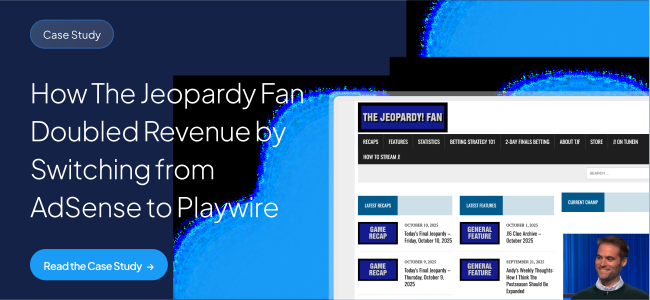
Revenue expectations: Technical publishers switching from AdSense to advanced platforms with self-service capabilities typically see 75-150% revenue increases, with top performers doubling their previous earnings.
For Premium Publishers (Medium-Sized Teams)
Premium publishers have built recognized brands with loyal audiences. They employ content teams, understand their audience deeply, and refuse to compromise user experience for marginal revenue gains.
What to prioritize:
- Brand-first approach: Monetization strategies that enhance rather than detract from user experience
- Premium demand access: Direct relationships with quality advertisers willing to pay for premium placements
- Customization options: Ability to tailor ad layouts, formats, and experiences to match brand standards
- Advanced UX tools: Testing capabilities, viewability optimization, and user experience monitoring
These publishers typically operate 1-3 high-quality sites with engaged audiences. Revenue matters, but not at the expense of the brand they've spent years building. The right platform understands this balance.
Publishers who optimize ad placement quality over quantity often see higher CPMs because advertisers pay more for attention and viewability. Building audience segments from first-party data makes inventory more valuable, with robust data strategies commanding 30-50% higher CPMs for targeted inventory.
Revenue expectations: Premium publishers moving beyond AdSense typically see 100-200% revenue increases while maintaining or improving user experience metrics.

For Portfolio Publishers (Enterprise Scale)
Portfolio publishers manage multiple sites, often acquired over time. They need operational efficiency, consolidated reporting, and solutions that scale across diverse properties without requiring individual customization.
What to prioritize:
- Operational simplification: Single payment, unified reporting, GAAP compliance
- Network effects: Ability to leverage learnings across multiple properties
- Cost reduction: Transform ad operations from cost center to profit center
- Expert team access: Full yield ops, ad ops, and technical support without building in-house
These publishers juggle 5-50+ sites with varying traffic levels and verticals. Managing individual monetization strategies for each property creates unsustainable complexity. The right platform streamlines operations while maximizing revenue across the entire portfolio.
Revenue expectations: Portfolio publishers consolidating fragmented monetization strategies typically see 50-125% revenue increases while dramatically reducing operational overhead.
Related Content:
- How Much Ad Revenue Can a Website Make?: Benchmark your earnings against industry standards by traffic tier
- How to Manage and Monitor Your Website Ad Revenue Metrics: Track the metrics that matter for catching revenue drops fast
- Best Practices for Ad Clutter and Ad Density: Balance revenue optimization with user experience like a pro
Top AdSense Alternatives Worth Considering
The monetization platform landscape includes dozens of vendors making big promises. Here's what actually separates legitimate solutions from noise.
Platform Type | Best For | Key Differentiator | Typical Revenue Lift |
Publishers wanting comprehensive solutions | Complete ad tech stack with expert support | 75-200% | |
Header Bidding Wrappers | Technical publishers maintaining control | Advanced auction management with flexibility | 50-150% |
SSP Direct Relationships | Enterprise publishers with scale | Direct demand access, but requires technical resources | 40-100% |
Ad Networks | Publishers seeking simplicity over optimization | Easy implementation, limited control | 20-60% |
Full-Stack Monetization Platforms
Full-stack platforms provide everything publishers need to maximize ad revenue in a single solution. These platforms combine header bidding, ad serving, analytics, yield management expertise, and often direct sales capabilities.
When to choose this approach:
- You want guaranteed revenue improvement without building internal ad ops expertise
- Your traffic has reached 500,000+ monthly sessions
- You'd rather focus on content than ad tech infrastructure
- You value expert support and ongoing optimization
Full-stack platforms work for publishers who recognize that maximizing ad revenue requires specialized expertise they don't want to develop in-house. These solutions deliver the highest revenue potential while consuming the least publisher time and attention.
Playwire RAMP Platform: Provides managed service or self-service options depending on publisher preference. Publishers get AI-driven optimization managing approximately 1.2 million price floor rules per website, traffic shaping worth a 12% RPS boost, expert yield management, real-time analytics, and access to premium direct demand. Average revenue lift of 100%+ compared to AdSense.
Best for: Publishers with 500,000+ monthly pageviews seeking managed optimization and premium demand access. Serves vertical including News, Lifestyle, Gaming, Entertainment, Casual Gaming, Education, and more.
Key features: Proprietary AI-driven price flooring, global direct sales team access, high-impact ad units, real-time analytics, enterprise-grade infrastructure.
Traffic requirements: Minimum 500,000 monthly pageviews.
Revenue share: Transparent revenue split based on services utilized.
Lifestyle-Focused Platforms
Mediavine focuses exclusively on lifestyle content publishers, offering highly optimized ad layouts and strong community support.
Best for: Lifestyle, food, parenting, and DIY bloggers with consistent traffic.
Key features: Proprietary video player, site speed optimization, dedicated support community.
Traffic requirements: 50,000 monthly sessions minimum.
Revenue share: Competitive rates for qualifying publishers.
AI-Driven Testing Platforms
Ezoic uses AI-driven testing to optimize ad placements and layouts across your site automatically.
Best for: Publishers wanting automated optimization with minimal technical involvement.
Key features: AI layout testing, site speed tools, analytics platform.
Traffic requirements: 10,000 monthly visitors.
Revenue share: Free tier available, premium tiers with revenue share.
Header Bidding Wrapper Providers
Header bidding wrappers give technical publishers the tools to manage their own unified auctions while maintaining relationships directly with SSPs and demand partners.
When to choose this approach:
- You have technical resources to manage complex integrations
- You want full control over your ad stack
- You're willing to handle SSP relationships and troubleshooting
- You have time to actively manage and optimize your setup
Wrapper solutions require ongoing technical management but offer maximum control for publishers who want hands-on optimization. You'll need to handle SSP integrations, manage timeout settings, optimize price floors, and troubleshoot issues when they arise.
Prebid.js (Open Source): Free header bidding wrapper that works brilliantly if you have engineering resources and yield expertise. Requires significant technical knowledge and ongoing management.
MonetizeMore: Provides header bidding management with PubGuru technology for technical publishers who want hands-on optimization support with expert guidance.
Traffic requirements: 10,000+ monthly pageviews.
Direct SSP Relationships
Publishers with significant scale can establish direct relationships with supply-side platforms, bypassing intermediaries entirely.
When to choose this approach:
- You consistently deliver 10+ million monthly pageviews
- You have dedicated ad ops and yield management teams
- You want maximum control and minimum revenue share
- You can manage multiple vendor relationships simultaneously
Direct SSP relationships offer the lowest take rates but require the most publisher resources. You'll manage individual contracts, integrations, reporting systems, and optimization for each partner. Most publishers find this approach too resource-intensive until they reach substantial scale.
Next Steps:
- Why We'll Suggest That You Change Your Layout: Understand why ad layout optimization is crucial after switching platforms
- Revolutionizing Unified Pricing Rules: Discover how AI-driven price flooring can boost revenue 20%+
What Revenue Increase Should You Expect?
Publishers switching from AdSense to advanced monetization platforms consistently ask the same question: how much more will I make? The honest answer requires examining multiple factors that influence revenue performance.
Traffic Volume Matters
Higher traffic provides more data for optimization algorithms to learn from and creates opportunities for premium direct deals. The revenue lift percentages tend to increase with traffic volume.
Monthly Sessions | Typical Revenue Increase | Revenue Floor | Revenue Ceiling |
500,000 | 75-125% | $5,000/month | $10,000/month |
1 Million | 100-150% | $10,000/month | $25,000/month |
5 Million | 125-175% | $50,000/month | $185,000/month |
10+ Million | 150-200% | $100,000/month | $400,000/month |
These ranges assume US-majority traffic and quality content that attracts engaged users. Your actual results depend on vertical, audience composition, and content quality.
Content Vertical Influences CPMs
Advertiser demand varies dramatically by vertical. Finance, technology, and B2B content typically commands higher CPMs than general entertainment. Gaming audiences offer unique high-impact opportunities. Educational content attracts quality advertisers seeking engaged learners.
Publishers in high-value verticals see larger absolute revenue increases even if the percentage lift matches lower-value categories. A 100% increase on a $20 AdSense RPM delivers far more than the same percentage lift on a $5 RPM.
Implementation Quality Drives Results
The same platform delivers wildly different results depending on implementation quality. Proper ad layout optimization, appropriate ad density, strategic use of high-impact units, and ongoing yield management separate top performers from average results.
Publishers who actively participate in optimization, test new ad formats, and work strategically with their monetization partner consistently outperform those who implement and forget. The relationship between publisher and platform matters.
How to Choose the Right Alternative for Your Site
Selecting the optimal AdSense alternative requires evaluating several critical factors specific to your publishing business.
Traffic Volume and Geographic Mix
Your monthly traffic volume and visitor geography significantly impact which alternatives make sense. Some platforms require minimum traffic thresholds, while others accept smaller publishers but with different service levels.
Traffic from Tier 1 countries (United States, Canada, United Kingdom, Australia) generally commands higher CPMs across all platforms. If your audience is primarily Tier 3 geography, some platforms may not provide meaningful improvements over AdSense.
Click-Through Rate Analysis
The relationship between CTR and optimal monetization strategy is often misunderstood. If your ad units consistently achieve CTRs above 2%, AdSense's CPC model may actually outperform impression-based header bidding for those specific units.
However, most publishers have mixed CTR performance across different ad placements. The solution is running both AdSense and header bidding simultaneously, routing high-CTR placements through AdSense while monetizing impression-based inventory through header bidding.
Technical Capabilities
Header bidding implementation complexity varies significantly across solutions. Open-source Prebid requires developer resources for setup and ongoing optimization. Managed platforms handle implementation but may offer less customization.
Evaluate your team's technical capabilities honestly. Publishers with development resources gain maximum flexibility with self-serve platforms. Those without technical staff benefit from managed solutions that handle implementation and ongoing optimization.
Revenue Goals vs Control Preferences
Some publishers prioritize maximum revenue and prefer outsourcing optimization to experts. Others want granular control over every aspect of their monetization strategy, even if it requires more resources.
Managed services typically deliver higher revenue with less effort by combining technology, demand relationships, and expert optimization. Self-serve platforms provide maximum control but require significant time investment for ongoing management.
See It In Action:
- Spelling Bee Solver Case Study: How this publisher saw 90% year-over-year revenue increases after switching
- Chess.com Case Study: Immediate 130% revenue boost with sustained 30% annual growth
- ConvertCase.net Case Study: How this utility site doubled ad revenue by switching from their previous partner
Making the Switch: What to Expect
Transitioning from AdSense to an advanced monetization platform requires planning, but the process is more straightforward than most publishers expect.
The Evaluation Process
Start by requesting proposals from 2-3 platforms that match your publisher profile. Provide accurate traffic data, geographic breakdowns, and current AdSense performance to get realistic projections.
Key evaluation criteria:
- Revenue performance: Look for concrete case studies from publishers similar to you, not generic promises
- Technical implementation: Understand what's required from your team versus handled by the platform
- Support structure: Determine who you'll work with and how responsive they'll be
- Contract terms: Review revenue share, payment terms, and termination clauses carefully
- Platform capabilities: Verify the platform actually does what marketing materials claim
Schedule calls with actual account managers, not just sales teams. Ask technical questions. Request references from current publishers. Legitimate platforms welcome due diligence.
Testing Approaches
Most publishers test new platforms before fully committing. Two common approaches work well.
- AB split testing: Run the new platform on 40-50% of traffic while maintaining AdSense on the remainder. Compare performance over 30-60 days. This approach provides direct performance comparison but requires technical implementation of both solutions simultaneously.
- Full migration testing: Switch entirely to the new platform for 60-90 days, comparing results to your historical AdSense performance. This eliminates split testing complexity but requires confidence in the platform selection.
Publishers who run proper tests avoid the unfortunate scenario of switching based on promises, only to discover the new platform underperforms their previous solution. Test thoroughly.
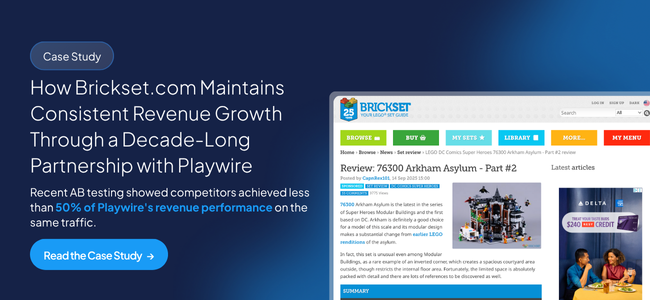
Brickset is a great example of a publisher who ran a well-structured head-to-head AB test to make an informed decision.
Implementation Timeline
Well-executed platform migrations typically follow this timeline:
- Week 1-2: Technical implementation and integration. Revenue may actually dip 10-20% during initial setup as demand sources learn your inventory and algorithms begin optimization. This temporary decrease is normal and expected.
- Week 3-4: Initial optimization and configuration. Revenue typically returns to AdSense levels as the platform establishes baseline performance. Ad layouts get refined, bidder settings optimize, and the platform learns your inventory.
- Week 5-8: Performance stabilization and acceleration. Revenue improvements become visible as optimization algorithms identify winning strategies. Most publishers see 20-40% increases during this phase compared to their previous AdSense earnings.
- Week 9+ (Months 3-6): Steady-state performance and sustained growth. Revenue stabilizes at new baseline, ongoing optimization continues improving results. Publishers at this stage typically report 50-200% revenue increases compared to their original AdSense performance.
Expect some performance volatility during the first 60 days as the new system optimizes. Publishers who panic and switch back during this learning period miss the revenue improvements that emerge once optimization completes.
Common Mistakes When Switching from AdSense
Publishers making the transition to header bidding or alternative platforms often encounter preventable issues that impact results.
- Switching too quickly without testing. Running parallel A/B tests comparing AdSense against alternatives provides data-driven validation before fully committing. Test on a portion of traffic for at least 30 days to account for seasonal variations.
- Expecting immediate results. Header bidding platforms need time to learn your inventory and optimize demand paths. Initial performance may actually dip slightly before improving as algorithms gather data and optimize settings.
- Ignoring page speed impacts. Adding header bidding increases page load times if not implemented carefully. Modern solutions use asynchronous loading and server-side bidding to minimize latency, but publishers should monitor Core Web Vitals closely.
- Neglecting ongoing optimization. Header bidding isn't set-and-forget. Demand landscape changes, new SSPs emerge, and optimization opportunities evolve. Whether you manage this internally or through a partner, ongoing attention drives sustained revenue growth.
Maximizing Revenue with Header Bidding
Publishers who achieve the highest revenue improvements from AdSense alternatives follow specific best practices.
- Implement comprehensive header bidding stacks. The more quality demand sources competing for your inventory, the higher your CPMs. Leading publishers integrate 15-25 SSPs and ad exchanges, creating genuine auction pressure that drives bids higher.
- Optimize price floors strategically. Dynamic price floor optimization can increase revenue by 15-25% alone. Rather than setting static floors, use AI-driven algorithms that adjust floors based on hundreds of variables including time, geography, device, and demand patterns.
- Balance ad density with user experience. More ads don't necessarily mean more revenue. Publishers who optimize ad placement quality over quantity often see higher CPMs because advertisers pay more for attention and viewability.
- Leverage first-party data. Building audience segments from your first-party data makes your inventory more valuable to advertisers. Publishers with robust data strategies command 30-50% higher CPMs for targeted inventory.
- Monitor performance continuously. The highest-earning publishers check their analytics daily, looking for performance changes that signal issues or optimization opportunities. Real-time data access enables quick responses that protect revenue.
Red Flags to Avoid
The monetization platform landscape includes vendors who overpromise, underdeliver, and damage publisher revenue. Recognizing warning signs protects you from costly mistakes.
Unrealistic Revenue Projections
Vendors promising 300%+ revenue increases without seeing your site are lying. Legitimate platforms provide conservative projections based on actual data from similar publishers, not fantasy numbers designed to close deals.
Revenue estimates that seem too good to be true usually are. Ask how projections were calculated and request case studies from publishers with similar traffic profiles and verticals.
Lack of Transparency
Platforms that won't explain their technology, demand sources, or optimization approach are hiding something. Quality vendors welcome technical questions and provide detailed answers.
If a platform representative can't clearly explain how their solution works, how they source demand, and what differentiates their offering, find a different partner.
Poor Support Structure
Vendors who promise dedicated support but assign you to general support queues aren't actually providing the partnership they advertised. Confirm you'll have a named account manager before signing.
Test responsiveness during the sales process. If they take 48+ hours to respond to questions when they're trying to win your business, imagine how long you'll wait when problems arise after you've signed.
Complex, Publisher-Unfriendly Contracts
Contracts with automatic renewals, aggressive termination penalties, or unclear revenue share structures benefit vendors at publisher expense. Read contracts carefully and negotiate unfavorable terms before signing.
Legitimate platforms offer fair contracts with reasonable terms. If the contract feels predatory, the relationship probably will be too.
The Playwire Difference
We've spent nearly two decades helping publishers maximize ad revenue, starting when most current platforms didn't exist. This experience shapes how we approach publisher partnerships.
Quality, Performance, Transparency
Our QPT initiative transformed how we think about monetization. Rather than maximizing ad requests regardless of value, we optimize for quality impressions that drive real revenue.
One publisher reduced ad requests by 61% while increasing revenue 76% and improving viewability 107%. This approach works because we're optimizing for your success, not our impression volume.

AI-Powered Optimization at Scale
Our proprietary AI and machine learning algorithms manage approximately 1.2 million price floor rules per publisher, far beyond Google's 200-rule limit. This optimization happens automatically, continuously adapting to maximize your revenue.
Publishers typically see 20%+ revenue lifts from price floor optimization alone, before factoring in demand optimization, layout improvements, and premium direct sales.
Managed Service or Self-Service
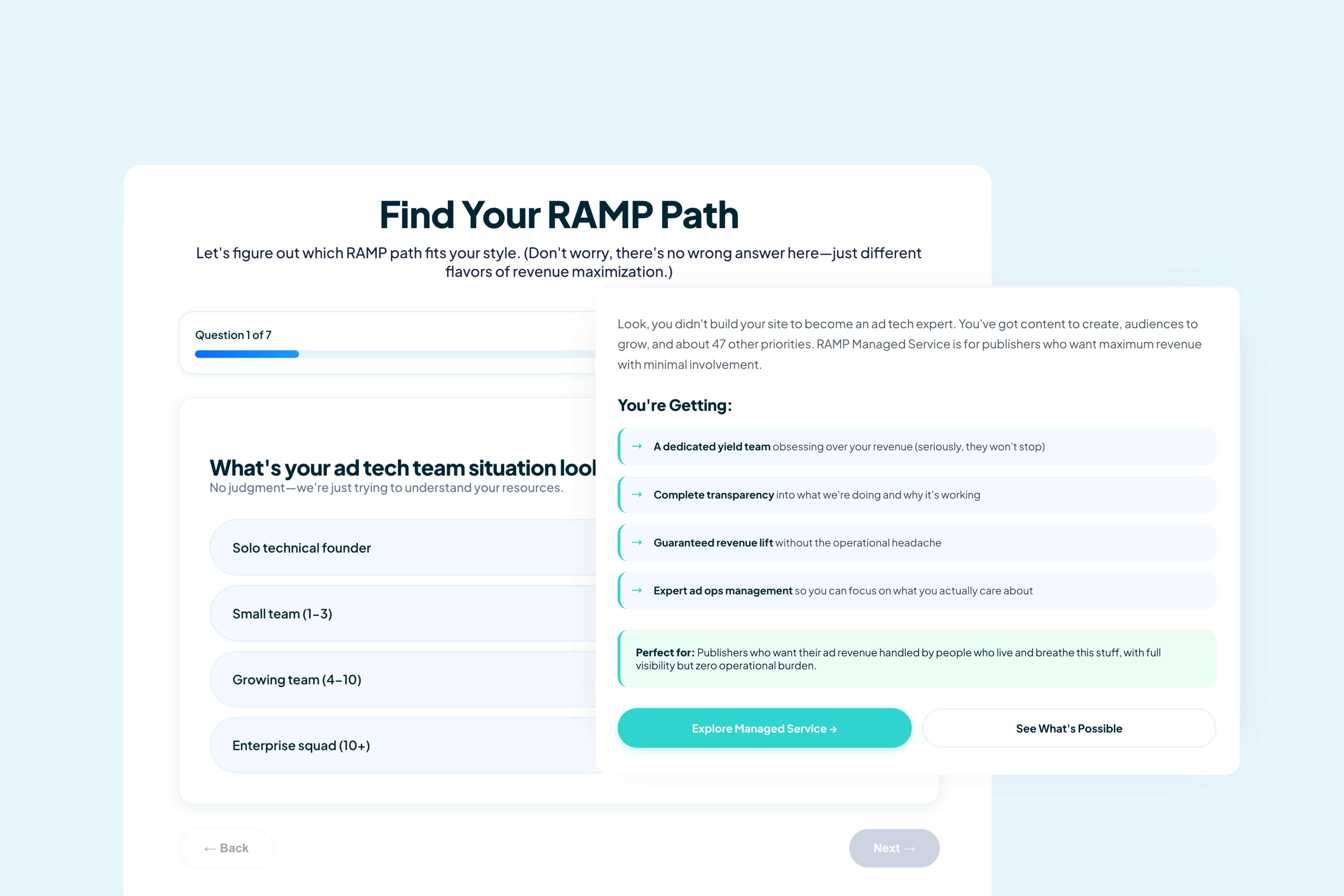
You choose your level of involvement. Want hands-on control over every setting? Our self-service platform provides granular controls and full transparency. Prefer to focus on content while experts handle optimization? Managed service delivers maximum revenue with minimum publisher effort.
This flexibility matters because your needs evolve. Start with managed service, transition to self-service as your team grows, or mix approaches across different aspects of your ad stack.
Real Publisher Success
Spelling Bee Solver saw 90% year-over-year revenue increases after switching to Playwire. Chess.com experienced immediate 130% revenue boosts and sustained 30% year-over-year growth thereafter. Brickset tested competitors and found they couldn't achieve even 50% of Playwire's performance on identical traffic.
These results aren't cherry-picked outliers. They represent typical outcomes for publishers who actively partner with us to optimize their monetization strategy.
Taking the Next Step
AdSense served its purpose getting you started. Now you're ready for a monetization solution that treats your traffic like the valuable asset it actually is.
If you're currently earning $1,000+ monthly from AdSense, you're likely leaving significant revenue on the table. The programmatic advertising landscape has evolved dramatically beyond Google's single-source ecosystem.
Header bidding alternatives create genuine competition for your inventory by allowing multiple demand sources to bid simultaneously. This fundamental shift from sequential to parallel auctions drives measurable revenue increases averaging 50-200% for qualifying publishers.
The best time to switch was when you hit 500,000 monthly sessions. The second-best time is today. Every day you delay represents revenue left on the table and optimization opportunities missed.
Start by requesting proposals from platforms that match your publisher profile and business objectives. Test thoroughly before fully committing. Ask hard questions and verify claims with current publisher references.
Ready to see how much more your site could be earning? Contact Playwire for a free revenue assessment. Our team will analyze your current performance and show you exactly what's possible with a comprehensive header bidding approach.
When you're ready to see what professional monetization actually looks like, we're here. No pressure, no aggressive sales tactics, just straight talk about what we can deliver for publishers like you.
