
-1.png?width=800&height=157&name=1-playwire-logo-primary-2021%20(1)-1.png)


January 14, 2026

Editorial Policy
All of our content is generated by subject matter experts with years of ad tech experience and structured by writers and educators for ease of use and digestibility. Learn more about our rigorous interview, content production and review process here.

The Engineering Bottleneck Nobody Talks About
Most ad tech platforms tout their automation capabilities. Fewer acknowledge the dirty secret: accessing that automation often requires engineers.
Want to adjust your price floor strategy? Better submit a ticket. Need to test a new ad layout variation? Hope your dev team has bandwidth. Looking to change which bidders get called under specific conditions? Get in line.
This creates a frustrating paradox. Publishers have the strategic knowledge to optimize their ad monetization. They understand their audience, their content, and their revenue goals. Yet they remain trapped behind engineering queues and deployment schedules.
The problem compounds when you consider the pace of ad tech. Markets shift. Seasonality changes demand. New opportunities emerge and disappear in days. Waiting two weeks for an engineer to implement a simple rule change isn't a minor inconvenience. It's lost revenue.
Read all blogs in the Take Control of Your Ad Strategy series:
What Visual Configuration Actually Means
Let's define our terms. Visual configuration refers to interfaces that let publishers create, modify, and deploy monetization rules without writing code.
The "visual" part matters. Spreadsheets require formulas. JSON configs require syntax knowledge. Database queries require SQL. Visual interfaces require none of these. They present options, let you select conditions, and handle the technical translation behind the scenes.
The "configuration" part matters equally. This isn't about one-time setup. It's about ongoing strategy management. Publishers need to adjust rules as conditions change, test new approaches, and iterate based on results. Visual configuration makes this iteration loop fast enough to actually be useful.
Traditional Approach | Visual Configuration Approach |
Submit ticket to engineering | Make change directly in dashboard |
Wait for prioritization | See change reflected immediately |
Code review and testing | Built-in validation prevents errors |
Deployment window scheduling | No deployment required |
Post-deployment monitoring | Real-time feedback on rule performance |
Days to weeks per change | Minutes to hours per change |
Why Traditional Interfaces Fail Publishers
Most ad tech platforms were built by engineers for engineers. This shows in their interfaces.
Config files require exact syntax. Miss a comma and your entire price floor strategy breaks. Misplace a bracket and you've accidentally excluded mobile traffic from premium demand. These errors are easy to make and hard to diagnose.
API-first approaches assume publishers have developers available. They don't account for the small teams running most independent publisher operations. A two-person content team can't justify hiring a full-time engineer to manage ad configuration.
Dashboard limitations create artificial constraints. Many platforms offer dashboards that show data but don't allow meaningful interaction. You can see what's happening, but changing it requires going through support or wrestling with documentation.
The quote above captures what many publishers experience. Analytics visibility is step one. Actionable control is step two. Most platforms stop at step one.
The Components of Effective Visual Configuration
Real visual configuration systems share several characteristics that separate them from glorified dashboards.
Rules-Based Logic Without Code
Effective platforms let publishers create conditional rules using plain language concepts. "If traffic comes from this source, use these bidders." "If the user is in this geography, set this price floor." The platform handles translating these rules into technical implementation.
Version Management and Experimentation
Publishers need to test changes before committing to them. Visual configuration systems should support running multiple strategy versions simultaneously. Split traffic between approaches. Compare results. Promote winners without engineering involvement.
Real-Time Feedback
Changes should produce visible results quickly. Not next week. Not tomorrow. Hours or less. This feedback loop lets publishers iterate rapidly and course-correct before small issues become major revenue problems.
Granular Control Where Wanted, Automation Where Not
The best systems don't force an all-or-nothing choice. Publishers should control the elements they understand best while delegating others to machine learning. A publisher might want manual control over ad layouts but automated optimization for price floors. Visual configuration supports this hybrid approach.

Read our Guide to Ad Monetization Platforms.
What You Should Be Able to Configure Visually
Sophisticated monetization requires control over multiple system components. Each should be accessible through visual tools.
Ad Units and Layouts
Layout decisions have the single biggest impact on ad revenue. Publishers need to adjust placements based on page type, traffic source, geography, and device. Visual configuration means building these variations through interface selections, not code changes.
Bidder Management
Which demand sources get called affects both revenue and page performance. Rules should govern bidder participation based on user context, inventory type, and historical performance. Visual tools make these rules manageable without deep technical knowledge.
Price Floors
Effective price flooring requires constant adjustment. Different user segments, times of day, and content categories warrant different floor strategies. Manual management of hundreds of rules isn't practical. Visual interfaces let publishers define the strategy while automation handles execution at scale.
Identity Solutions
Privacy regulations and signal loss make identity strategy increasingly complex. Publishers benefit from bid-by-bid decisions about which identity solutions to deploy. Visual configuration lets publishers set the parameters while AI determines optimal application.
Analytics and Reporting
Data visibility enables better decisions. Visual configuration extends to custom report building. Publishers should create the views they need without SQL queries or developer assistance.
Configuration Area | What Visual Tools Enable |
Ad Layouts | Build custom layouts per page section, traffic source, or geography |
Bidders | Set rules for which demand partners participate under what conditions |
Price Floors | Define floor strategies by inventory, user, and context characteristics |
Identity | Configure when to apply different identity solutions |
Experiments | Run A/B tests across traffic segments without engineering |
Analytics | Build custom reports and dashboards directly |
The Hidden Cost of Manual Configuration
Publishers often underestimate how much time they spend on ad operations firefighting. A pricing rule that breaks silently. A bidder timeout causing revenue drops. A layout change that tanks viewability. These issues consume hours of investigation time.
Visual configuration with proper validation prevents many of these problems entirely. Built-in checks catch configuration errors before deployment. Version history enables quick rollbacks when issues arise. Real-time monitoring surfaces problems before they become catastrophic.
The time savings compound. Hours not spent troubleshooting become hours spent on actual strategy. Optimization cycles that took weeks happen in days. Testing that never happened because it was too cumbersome suddenly becomes routine.
Automation That Works Within Your Strategy
Here's where the conversation gets interesting. Automation and control aren't opposites. They're complements.
Publishers set the strategic framework through visual configuration. They define what they want: which ad positions matter most, what user experience constraints exist, which demand partners they trust. The automation then executes within these constraints, optimizing the decisions that humans shouldn't be making manually.
Consider price floors. A human can't realistically set optimal floors for every combination of user, inventory, and market condition. The combinations number in the millions. But a human can define the strategy: "Prioritize fill rate for this inventory type. Prioritize CPM for that one. Never accept below this threshold for premium positions."
Machine learning handles the execution. Visual configuration handles the strategy. Both work together.
Strategic Automation Components
- Traffic shaping: AI determines optimal bidder participation on a bid-by-bid basis, only on the conditions you allow it to
- Price optimization: Machine learning sets floors dynamically, respecting the cases where you want manual control
- Identity selection: Automation chooses which identity solutions maximize value, following your pre-defined rules for when it should activate

View the Ad Monetization Platform Resource Center.
What This Looks Like in Practice
Abstract concepts become concrete through examples. Here's how visual configuration changes actual workflows.
Scenario: Seasonal Strategy Adjustment
Without visual configuration: Publisher identifies need for holiday pricing changes. Submits request to ad ops team. Request gets queued. Implementation happens a week later. Peak season partially missed.
With visual configuration: Publisher sees holiday traffic increasing in real-time analytics. Opens configuration interface. Adjusts price floor rules for high-value inventory. Creates new layout variation emphasizing premium placements. Changes deploy immediately. Full season captured.
Scenario: Performance Issue Response
Without visual configuration: Publisher notices revenue drop in morning reports. Opens ticket with platform support. Waits for investigation. Gets diagnosis two days later. Implements fix the following week. Revenue lost for ten days.
With visual configuration: Real-time dashboard flags revenue anomaly within hours. Publisher opens configuration to review recent changes. Identifies problematic rule. Rolls back to previous version. Revenue restored within the day.
Scenario: New Demand Partner Testing
Without visual configuration: Publisher wants to test new SSP. Engineering integration required. Months of development time. All-or-nothing launch. Limited ability to compare performance.
With visual configuration: Publisher enables new demand partner through interface toggle. Sets traffic allocation to 10% for testing. Monitors performance against existing partners in same dashboard. Gradually increases allocation as confidence builds. Full transition or removal equally easy.
The Technical Foundation That Makes This Possible
Visual configuration isn't magic. It requires architectural decisions that prioritize publisher control.
Config-Based Architecture
Systems built on configuration files rather than hard-coded logic allow changes without code deployments. The interface writes configs. The runtime reads configs. Publishers interact with the interface. The technical complexity stays hidden.
Validation Layers
Good systems prevent invalid configurations before they deploy. Rules that would break functionality get rejected with explanations. Publishers can experiment confidently knowing the system won't let them cause catastrophic failures.
Real-Time Processing
Configuration changes should take effect immediately, not after batch processing cycles. This requires architecture designed for real-time rule evaluation. More complex to build, but essential for the feedback loops that make visual configuration valuable.
Versioning and Rollback
Every configuration state should be tracked and recoverable. Publishers should see what changed, when, and by whom. Rolling back to any previous state should take seconds, not hours.
Measuring Success: What Changes When Configuration Becomes Visual
The impact shows up in multiple metrics, some obvious and some subtle.
Time Metrics
- Change implementation: Days to minutes
- Issue resolution: Days to hours
- Experimentation cycles: Weeks to days
- New strategy deployment: Months to weeks
Resource Metrics
- Engineering hours on ad configuration: Significant reduction
- Support ticket volume: Lower
- Time spent troubleshooting: Less
- Time spent on actual optimization: More
The qualitative changes matter equally. Publishers report feeling more in control of their monetization. They experiment more because experimentation costs less. They catch issues faster because they understand their configuration better. They optimize more effectively because the feedback loop is tight enough to learn from.
The Playwire Approach to Visual Configuration
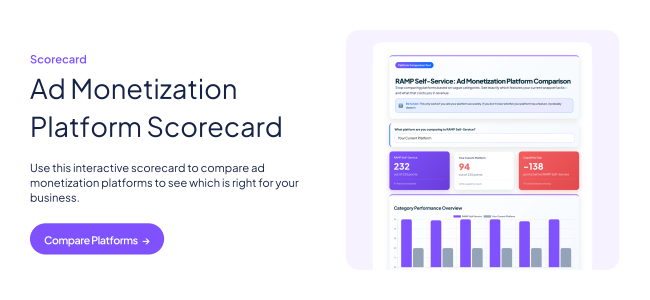
Publishers deserve tools that match their strategic capabilities. The RAMP Self-Service Platform was built with this principle at its core.
Every configuration component is accessible through visual interfaces. Ad layouts. Bidder rules. Price floor strategies. Identity solutions. Experimentation management. Publishers control what they want to control. Machine learning handles the rest.
The config-based architecture means changes deploy instantly. No waiting for engineering queues. No deployment windows. No hoping the next release includes your request. You make the change. The change goes live.
What Sets the RAMP Platform Apart
- Rules-based control: Define your strategy using visual tools, not code
- AI where it matters: Machine learning optimizes within your strategic framework
- Real-time everything: Analytics, configuration, and feedback all happen live
- Version management: Test confidently, roll back instantly
- No engineering bottleneck: Your strategy, your timeline
Taking Control of Your Ad Strategy
Visual configuration isn't about replacing expertise with simplicity. It's about matching interface complexity to user capability. Publishers have strategic expertise. They deserve tools that let them apply it directly.
The question isn't whether automation matters. It obviously does. The question is who sets the parameters for that automation. With proper visual configuration, the answer is you.
Publishers ready to stop waiting for engineering and start executing their own strategies should explore what modern platforms make possible. The technology exists. The interfaces have matured. The bottleneck has been optional for years.
The only question left: how much revenue have you lost waiting for permission to optimize?
Ready to see what visual configuration can do for your ad strategy? Playwire's RAMP Platform puts control where it belongs: in your hands. Apply now to discover what's possible when engineering stops being your bottleneck.
