
-1.png?width=800&height=157&name=1-playwire-logo-primary-2021%20(1)-1.png)


August 6, 2026

Editorial Policy
All of our content is generated by subject matter experts with years of ad tech experience and structured by writers and educators for ease of use and digestibility. Learn more about our rigorous interview, content production and review process here.
Key Points
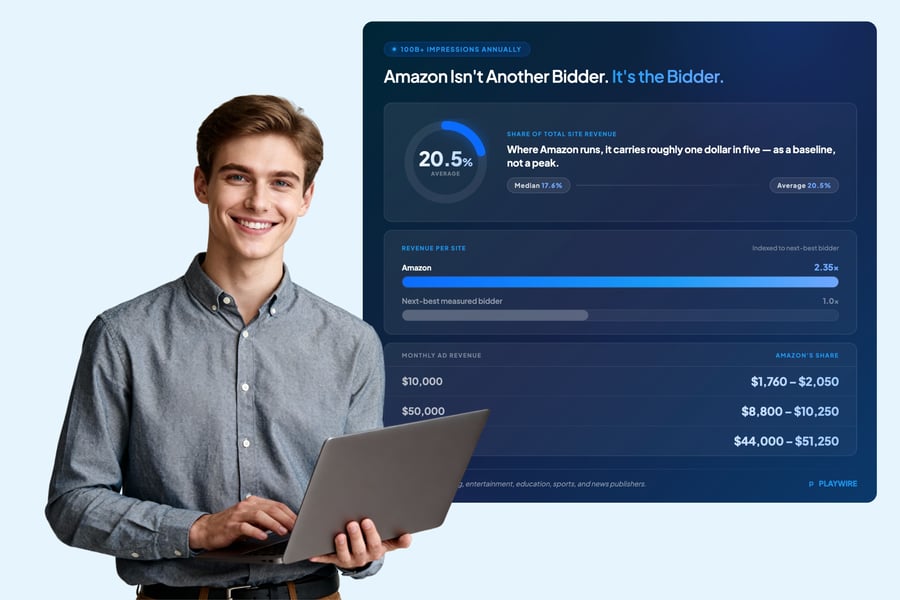
- Amazon demand averages 20.5% of total site revenue across publishers where it runs, with a median of 17.6%, roughly one dollar in every five to six.
- Amazon generates 2.35× more revenue per site than any other measured bidder, making it categorically different from other demand partners.
- Losing Amazon access doesn't just remove one line item; it softens CPMs across your entire remaining demand stack by removing competitive pressure.
- Amazon reviews APS publisher applications once, with no second look. The cost of a weak submission is the full value of that revenue gap, indefinitely.
- Publishers with a well-diversified stack target no single demand partner above 10. 12% of total revenue; Amazon routinely runs at nearly double that, which makes access governance worth treating as revenue infrastructure.
Losing Amazon demand doesn't feel abstract when you're looking at a dashboard with a hole in it. The line item disappears, but the problem doesn't stop there. Every remaining bidder in your stack suddenly faces less competition, and CPMs soften in ways that don't show up neatly labeled "Amazon impact." The real cost is larger than the number you can point to.
This piece is about making that number concrete. Not directionally, but with actual benchmarks from publisher ecosystems running at scale. Publishers evaluating Amazon Publisher Services, or trying to understand what they forfeited when access was removed, deserve a real yield framework, not a vague sense that Amazon is "important."

How Amazon Publisher Services Ad Revenue Stacks Up
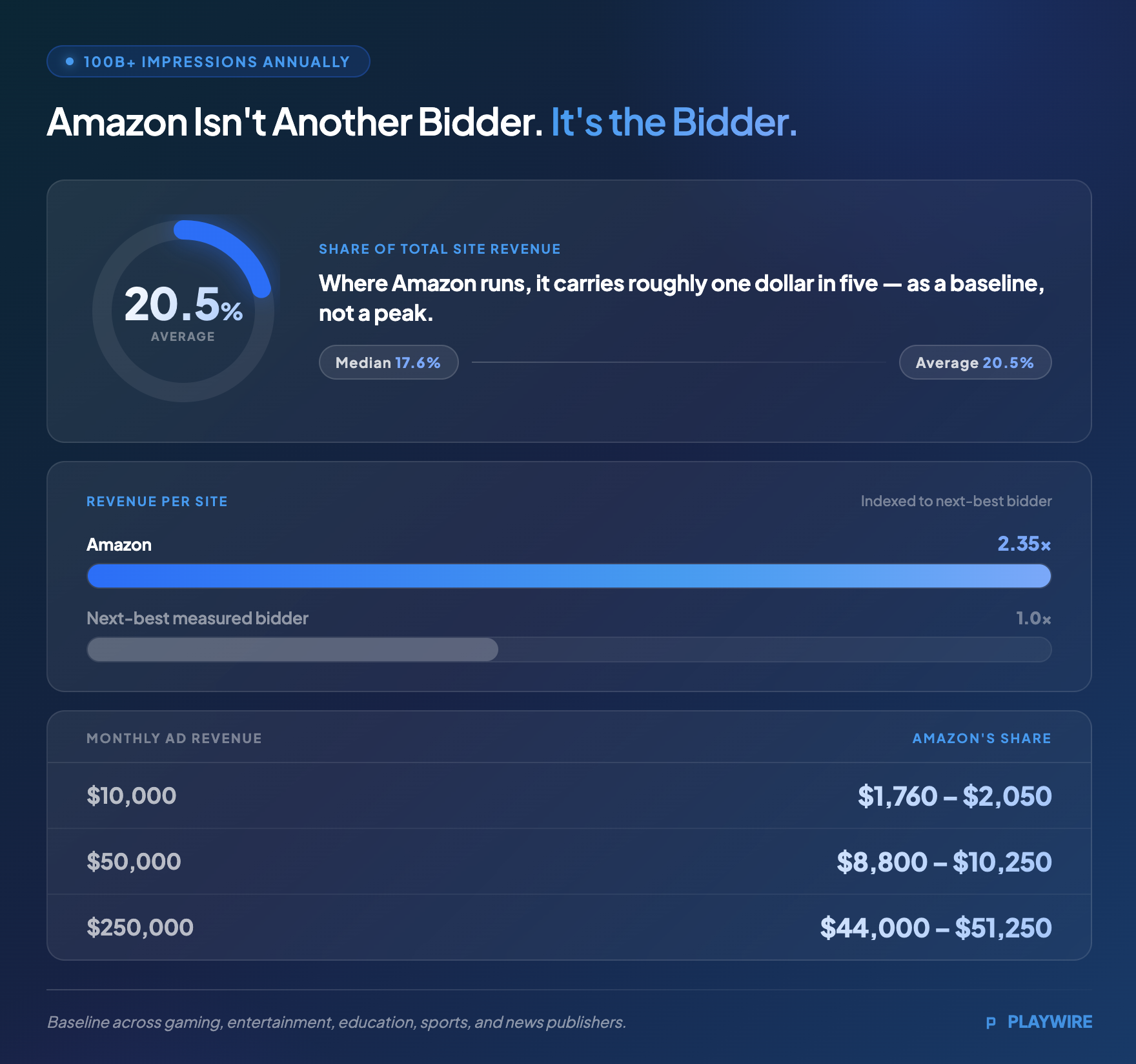
Across our publisher ecosystem, derived from 100 billion-plus impressions annually, Amazon averages 20.5% of total site revenue where it runs, with a median contribution of 17.6%. That's not a peak figure or a best-case scenario. That's the baseline across a broad network of publishers in gaming, entertainment, education, sports, and news.
Put another way: for a publisher generating $10,000 per month in ad revenue, Amazon is typically responsible for $1,760 to $2,050 of that. At $50,000 per month, that's $8,800 to $10,250 gone if access disappears. The math doesn't get more comfortable at enterprise scale.
What makes this particularly significant is the per-bidder comparison. Amazon generates 2.35× more revenue per site than any other measured bidder in the same ecosystem. That's not a marginal edge. Amazon isn't competing in the same tier as other demand partners. It's operating in a different weight class entirely.
Why the Publisher Revenue Gap Is Larger Than the Line Item
Publishers who lose Amazon access often notice the damage exceeds what their Amazon line item suggests. This isn't accounting confusion. It's auction mechanics.
Amazon's presence in an auction applies competitive pressure that pushes other bidders higher. When Amazon bids aggressively on an impression, other DSPs and SSPs have to respond to stay competitive. Remove that pressure, and the remaining bidders have less incentive to bid at the top of their range. CPMs soften across the stack, not just on impressions Amazon would have won.
The practical implication: the revenue gap from losing Amazon access is consistently larger than the Amazon revenue share figure alone implies. A publisher losing access to their Amazon line item may see total yield erosion extending well beyond the Amazon-attributed share, once the auction-pressure effect propagates through the rest of their demand partners. If you've already lost access and are working through recovery, our guide on recovering publisher revenue after losing Amazon as a bidder covers the rebuild sequence in detail.
Benchmarks by Publisher Revenue Tier
The following benchmarks illustrate how publishers earn ad revenue from Amazon at different monthly revenue scales, using the 17.6% median and 20.5% average figures from our network data.
| Monthly Ad Revenue | Amazon at Median (17.6%) | Amazon at Average (20.5%) | Annual Impact (Average) |
|---|---|---|---|
| $5,000 | $880 | $1,025 | $12,300 |
| $10,000 | $1,760 | $2,050 | $24,600 |
| $25,000 | $4,400 | $5,125 | $61,500 |
| $50,000 | $8,800 | $10,250 | $123,000 |
| $100,000 | $17,600 | $20,500 | $246,000 |
These figures represent the direct revenue exposure from Amazon access loss, before accounting for the auction-suppression effect on remaining demand. Publishers in the 25. 30% dependency range, which some sites hit particularly in certain content verticals, should treat these figures as a floor, not a ceiling. For a broader view of the structural revenue gap that Amazon's SSP dynamics create for publishers, we've covered the demand-side mechanics in depth separately.
Essential Background Reading:
- Amazon Publisher Services (APS) Explained: TAM, UAM, and Eligibility: How the two APS programs work, who qualifies for each, and what the eligibility process actually involves.
- What to Expect Inside the Amazon Publisher Services Agreement: A breakdown of what the APS contract actually commits publishers to before they sign.
- Amazon Publisher Services Header Bidding: TAM, UAM, and the Access Layer Nobody Talks About: The header bidding structure underlying APS, and why the access layer is the piece most publishers underestimate.
- 5 Ad Revenue Metrics Publishers Should Track That Might Surprise You: The metrics that actually surface invisible yield problems. Including the kind Amazon's absence creates.
The Demand Concentration Risk Problem
Healthy demand stack diversification targets no single partner exceeding 10. 12% of total revenue. Amazon routinely runs at 17. 20%, putting most publishers well outside that range with a single demand source they didn't choose to concentrate in. It just performs that well.
This creates a specific kind of risk that's different from normal concentration risk. Publishers can reduce exposure to a DSP they're overweighted in by adjusting floors or blocking rules. They can't manufacture Amazon demand at will. Access is gated, approval is one-shot, and the review covers content governance and brand safety in ways that have nothing to do with traffic quality or technical integration.
The concentration isn't inherently a problem while access is active. It becomes one the moment access is threatened, or when a publisher realizes they never had it to begin with.
Related Content:
- The Amazon SSP Problem: Why So Many Publishers Now Have a Structural Revenue Gap: The demand-side mechanics behind why losing Amazon access creates a gap larger than the line item.
- Amazon Ad Revenue Growth: What It Means for Publisher Access and CPMs: How Amazon's expanding DSP business affects publisher access dynamics and CPM pressure across the stack.
- Getting (and Keeping) Amazon Publisher Services Demand: The UGC Governance Problem Publishers Aren't Solving: Why UGC governance is the actual gate for APS access, and why most publishers aren't addressing it.
- Beyond Google Ad Revenue: Sophisticated Strategies for Sophisticated Publishers: Demand diversification strategies for publishers who need more than Google to run a healthy yield stack.
- Programmatic Monetization: The Complete Publisher's Guide to Maximizing Ad Revenue: How to structure your full programmatic stack for maximum auction competition, including where Amazon fits.
What Publishers Without Amazon Access Are Forgoing
Every month a publisher operates without Amazon demand, they're not in a neutral state. They're running at a structural revenue deficit relative to what their inventory could generate with full demand competition.
A few concrete dimensions of that deficit:
- Revenue per session gap: Publishers with Amazon active generate meaningfully higher RPS than comparable publishers without it, because Amazon's demand pressure lifts the floor on every auction, not just the ones Amazon wins.
- Direct revenue contribution: At median, Amazon is responsible for nearly one in five revenue dollars. That's not a secondary bidder; it's a primary revenue driver operating alongside your programmatic stack.
- Competitive disadvantage in the auction: An auction with Amazon present is structurally more competitive than one without it. Publishers without access are running a less competitive auction on every impression, every day.
The absence of Amazon demand doesn't appear as a visible problem in reporting. There's no "Amazon gap" line item when you've never had it. The revenue just isn't there, and it's easy to mistake lower-than-potential yield for normal performance. Tracking the ad revenue metrics that actually surface this kind of invisible underperformance is where yield-focused publishers start.

How Amazon TAM and UAM Access Works
Publishers sometimes treat APS access as a purely technical question. Get the tag in, get the demand flowing. The technical integration is genuinely straightforward: Amazon's own documentation states that the primary requirement for TAM is active integration with the APS tag or SDK, plus contractual relationships with your desired demand partners. That's an integration spec, not an admissions policy.
TAM and UAM serve different publisher segments. TAM (Transparent Ad Marketplace) requires existing direct SSP relationships and is structured for larger publishers who manage their own demand partner contracts. UAM (Unified Ad Marketplace) handles demand connections on Amazon's side, making it more accessible for mid-size publishers who don't maintain direct SSP relationships. Neither program publishes eligibility thresholds, traffic minimums, or qualification criteria on the publisher-facing side.
The actual gate for both is content governance. Before approving a publisher for demand, Amazon conducts a review covering how content is moderated, how it's reviewed and approved, how quickly problem content is removed, how sensitive content is handled, whether governance practices are documented for demand partners, what automated screening is in place, and how user interactions are monitored.
Two things about that process matter enormously for publishers doing yield planning.
First, Amazon reviews each submission once. There is no second review after a decision is made. A rushed or incomplete submission doesn't get a follow-up conversation. It gets a result that stands. For a revenue gap measured in the figures above, treating that submission as a casual exercise is a significant operational error. Understanding what the Amazon Publisher Services agreement actually commits you to before you submit is not optional prep work.
Second, the review is a governance evaluation, not a content quality evaluation. Amazon isn't primarily asking whether your content is good. It's asking whether you can demonstrate control over content you didn't write yourself: comments, user profiles, forum posts, reviews, community submissions. Most publishers don't think of their comment section as inventory-adjacent risk. In this context, it is. The UGC governance documentation Amazon expects before approving you goes deeper on what that review actually covers.
Next Steps:
- What UGC Governance Documentation Amazon Expects Before Approving You: The governance categories Amazon evaluates during its one-shot publisher review, and how to approach each one.
- How to Write a UGC Moderation Policy That Satisfies Amazon's Brand Safety Requirements: What a submission-ready moderation policy needs to demonstrate to pass Amazon's brand safety review.
- Navigating Amazon Publisher Services Documentation: A Practical Walkthrough: A step-by-step orientation to the APS documentation and what publishers need to prepare before submitting.
- How to Recover Publisher Revenue After Losing Amazon as a Bidder: The recovery sequence for publishers who've already lost access and need to rebuild yield while pursuing re-entry.
- Ad Revenue Analytics: What Sophisticated Publishers Track to Maximize Earnings: The reporting practices that let publishers see yield gaps clearly, and act on them before they compound.
How Amazon Enforces Supply Quality
Amazon has published that it runs always-on AI models identifying and blocking low-quality and made-for-advertising (MFA) inventory. It strengthens that enforcement with third-party classification input from Jounce Media and Deepsea.io, which it uses to restrict domains sharing similar characteristics with flagged inventory.
This matters for one specific reason: a publisher can be caught by similarity to flagged inventory rather than by anything they specifically did wrong. There's no cited rule, and no notice, because there was never a published rule to cite.
Amazon's publisher-side access program has no published eligibility criteria, no public violation taxonomy, and no documented appeal process. That's a notable asymmetry given that Amazon's DSP side has a published malvertising suspension policy with an explicit appeal path. The publisher side has no equivalent. Amazon operates TAM and UAM as a private program rather than an open marketplace, and the absence of a rulebook is a design choice, not an oversight. Understanding how Amazon DSP demand flows through publisher inventory helps clarify why the access stakes are this high.
For comparison: Google publishes an entire AdSense help center covering the most common policy violations that lead to account closure. Amazon's publisher side has no policy center, no violation list, and no appeals documentation.
See It In Action:
- Amazon Publisher Services Review: What Publishers Need to Know Before Applying: A publisher-perspective evaluation of APS. What the program delivers, where it falls short, and how to approach it.
- Amazon Publisher Services DSP: What It Is and Why It Matters for Your Inventory: How Amazon DSP demand flows through APS and why it commands the CPM premiums it does.
- Brand Safety and Ad Quality for News Publishers: Protecting Revenue and Reputation: How brand safety enforcement affects publisher revenue access, and what governance-forward publishers do differently.
- Ad Revenue Attribution: Making Strategic Business Decisions for Publishers: How to attribute revenue impact accurately across your demand stack. Including what Amazon's absence actually costs.
Frequently Asked Questions: Publisher Ad Revenue from Amazon
This section addresses the questions publishers most commonly ask about earning ad revenue from Amazon Publisher Services.
How do publishers make money from Amazon advertising?
Publishers earn ad revenue from Amazon through Amazon Publisher Services (APS), which includes two programs: TAM (Transparent Ad Marketplace) and UAM (Unified Ad Marketplace). Both connect publisher inventory to Amazon DSP demand. Amazon's demand competes in real-time auctions alongside other SSPs and DSPs, and the competitive pressure it applies typically lifts CPMs across the entire auction, not just on impressions Amazon wins.
What is the difference between Amazon TAM and UAM for publishers?
TAM requires publishers to have existing direct contractual relationships with SSP demand partners. It's designed for larger publishers who manage their own demand stack. UAM has Amazon manage demand connections on the publisher's behalf, making it more accessible for mid-size publishers without direct SSP relationships. Neither program publishes explicit traffic thresholds or eligibility criteria on the publisher side.
How much ad revenue does Amazon generate for publishers?
Publishers in our network where Amazon runs see Amazon account for an average of 20.5% of total site revenue, with a median of 17.6%. Amazon generates 2.35× more revenue per site than any other measured bidder in the same ecosystem. These figures derive from 100 billion-plus impressions annually across publishers in gaming, entertainment, education, sports, and news.
Is Amazon TAM invite-only?
Amazon has not published eligibility criteria or a formal application process for TAM on its publisher-facing documentation. The only stated technical requirement is active APS tag or SDK integration plus contractual relationships with desired demand partners. In practice, access approval involves a content governance and brand safety review, and Amazon reviews each submission once with no second look. The full APS header bidding structure, including the access layer most publishers miss, is worth understanding before you apply.
What happens if Amazon removes publisher access to APS?
Publishers who lose APS access don't just lose the Amazon revenue line item. They lose the competitive auction pressure Amazon applied to every impression. CPMs soften across the remaining demand stack, making the total revenue impact consistently larger than the Amazon-attributed share alone. Publishers in the 25. 30% Amazon dependency range can experience access loss closer to a revenue crisis than a revenue dip.
Can I run Amazon UAM alongside Google Open Bidding and Prebid?
Yes. Amazon UAM is designed to run alongside other header bidding solutions including Prebid and Google Open Bidding. Publishers running UAM with existing Prebid setups maintain their existing demand partner relationships while adding Amazon demand into the auction.
How does Amazon detect invalid traffic on publisher inventory?
Amazon operates sophisticated invalid traffic detection built over more than a decade. It also runs always-on AI models that identify and block low-quality and made-for-advertising (MFA) inventory. Third-party classification vendors Jounce Media and Deepsea.io provide additional domain-level classification that Amazon uses to restrict inventory sharing characteristics with flagged domains.
How do I get access to Amazon Publisher Services?
Access to Amazon Publisher Services requires completing an APS agreement and passing a content governance and brand safety review. Amazon evaluates how content is moderated, how quickly problematic content is removed, how sensitive content is handled, what automated screening is in place, and how user-generated content is governed. Amazon reviews each publisher submission once, with no documented appeal path if the submission is declined. A practical walkthrough of the APS documentation process covers how to approach that submission without walking in cold.
The Yield Gap Is Quantifiable. The Fix Requires Process.
Understanding the benchmarks is the first step. Closing the gap requires getting through a one-shot governance review with no safety net on the other side.
Amazon reviewed content governance and brand safety before approving publishers for demand, and applied a 10% publisher transaction fee to Amazon DSP demand in September 2023 with roughly 30 days' notice. The program operates on Amazon's terms, moves on Amazon's timeline, and offers no formal appeal process on the publisher side. Publishers who treat APS access as passive inventory management tend to find out how wrong that assumption is at the worst possible moment. Understanding what Amazon's ad revenue growth means for publisher access and CPMs is part of that picture.
How We Help Publishers Access and Keep Amazon Demand
We've built a structured intake and review process, backed by internal tooling and human review at every step, that takes a publisher from "we moderate our comments, I think" to a documented, submission-ready governance package. Publishers can self-assess readiness before anything is sent to Amazon, so no one walks into a one-shot review underprepared.
.png?width=1536&height=1146&name=amazon-tool-mockup%20(1).png)
The other half of the value is advocacy. We work directly with Amazon on behalf of our publishers, and partner scale materially changes the outcome. An individual publisher submitting independently is making a cold request to a program that receives no shortage of them. A partner operating at our network scale, 100 billion-plus impressions annually, has a different conversation. No other monetization partner has built specifically for this problem.
For publishers running at $10,000 per month in ad revenue, closing the Amazon gap is worth $24,600 annually at the average contribution rate. At $50,000 per month, it's $123,000. Those are the numbers worth protecting. Talk to us about getting your governance in order before Amazon reviews it.
