
-1.png?width=800&height=157&name=1-playwire-logo-primary-2021%20(1)-1.png)


August 6, 2026

Editorial Policy
All of our content is generated by subject matter experts with years of ad tech experience and structured by writers and educators for ease of use and digestibility. Learn more about our rigorous interview, content production and review process here.
Key Points
- Amazon DSP connects brand and agency advertisers to publisher inventory through Amazon Publisher Services, bringing demand that operates differently from standard open-market programmatic.
- DSP buyers use audience targeting built on Amazon's first-party shopping and behavioral data, which is why they often bid at higher CPMs than generic programmatic demand.
- Amazon DSP demand flows to publishers through TAM (Transparent Ad Marketplace) for larger publishers with existing SSP relationships, and through UAM (Unified Ad Marketplace) for mid-size publishers.
- Losing access to APS doesn't just remove one bidder. It removes competitive pressure across your entire auction stack, softening CPMs from every remaining demand source.
- Understanding how DSP demand works gives publishers a more accurate picture of what APS access is actually worth and why the approval process matters as much as it does.
Publishers talk about Amazon Publisher Services as an access problem: who gets it, who loses it, and what it costs. That framing is accurate but incomplete. Before you can fully understand why APS access carries real revenue weight, you need to understand what's on the other side of that integration. Amazon's Demand-Side Platform and the buyers using it to reach your audience.
This article covers the demand side of the APS equation. Who's buying through Amazon DSP, what data they're using to target your inventory, and why that translates into CPM premiums most other demand sources can't match.

What Amazon Publisher Services DSP Is
Amazon DSP is a programmatic advertising platform that lets brands and agencies buy display, video, and audio ad inventory at scale, across both Amazon-owned properties and third-party publisher sites. It's a full-stack DSP with audience targeting, creative management, and reporting, built specifically around Amazon's first-party data assets.
The distinction that matters for publishers is where those data assets come from. Amazon's purchasing, browsing, and streaming data gives advertisers something the typical DSP can't offer: verified consumer intent. An advertiser running a campaign through Amazon DSP isn't targeting a probabilistic audience segment based on third-party cookie inference. They're targeting people who searched for a product category, added items to a cart, watched a particular genre of content, or demonstrated purchase behavior that Amazon can observe directly.
That specificity costs money. Publishers with APS access are the ones getting paid for it.
How Amazon DSP Connects to Your Inventory: TAM vs. UAM
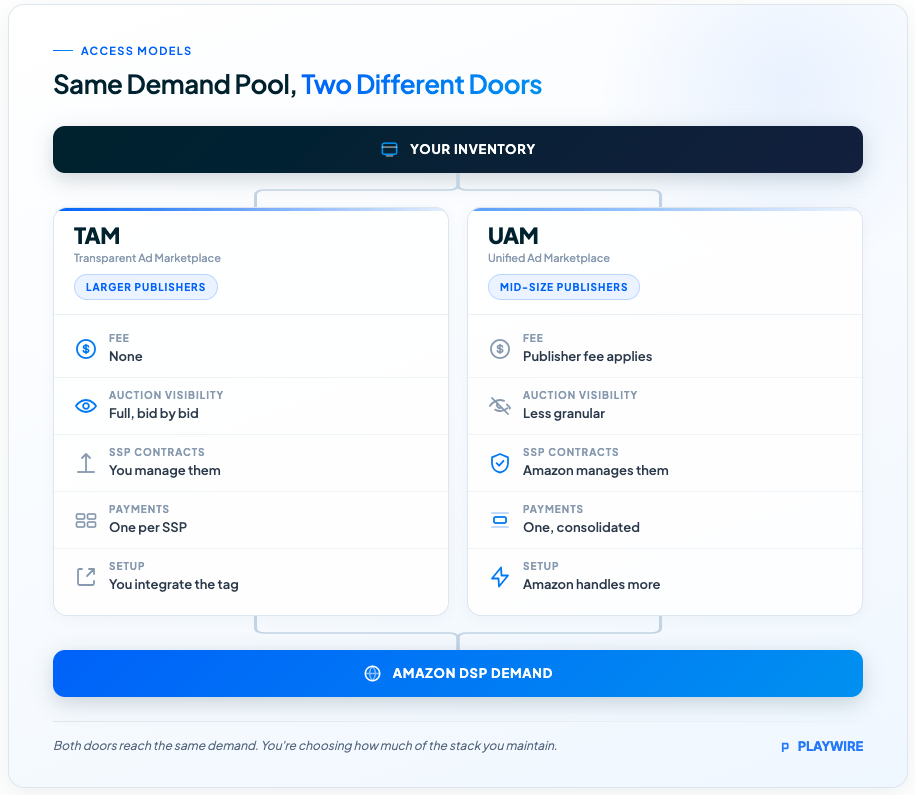
Amazon DSP demand reaches third-party publisher inventory through Amazon Publisher Services, specifically through two products with meaningfully different access models. The full APS agreement governs both, but the operational differences between TAM and UAM shape how that demand flows to your stack.
| Feature | TAM | UAM |
|---|---|---|
| Target publisher size | Larger publishers | Mid-size publishers |
| SSP relationship requirement | Publisher manages own SSP contracts | Amazon manages demand connections |
| Fee structure | No publisher fee | Publisher fee charged |
| Payment method | Separate payments from each SSP | Single payment from Amazon |
| Technical setup | Publisher integrates APS tag/SDK | Simpler entry; Amazon handles more |
| Auction transparency | Full visibility into Amazon vs. SSP bids | Less granular auction-level visibility |
| Managed vs. self-serve | Self-managed SSP relationships | Amazon-managed demand |
TAM (Transparent Ad Marketplace) is the server-side header bidding product. Publishers using TAM participate in an auction alongside their existing demand stack. You maintain your SSP relationships, Amazon participates as an additional bidder, and you keep visibility into what Amazon is paying versus what your other partners are paying. TAM requires that you already have direct contractual relationships with the demand partners you want to access. The stated technical requirement is an active APS tag or SDK integration.
UAM (Unified Ad Marketplace) is designed for mid-size publishers who don't want to manage individual SSP relationships. Amazon handles the demand connections, and you get access to the DSP pool without needing to negotiate your own seat at each SSP. It's a simpler entry point, but you trade some of the auction transparency you'd get with TAM.
Both paths get Amazon DSP demand flowing to your inventory. The difference is in how much of your stack infrastructure you control and maintain independently. For a deeper look at how Amazon Publisher Services header bidding integrates with your existing demand stack, the mechanics are worth understanding before you go through setup.
Why Amazon DSP Buyers Bid at Premium CPMs
The CPM advantage from Amazon DSP isn't marketing positioning. It has a specific structural explanation.
Most programmatic demand runs on audience targeting assembled from third-party data, contextual signals, or probabilistic identity graphs. The signal quality degrades constantly: cookies expire, identifiers rotate, panels get stale. Advertisers know this, which is why they hedge their bids. They pay less per impression because they're less certain the impression will reach the person they're trying to reach.
Amazon's first-party data has different characteristics. It's logged-in behavioral data tied to real purchase activity. An advertiser targeting "shoppers who have browsed athletic footwear in the past 30 days" on Amazon DSP is working from a dataset that doesn't require inference. The audience is defined, recent, and verified. That certainty supports higher bids.
There's also the measurement angle. Amazon DSP campaigns can close-loop reporting from ad exposure to purchase on Amazon, giving brands a direct revenue attribution path that most publisher environments can't offer. Advertisers willing to pay for outcomes, rather than just impressions, tend to bid accordingly.
The result is a demand source that sits in a different CPM tier from standard open-market programmatic. That differential is real and consistent, which is one reason what publishers are actually earning from Amazon ad revenue consistently surprises publishers who haven't stress-tested their dependency on it.
Essential Background Reading:
- Amazon Publisher Services (APS) Explained: TAM, UAM, and Eligibility: The foundational breakdown of how APS is structured, who qualifies for each product, and what the access model actually looks like.
- What to Expect Inside the Amazon Publisher Services Agreement: A plain-language walkthrough of what the APS contract actually commits you to and what it leaves deliberately undefined.
- Getting (and Keeping) Amazon Publisher Services Demand: The UGC Governance Problem Publishers Aren't Solving: The pillar piece for this cluster. Why content governance is the real gate to APS demand, and what publishers consistently get wrong.
- Publisher Ad Revenue Maturity Model: Where Are You on the Revenue Curve? A framework for understanding where your current demand stack sits relative to a fully optimized revenue operation.
The Competitive Pressure Effect
There's a dimension to Amazon DSP demand that CPM line items alone don't capture.
When Amazon participates in your header bidding auction, it's not just adding one more bidder at the margin. It's adding a bidder with deep pockets and strong targeting signal, which forces every other SSP in your stack to compete harder. Bidders respond to competition. If Google, Xandr, and Magnite know Amazon is in the auction, they submit more aggressive bids to win impressions they'd otherwise grab at lower prices.
Remove Amazon from that auction and the pressure drops. The remaining bidders don't become more generous because you need the revenue. They read the reduced competition and bid accordingly. This is why publishers with 20. 25% Amazon line item dependency often feel a revenue hole larger than 20. 25% when access is lost. Per our network data, Amazon generates 2.35× more revenue per site than any other measured bidder: partly because of its own CPMs, and partly because of what it does to every other bidder's behavior.
That multiplier effect is the part publishers tend to miss until after access is gone. The structural revenue gap that results isn't just an Amazon line item problem. It's a whole-stack problem.

What Types of Advertisers Use Amazon DSP
Amazon DSP serves a wide range of buyer types, and understanding who they are helps clarify what inventory they're looking for.
| Buyer Type | Primary Use Case | Why They Use Amazon DSP |
|---|---|---|
| Direct-to-consumer brands | Retargeting shoppers across the open web | Amazon purchase data enables precise retargeting without third-party cookies |
| Retail advertisers | Drive traffic to Amazon storefronts or owned DTC sites | Closed-loop attribution from ad view to purchase |
| Agency trading desks | Run audience-targeted campaigns for brand clients | Scale plus data quality across a single DSP |
| Streaming and entertainment brands | Reach viewers based on Amazon Prime viewing behavior | Intent-based audience targeting tied to content consumption |
| CPG brands | Upper and mid-funnel campaigns | Broad reach with demographic and behavioral precision |
Each of these buyer types brings a different bid profile and a different sensitivity to inventory quality. Retail and DTC advertisers bidding on retargeting audiences tend to submit higher CPMs for specific audience matches. Brand-safety-conscious advertisers in entertainment and CPG are evaluating your content environment, not just your traffic numbers. Both segments can be locked out if your content governance doesn't hold up to review.
Related Content:
- The Amazon SSP Problem: Why So Many Publishers Now Have a Structural Revenue Gap: How Amazon's auction dynamics create a revenue gap that extends well beyond the Amazon line item when access is disrupted.
- Amazon Ad Revenue Growth: What It Means for Publisher Access and CPMs: How Amazon's advertiser-side growth translates, or doesn't, into better publisher access and higher CPMs.
- Amazon Publisher Services Header Bidding: TAM, UAM, and the Access Layer Nobody Talks About: A technical walkthrough of how TAM and UAM fit into a header bidding stack and what that integration actually requires.
- Session RPM vs. Page RPM: The Metric That Actually Matters for Publisher Revenue: Why session-level yield is the right lens for evaluating demand partner contributions, including Amazon DSP.
- What Separates the Top 10% of Website Publishers From Everyone Else: Data-Backed: The demand stack and yield practices that distinguish publishers generating consistently higher revenue per session.
The Inventory Quality Signal Amazon DSP Sends
Amazon publicly describes running AI-driven blocking of low-quality inventory, including domains with made-for-advertising characteristics. It supplements that with third-party classification from vendors including Jounce Media and Deepsea.io to restrict domains sharing similar characteristics with flagged inventory. Sophisticated invalid traffic detection rounds out the stack.
This matters for publishers because the classification operates at a level of specificity that can catch inventory by proximity, not just by direct violation. You don't have to be doing something wrong to be grouped with inventory that is. If your domain shares characteristics with a flagged cluster, the DSP-side filtering will treat you accordingly, and you won't receive a notice explaining why.
The practical implication: the quality standards Amazon DSP buyers expect are enforced on the supply side through the access criteria Amazon applies to publishers. Getting approved for APS is, in part, a signal to DSP buyers that your inventory has cleared Amazon's quality bar. That signal has value beyond the impression revenue.
The Access Gate Most Publishers Don't See Coming
The actual gate to Amazon Publisher Services demand isn't purely a matter of traffic scale or SSP relationships.
Amazon may require prospective publishers to document how they handle brand safety to get access to their demand. The review typically covers how content is moderated, how UGC surfaces are managed, how quickly problem content is addressed, whether practices are documented, and what automated screening is in place. It's a governance evaluation, not a content audit. Understanding what UGC governance documentation Amazon expects before you submit is the difference between a credible submission and a wasted opportunity.
Almost any user-generated content creates exposure here. Comments on blog posts count. Community forums, user profiles, reviews, uploads. Any surface where a stranger can type something into your site is a content surface Amazon's demand partners treat as risk. Most publishers don't think of their comment section as inventory-adjacent risk. It is.
The more consequential detail: Amazon usually only reviews each submission once. There is rarely a second look after a decision. A rushed or underprepared submission is more expensive than a delayed one, because there's no appeal path documented for publishers. Compare that to Amazon's DSP-side malvertising suspension policy, which explicitly includes an appeal path for advertisers. The asymmetry is notable.
This access structure isn't an oversight. A published rulebook creates an appeal surface, and Amazon has no interest in adjudicating thousands of publisher submissions. Publishers navigating this process for the first time tend to discover its difficulty after the decision, not before. The full picture of the APS access layer, including why UGC governance is the piece most publishers miss. Is worth reading before you attempt onboarding.
Next Steps:
- What UGC Governance Documentation Amazon Expects Before Approving You: The specific categories of content governance Amazon evaluates in its publisher review, and why most publishers are underprepared.
- How to Write a UGC Moderation Policy That Satisfies Amazon's Brand Safety Requirements: What a credible moderation policy needs to demonstrate, and why generic templates don't survive Amazon's single-review process.
- Navigating Amazon Publisher Services Documentation: A Practical Walkthrough: How to read what Amazon actually publishes about APS, and what the gaps in that documentation mean for publishers.
- How to Recover Publisher Revenue After Losing Amazon as a Bidder: The demand diversification and yield strategy moves that stabilize revenue after APS access is lost.
- The Publisher's Guide to Viewability Optimization: Chasing Perfect Isn't the Answer: How viewability thresholds affect DSP buyer behavior and what the right target range actually looks like for publisher inventory.
What Happened in September 2023
Understanding the current APS landscape requires knowing what changed in fall 2023.
Amazon applied a 10% publisher transaction fee to Amazon DSP demand with roughly 30 days' notice. Publishers absorbed it. The access removals that followed carried the same character: unilateral, fast, and with no documented appeal path for most affected publishers.
The publishers hit hardest weren't necessarily doing anything wrong. Amazon's third-party classification process. Which includes domain similarity analysis through vendors like Jounce Media and Deepsea.io, means a publisher can lose access based on characteristics it shares with flagged inventory, not based on a specific violation. No cited rule, no appeal process, because there was never a published rulebook to cite.
Publishers in the 25-30% Amazon revenue dependency range experienced losses closer to a revenue crisis than a revenue dip, for the reasons described in the competitive pressure section above. If you want a clearer sense of how Amazon ad revenue growth affects publisher access and CPMs going forward, that context matters. If you're not already thinking about demand diversification with that event as context, you should be.
Amazon Publisher Cloud: The First-Party Signal Layer
Amazon Publisher Cloud (APC) is the piece of the APS ecosystem that competitors have largely ignored, and it's worth understanding.
APC lets publishers collaborate with advertisers on first-party audience signals to activate deals directly in Amazon DSP. Rather than relying solely on Amazon's own data targeting, advertisers can work with a publisher's first-party audience data to build deal-level targeting that runs through Amazon DSP's buying infrastructure.
For publishers with meaningful first-party data, this creates a deal activation path that sits above standard open-market programmatic. It's available to US and Canada web and streaming TV publishers and represents an additional layer of Amazon DSP demand that isn't accessible through TAM or UAM alone.
The practical implication is that APS access is no longer a binary. Publishers with APC relationships can offer advertisers something richer than inventory: a data collaboration opportunity that the programmatic open market doesn't support. That's a different conversation with a different CPM ceiling.
See It In Action:
- Serebii Case Study: How a large fan-site publisher optimized its demand stack and revenue performance working with Playwire.
- Ad Revenue from Amazon: What Publishers Are Really Earning (and Risking): Network-level data on what Amazon actually contributes to publisher revenue, and what's at stake when access is disrupted.
- Amazon Publisher Services Review: What Publishers Need to Know Before Applying: A ground-level look at what the APS application process involves and what separates successful submissions from unsuccessful ones.
How APS Access Fits Into a Healthy Demand Stack
A well-diversified publisher doesn't want any single demand partner representing more than 10. 12% of total revenue. That's the range where a single partner's loss is painful but survivable. Amazon's actual contribution frequently exceeds that threshold, which is why access management and stack diversification work together, not as alternatives.
Losing APS access shouldn't crater your business. If you're operating without an active plan to offset that loss, it will hurt in ways that show up across the whole stack, not just in your Amazon line items. Publishers who've already been through this know what recovering publisher revenue after losing Amazon as a bidder actually requires, and how long it takes to stabilize.
The goal is having Amazon in your auction as a strong, consistently active bidder, while your remaining demand is developed well enough that its absence doesn't leave a hole you can't fill. That balance takes intentional yield strategy, not just integration.
How We Approach APS Access at Playwire
We work with Amazon's UAM and TAM products as part of our full demand stack, running both server-side and client-side header bidding integrations. When Amazon is participating in your auction, you see it in your revenue. When access is disrupted, you feel it across every bidder.
For publishers working through the APS onboarding process, the content governance and brand safety review that Amazon requires before approving demand is the piece most publishers underestimate. It covers how your content is moderated, how UGC surfaces are managed, and whether your practices can be documented in a way that satisfies Amazon's review. Which happens once, with no second look. Knowing how to write a UGC moderation policy that satisfies Amazon's brand safety requirements is foundational to getting that submission right.
We built tooling specifically to help publishers prepare and submit that documentation, with human review at every step. We advocate directly to Amazon on behalf of our publishers. A partner operating at our network scale has a materially different conversation with Amazon than an individual publisher filing a request alone.
If your APS access is at risk, or you're trying to get approved for the first time, the process is more demanding than it looks from the outside. We've navigated it. Talk to our team about what that looks like for your specific inventory.
.png?width=1536&height=1146&name=amazon-tool-mockup%20(1).png)
Frequently Asked Questions
What is Amazon Publisher Services (APS)?
Amazon Publisher Services is Amazon's publisher-facing monetization suite. It gives publishers access to Amazon DSP demand. Advertising spend from brands and agencies using Amazon's first-party data for audience targeting. Through two products: TAM (Transparent Ad Marketplace) for larger publishers with existing SSP relationships, and UAM (Unified Ad Marketplace) for mid-size publishers who prefer Amazon to manage demand connections on their behalf.
What is the difference between Amazon TAM and UAM?
TAM (Transparent Ad Marketplace) is a server-side header bidding product for larger publishers. Publishers maintain their own SSP contracts and receive separate payments from each SSP. TAM provides full auction transparency, showing what Amazon pays versus other demand partners. UAM (Unified Ad Marketplace) targets mid-size publishers, with Amazon managing demand connections and issuing a single consolidated payment. UAM charges a publisher fee; TAM does not. The core tradeoff is control and transparency in exchange for operational simplicity.
How do publishers get access to Amazon DSP demand?
Publishers access Amazon DSP demand by integrating with Amazon Publisher Services through either TAM or UAM. Beyond the technical integration, Amazon requires a content-governance and brand-safety review before approving publishers for demand. This review evaluates moderation practices, how user-generated content is managed, and whether those practices are documented. Amazon reviews each submission once, with no published appeal path if the application is unsuccessful.
What is Amazon Publisher Cloud and how does it work?
Amazon Publisher Cloud (APC) is a data collaboration layer within Amazon Publisher Services. It allows publishers to work with advertisers on first-party audience signals to activate private marketplace deals directly within Amazon DSP. Rather than relying solely on Amazon's own data, advertisers can incorporate a publisher's first-party audience data into deal-level targeting. APC is available to US and Canada web and streaming TV publishers and represents an additional Amazon DSP demand tier beyond what TAM or UAM alone provides.
Can small publishers use Amazon Publisher Services?
Amazon publishes no explicit traffic threshold for APS eligibility. TAM is generally oriented toward larger publishers with existing SSP relationships, while UAM targets mid-size publishers. In practice, eligibility is also shaped by a content-governance review that Amazon requires before approving demand. Publishers without documented moderation practices or with unmanaged user-generated content surfaces may not pass that review regardless of traffic volume. A fuller breakdown of Amazon Publisher Services eligibility is available for publishers working through that question.
What happens if Amazon removes publisher access to DSP demand?
When a publisher loses APS access, the impact extends beyond the direct Amazon revenue line. Amazon's presence in a header bidding auction creates competitive pressure that lifts bids from every other SSP in the stack. Remove Amazon and that pressure drops, causing CPMs to soften across remaining demand sources. Based on our network data, Amazon generates 2.35× more revenue per site than any other measured bidder. Meaning the revenue loss from an access removal typically exceeds what the Amazon line item alone would suggest.
