
-1.png?width=800&height=157&name=1-playwire-logo-primary-2021%20(1)-1.png)


August 6, 2026

Editorial Policy
All of our content is generated by subject matter experts with years of ad tech experience and structured by writers and educators for ease of use and digestibility. Learn more about our rigorous interview, content production and review process here.

Key Points
- Amazon Publisher Services delivers real demand value. Playwire network data shows Amazon averages 20.5% of total site revenue where it runs, with a median of 17.6%.
- Access is not guaranteed, not transparent, and not recoverable once lost. There is no published eligibility criteria, no violation taxonomy, and no documented appeal path for publishers.
- The gate to APS approval is a content-governance and brand-safety review, not a technical integration check, and most publishers don't know it exists until they've already failed it.
- Amazon reviews submissions once. There is no second look. A rushed submission costs more than a delayed one.
- APS demand is worth pursuing, but the opacity, unilateral access decisions, and auction-wide CPM effects of losing it make diversification mandatory, not optional.
Publishers comparing monetization partners want a straight answer on Amazon Publisher Services: is it worth it, and what's the catch? The honest answer is yes, and several.
Amazon Publisher Services isn't a scam, isn't overrated, and isn't a simple plug-and-play revenue solution. It's a high-value, opaque, unilaterally managed program that can account for a disproportionate share of your total revenue and can disappear with 30 days' notice or less, with no cited reason and no appeal path. That combination deserves a clearer-eyed review than most of what's out there. For a deeper look at what the APS agreement actually covers and what it doesn't, the fine print matters before you sign anything.

What Amazon Publisher Services Actually Is
Amazon Publisher Services is Amazon's publisher-side monetization offering, operating through two primary programs: Transparent Ad Marketplace (TAM) and Unified Ad Marketplace (UAM). TAM is a server-side header bidding solution that requires publishers to have existing direct relationships with their demand partners. UAM handles those demand connections itself, making it more accessible for mid-size publishers who haven't built out their own SSP seat infrastructure. For a full breakdown of how these programs are structured and who qualifies for each, the APS TAM and UAM program overview covers the eligibility mechanics in detail.
Both programs give publishers access to Amazon DSP demand, which is the actual source of APS's yield impact. Amazon's first-party shopper data makes its demand genuinely differentiated. Buyers using Amazon DSP are often bidding on audience segments that no other DSP can match with the same signal quality. That translates into real CPM lift that shows up in the data. Understanding how Amazon DSP demand flows into your inventory and why it matters is worth doing before you build expectations around it.
Playwire ecosystem data puts the revenue contribution in concrete terms: Amazon averages 20.5% of total site revenue where it runs, with a median of 17.6%. Per site, Amazon generates 2-3 times more revenue than any other measured bidder in the stack. That's not a marginal line item. For most publishers running APS, it's their single largest demand source.
TAM vs. UAM: Key Differences
The two APS programs serve different publisher profiles. Understanding which one you're eligible for and what each requires is the first decision in the process.
| Dimension | TAM (Transparent Ad Marketplace) | UAM (Unified Ad Marketplace) |
|---|---|---|
| Demand connections | Publisher manages own SSP relationships | Amazon manages demand connections |
| Who it's for | Publishers with existing SSP seats | Mid-size publishers without SSP infrastructure |
| Technical requirement | Active APS tag or SDK + SSP contracts | APS integration; no SSP contracts required |
| Auction type | Server-side header bidding | Managed demand, server-side |
| Transaction fee | None published | 10% on Amazon DSP demand |
| GAM requirement | Yes | Yes |
| Control level | Higher | Lower |
TAM gives publishers more control and a cleaner revenue split, but demands more operational infrastructure. UAM trades that control for accessibility. The right choice depends on where your SSP relationships actually stand, not where you'd like them to stand.
Where APS Delivers
The yield case for APS is straightforward when it's working.
Amazon's shopper data creates bid competition that other demand sources can't replicate. Retail-intent signals, purchase history, and behavioral segments from Amazon's own ecosystem produce buyers willing to pay at the top of the range for specific audiences. Publishers in verticals with strong commerce adjacency, home, parenting, gaming, education, entertainment. See this most acutely.
Beyond audience targeting, the technical integration is relatively clean. TAM's server-side architecture reduces page latency compared to client-side header bidding wrappers, and the APS tag or SDK integration is well-documented. For publishers who already have their SSP relationships in place, the TAM setup is a tractable project for a competent developer. The practical walkthrough of APS documentation is useful if you want to know what you're walking into before you start.
The auction pressure effect is also worth naming. A strong bidder in your stack doesn't just win impressions. It pushes other bidders to compete harder. Amazon's presence in the auction has a multiplier effect on overall yield that makes its actual revenue contribution larger than the Amazon line item alone suggests.
Essential Background Reading:
- Amazon Publisher Services (APS) Explained. TAM, UAM, and Eligibility: How the two APS programs are structured, who qualifies for each, and what the eligibility mechanics actually look like before you apply.
- What to Expect Inside the Amazon Publisher Services Agreement: A breakdown of what the APS contract covers, what it doesn't define, and what publishers need to understand before signing.
- Amazon Publisher Services DSP. What It Is and Why It Matters for Your Inventory: How Amazon DSP demand flows into publisher inventory, why its first-party signal quality is differentiated, and what that means for your CPMs.
- Getting and Keeping Amazon Publisher Services Demand. The UGC Governance Problem: The governance gap most publishers don't see until after they've lost access, and why UGC surfaces are the primary approval risk.
Where APS Falls Short
The gaps in APS are real, and they cluster around the same problem: this is a program Amazon runs for advertisers first, publishers second.
Reporting: APS reporting gives publishers less granularity than most would want. Bid-level transparency, segment-level performance data, and auction-level insight are limited compared to what publishers can get from their SSP dashboards. If you're running a tight yield operation and need data to optimize against, APS is not going to be your most informative partner.
Support: Publisher support at APS is not an advertised strength. Response times and resolution quality are inconsistent, particularly for publishers who aren't operating at the scale where Amazon assigns a dedicated contact. This is a meaningful operational risk when troubleshooting integration issues or trying to understand a revenue drop.
Access: This is the biggest issue, and it's the one that gets the least coverage. Amazon has published no eligibility criteria for TAM, no violation taxonomy, and no documented appeal process for publishers. The September 2023 10% publisher transaction fee on Amazon DSP demand arrived with roughly 30 days' notice. Access removals have been unilateral, fast, and offered no path back for most affected publishers.
The comparison that makes the gap concrete: Google publishes an entire help page covering the most common invalid traffic and policy violations that lead to AdSense account closure. Amazon's publisher side has no equivalent. No policy center, no violation list, no appeals documentation. If you lose access, you will not receive a cited reason, because there is no published rule you could have been cited for breaking.
There's a specific asymmetry worth understanding. Amazon's DSP side has a published malvertising suspension policy with an explicit appeal path. The publisher supply side has none. This isn't an oversight. A rulebook creates an appeal surface, and adjudicating thousands of publisher appeals at scale isn't something Amazon has any interest in doing. The structural revenue gap this creates for publishers is a problem the industry hasn't solved.

The Hidden Gate: Amazon Publisher Services Approval and Content Governance
Most Amazon Publisher Services reviews cover yield, reporting, and support. They miss the part that actually determines whether you get approved.
Before Amazon approves a publisher for APS demand, it requires answers to a content-governance and brand-safety review. This is not a technical integration check. It covers how content is moderated, how it's reviewed and approved, how quickly problem content comes down, how audit processes work, how sensitive content is handled, what automated screening is in place, and whether any of this is documented for demand partners. Understanding what UGC governance documentation Amazon expects before approving you is the starting point for any publisher with user-contributed content.
The most common failure point is user-generated content. Comments on blog posts. Forum threads. User profiles. Reviews. Anything a visitor can type into your site is a content surface that Amazon treats as brand-safety exposure. Most publishers don't think of their comment section as inventory-adjacent risk. Amazon does. The full picture of the UGC governance problem publishers aren't solving explains why this keeps catching publishers off guard.
Amazon also uses third-party classification input from Jounce Media and Deepsea.io to restrict inventory by similarity to flagged domains. A publisher can be caught in a removal or denial based on characteristics their inventory shares with flagged supply, without having done anything specifically wrong. No notice, no cited rule. Because there was never a published rule to cite.
Amazon reviews each submission once. There is no second look after a decision. A publisher who submits before their governance documentation is in order has, in practical terms, burned the review. There is no retry queue, no conditional approval, no "here's what to fix." The one-shot nature of the APS approval process is the single most important operational fact that publishers don't know in advance.
Related Content:
- Amazon Publisher Services Header Bidding. TAM, UAM, and the Access Layer Nobody Talks About: The server-side header bidding mechanics behind APS, how the access layer works, and what publishers consistently miss when evaluating the program.
- The Amazon SSP Problem. Why So Many Publishers Now Have a Structural Revenue Gap: Why APS access decisions create a lasting revenue gap, and how the loss ripples through the entire demand stack rather than just the Amazon line item.
- Jounce, What Publishers Need to Know: How Jounce Media's domain classification works and why it matters for publishers trying to understand supply quality assessments that affect APS access.
- Amazon Ad Revenue Growth. What It Means for Publisher Access and CPMs: How Amazon's growing advertiser business is reshaping access dynamics and CPM competition for publishers in the APS ecosystem.
- What Publishers Need to Know About Contextual Advertising: How contextual targeting fits into the demand picture as a complement to audience-signal-dependent demand like Amazon DSP.
The Revenue Math When APS Access Goes Away
The loss of APS access is not a line-item problem. It's a stack-wide problem.
When a major bidder exits your auction, remaining bidders face less competition. They don't need to bid at the top of their range to win. CPMs soften across the stack even when fill rate holds. Publishers who've lost APS access consistently experience the revenue hole as larger than the Amazon line item suggests, because it is: the competitive pressure Amazon was applying disappears simultaneously with the direct revenue.
Playwire network data frames the dependency risk plainly: publishers in the 25. 30% Amazon-dependency range experience the loss closer to a revenue crisis than a revenue dip. Well-diversified stacks target no single demand partner exceeding 10. 12% of total revenue. Most publishers running APS without active diversification are sitting well above that threshold. If you've already lost APS access and need to rebuild yield, the publisher revenue recovery playbook after losing Amazon as a bidder is the place to start.
Understanding what publishers are actually earning from Amazon demand and what they're risking gives the concentration risk a sharper edge than the averages alone suggest.
Next Steps:
- What UGC Governance Documentation Amazon Expects Before Approving You: The categories of documentation Amazon evaluates during its content-governance review, and why most publishers aren't ready when they think they are.
- How to Write a UGC Moderation Policy That Satisfies Amazon's Brand Safety Requirements: What a submission-ready moderation policy needs to cover, and why the governance documentation has to be built for a demand-partner audience, not an internal one.
- Navigating Amazon Publisher Services Documentation. A Practical Walkthrough: A step-by-step walkthrough of what the APS documentation process actually involves before a publisher submits for review.
- How to Recover Publisher Revenue After Losing Amazon as a Bidder: If access is already gone, the recovery playbook for rebuilding yield across the demand stack without the Amazon line item.
- What Separates the Top 10% of Website Publishers From Everyone Else. Data-Backed: The operational and strategic differences that distinguish high-performing publishers, including how they approach demand stack diversification.
Amazon Publisher Services at a Glance
| Dimension | Assessment |
|---|---|
| Yield impact | High, 20.5% avg. site revenue; 2.35× per-site vs. next bidder |
| Audience signal quality | Strong. Amazon first-party shopper data is genuinely differentiated |
| Technical integration | Tractable. Clean APS tag/SDK documentation for TAM; UAM is simpler |
| Reporting granularity | Below average. Limited bid-level and segment-level transparency |
| Publisher support | Inconsistent. No reliable escalation path for most publishers |
| Access criteria | Unpublished. No eligibility criteria, violation taxonomy, or appeal path |
| Approval process | One-shot. Single review with no documented retry mechanism |
| UGC exposure | High. Comment sections and any user-generated content surfaces are scrutinized |
| Removal risk | Real. Removals are unilateral and have occurred with minimal notice |
| Revenue concentration risk | Significant. Requires active diversification to stay under 10. 12% dependency |
What This Means for Publishers Comparing Options
APS is worth pursuing. The yield impact is real, the demand is differentiated, and the first-party signal quality from Amazon's ecosystem is something no other DSP can replicate at scale. If you can get access and maintain it, it belongs in your stack.
The questions worth asking before you pursue Amazon Publisher Services:
- Your UGC surface: What content can visitors create, publish, or contribute on your site? This is your primary approval risk, whether or not you've thought of it that way.
- Your documentation: Can you evidence your moderation process, review cadence, and response timelines in writing, for a demand partner audience? If your governance practice exists but isn't documented, it isn't submittable.
- Your submission readiness: Are you actually ready to submit, given that Amazon reviews once? The honest answer for most publishers is: probably not yet.
- Your diversification: If Amazon accounts for 20%+ of your revenue today, what's the recovery plan if access goes away tomorrow? "Reapply" is not a documented option.
The publishers who get the most from APS pursue it deliberately. That means getting governance documentation in order before submitting, understanding UGC exposure before Amazon flags it, and building a diversified demand stack so that a unilateral access decision doesn't become a revenue crisis. How Amazon's ad revenue growth is reshaping publisher access and CPMs is context worth having before you make that stack decision.
See It In Action:
- Ad Revenue from Amazon. What Publishers Are Really Earning (and Risking): Real revenue contribution data from Amazon across Playwire's publisher network, with the concentration risk numbers that put the dependency problem in sharp focus.
- Gaming Publisher Revenue Guide. Why Ad Density Is Everything: How gaming publishers optimize yield across their demand stack, including the role Amazon demand plays in high-engagement content environments.
- Education Publisher Ad Revenue Monetization. The Lesson Loop Advantage: How education publishers with UGC surfaces and community features navigate demand quality requirements while protecting revenue.
- Sports Publisher Ad Revenue Optimization. Why the Sports Playbook Is Different: Demand stack strategy for sports publishers, including how APS demand performs in high-frequency, audience-loyal content environments.
Frequently Asked Questions About Amazon Publisher Services
What is Amazon Publisher Services?
Amazon Publisher Services (APS) is Amazon's publisher-side monetization platform, offering server-side header bidding access to Amazon DSP demand through two programs: Transparent Ad Marketplace (TAM) and Unified Ad Marketplace (UAM). TAM requires publishers to manage their own SSP relationships; UAM manages demand connections on the publisher's behalf.
What is the difference between TAM and UAM?
TAM (Transparent Ad Marketplace) is a server-side header bidding solution where publishers maintain their own contractual SSP relationships and retain more auction control. UAM (Unified Ad Marketplace) manages demand connections for publishers, making it more accessible for mid-size publishers without established SSP seats, but charges a 10% transaction fee on Amazon DSP demand.
What are the requirements for Amazon Publisher Services?
The stated technical requirements are an active APS tag or SDK integration and, for TAM, existing direct contracts with desired demand partners. Google Ad Manager (GAM) is also required. What isn't stated publicly, but is evaluated before approval. Is a content-governance and brand-safety review covering moderation practice, UGC surfaces, review processes, and documentation. Publishers should treat that governance review as the real eligibility gate.
Is Amazon Publisher Services free?
TAM itself does not charge publishers a transaction fee. UAM charges a 10% transaction fee on Amazon DSP demand. In September 2023, Amazon applied a 10% publisher transaction fee to Amazon DSP demand accessed through APS with roughly 30 days' notice. Illustrating that fee structures can change unilaterally.
How do I get access to Amazon Publisher Services?
Publishers apply through the APS portal. The process includes a content-governance and brand-safety review that Amazon conducts once, with no documented second review or retry mechanism. Because Amazon reviews submissions one time, submitting before governance documentation is fully prepared carries significant risk. There is no published eligibility criteria that tells publishers what a passing submission looks like. The APS header bidding setup and access layer overview walks through what the process actually involves.
Why was my Amazon Publisher Services access removed?
Amazon has published no violation taxonomy for publisher-side access decisions. Removals are unilateral and typically come without a cited reason. Amazon's supply quality systems use AI-driven assessment of inventory characteristics and apply third-party classification input from Jounce Media and Deepsea.io to restrict inventory based on similarity to flagged domains. A publisher can be affected by removal without having violated any specific published rule, because no such rulebook exists for the publisher supply side.
What happens to my revenue if I lose Amazon demand?
The revenue impact extends beyond the Amazon line item. Losing a major bidder reduces competitive pressure across the entire auction, causing CPMs to soften stack-wide even when fill rate holds. Publishers in the 25. 30% Amazon-dependency range have experienced outcomes closer to a revenue crisis than a revenue dip. Well-diversified stacks target no single demand partner exceeding 10. 12% of total revenue.
Is Amazon Publisher Services worth it for small publishers?
For publishers with strong content governance, documented moderation practices, and minimal unmoderated UGC exposure, APS is worth pursuing. The demand is genuinely differentiated and the revenue contribution can be substantial. For publishers with active comment sections, forums, or other user-generated content surfaces who haven't documented their governance practice, the one-shot review process creates meaningful risk. Small publishers should assess their governance readiness before submitting, not after. The UGC moderation policy requirements Amazon expects are a useful frame for where to start that assessment.
Can I use both TAM and UAM at the same time?
TAM and UAM serve different demand configurations, and publishers generally choose based on their SSP infrastructure. Publishers with established SSP relationships typically use TAM for the control and fee structure advantages. UAM is typically used by publishers who need Amazon to manage demand connections. Running both simultaneously is not standard practice and depends on Amazon's program terms as applied to a given publisher's setup.
How Playwire Approaches APS Access
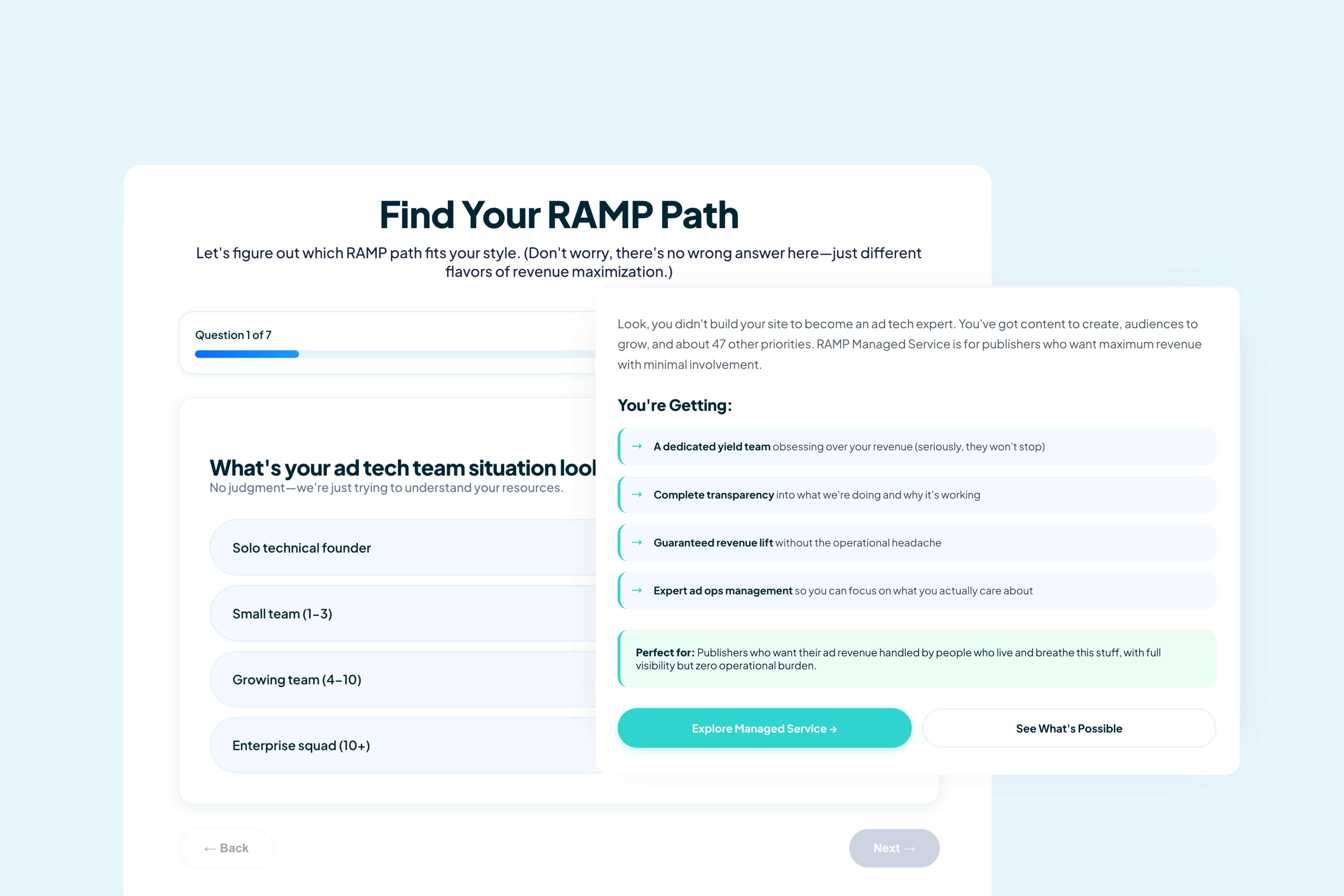
We built a structured intake and review process that takes a publisher from informal moderation practice to a documented, submission-ready governance package. Internal tooling handles the drafting and assessment work. Human review runs at every step. Publishers can self-assess readiness before anything goes to Amazon.
.png?width=1536&height=1146&name=amazon-tool-mockup%20(1).png)
The part that matters most: we advocate directly to Amazon on behalf of our publishers, with network scale behind that ask. A partner with the scale that SSPs and demand platforms pay attention to creates materially better odds than an individual publisher submitting cold. That's not a sales line. It's the operational reality of how access decisions get made at programs that run without published rulebooks.
APS is a significant revenue opportunity. It's also a one-shot process with no published eligibility criteria. Those two facts together are why publishers who pursue it without preparation consistently underperform against those who don't. If you're evaluating whether to pursue APS access, or trying to understand why you lost it, talk to us. We've got the data to back it up.
