
-1.png?width=800&height=157&name=1-playwire-logo-primary-2021%20(1)-1.png)


August 6, 2026

Editorial Policy
All of our content is generated by subject matter experts with years of ad tech experience and structured by writers and educators for ease of use and digestibility. Learn more about our rigorous interview, content production and review process here.
Key Points
- The Amazon Publisher Services agreement is a contract, not a rulebook: it defines program terms and payment conditions but does not tell you what qualifies or disqualifies you for access.
- Content governance obligations are embedded in the agreement through brand-safety and content-moderation requirements that apply directly to any UGC your site carries.
- Amazon reviews submissions once, with no documented appeal path for publishers. Making preparation the only real leverage you have.
- UGC surfaces you may not think of as risky (comment sections, user profiles, community uploads) are the most common failure point in the approval process.
- Understanding what the agreement implies about content moderation before you sign is revenue protection, not just legal hygiene.
Publishers preparing to apply to Amazon Publisher Services typically spend their energy on the technical integration questions: APS tag vs. SDK, TAM vs. UAM, which demand partners need direct SSP relationships. The agreement itself gets skimmed, signed, and filed.
That's a mistake. The contractual terms aren't just legalese. They carry real obligations around content governance that catch publishers off-guard, especially those running any form of user-generated content. Here's what you're actually committing to.
The Amazon Publisher Services Agreement: Structure and Scope
The Amazon Publisher Services agreement is a contract, not an eligibility rubric. Its job is to define the terms of the program relationship: how TAM (Transparent Ad Marketplace) and UAM (Unified Ad Marketplace) work, what data-processing obligations you're taking on, and the "Ineligible Events" that govern when Amazon isn't obligated to pay.
What the agreement does not do is publish a list of what gets a publisher approved or removed. No threshold you can look up, no violation taxonomy, no documented publisher-facing appeal process. Amazon's DSP side has a published malvertising suspension policy that explicitly includes an appeal path. The publisher side has no equivalent.
You're committing to obligations whose enforcement parameters aren't publicly defined. That's worth understanding before you sign.

TAM vs. UAM: What the Agreement Covers Differently
The two products have meaningfully different access models, and the agreement reflects that. For a deeper breakdown of how each product works and who qualifies, see our guide to Amazon Publisher Services TAM, UAM, and eligibility.
| TAM (Transparent Ad Marketplace) | UAM (Unified Ad Marketplace) | |
|---|---|---|
| Who manages demand connections | Publisher holds direct SSP relationships | Amazon manages demand connections on publisher's behalf |
| Technical requirement | Active APS tag or SDK integration, plus contracts with desired demand partners | Active APS tag or SDK integration |
| Primary audience | Larger publishers with existing SSP relationships | Mid-size publishers who want Amazon to handle the demand layer |
| Auction transparency | Publisher sees bidder-level data | More limited visibility |
| Fee model | $0.01 CPM bidder fee | Revenue share charged to publisher |
| Shopping Insights access | Yes | No |
TAM requires more infrastructure from the publisher upfront. UAM reduces that lift but gives you less control over the demand stack. Neither product changes the content-governance obligations that run across both programs.
Ineligible Events and the Payment Conditions
"Ineligible Events" is a defined term in the Amazon Publisher Services agreement, and it's where publishers often find unexpected exposure. This language defines the circumstances under which Amazon does not have to pay for traffic or impressions, covering scenarios including invalid traffic, policy violations, and inventory that doesn't meet quality thresholds.
The connection to content governance is direct. If your inventory is classified as low-quality, or if your site shares characteristics with flagged inventory, the Ineligible Event language creates a mechanism for Amazon to withhold payment, not just suspend access. Publishers running UGC surfaces need to read this section carefully. The inventory quality question isn't limited to your own editorial content.

What the Agreement Does Not Tell Publishers
The absence of a publisher-facing policy center is not an oversight. Consider the comparison: Google publishes an entire AdSense help section on the most common invalid traffic and policy violations that lead to account closure, covering bot traffic, incentivized traffic sources, and ad-click manipulation. Publishers who violate policy can read exactly what they violated and understand the path to remediation.
Amazon's publisher side has no policy center, no violation list, no publisher-facing appeals documentation. The reason is structural: a published rulebook creates an appeal surface. If a rule is documented, a publisher can argue they didn't violate it. Amazon's current approach keeps enforcement parameters private, which means there is nothing to appeal against.
That's a design choice, not an administrative gap.
For publishers, the practical implication is specific. You take on defined obligations. Amazon retains undefined enforcement authority. The best protection against that asymmetry isn't better negotiating, the agreement isn't negotiable. It's not giving Amazon a reason to use it.
Why Amazon Can Change the Agreement Unilaterally
September 2023 is the clearest documented example of what unilateral agreement modification looks like in practice. Amazon applied a 10% publisher transaction fee to Amazon DSP demand with roughly 30 days' notice. Publishers absorbed it. Access removals that followed carried the same character: unilateral, fast, and with no appeal path for most affected publishers.
The agreement permits this. Publishers who treat the APS relationship as stable and symmetric are misreading the contract they signed. For a fuller picture of what that fee change and subsequent access removals cost publishers, see our analysis of the structural revenue gap Amazon's SSP changes created.
Supply Quality Classification and Similarity Risk
Amazon has publicly described running always-on AI models that identify and block low-quality inventory, including domains with made-for-advertising characteristics. It supplements these with third-party classification input from Jounce Media and Deepsea.io to restrict domains sharing similar characteristics, alongside long-running invalid traffic detection built over more than a decade.
The classification risk this creates is meaningful and underappreciated. A publisher can be flagged by similarity to problematic inventory rather than by anything they specifically did wrong. No notice, no cited rule, because there was never a published rule to cite.
Essential Background Reading:
- Amazon Publisher Services (APS) Explained: TAM, UAM, and Eligibility: How the two APS products work, who they're designed for, and what the access layer actually looks like before you apply.
- Amazon Publisher Services Header Bidding: TAM, UAM, and the Access Layer Nobody Talks About: The technical and structural details of how Amazon's header bidding products sit inside the broader auction stack.
- Getting (and Keeping) Amazon Publisher Services Demand: The UGC Governance Problem Publishers Aren't Solving: The pillar piece for this topic cluster. Why UGC governance is the access variable most publishers never see coming.
- Ad Revenue from Amazon: What Publishers Are Really Earning (and Risking): Network data on what Amazon actually contributes to publisher revenue, and what's at stake when access disappears.
The Content-Governance Layer That Most Publishers Miss
Here is what the agreement implies but doesn't itemize: before Amazon approves a publisher for its demand, there is a content-governance and brand-safety review. This isn't a checkbox. It's a structured evaluation of how you govern the content that appears on your site.
The review covers territory including how content is moderated, how quickly problematic content comes down, how sensitive content is handled, what documentation exists for demand partners, what automated screening is in place, and how user interactions are monitored. For a detailed breakdown of what Amazon expects to see in that documentation, our guide on UGC governance documentation Amazon requires before approving publishers is the right next read. Amazon evaluates each submission once. There is no second look after a decision.
A rushed submission is more expensive than a delayed one. Preparation is the only lever available to publishers, and most don't know the review exists until they're already in the process.
Why UGC Is the Most Common Failure Point
Most publishers think of "content" as what their editorial team produces. The governance review treats your site as the sum of everything a visitor might encounter, including anything a stranger typed into it.
Comment sections on blog posts count. User profiles count. Community forums, reviews, question-and-answer sections: any surface where a user can submit text or media is a content area demand partners treat as risk. The classification systems described above don't distinguish between your editorial voice and whatever someone posted in your comment thread at 2am.
The realization that lands hardest for most publishers: your comment section is inventory-adjacent risk. If you haven't governed it like one, the review will find that. The UGC governance problem publishers aren't solving goes deeper than most realize, and it's the reason access requests fail without a clear explanation.
What the Agreement Implies About Moderation Standards
The agreement doesn't specify a moderation approach, but the brand-safety obligations embedded in it require you to demonstrate control. The relevant questions are operational:
- Pre-moderation vs. post-moderation: Whether content is reviewed before it goes live or published first and reviewed after. Most real publisher operations are hybrid, using automated tooling for volume and human review for ambiguity.
- Response timelines: How quickly problematic content comes down after it's identified or reported.
- Audit cadence: How often your content environment and moderation processes are reviewed and documented.
- Sensitive content handling: Whether you have documented policies for content categories that carry elevated brand-safety risk.
- Documentation for demand partners: Whether your governance practices are written down in a form a demand partner could review.
These aren't suggestions. "We moderate our comments, I think" is not a sufficient posture. If you can't evidence your practices, you can't demonstrate control, and without demonstrated control, approval is at risk. Our guide on how to write a UGC moderation policy that satisfies Amazon's brand safety requirements walks through what that documentation needs to cover.
Related Content:
- Navigating Amazon Publisher Services Documentation: A Practical Walkthrough: A publisher-facing guide to what APS documentation actually covers and where the gaps are.
- Amazon Publisher Services DSP: What It Is and Why It Matters for Your Inventory: How Amazon DSP demand flows into publisher inventory and why the DSP-side policies matter for your access status.
- Amazon Ad Revenue Growth: What It Means for Publisher Access and CPMs: How Amazon's expanding DSP spend is changing the dynamics of publisher access and auction competition.
- The Amazon SSP Problem: Why So Many Publishers Now Have a Structural Revenue Gap: Why losing Amazon as a bidder creates a gap larger than the Amazon line item alone.
- Publisher Ad Revenue Maturity Model: Where Are You on the Revenue Curve?: How demand diversification fits into a publisher's broader revenue maturity strategy.
The Revenue Stake Behind the Paperwork
The compliance framing can make this feel like a legal exercise. It's a revenue exercise.
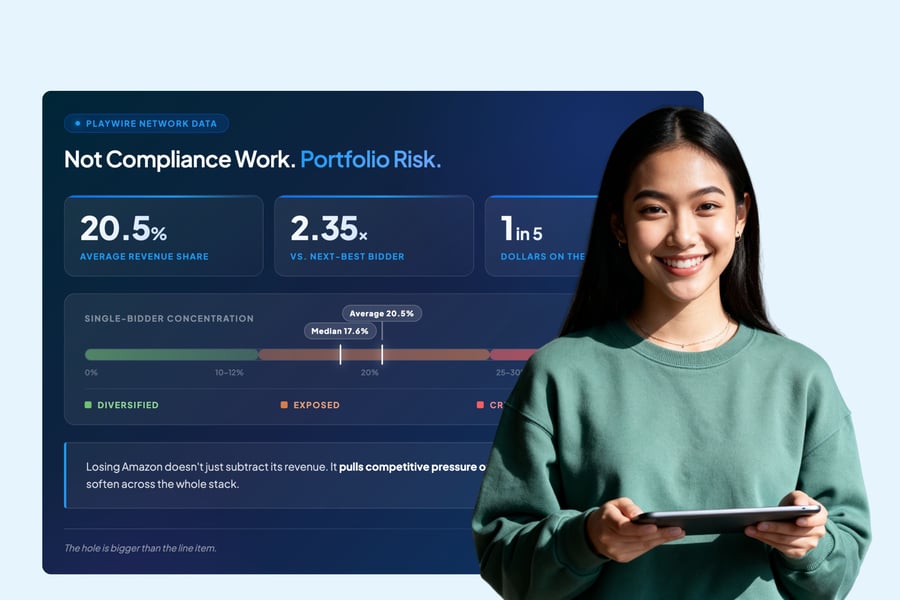
Our network data shows Amazon averaging 20.5% of total site revenue where it runs, with a median of 17.6%. That's roughly one dollar in every five to six. Amazon generates 2.35 times more revenue per site than any other measured bidder in our ecosystem. Publishers with dependencies in the 25. 30% range don't experience access removal as a revenue dip. They experience it as a crisis. For a full breakdown of what publishers are actually earning from Amazon and what they're risking, see our analysis of Amazon ad revenue for publishers.
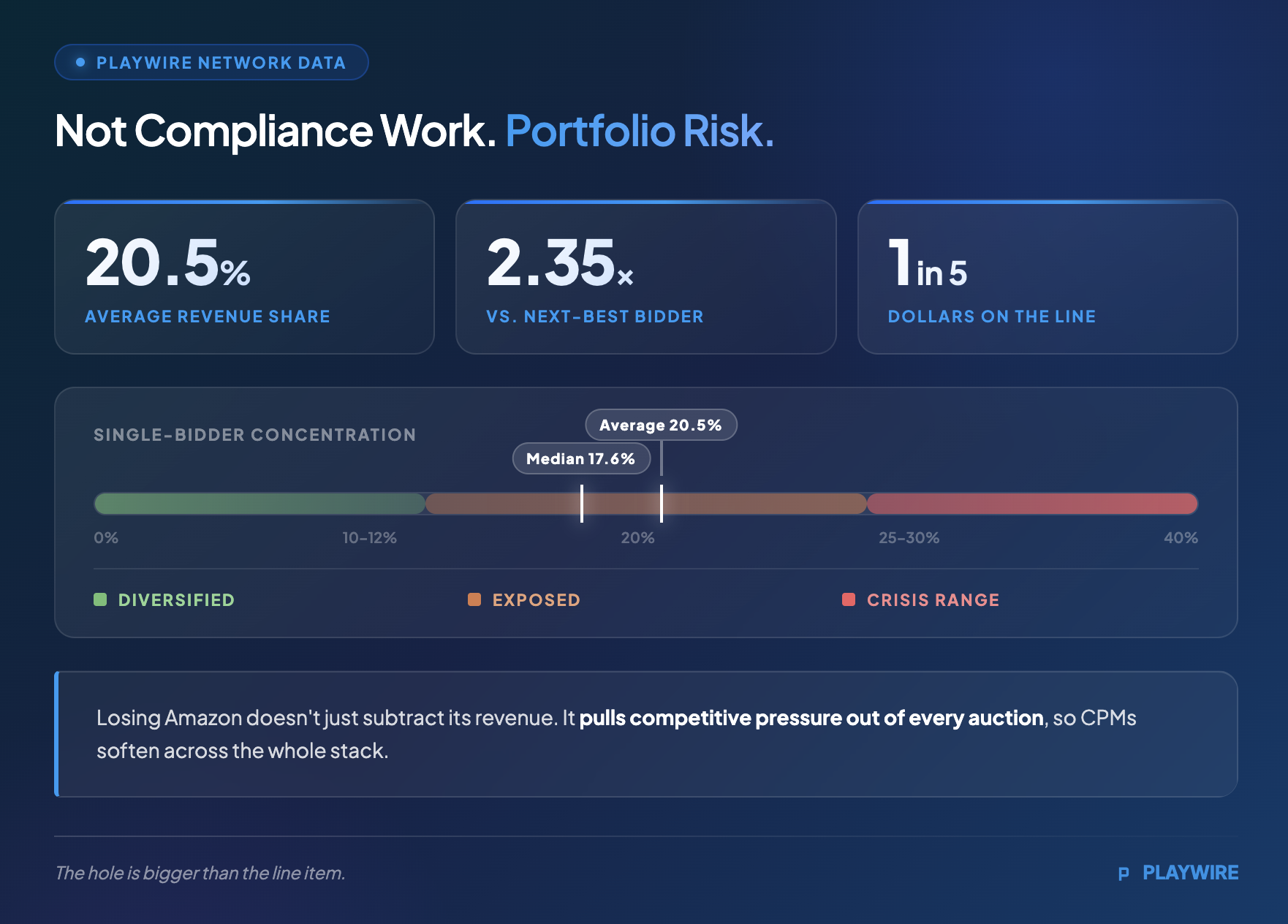
The direct loss understates the actual impact. Amazon applies competitive pressure across the entire auction. Remove a major bidder and the remaining bidders face less pressure to compete at the top of their range, so CPMs soften across the stack even when fill rate holds. The hole is larger than the Amazon line item, because it functionally is.
Well-diversified stacks target no single demand partner exceeding 10. 12% of total revenue. For publishers currently above that threshold on Amazon, understanding what you've committed to in the agreement, and whether your content governance can actually support it, isn't a compliance task. It's portfolio risk management.
Next Steps:
- What UGC Governance Documentation Amazon Expects Before Approving You: A detailed look at the territory the content-governance review covers and what demonstrated control actually requires.
- How to Write a UGC Moderation Policy That Satisfies Amazon's Brand Safety Requirements: Practical guidance on building the moderation documentation demand partners need to see.
- Amazon Publisher Services Review: What Publishers Need to Know Before Applying: A pre-application overview of what APS actually delivers and what the process involves.
- How to Recover Publisher Revenue After Losing Amazon as a Bidder: If access is already gone, here's how publishers have rebuilt yield without Amazon in the stack.
- What Separates the Top 10% of Website Publishers From Everyone Else: Data-Backed: How demand governance and stack discipline show up in the data on top-performing publishers.
How We Approach This Problem
We built a structured intake and review process for exactly this situation: taking a publisher from "we moderate our comments, I think" to a documented, submission-ready governance package. That includes internal tooling to draft and assess governance documentation, with human review at every step, followed by direct advocacy to Amazon on the publisher's behalf.
The advocacy piece matters more than it might seem. A partner with the scale that SSPs and demand partners respond to creates materially different incentives around approval than an individual publisher filing a request alone. No publisher controls Amazon's decision. The odds change, though, when the ask is backed by a network running over 100 billion impressions annually.
No other monetization partner has built specifically for this problem. The APS access process isn't something publishers can brute-force with good intentions and a tidy comment section. The governance review is real operational work, the submission window is one shot, and the revenue at stake is too significant to approach without preparation.
If you're preparing to apply to APS, or trying to understand why you lost access, contact us before you submit anything.
.png?width=1536&height=1146&name=amazon-tool-mockup%20(1).png)
See It In Action:
- Serebii Case Study: How a high-traffic gaming publisher optimized revenue and demand stack performance through Playwire's managed approach.
- Gaming Publisher First-Party Data: Identity Segmentation and CPM Lift: How publishers with active community surfaces used first-party data governance to drive CPM improvement rather than risk exposure.
- Education Publisher Ad Revenue Monetization: The Lesson Loop Advantage: How education publishers with UGC surfaces and community features navigate demand access and brand safety.
Frequently Asked Questions About the Amazon Publisher Services Agreement
What is the Amazon Publisher Services agreement?
The Amazon Publisher Services (APS) agreement is the contract publishers sign to access Amazon's programmatic demand through TAM (Transparent Ad Marketplace) or UAM (Unified Ad Marketplace). It defines program terms, data-processing obligations, payment conditions, and "Ineligible Events," which are the circumstances under which Amazon is not required to pay for traffic or impressions. The agreement does not publish eligibility criteria, a violation taxonomy, or a publisher-facing appeals process.
What is the difference between Amazon TAM and UAM?
TAM (Transparent Ad Marketplace) is Amazon's server-side header bidding product for larger publishers. It requires the publisher to hold direct contractual relationships with each SSP they want to access and gives the publisher bidder-level auction transparency. UAM (Unified Ad Marketplace) is Amazon's managed option for mid-size publishers, where Amazon handles the demand connections on the publisher's behalf. TAM charges a $0.01 CPM bidder fee; UAM charges publishers a revenue share. TAM also includes access to Amazon's Shopping Insights feature; UAM does not.
What are Ineligible Events in the Amazon Publisher Services agreement?
Ineligible Events are defined conditions in the APS agreement under which Amazon is not obligated to pay publishers for impressions or traffic. The category includes invalid traffic, policy violations, and inventory that doesn't meet Amazon's quality thresholds. For publishers running user-generated content, this section carries particular risk: if inventory is classified as low-quality or shares characteristics with flagged inventory, the Ineligible Event provisions give Amazon a mechanism to withhold payment, not just restrict access.
What are the requirements for Amazon TAM?
Amazon's publicly stated technical requirements for TAM are active integration with the APS tag or SDK, plus existing contractual relationships with the demand partners a publisher wants to access. TAM is described as invite-only, but Amazon has not published a traffic threshold, a scale requirement, or any eligibility criteria defining who qualifies. Publishers also go through a content-governance and brand-safety review before being approved, a process Amazon does not publicize but conducts on every submission.
Why was I removed from Amazon Publisher Services?
Amazon has not published a violation taxonomy or removal criteria for publishers. Removals are unilateral and are not accompanied by a cited rule, because there is no public rulebook to cite. Amazon uses AI-driven classification models and third-party classifiers, including Jounce Media and Deepsea.io, that can flag inventory by similarity to problematic domains, not only for direct violations. Publishers running user-generated content surfaces (comment sections, forums, user profiles) are frequently flagged through this classification process without having committed a specific, identifiable violation.
How do I appeal an Amazon Publisher Services removal?
Amazon has not published an appeal process for publishers removed from APS. This is an explicit asymmetry: Amazon's DSP side has a published malvertising suspension policy that includes a documented appeal path. The publisher side has no equivalent. No publisher-facing policy center, no violation list, no formal remediation framework. For publishers who have lost access and want to pursue reinstatement, working through an established network partner that can advocate directly to Amazon is currently the most viable path. A formal appeal process does not exist.
Does Amazon charge publishers for UAM?
UAM charges publishers a revenue share rather than a flat fee. TAM uses a different structure: a $0.01 CPM fee applied per bidder. Publishers using UAM surrender a portion of revenue in exchange for Amazon managing the demand connections on their behalf, which removes the requirement to hold direct SSP contracts.
