
-1.png?width=800&height=157&name=1-playwire-logo-primary-2021%20(1)-1.png)


August 6, 2026

Editorial Policy
All of our content is generated by subject matter experts with years of ad tech experience and structured by writers and educators for ease of use and digestibility. Learn more about our rigorous interview, content production and review process here.

Key Points
- Amazon requires publishers to pass a content-governance and brand-safety review before accessing APS demand, and there is no published rulebook explaining what that review actually evaluates.
- The review happens once, usually with no second look. A rushed or underprepared submission is more expensive than a delayed one.
- User-generated content, including comment sections on otherwise editorial sites, is the most common failure point. Most publishers don't recognize it as a risk surface until after a rejection.
- Amazon's review is a governance evaluation, not a content evaluation. It's asking whether you can demonstrate control, not whether your content is good.
- Working with a partner who has network-scale relationships with Amazon changes the odds in ways a solo submission cannot.
Your content is fine. Your comment section isn't.
That's the version of events playing out for publishers who apply for Amazon Publisher Services access and get rejected without explanation. They spent time cleaning up their ad stack, checking their IVT numbers, making sure their programmatic setup was solid, and then Amazon looked at the three-year-old comment thread under their most popular article and decided they'd seen enough.
Amazon doesn't publish its eligibility criteria for TAM. There's no violation list, no policy center, and no appeal path for most publishers who get turned down. What does exist, on the advertiser-facing side, is public acknowledgment that Amazon runs always-on AI models to identify and block low-quality inventory, uses third-party classification input from vendors including Jounce Media and Deepsea.io to restrict domains sharing similar characteristics, and operates sophisticated invalid traffic detection it's been building for over a decade. The implication for publishers: you can be flagged by similarity to problematic inventory, not just by anything you specifically did wrong.
Amazon's DSP side has a published malvertising suspension policy with an explicit appeal path. The publisher side has nothing equivalent. Google publishes an entire help center section on the most common violations that lead to AdSense account closure. Amazon publishes nothing comparable for publishers. The absence of a rulebook isn't an oversight. A rulebook creates an appeal surface, and Amazon has no interest in adjudicating thousands of publisher appeals.
What Amazon does have is a content-governance and brand-safety questionnaire that publishers must complete before approval. Most publishers don't know it exists until they're staring at it. And almost none of them know what a strong answer looks like, which is exactly what the UGC governance documentation Amazon expects before approving you is designed to address.

What Amazon Is Evaluating Before Granting APS Access
The governance review isn't primarily a content audit. Amazon isn't reading your articles and deciding whether it likes them. It's evaluating whether you can demonstrate operational control over the content surfaces you didn't write yourself.
That framing changes everything about how you should approach the submission. The question isn't "is our content good?" The question is "can we prove we know what's on our site and can control what happens there?"
The questionnaire covers territory across several categories. Understanding those categories, at a high level, is the first step to not walking in blind:
- Moderation practice: how content is reviewed before or after it goes live, and what the process looks like in practice
- Review and approval workflows: who is responsible for content decisions, and whether those responsibilities are documented
- Response timelines: how quickly problematic content comes down after it's identified or reported
- Audit cadence: how often the publisher reviews content surfaces and whether that review is systematic or ad hoc
- Sensitive content handling: what happens when content touches categories advertisers treat as high-risk
- Documentation: whether policies are written down and accessible to both users and demand partners
- Automated screening: what tooling, if any, is in place to catch problems at volume before humans see them
- User interaction monitoring: how the publisher tracks and responds to patterns in user behavior on the site
That list explains why publishers with professionally managed editorial content still fail this review. The questions aren't about your articles. They're about your comment section, your forum, your user profile pages, your community submissions portal. Anything a stranger can type into your site. Understanding what the Amazon Publisher Services agreement actually covers before you reach this step is time well spent.

Why Informal Moderation Practices Fail the APS Review
Most publishers with active user communities actually do moderate. They delete spam, ban bad actors, and have someone keeping an eye on things. The problem is that "someone keeps an eye on things" is not a documentable governance posture.
Amazon is reviewing a submission, not a website. It can't observe your informal practices. It can only read what you wrote down. If your moderation approach exists in institutional memory rather than in policy documents, it doesn't exist for the purposes of this review.
The distinction between how publishers actually operate and how they're able to represent that operation on paper is where most submissions break down. Pre-moderation reviews content before it goes live. Post-moderation publishes first and reviews after. Reactive moderation acts on user reports. Most real operations are hybrid, with automated tooling handling volume and humans handling ambiguity. None of those approaches fail on their own. They fail when the publisher can't describe them clearly, consistently, and in writing. Which is why writing a UGC moderation policy that satisfies Amazon's brand safety requirements is a distinct skill from simply having a moderation practice.
Response timelines are a particularly common gap. If a user reports harmful content, how long does it take your team to review and act? If the answer is "it depends" or "usually pretty quickly," that's not submittable. Demand partners need to know that a brand's ad won't be sitting next to a problem for an unknown and unbounded period of time.
The audit cadence question catches publishers who moderate reactively but never proactively. Reacting to reports is necessary but not sufficient. Amazon wants to see that you're periodically reviewing your content surfaces, not waiting for something to go wrong before you look.
Essential Background Reading:
- Amazon Publisher Services (APS) Explained: TAM, UAM, and Eligibility: How TAM and UAM work, who qualifies, and what the access structure actually looks like from a publisher's perspective.
- What to Expect Inside the Amazon Publisher Services Agreement: A close read of the APS contract terms, what the agreement covers, and the obligations publishers are signing up for.
- Amazon Publisher Services Review: What Publishers Need to Know Before Applying: An honest assessment of what publishers encounter when they go through the APS application process.
- Ad Revenue from Amazon: What Publishers Are Really Earning (and Risking): The real revenue numbers from Amazon demand, and the dependency risk that comes with them.
The UGC Risk Surface Most Publishers Miss
The word "UGC" triggers a mental image of a forum, or maybe a community platform with thousands of daily posts. That's the obvious case. The less obvious cases are the ones that cost publishers APS access.
A comment section on an editorial site is UGC. User reviews on a product or comparison page are UGC. User-submitted photos on a community page are UGC. A "submit your question" form with public-facing output is UGC. A community profile that users fill out themselves is UGC. If a stranger can type something into your site and it becomes visible to other visitors, it's a content surface that a demand partner will treat as risk, and Amazon's AI-driven systems will classify accordingly.
The auction doesn't help you here. When a programmatic auction closes in under 100 milliseconds, there's no time for a human to review the page a user is about to see. Content gets classified at the account or domain level, not at the individual post level, which means one problematic piece of user-submitted content can affect how the entire domain gets scored. The broader Amazon SSP problem publishers are navigating makes this classification dynamic especially consequential.
This is the math that makes governance documentation valuable even for publishers whose content is excellent. Your editorial reputation doesn't protect you if your comment section is ungoverned. The AI models scoring your inventory can't read your editorial mission statement.
Related Content:
- Getting (and Keeping) Amazon Publisher Services Demand: The UGC Governance Problem Publishers Aren't Solving: The pillar guide to why UGC governance is the access problem most publishers ignore until it's too late.
- What UGC Governance Documentation Amazon Expects Before Approving You: A detailed breakdown of the documentation categories Amazon evaluates during the brand-safety review.
- How to Write a UGC Moderation Policy That Satisfies Amazon's Brand Safety Requirements: What a submittable moderation policy looks like and how to build one from your existing practices.
- The Amazon SSP Problem: Why So Many Publishers Now Have a Structural Revenue Gap: Why losing Amazon demand creates a hole larger than the Amazon line item, and how competitive pressure explains the difference.
- Amazon Publisher Services DSP: What It Is and Why It Matters for Your Inventory: How the Amazon DSP connects to publisher inventory and why the demand side of this relationship shapes access decisions.
What a Strong APS Governance Submission Demonstrates
A strong governance submission doesn't necessarily prove that you have a large moderation team or expensive tooling. It demonstrates that you've thought carefully about the problem, built a process proportionate to your scale, and written that process down in a form legible to a demand partner.
For a publisher running a mid-size forum, a strong submission might describe a hybrid moderation approach: automated keyword and pattern screening runs on all posts before visibility, flagged content routes to a human reviewer with a defined review window, appeals follow a documented process, and the whole system gets audited quarterly. The specific values matter less than the presence of a coherent, documented system.
For a publisher with a comment section on an otherwise editorial site, the volume bar is lower, but the categories are the same. You need to be able to describe what happens when something goes wrong, how quickly, and who is responsible.
The documentation itself needs to be formal enough to be submittable. Written policies, not bullet points in a Slack message. Defined process owners, not "whoever is around." Timelines expressed as commitments, not estimates. For a fuller picture of how to navigate this process, a practical walkthrough of Amazon Publisher Services documentation covers the procedural side in detail.
Next Steps:
- Navigating Amazon Publisher Services Documentation: A Practical Walkthrough: A step-by-step guide to working through the APS documentation process without burning your one-shot submission.
- Amazon Publisher Services Header Bidding: TAM, UAM, and the Access Layer Nobody Talks About: How Amazon's header bidding structure works and why the access layer underneath it determines what publishers actually earn.
- Amazon Ad Revenue Growth: What It Means for Publisher Access and CPMs: How Amazon's expanding DSP spend is reshaping publisher access decisions and CPM floors across the ecosystem.
- 10 Ad Revenue Optimization Ideas That Actually Move the Needle: Yield optimization strategies that apply regardless of which demand partners you're running.
- Fill Rate Is the Most Underrated Revenue Lever, Though Complex to Change: Why fill rate matters more than most publishers realize, and how losing a major bidder like Amazon exposes that gap fast.
The One-Shot Problem With Amazon Publisher Services
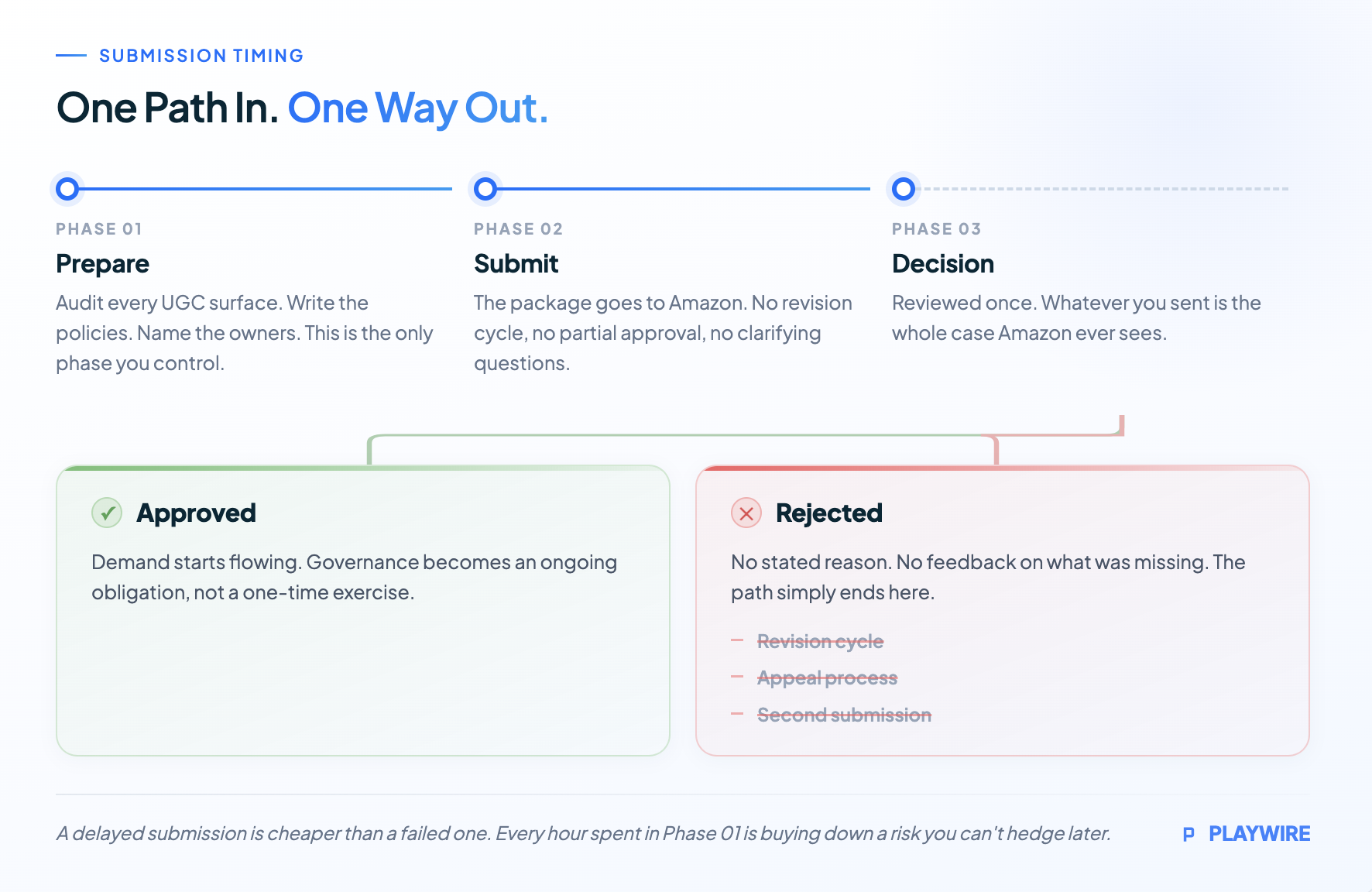
Amazon typically reviews each submission once. There is often no second look after a decision.
That single fact should change how publishers think about the timing of a submission. Submitting before your governance documentation is ready doesn't save time. It costs access. A rejected submission leaves you with no path forward and no feedback on why the answer was wrong. The "move fast" instinct that works in most publishing contexts actively works against you here.
The preparation phase exists to do the work that the submission can't redo. Audit your UGC surfaces before you write a word of your governance documentation. Identify every place a user can contribute content to your site, assess the risk level of each surface, and make sure your documented policies cover all of them. Not just the obvious ones. Understanding what publishers are really earning and risking from Amazon ad revenue before that first submission helps frame the stakes accurately.
Be honest in the submission, too. Overstating your moderation infrastructure is a problem that compounds. If you commit to a four-hour response SLA and your actual capacity is 48 hours, you've created a gap that will eventually cost you more than the initial rejection would have.
See It In Action:
- How to Recover Publisher Revenue After Losing Amazon as a Bidder: The recovery playbook for publishers who've already lost access. Demand diversification, floor strategy, and RPS stabilization.
- The Amazon SSP Problem: Why So Many Publishers Now Have a Structural Revenue Gap: How publishers across verticals experienced the revenue impact when Amazon demand disappeared from their stacks.
- Ad Revenue from Amazon: What Publishers Are Really Earning (and Risking): Network data on what Amazon actually contributes to publisher revenue, and the risk profile that comes with that dependency.
How Playwire Helps Publishers Secure Amazon Ad Revenue
We built a structured intake and documentation process, backed by internal tooling, that takes publishers from "we moderate our comments, I think" to a submission-ready governance package. That includes a readiness assessment before anything is sent to Amazon, so publishers can identify gaps in their current documentation without burning a submission to find out where they stand.
.png?width=1536&height=1146&name=amazon-tool-mockup%20(1).png)
The tooling handles the drafting and assessment layer. Human review covers the judgment calls: the places where operational specifics need to be represented accurately rather than optimistically.
The other piece is advocacy. When we submit on behalf of a publisher, we're not a solo voice filing a request into a void. We're a partner operating at network scale, with the kind of SSP relationships that create actual incentive for Amazon to engage. An individual publisher filing a request has a fundamentally different conversation than a network partner doing the same. The full picture of how Amazon Publisher Services header bidding works across TAM, UAM, and the access layer explains why network-scale advocacy matters at the structural level.
Amazon accounts for an average of 20.5% of total site revenue across our publisher network where it runs, with a median of 17.6%. That figure comes from our own network data across 100 billion-plus impressions annually. Per site, Amazon generates 2.35× more revenue than any other measured bidder. For publishers at the high end of that dependency range, losing access isn't a revenue dip. It's a revenue crisis. The direct loss understates the total impact, because removing a major bidder reduces competitive pressure across the entire auction, softening CPMs on everything else too. If you've already lost access, recovering publisher revenue after losing Amazon as a bidder is the starting point for rebuilding.
No other monetization partner has built for this specific problem. Most stop at helping publishers recover after losing Amazon access. We work to help publishers get access, and keep it, by making sure their governance posture is defensible before they submit.
If you're preparing for APS and you're not sure your documentation is ready, start by talking to us. One submission is all you get.
