
-1.png?width=800&height=157&name=1-playwire-logo-primary-2021%20(1)-1.png)


August 6, 2026

Editorial Policy
All of our content is generated by subject matter experts with years of ad tech experience and structured by writers and educators for ease of use and digestibility. Learn more about our rigorous interview, content production and review process here.

Key Points
- Amazon Publisher Services (APS) is an umbrella program, not a single product. It contains distinct tools serving different publisher sizes and technical configurations.
- TAM (Transparent Ad Marketplace) and UAM (Unified Ad Marketplace) are the two primary header bidding products under APS, and they are not interchangeable.
- APS demand is significant enough that losing access creates real revenue consequences: Playwire network data shows Amazon averaging 20.5% of total site revenue where it runs, with a median of 17.6%.
- Access to APS is not automatic or permanent, and Amazon evaluates publishers against criteria it does not publish, including a content governance and brand safety review.
- Understanding what APS is and how its components differ is the prerequisite to evaluating whether and how to pursue it.
You've seen the acronym. Maybe in a job posting, a vendor pitch, or buried in a monetization forum thread where everyone acts like it's obvious. Amazon Publisher Services APS gets treated as shorthand for something publishers are supposed to already know. Most don't, not precisely, and the ambiguity costs them.
This is the orientation piece. No assumed knowledge, no hand-waving. Just a clear map of what APS is, what sits inside it, and why the distinctions matter for your revenue stack.
What Amazon Publisher Services (APS) Is
Amazon Publisher Services is Amazon's publisher-facing monetization infrastructure: the collection of tools and services that allow digital publishers to access Amazon's advertising demand. That demand includes Amazon DSP buyers, endemic advertisers (brands selling on Amazon who want to reach relevant audiences off-platform), and third-party demand that flows through Amazon's connections.
The "APS" acronym refers to the overall program. Think of it as the brand name for Amazon's publisher business, not a single product you install and run. Inside that umbrella sit distinct products with different mechanics, different eligibility requirements, and different tradeoffs. Treating APS as monolithic is where most publisher confusion starts.
Amazon describes APS as a suite of cloud services for publishers. The practical meaning: it's the access point to Amazon's demand stack, structured into tiers that roughly correspond to publisher size, technical sophistication, and existing SSP relationships. For a full walkthrough of the program's terms and what the agreement actually commits you to, see what to expect inside the Amazon Publisher Services agreement.

TAM vs. UAM: The Core Products Inside APS
The two products that define most publishers' experience with APS are Transparent Ad Marketplace (TAM) and Unified Ad Marketplace (UAM). They solve similar problems, connecting publishers to demand, but through fundamentally different mechanisms. The distinction isn't academic. Getting this wrong at the application stage wastes a submission you don't get to repeat.
Transparent Ad Marketplace (TAM)
TAM is Amazon's server-side header bidding solution, designed for larger publishers who already have direct relationships with multiple SSPs. The integration works through the APS tag (or SDK for app publishers), and TAM then connects to the SSPs you've contracted with directly. Amazon manages the server-side auction infrastructure; you bring the demand relationships.
The key operational detail: TAM requires that you already have contractual relationships with the demand partners you want to access through it. If you don't have a direct deal with a given SSP, TAM can't route to them on your behalf. This makes TAM a tool for publishers who have already built out their demand stack and want to add Amazon's server-side header bidding wrapper layer on top.
Unified Ad Marketplace (UAM)
UAM is the alternative for publishers who haven't built those direct SSP relationships yet, or who don't want to manage them. Amazon handles the demand connections on your behalf, integrating with multiple demand sources through its own contracts rather than yours. You get access to competition without having to negotiate and maintain individual SSP agreements.
The tradeoff is control. With UAM, Amazon is the intermediary managing those relationships. That's simpler operationally, but it means you have less visibility into the demand sources and fewer levers to pull if you want to adjust how specific SSPs see your inventory.
UAM is typically the entry point for mid-size publishers who want Amazon's demand without the overhead of a full SSP portfolio. TAM is typically where larger, technically-equipped publishers end up once they've established those relationships.
TAM vs. UAM: Side-by-Side Comparison
The two products share a goal but differ significantly in implementation and fit. Here's how they compare across the dimensions that matter most to publishers evaluating which path makes sense.
| Dimension | TAM | UAM |
|---|---|---|
| Integration method | Server-side (APS tag/SDK) | Server-side (APS tag/SDK) |
| SSP relationships | Publisher holds direct contracts | Amazon manages demand connections |
| Technical complexity | Higher, requires SSP relationship management | Lower. Amazon handles demand side |
| Publisher size fit | Larger, established publishers | Mid-size publishers building demand |
| Control over demand sources | Higher | Lower |
| Amazon as intermediary | Partial | Full on demand management |
| Target publisher profile | Portfolio publishers, enterprise | Growing publishers, smaller technical teams |
Both products require active APS tag or SDK integration as their only stated technical prerequisite on the integration side. The distinction is what happens after the tag fires: whose demand relationships get called.
Essential Background Reading:
- Getting and Keeping Amazon Publisher Services Demand: The UGC governance problem most publishers aren't solving, and why access to APS hinges on more than traffic thresholds.
- What to Expect Inside the Amazon Publisher Services Agreement: What the APS contract actually says about TAM, UAM, data obligations, and when Amazon doesn't have to pay.
- Amazon Publisher Services DSP: What Amazon DSP actually is, how it connects to APS, and what it means for the demand showing up in your reports.
- Ad Revenue from Amazon: What Publishers Are Really Earning (and Risking): The revenue dependency numbers that make APS access a strategic question, not just a technical one.
Other Components Under the APS Umbrella
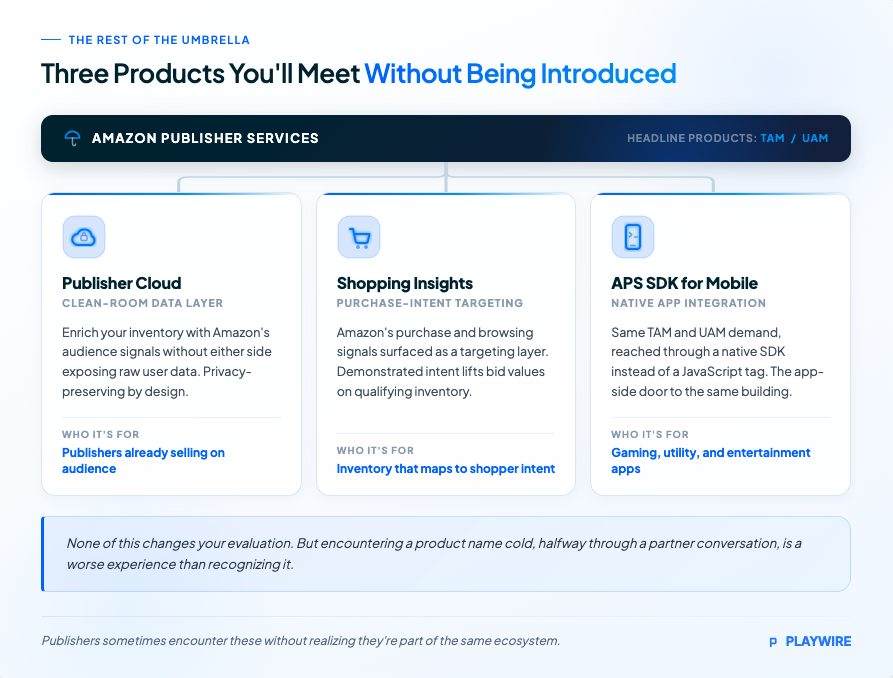
TAM and UAM are the headline products, but APS includes additional capabilities that publishers sometimes encounter without realizing they're part of the same ecosystem.
Publisher Cloud: Amazon's data collaboration infrastructure, allowing publishers to use Amazon's audience data signals to enrich their inventory for advertisers without exposing raw user data. It's the privacy-preserving clean-room data layer, relevant primarily for publishers sophisticated enough to be thinking about audience-based selling.
Shopping Insights: Audience intelligence based on Amazon's purchase and browsing signals, surfaced to publishers as a targeting enhancement for their inventory. The core value proposition: advertisers buying through APS can reach audiences with demonstrated purchase intent, and that intent data improves bid values for qualifying publisher inventory.
APS SDK for Mobile: The mobile-native integration path for app publishers. The SDK connects app inventory to the same TAM/UAM demand infrastructure, but through a native integration rather than a JavaScript tag. Mobile publishers working within gaming, utility, or entertainment apps are typically the primary users.
These additional components aren't always relevant at the evaluation stage, but knowing they exist prevents the confusion that comes from encountering them later without context.
Related Content:
- Amazon Publisher Services Header Bidding: TAM, UAM, and the access layer nobody talks about. Including how timeout configuration determines whether Amazon's bid actually competes.
- Navigating Amazon Publisher Services Documentation: A practical walkthrough of what Amazon publishes, what it doesn't, and how to read what's there.
- Amazon Publisher Services Review: What publishers need to know before applying. Including what the review process actually evaluates.
- Amazon Ad Revenue Growth: What It Means for Publisher Access and CPMs: How Amazon's growing ad business is reshaping who gets access and what inventory commands in auction.
- The Amazon SSP Problem: Why losing Amazon as a bidder creates a structural revenue gap that extends well beyond the Amazon line item itself.
APS Eligibility: What Amazon Evaluates
Every competitor article treats APS eligibility as a traffic and scale question. That's incomplete. Publisher size matters, but it isn't the whole picture.
Amazon evaluates publishers on content governance and brand safety before approving them for demand. The review covers how content is moderated, how UGC surfaces are managed, what review and audit processes are in place, and how sensitive or problematic content is handled. This applies to any surface where a third party can contribute content: comment sections, forums, user reviews, community uploads, or any feature where a stranger can type something into your site.
Most publishers don't think of their comment section as an inventory-adjacent risk. Amazon does. For a detailed breakdown of what UGC governance documentation Amazon expects before approving you, the requirements go well beyond having a moderation policy on paper.
The review happens once. There is no second submission after a decision, and no documented appeal path for publishers denied or removed from APS. Amazon's DSP side has a published malvertising suspension policy that explicitly includes an appeal mechanism. The publisher side of APS has no equivalent: no violation taxonomy, no published eligibility criteria, no appeals documentation. Amazon does not publish what disqualifies a publisher because publishing that list would create an appeal surface Amazon has chosen not to maintain.
That asymmetry is worth understanding before you submit anything. A rushed submission is more expensive than a delayed one.

Why APS Revenue Dependency Changes the Stakes
The case for caring about APS isn't abstract. Playwire ecosystem data shows Amazon averaging 20.5% of total site revenue where it runs, with a median of 17.6%. That's roughly one dollar in every five to six. The same data shows Amazon generating 2.35 times more revenue per site than any other measured bidder in the stack. For a fuller breakdown of what publishers are really earning from Amazon ad revenue, and what they're risking. The concentration numbers are worth sitting with.
Publishers in the 25-30% dependency range who lose access don't experience a line-item reduction. They experience something closer to a revenue crisis.
The direct loss also understates the impact. Amazon applies competitive pressure across the entire auction. Remove a major bidder and the remaining bidders face less pressure to bid at the top of their range, so CPMs soften across the stack even when fill rate holds. Publishers consistently feel the hole as larger than their Amazon line item, because it is. The structural revenue gap that emerges when Amazon leaves an auction is documented and measurable.
A well-diversified stack targets no single demand partner exceeding 10-12% of total revenue. Given Amazon's average contribution of 20.5% where it runs, publishers already relying heavily on APS have a concentration question worth tracking regardless of their current access status.
Next Steps:
- What UGC Governance Documentation Amazon Expects Before Approving You: The categories Amazon's content governance review covers and why most publishers aren't ready the first time.
- How to Write a UGC Moderation Policy That Satisfies Amazon's Brand Safety Requirements: What a defensible moderation policy looks like and why the documentation matters as much as the practice.
- Publisher Ad Revenue Maturity Model: Where APS fits in the broader revenue stack and how demand diversification maps to publisher maturity.
- What Separates the Top 10% of Website Publishers From Everyone Else: Data-backed patterns in how high-performing publishers manage demand relationships and revenue concentration.
How APS Fits Into a Publisher's Broader Demand Stack
APS is not a standalone monetization solution. It's a demand source that sits inside a larger header bidding ecosystem, competing in the same auction as other SSPs and exchanges. The architecture question is where, and how, it participates in that auction.
For publishers running client-side header bidding through Prebid.js, APS participates as a server-side bidder that runs concurrently. Amazon's auction happens server-side, and the result competes with the client-side bids. Getting the timeout configuration right matters here: if your client-side auction closes before TAM's server-side response arrives, Amazon's bid doesn't compete, and you've technically integrated APS without actually getting its demand into the running.
For publishers using a managed monetization partner, APS integration is typically handled within the partner's header bidding wrapper. The yield implications, timeout tuning, floor coordination, bid density. Are managed at the platform level rather than requiring publisher-side intervention on each variable. Understanding how Amazon DSP demand flows through your inventory is relevant context for evaluating how much of that demand you're actually capturing.
See It In Action:
- How to Recover Publisher Revenue After Losing Amazon as a Bidder: The tactical path publishers take when APS access disappears and revenue needs to be rebuilt from the demand stack up.
- Entertainment Publisher Ad Revenue: How volume and geography interact with demand-source dependency to define a publisher's actual revenue risk profile.
- Gaming Publisher First-Party Data: Identity Segmentation and CPM Lift: How publishers with strong first-party data infrastructure reduce their dependence on any single demand source.
- News Publisher Ad Revenue Monetization Strategy: When the answer to a revenue problem isn't more ad units, and why demand quality matters more than demand quantity.
What APS Does Not Cover
Some clarity on scope is useful for publishers who encounter APS in contexts where its reach is overstated.
APS is not Amazon's DSP product. Amazon DSP is the buy-side tool advertisers use to purchase display, video, and audio inventory. Publishers access Amazon DSP spend indirectly, through APS connections, but they don't manage or operate the DSP. Seeing "Amazon DSP" in a campaign report means Amazon DSP buyers bid on your inventory through APS. It doesn't mean you have a DSP integration to configure.
APS is also not a replacement for AdX or a competing ad server. It operates alongside your ad server, not in place of it. Publishers sometimes encounter vendor framing that implies APS is an either/or choice against Google's infrastructure. It isn't. APS is a demand source that competes in your existing auction environment, integrated through a tag or SDK that passes bids to your ad server for final decisioning.
Frequently Asked Questions About Amazon Publisher Services APS
Publishers evaluating APS consistently run into the same questions. Here are direct answers.
What is Amazon Publisher Services (APS)?
Amazon Publisher Services is Amazon's suite of cloud-based tools and programs that give digital publishers access to Amazon's advertising demand. The program includes two primary header bidding products. Transparent Ad Marketplace (TAM) and Unified Ad Marketplace (UAM). Along with data tools like Publisher Cloud and Shopping Insights. APS is not a single product; it's the umbrella program for Amazon's entire publisher-facing monetization infrastructure.
What is the difference between TAM and UAM?
TAM (Transparent Ad Marketplace) is Amazon's server-side header bidding solution for publishers who already hold direct contracts with multiple SSPs. TAM routes those existing relationships through Amazon's server-side auction infrastructure. UAM (Unified Ad Marketplace) is designed for mid-size publishers who don't have or don't want to manage direct SSP relationships. With UAM, Amazon manages the demand connections on the publisher's behalf. TAM gives publishers more control; UAM reduces operational overhead at the cost of visibility into demand sources.
Is Amazon Publisher Services invite-only?
APS is not purely invite-only, but it is not open to all publishers. Publishers apply and are reviewed before gaining access. Amazon's review process covers publisher size, traffic quality, and content governance, including how UGC surfaces are moderated. Amazon does not publish its eligibility criteria, and each submission is reviewed once with no documented path for reconsideration.
What are the eligibility requirements for APS?
Amazon has not published a formal eligibility criteria document for its publisher programs. Based on publicly available information, TAM requires active APS tag or SDK integration and existing contractual relationships with the SSP demand partners a publisher wants to access. Beyond technical prerequisites, Amazon conducts a content governance and brand safety review before approving publishers. That review covers moderation practices, user-generated content surfaces, audit frequency, and documented policies for handling sensitive content. Publisher size and traffic quality are also factors, though Amazon has not published specific thresholds.
Can small publishers use APS?
UAM is the more accessible path for smaller and mid-size publishers, since it doesn't require pre-existing SSP relationships. TAM is generally suited to larger publishers with established demand stacks. Neither program publishes a specific traffic threshold for eligibility, but Amazon's review process effectively filters for publishers with sufficient scale, traffic quality, and content governance practices.
Does Amazon Publisher Services charge a fee?
Amazon applies a publisher transaction fee to Amazon DSP demand flowing through APS. In September 2023, Amazon applied a 10% transaction fee to Amazon DSP demand with approximately 30 days' notice to affected publishers. This fee structure is defined in the APS agreement and can change. Publishers should factor the fee into their net revenue calculations when evaluating APS as a demand source.
How does server-side header bidding work with APS?
Server-side header bidding moves the auction from the user's browser to Amazon's servers. When a page loads, the APS tag calls Amazon's infrastructure, which runs an auction among the connected demand partners on the server side. The winning bid from that server-side auction then competes with client-side bids in the publisher's main auction. This reduces browser-side latency from running multiple bidder calls, but introduces a dependency on correct timeout configuration: if the client-side auction resolves before Amazon's server-side response returns, the Amazon bid doesn't participate.
What is Amazon Publisher Cloud?
Amazon Publisher Cloud is Amazon's clean-room data collaboration infrastructure for publishers. It allows publishers to activate Amazon's audience signals. Including purchase intent and browsing behavior data. Against their own inventory for advertisers, without exposing raw user data. It's designed for publishers sophisticated enough to be pursuing audience-based selling strategies and who want access to Amazon's first-party data layer for inventory enrichment.
How does APS compare to Google Open Bidding?
Both APS and Google Open Bidding (now part of Google Ad Manager's unified first-price auction) provide server-side demand access for publishers. The primary difference is ecosystem alignment: APS connects publishers to Amazon DSP demand and Amazon-adjacent buyers, while Google Open Bidding connects publishers to Google's demand partner network within Google Ad Manager. Many publishers run both simultaneously. APS requires its own tag or SDK integration alongside any existing Google infrastructure; the two are not mutually exclusive.
How does APS compare to Prebid?
Prebid.js is an open-source client-side header bidding wrapper that publishers configure and control directly. APS operates server-side through Amazon's infrastructure. Publishers frequently run APS and Prebid concurrently: Prebid handles client-side demand partners while APS (via TAM or UAM) handles Amazon's server-side auction, with both results competing in the final ad server decisioning. The choice is not either/or. Prebid gives publishers full transparency and control over bidder configuration; APS gives publishers access to Amazon demand that doesn't have a native Prebid adapter equivalent for server-side auction participation.
How Playwire Handles APS Access for Publishers
We work with Amazon's TAM and UAM products as part of our RAMP platform, and our publishers access APS demand through that integration. Timeout tuning, floor configuration, and auction participation are managed within the platform rather than requiring each publisher to maintain those variables independently.
More relevant for publishers still evaluating access: partner scale matters when pursuing APS approval. A monetization partner with the network weight that SSPs and demand partners respond to can advocate for publishers through the approval process in ways an individual submission cannot. We built a structured process, backed by internal tooling, to take publishers from initial governance assessment through a submission-ready package, and then we advocate directly to Amazon on their behalf.
No other monetization partner has built for this problem specifically. The full picture of getting and keeping Amazon Publisher Services demand, including the UGC governance problem most publishers aren't solving. Is worth reading before you decide how to approach the process.
If you're in the early stages of understanding what APS is and whether it belongs in your stack, this is the right place to start. When you're ready to evaluate access specifically. What Amazon is assessing and how the process works. That's a conversation worth having with partners who've navigated it. If you've already lost access and need to understand your recovery options, how to recover publisher revenue after losing Amazon as a bidder covers the tactical path forward.
Amplify Your Ad Revenue. Start here.
