
-1.png?width=800&height=157&name=1-playwire-logo-primary-2021%20(1)-1.png)


August 6, 2026

Editorial Policy
All of our content is generated by subject matter experts with years of ad tech experience and structured by writers and educators for ease of use and digestibility. Learn more about our rigorous interview, content production and review process here.

Key Points
- APS documentation separates TAM and UAM into distinct technical tracks. Knowing which one applies to your setup before you start saves significant debugging time.
- The most common implementation failures trace to bid parameter mismatches and timeout misconfiguration, both of which are documented but easy to overlook.
- Amazon's supply quality enforcement operates through AI-driven classification and third-party data sources, meaning a publisher can be flagged for inventory similarity to problematic domains, not just direct violations.
- Access to APS demand requires more than correct tag implementation: content governance and brand safety documentation are evaluated before approval, and Amazon reviews each submission once with no second look.
- When something breaks, the path to resolution depends on whether you're troubleshooting a technical integration issue or an access and approval issue. These are entirely different problems with entirely different fixes.
The Amazon Publisher Services is organized for people who already know what they're looking for.
If you're implementing TAM or UAM for the first time, or you've inherited a broken setup and need to figure out what went wrong, the official docs will eventually get you there. But the navigation logic isn't obvious, and the gaps between sections are where implementation errors tend to live. This walkthrough maps the terrain, flags the common failure points, and tells you where the documentation stops and the undocumented access process begins. That second part is what most publisher-facing guides skip entirely. For a broader look at how APS access and UGC governance interact, this guide on getting and keeping Amazon Publisher Services demand covers the full picture.

TAM vs. UAM: Get This Right Before You Touch a Tag
The APS product suite splits into two distinct paths with different technical requirements, different demand configurations, and different operational models. Implementing the wrong one, or conflating them, produces problems that look like bugs but are actually architecture mismatches. For a full breakdown of how TAM and UAM compare, including eligibility details, Amazon Publisher Services explained: TAM, UAM, and eligibility covers the complete picture.
Transparent Ad Marketplace (TAM) is a server-side header bidding solution. Your publisher maintains direct contractual relationships with the SSPs participating in the auction, and those demand partners bid alongside your existing header bidding setup. The APS tag calls Amazon's server, which calls out to the demand partners you've configured. TAM requires active APS tag integration and existing direct relationships with your desired demand partners. Those contracts are prerequisites, not something the platform handles for you. To understand how TAM fits into the broader Amazon Publisher Services header bidding architecture, including the access layer most publishers never see, there's a dedicated breakdown worth reading alongside the official docs.
Unified Ad Marketplace (UAM) is the managed-demand path. Amazon handles the demand partner relationships, so you don't need pre-existing SSP contracts. This is the right choice for mid-size publishers who want access to multiple demand sources without building out individual partnerships. The technical integration is simpler, but the tradeoff is less granular control over which demand partners participate.
The documentation addresses both products, often in adjacent pages that don't clearly signal which path they're covering. Identify which product your publisher is using before you start, and filter every documentation page through that lens.
| TAM | UAM | |
|---|---|---|
| Access model | Publisher-managed SSP relationships | Amazon manages demand connections |
| Who it's for | Publishers with existing direct SSP contracts | Mid-size publishers without pre-existing SSP relationships |
| Technical requirement | Active APS tag or SDK integration | APS tag integration |
| SSP relationships | Publisher holds contracts directly | Amazon holds contracts |
| Demand control | Publisher configures which partners participate | Amazon manages partner configuration |
| Fees | Subject to Amazon transaction fee (10% applied to Amazon DSP demand as of September 2023) | Amazon manages fee structure with demand partners |
Where the Amazon Publisher Services Documentation Lives and How It's Structured
APS documentation is hosted under the Amazon Publisher Services umbrella and organized into product-level sections. The broad structure looks like this:
| Section | What It Covers |
|---|---|
| Getting Started | Account setup, publisher onboarding, eligibility |
| TAM Integration Guides | APS tag implementation, bid parameter configuration |
| UAM Integration Guides | UAM-specific tag setup, demand configuration |
| SDK Documentation | Mobile app integration for iOS and Android |
| API Reference | Programmatic access to APS reporting and configuration |
| Policy and Terms | APS agreement, Ineligible Events definitions, supply quality policies |
The Policy and Terms section is the one technical implementers skip most often. Don't. The supply quality documentation in that section explains the enforcement mechanisms that determine whether your inventory gets monetized or blocked, and understanding those mechanisms has direct debugging implications that no amount of tag auditing will surface on its own. If you want a clearer read on what the formal agreement actually commits you to, what to expect inside the Amazon Publisher Services agreement breaks down the contract language in publisher-legible terms.

The Tag Implementation: Where Most Errors Start
For TAM, the core implementation is the APS JavaScript tag. The tag loads asynchronously, calls the APS server with bid request parameters, and returns bids that enter your existing header bidding wrapper. The sequence matters, and the documentation covers it clearly. Three places is where implementations consistently break.
Bid parameter configuration: TAM requires that bid requests include correctly formatted slot parameters matching the ad units you've defined in the APS console. Mismatches between the parameters in your tag and the configuration in the console produce silent failures. The tag loads, the request fires, and nothing comes back. The documentation shows the required parameter structure; cross-reference your implementation against it directly rather than assuming the format matches what you used with other partners.
Timeout alignment: APS bids compete in your header bidding auction, which means they're subject to your auction timeout. If your overall wrapper timeout is tight and the APS server response is slow, Amazon bids will time out before they can compete. The documentation covers timeout configuration, but it doesn't tell you what a right-sized timeout looks like relative to other bidders. APS should have competitive timeout allocation: not longer than your slowest bidder, but not so short that latency from server-side calls creates systematic exclusion. Test this empirically with your specific stack.
Duplicate tag loading: Publishers running multiple monetization solutions sometimes end up with the APS tag loading more than once. The documentation covers this as a known failure mode. Audit your tag loading order carefully, especially if you're implementing APS alongside an existing header bidding wrapper that may already include APS through a shared configuration.
Essential Background Reading:
- Amazon Publisher Services (APS) Explained: TAM, UAM, and Eligibility: The foundational overview of how TAM and UAM differ, who qualifies for each, and what the eligibility process actually involves.
- What to Expect Inside the Amazon Publisher Services Agreement: A plain-language breakdown of the APS contract, Ineligible Events definitions, and what you're actually committing to before you sign.
- Getting (and Keeping) Amazon Publisher Services Demand: The UGC Governance Problem Publishers Aren't Solving: The pillar piece for this cluster. Covers why access is harder than it looks and what governance has to do with it.
- Amazon Publisher Services Review: What Publishers Need to Know Before Applying: What the application process looks like from the publisher side, including the parts Amazon doesn't publish.
Mobile SDK Implementation
If you're integrating APS into a mobile app, you're in different documentation territory entirely. The iOS and Android SDKs have separate integration guides with SDK-specific parameter handling and lifecycle management requirements that don't apply to web implementations.
The most common mobile-specific failure point is initialization timing. The APS SDK needs to initialize before ad requests fire, and the initialization is asynchronous. Implementations that don't account for this properly will fire bid requests before the SDK is ready, producing empty responses that look like demand issues. The documentation covers the initialization sequence explicitly. Follow it in order, and don't parallelize initialization with your first ad request.
Related Content:
- The Amazon SSP Problem: Why So Many Publishers Now Have a Structural Revenue Gap: Why supply quality enforcement creates revenue gaps that go well beyond the Amazon line item, and why the hole is larger than publishers expect.
- Amazon Publisher Services DSP: What It Is and Why It Matters for Your Inventory: How the Amazon DSP connects to publisher inventory and why demand-side dynamics affect what Amazon's supply team evaluates.
- Amazon Ad Revenue Growth: What It Means for Publisher Access and CPMs: Amazon's advertising business is growing fast. What that means for publisher leverage, CPMs, and access dynamics.
- Ad Revenue from Amazon: What Publishers Are Really Earning (and Risking): Data on what Amazon actually contributes to publisher revenue, and what's at stake when access disappears.
- The Publisher's Guide to Viewability Optimization: Chasing Perfect Isn't the Answer: Supply quality evaluation includes viewability signals. This guide covers how to optimize without overcorrecting.
The Supply Quality Layer You Can't Configure
Successful tag implementation doesn't guarantee access to APS demand.
Amazon runs always-on AI models that identify and block low-quality inventory, and it supplements those models with third-party classification data from sources including Jounce Media and Deepsea.io to restrict domains that share characteristics with flagged inventory. The practical implication is significant: a publisher can have a correctly implemented tag, valid account credentials, and compliant content, and still see APS demand not flowing, because their domain was caught by similarity-based classification rather than any specific violation.
This is a supply quality enforcement issue, not a technical integration issue, and the debugging path is completely different. No amount of tag auditing resolves it.
This distinction matters for how you triage. If the tag is firing, the parameters match, timeouts are reasonable, and bids still aren't coming through, you're likely looking at a demand access issue, not an implementation bug. The Amazon SSP problem and the structural revenue gap it creates for affected publishers explains why that distinction has such outsized revenue consequences.
What Amazon Publisher Services Documentation Doesn't Cover
This is the content gap that no third-party guide addresses directly, and it's the most operationally important thing to understand about APS access.
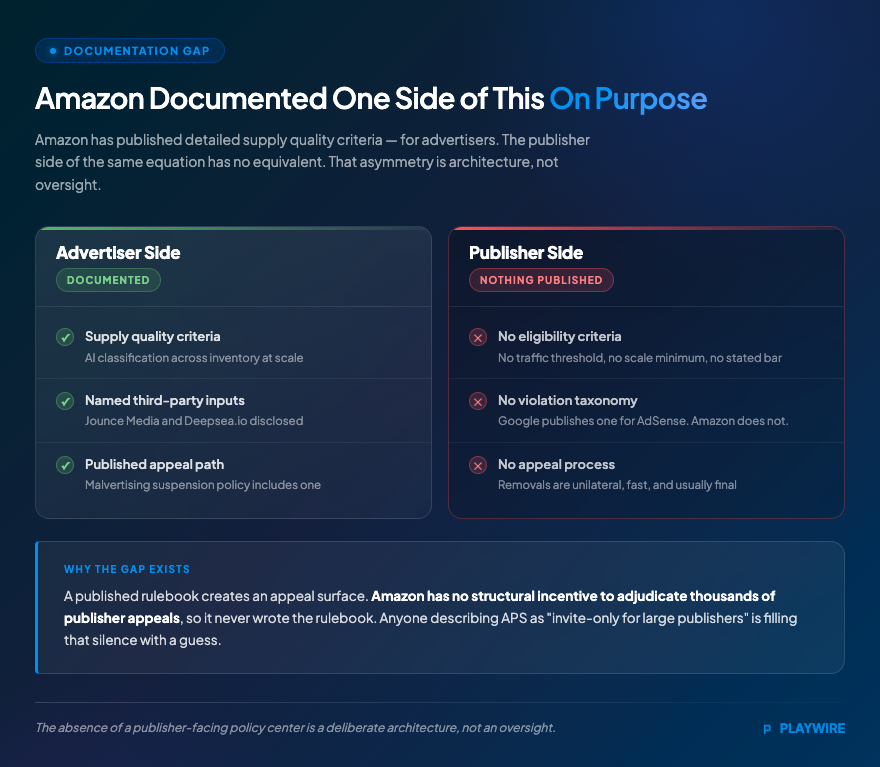
Amazon has published, for advertisers, detailed information about how it evaluates publisher supply quality: AI-driven classification across inventory at scale, third-party vendor inputs from Jounce Media and Deepsea.io, and long-running invalid traffic detection. What Amazon has not published, for publishers, is any equivalent policy documentation on the other side of that equation.
Specifically:
- No publisher-facing eligibility criteria: There is no published traffic threshold, no scale requirement, no stated minimum for TAM qualification. Competitors describing APS as "invite-only for large publishers" are guessing.
- No violation taxonomy: There is no published list of what gets a publisher removed or rejected. Compare this to Google, which maintains an explicit AdSense policy center documenting the most common violations that lead to account closure: bot traffic, incentivized clicks, invalid traffic sources. Amazon has no equivalent for publishers.
- No documented appeal process: Amazon's DSP side maintains a published malvertising suspension policy that includes an explicit appeal path for advertisers. The publisher side has nothing comparable. Access removals are unilateral, fast, and in most cases offer no documented path to resolution.
The absence of a publisher-facing policy center is a deliberate architecture, not an oversight. A published rulebook creates an appeal surface, and Amazon has no structural incentive to adjudicate thousands of publisher appeals. Understanding this shifts how you approach both the initial access process and ongoing compliance. The Amazon Publisher Services review covers what publishers need to know before applying, including what this opacity means in practice for new applicants.
Next Steps:
- What UGC Governance Documentation Amazon Expects Before Approving You: The governance categories Amazon evaluates. Described at the level of territory covered, not as a checklist to work through solo.
- How to Write a UGC Moderation Policy That Satisfies Amazon's Brand Safety Requirements: What a publisher-facing moderation policy needs to address before it can support a credible governance submission.
- How to Recover Publisher Revenue After Losing Amazon as a Bidder: If access is already gone, this is the revenue recovery playbook. Including why the hole is larger than the Amazon line item suggests.
- Publisher Ad Revenue Maturity Model: Where Are You on the Revenue Curve?: Where demand diversification fits in the broader arc of publisher monetization maturity. Useful context for any publisher over-indexed on a single bidder.
- Yield Experiment Playbook: A structured approach to testing timeout configurations, floor adjustments, and demand stack changes. Directly applicable to APS optimization work.
Content Governance and the Importance for Amazon Approval
This is the part most technical implementers don't know exists until they're already blocked.
Before Amazon approves a publisher for APS demand access, publishers are required to complete a content governance and brand safety review. The evaluation covers how content is moderated, how the publisher handles sensitive content, how quickly problematic content is removed, what automated screening is in place, and how user-generated content surfaces are managed. Understanding what UGC governance documentation Amazon expects before approving you is the starting point for publishers who haven't been through this process before.
That last category catches a lot of publishers off guard. User-generated content doesn't mean only active forums or community platforms. Comment sections on articles count. User profiles count. Review functionality counts. Any surface where a stranger can submit content to your property is a UGC surface from Amazon's perspective, and it's evaluated as such. Publishers who need to formalize their approach before submitting should look at how to write a UGC moderation policy that satisfies Amazon's brand safety requirements: it covers the documentation specifics without crossing into template territory.
Amazon reviews each submission once. There's no revision cycle, no partial approval, and no documented appeal process on the publisher side. A rushed or incomplete submission doesn't get a second look. Do not submit until your documentation is complete and accurate. A delayed submission is cheaper than a failed one.
See It In Action:
- Serebii Case Study: How a technical publisher optimized their full demand stack, including managed access to Amazon demand, through Playwire's platform.
- What Separates the Top 10% of Website Publishers From Everyone Else: Data-Backed: Data on what the highest-performing publishers do differently. Demand diversification and governance practices are part of the picture.
- Gaming Publisher First-Party Data: Identity Segmentation and CPM Lift: A vertical-specific example of how publishers build the audience quality signals that support stronger demand access and higher CPMs.
Debugging the Right Layer
When APS demand isn't flowing, the triage sequence matters. Work through these layers in order before escalating:
- Tag loading: Confirm the APS tag is loading without JavaScript errors. Use your browser console and a network inspector to verify the tag request fires and returns a response.
- Parameter validation: Compare your bid request parameters against the APS console configuration. Slot names, sizes, and targeting keys need to match exactly.
- Timeout verification: Check your header bidding wrapper logs to confirm APS bids are arriving before the auction closes. If they're consistently timing out, adjust accordingly.
- Fill rate vs. no bid: Distinguish between low fill rate (demand is present but not winning) and zero bids (no demand response at all). The former is an optimization problem; the latter usually indicates an access or configuration issue.
- Account status: Confirm your APS account is in active standing. Access removals happen unilaterally and without detailed notice in most cases.
- Content governance status: If the account is active but demand isn't flowing to specific properties, the property-level approval status is worth checking with your APS account contact.
The account status and content governance layers aren't debuggable through the tag alone. They require direct communication with Amazon, which is where publisher scale and existing relationships with Amazon's teams become operationally relevant. Understanding what publishers are really earning from Amazon ad revenue, and what they're risking by losing access puts the triage effort in the right context.
Frequently Asked Questions
What is the difference between Amazon TAM and UAM?
TAM (Transparent Ad Marketplace) is a server-side header bidding solution where the publisher maintains direct contractual relationships with participating SSPs. UAM (Unified Ad Marketplace) is a managed-demand path where Amazon handles demand partner relationships on the publisher's behalf. TAM gives publishers more control and requires pre-existing SSP contracts; UAM is simpler to implement but offers less granular demand configuration. Both require APS tag or SDK integration.
Is Amazon Publisher Services invite-only?
APS is not open enrollment, but "invite-only" understates what the access process actually involves. Publisher approval for APS demand access includes a content governance and brand safety review that covers moderation practices, UGC handling, sensitive content policies, and documentation. Meeting technical integration requirements is necessary but not sufficient for access. Amazon reviews each submission once with no documented revision or appeal process on the publisher side.
What happens if Amazon removes my publisher access?
Access removals are unilateral and typically come without detailed explanation or a documented appeal path. Unlike Amazon's DSP-side malvertising policy, which includes an explicit appeal process for advertisers, the publisher side has no published equivalent. If demand stops flowing, triage the technical integration first, then confirm account status with your APS contact. For publishers who've experienced removal, the path to resolution generally requires direct advocacy rather than a self-serve process. Publishers working through a removal should also read how to recover publisher revenue after losing Amazon as a bidder: the revenue hole is larger than the Amazon line item alone, and the recovery strategy matters.
Why was my Amazon Publisher Services application denied?
Amazon publishes no eligibility criteria or rejection taxonomy for publisher applications. Denial reasons can include content governance concerns, UGC surfaces that weren't adequately documented, supply quality classification by Amazon's AI models or third-party classification sources (Jounce Media, Deepsea.io), or similarity to flagged inventory rather than any direct violation. Because there's no published policy center on the publisher side, diagnosing a denial requires working through someone who has direct visibility into Amazon's assessment. The Amazon Publisher Services DSP and how it fits your inventory picture is also worth understanding: demand-side dynamics affect what Amazon's supply team is looking for on the publisher side.
Does Amazon charge publishers a fee for TAM or UAM?
Amazon applied a 10% publisher transaction fee to Amazon DSP demand accessed through TAM in September 2023, with approximately 30 days' notice. UAM fee structures are managed by Amazon as part of its demand partner relationships. Publishers should review the current APS agreement directly for specific fee terms, as Amazon has demonstrated a willingness to adjust these terms with limited advance notice. The Amazon ad revenue growth trajectory and what it means for publisher access and CPMs gives useful context for why Amazon has pricing leverage here.
Where Playwire Fits in This Stack
We work with Amazon's TAM and UAM products as part of our full demand stack, and we've built process infrastructure around the parts of APS access that aren't purely technical.
On the content governance side, we've built tooling specifically for the publisher intake and documentation process that Amazon requires. Publishers on our platform can self-assess their governance readiness before anything goes to Amazon. We assemble and review the documentation package with human review at every step, and we advocate directly to Amazon on the publisher's behalf. Partner scale creates real leverage here: a monetization partner operating at the scale that SSPs pay attention to can move the needle on approvals in ways an individual publisher filing a request simply cannot.
.png?width=1536&height=1146&name=amazon-tool-mockup%20(1).png)
The revenue math makes that advocacy worth pursuing seriously. Across our publisher ecosystem, Amazon accounts for an average of 20.5% of total site revenue where it runs, generating 2.35 times more revenue per site than any other measured bidder. For publishers in the 25. 30% dependency range, losing access isn't a revenue dip. It's a crisis. Getting the submission right on the first pass is material, because there's no second one.
On the technical side, our yield ops team handles timeout configuration, bid parameter management, and ongoing demand stack optimization that keeps APS performing within a competitive multi-bidder setup. You get full transparency into what's happening at the auction level, without having to own every layer of the stack yourself.
If you're implementing APS from scratch, dealing with a setup that isn't performing, or trying to figure out whether your problem is technical or access-related, we're worth a conversation.
