Your comment section is probably why you can't get Amazon demand.
Not your traffic. Not your integration. Not your CPMs or your floor strategy or your header bidding setup. Your comment section. Or your forum. Or your review widget. Or the user profile fields where visitors can type anything they want.
Amazon Publisher Services controls access to the single most valuable demand source in most publisher stacks. Across our publisher ecosystem, Amazon averages 20.5% of total site revenue where it runs, with a median of 17.6%. Roughly one dollar in every five to six. Per site, it generates 2.35× more revenue than any other measured bidder. That's not a line item. That's a pillar.
Most publishers with user-generated content surfaces either can't get Amazon demand, or can't keep it, because they don't understand what Amazon is evaluating when deciding who to allow into their ecosystem.
This guide covers the access and retention problem from end to end: what APS is, why the approval process works the way it does, what the content-governance evaluation covers, and what a documented UGC moderation posture needs to look like before anyone submits anything to Amazon.
Don't have time to read this?
Take a copy with you
Select Your Chapter
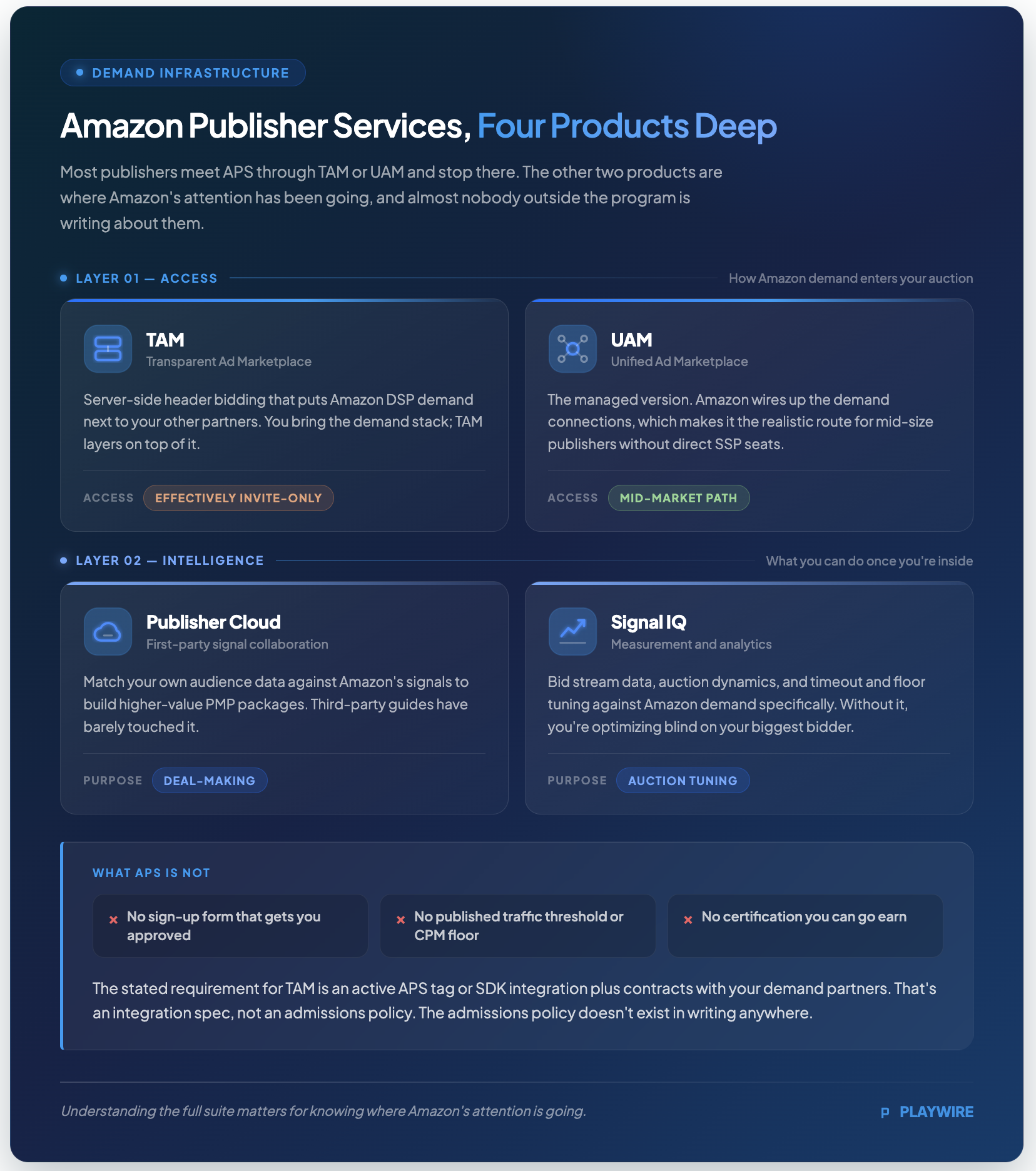
Amazon Publisher Services is the umbrella for Amazon's publisher-facing demand infrastructure. It includes four main products: Transparent Ad Marketplace (TAM), Unified Ad Marketplace (UAM), Amazon Publisher Cloud, and Signal IQ. Most publishers interact with it through TAM or UAM, but understanding the full suite matters for knowing where Amazon's attention is going. For a deeper orientation, our Amazon Publisher Services (APS) explained guide covering TAM, UAM, and eligibility walks through each product in detail.
TAM is a server-side header bidding solution that connects publishers to Amazon DSP demand alongside other demand partners. It requires existing direct SSP relationships: you bring your own demand stack and TAM layers on top. UAM is the managed version. Amazon handles demand connections for you, making it more accessible for mid-size publishers who don't maintain direct SSP seats.
Both routes put Amazon demand into your auction. The revenue impact is the same order of magnitude regardless of which path you take. The key practical difference is that TAM is effectively invite-only for publishers without an existing network partner relationship, while UAM offers a more direct path for mid-market publishers. The mechanics of Amazon Publisher Services header bidding for TAM and UAM, including the access layer most publishers overlook, are worth understanding before you decide which route to pursue.
Amazon Publisher Cloud is a newer addition to the APS suite that enables publishers to collaborate with advertisers using Amazon's first-party signals. It's built for audience-based deal-making: publishers can match their own data with Amazon's signals to create more valuable private marketplace packages. Third-party guides have barely touched this product, which is one reason publishers underestimate the full scope of what APS access actually unlocks.
Signal IQ is Amazon's measurement and analytics layer for publishers, designed to help evaluate bid stream data, identify auction dynamics, and optimize timeout and floor settings against Amazon demand specifically. If you're tuning your auction without Signal IQ data in the picture, you're optimizing blind on the most important bidder in your stack. Understanding the Amazon Publisher Services DSP and why it matters for your inventory is the right next step for publishers who want to see the full demand picture.
APS is not a public utility. There's no sign-up form that gets you approved. There's no published threshold for traffic, no minimum CPM floor, no certification you can earn. The stated technical requirement for TAM is active integration with the APS tag or SDK plus contractual relationships with your desired demand partners. That's an integration spec, not an admissions policy. The actual admissions policy doesn't exist in writing anywhere.
Here's what Amazon publishes about publisher eligibility: almost nothing useful.
The APS Agreement is a contract. It covers program terms, data processing obligations, and the "Ineligible Events" governing when Amazon doesn't have to pay. It does not define who qualifies or what gets a publisher removed. There is no publisher-facing eligibility document, no violation taxonomy, and no documented appeal process. Our breakdown of what to expect inside the Amazon Publisher Services agreement covers exactly what the contract does and doesn't tell you.
The asymmetry here is worth sitting with. Amazon's DSP side has a published malvertising suspension policy that includes an explicit appeal path. The publisher side has no equivalent. Google publishes an entire AdSense policy center detailing the categories of invalid traffic and content violations that lead to account closure. Amazon's publisher side has no policy center, no violation list, no appeals documentation.
What Amazon has published is an advertiser-facing supply quality post. In it, Amazon describes running always-on AI models that identify and block low-quality inventory including domains with made-for-advertising (MFA) characteristics. It describes strengthening those models with third-party classification input from Jounce Media and Deepsea.io to restrict domains sharing similar characteristics with flagged inventory. It describes sophisticated invalid traffic detection built over the past decade.
That last detail is the one publishers miss. Third-party classification means a publisher can be caught by similarity to flagged inventory rather than by anything they specifically did wrong. No cited rule, no notice, because there was never a published rule to cite. Amazon runs TAM as a private club (and for good reason: they need to maintain credibility with advertisers), and the absence of a rulebook is a design choice. A rulebook creates an appeal surface Amazon has no interest in adjudicating at scale.
Publishers who lose APS access, or who've never had it, tend to think the gap is whatever their Amazon line item says. It isn't.
Amazon doesn't just contribute its own demand. It applies competitive pressure across the entire auction. A strong Amazon bid forces every other bidder to compete harder to win. Remove that pressure, and the remaining bidders face less incentive to bid at the top of their range. CPMs soften across the stack even when fill rate holds steady. The hole you feel is consistently larger than the Amazon line item because the indirect effect on other bidders compounds the direct revenue loss.
For publishers in the 25-30% Amazon dependency range, the access removal lands closer to a revenue crisis than a revenue dip. Our ecosystem data derives from 100 billion-plus impressions annually, and the pattern is consistent: losing a dominant bidder reshapes the entire auction dynamic, not just the slot that bidder used to fill. Our full analysis of ad revenue from Amazon, including what publishers are really earning and risking, puts numbers to this dynamic across the publisher population.
Well-diversified stacks target no single demand partner exceeding 10-12% of total revenue. Amazon's 20.5% average contribution is a structural overweight, and it's one publishers accept because the alternatives don't generate equivalent yield. The answer isn't to deprioritize Amazon. The answer is to qualify, maintain access, and build enough diversification that a future disruption doesn't become an emergency. If you've already lost access, recovering publisher revenue after losing Amazon as a bidder covers the diversification path in practical terms.
The primary obstacle to APS approval for most publishers with community features is not technical. It's a content-governance and brand-safety review that Amazon requires before approving demand. Amazon evaluates prospective publishers on how content is moderated, how it's reviewed and approved, how quickly problem content comes down, how frequently moderation processes are audited, how sensitive content is handled, whether any of this is documented for users and demand partners, what automated screening is in place, and how user interactions are monitored.
These questions span the full content-governance territory. And Amazon reviews each submission once. There is no second look after a decision. A rushed, underprepared submission is more expensive than a delayed one. The cost is measured in months of lost Amazon revenue, not in submission fees.
This is a governance evaluation, not a content evaluation. Amazon is not primarily asking whether your content is good. It's asking whether you can demonstrate control over the content you don't write yourself. The details of what UGC governance documentation Amazon expects before approving you spell out the categorical territory that review covers.
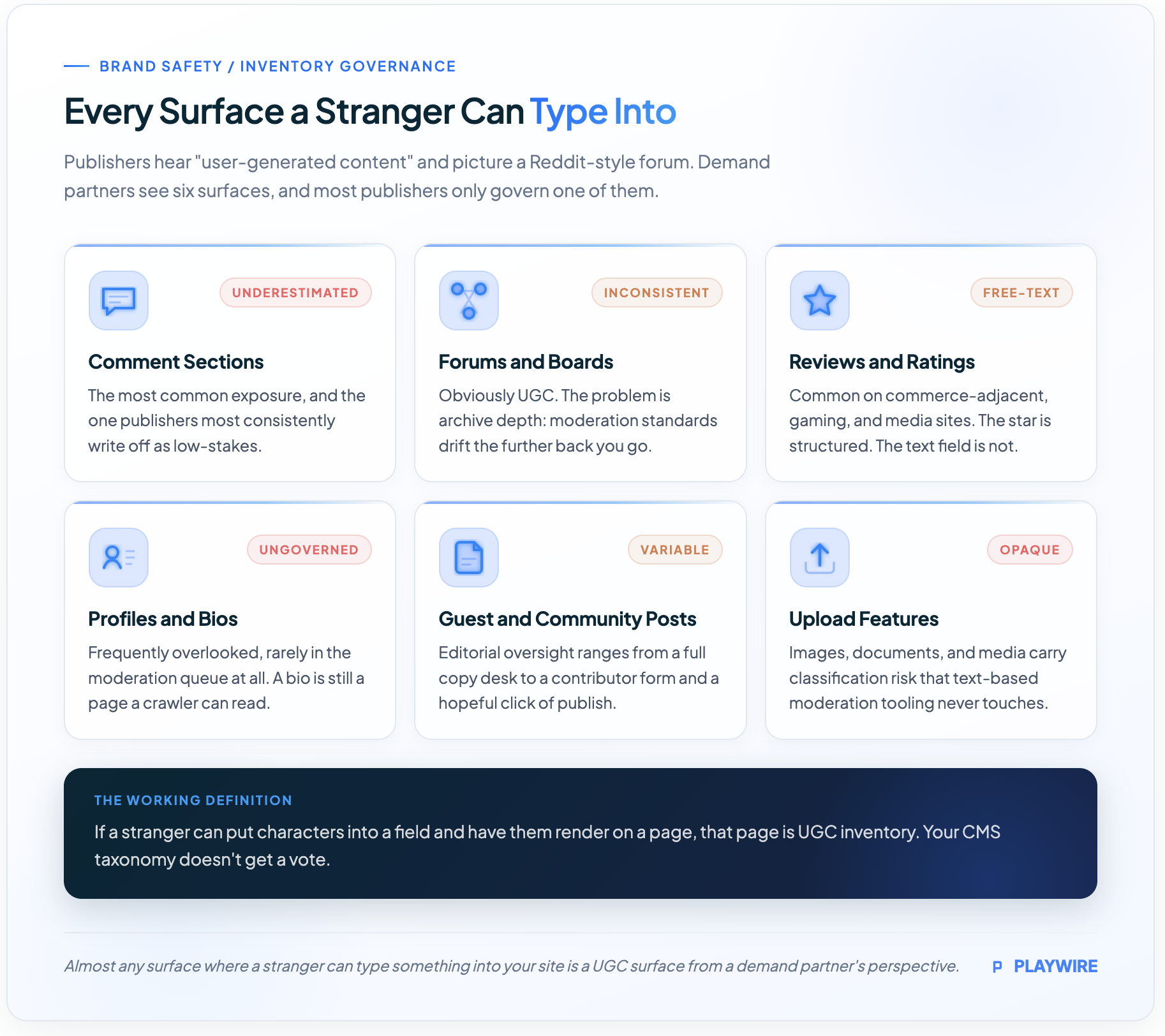
Publishers hear "user-generated content" and picture a Reddit-style forum. The actual exposure is much wider than that.
Almost any surface where a stranger can type something into your site is a UGC surface from a demand partner's perspective. That includes:

The structural difficulty is a huge obstacle. UGC creates a content classification problem programmatic advertising hasn't solved: content is created faster than it can be reviewed, categories get assigned at the account or channel level rather than the individual post level, and moderation is inconsistent across regions and languages. When an auction closes in under 100 milliseconds, there is no time for a human to review the page.
Brand safety concerns around UGC have measurably shaped how advertisers treat this inventory. Agency survey data has shown UGC risk mitigation lagging other brand safety measures, with under half of agencies having taken steps to mitigate risk on sites containing user-generated content even while a clear majority had already blocklisted specific sites. Amazon's content governance review is, from one angle, a structured response to what its advertiser base has been asking for.
The goal is not to remove UGC from your site. For many publishers, community features are product features: they're why users come back, and eliminating them to chase programmatic approval is the wrong trade. The goal is to govern those surfaces well enough to document that governance credibly to a demand partner.
Publishers who pass Amazon's content-governance review don't necessarily have better content than publishers who don't. They have better documentation of how their content is controlled (and they follow the processes).
The three established moderation approaches in the industry have specific names:
Moderation Approach | How It Works | Publisher Use Case |
|---|---|---|
Pre-moderation | Content reviewed before going live | Highest control; slower community experience |
Post-moderation | Content published first, reviewed after | Higher volume; requires fast response windows |
Reactive moderation | Action taken on user reports | Lower resource cost; least proactive coverage |
Most real publisher operations are hybrid: automated tooling handling volume, humans handling ambiguity. The question isn't which approach you use. The question is whether you can describe your approach, evidence its consistency, and demonstrate that it covers the surfaces a demand partner would classify as risk.
Over-correction is its own documented cost. Research from major news publishers indicates that keyword-based brand safety tools and overly strict filters can eliminate 40% to over 60% of otherwise high-quality inventory, with up to 70% of blocked impressions later found to have been unnecessarily restricted. The target is a governance posture that's credible to a demand partner without being so aggressive it depresses your own fill rate. Our guide to viewability optimization and why chasing perfect isn't the answer covers a related version of the same over-correction trap in a different dimension of publisher yield.
A documented governance posture generally needs to address these categories:
None of these are novel categories for a publisher with a mature community operation. What's novel is assembling them into a coherent document that evidences each one, and doing it before Amazon asks. For publishers who need to formalize this specifically for Amazon's brand safety requirements, our guide to writing a UGC moderation policy that satisfies Amazon's brand safety requirements covers the structure and substance that policy needs to contain.
Most publishers treat an application as a starting point: you submit, see what comes back, iterate. That's not how this works. Submit an underprepared governance package and the decision is made. There's no request for additional documentation, no clarifying call, no opportunity to resubmit. The cost of a failed submission isn't the submission itself. It's the window of Amazon revenue that doesn't run while you figure out what went wrong and how to approach the problem differently.
Publishers who self-assess their governance posture before submitting are not doing extra work. They're doing the correct amount of work. The preparation phase is when you can identify gaps in documentation, tighten moderation processes, and assemble evidence of consistency. Once the submission goes in, that window closes.
Navigating Amazon Publisher Services documentation is a practical walkthrough of the documentation landscape: what exists, what each document actually covers, and where the gaps are. It's useful preparation before you commit to a submission timeline.
For portfolio publishers managing multiple sites, the exposure math changes shape. The question isn't "does this one site have a comment section." The question is how many properties have any UGC surface, what the aggregate revenue at risk looks like across the portfolio, and how you build a repeatable governance process that doesn't require dedicated headcount on every property.
Amazon's 20.5% average revenue contribution applied across a portfolio of five or ten sites is a material number. The structural revenue gap that Amazon's SSP access problem creates for publishers is a useful read for portfolio publishers sizing this exposure across properties. The portfolio publisher's problem is that each site's UGC surfaces are slightly different: one runs a forum, one has user reviews, one has a comment section, one has a community submission feature. A single templated governance document doesn't solve that. Each property needs its own documented posture that reflects its own surfaces.
The operational implication is real: governance at portfolio scale requires a framework that's consistent enough to be maintainable but specific enough to be credible for each individual property. Publishers who treat this as a one-time documentation exercise discover that moderation practices drift over time, that new UGC surfaces get added without governance review, and that the documentation they submitted no longer reflects current practice.
We built a structured intake and review process, backed by internal tooling, that takes a publisher from "we moderate our comments, I think" to a documented, submission-ready governance package.
The process works in phases. First, we assess a publisher's current content surfaces and moderation practices to identify what's there, what's documented, and where the gaps are. That's the diagnostic that tells you whether a submission is premature. Publishers can self-assess their readiness before anything is sent to Amazon, because knowing you're not ready is valuable information. It means you can close the gap rather than burn the submission.
From the diagnostic, we help the publisher develop documentation that evidences each governance category across each UGC surface on the property. That's not a template fill-in. It's a process-specific document built to reflect what the publisher actually does, because a submission that describes a moderation practice the publisher doesn't actually have creates liability, not approval odds. Human review sits at every step.
Then we advocate. That's the part the process alone can't replace. A partner operating at the scale that SSPs and demand partners listen to creates a materially different dynamic than an individual publisher filing a request into a void. We work with Amazon's UAM and TAM products, and that relationship reflects the scale of our publisher network. An individual publisher is a single data point. A network advocating for a publisher is a conversation Amazon has incentive to engage with.
No other monetization partner has built for this problem specifically. Most offer demand access, including Amazon and 30-plus other SSPs and DSPs through our RAMP platform, but the APS governance gap is where publishers get stuck. The structured process for getting unstuck is ours. Our full review of what publishers need to know before applying to Amazon Publisher Services covers the landscape from the publisher's perspective, including the questions most applicants don't think to ask.
We don't promise approval. Amazon makes its own decisions. What we can do is ensure that when Amazon evaluates a publisher we've prepared, the submission reflects a governance posture that was built to be credible, not assembled the night before.
.png?width=1536&height=1146&name=amazon-tool-mockup%20(1).png)
Publishers researching APS access consistently run into the same questions. Here are direct answers to the most common ones.
Amazon Publisher Services (APS) is Amazon's suite of publisher-facing demand and data tools. It includes Transparent Ad Marketplace (TAM), Unified Ad Marketplace (UAM), Amazon Publisher Cloud, and Signal IQ. TAM and UAM are the primary access points for publishers seeking Amazon DSP demand in their header bidding auctions.
TAM (Transparent Ad Marketplace) is a server-side header bidding solution designed for larger publishers who already maintain direct relationships with SSPs. Publishers bring their own demand stack, and TAM layers Amazon demand on top. UAM (Unified Ad Marketplace) is the managed version: Amazon handles demand connections on the publisher's behalf, making it more accessible for mid-size publishers without direct SSP seats. Both products deliver Amazon demand. The key difference is who manages the surrounding demand relationships.
TAM does not charge publishers a fee on the publisher side. Costs are absorbed by the demand side. UAM operates differently, with Amazon managing demand connections and taking a percentage of revenue for that service. Fee structures can change. Amazon applied a 10% publisher transaction fee to Amazon DSP demand through TAM in September 2023 with roughly 30 days' notice, which is the kind of unilateral policy change publishers in the APS ecosystem need to factor into their dependency math.
TAM is not a self-serve signup. It requires active integration with the APS tag or SDK and existing contractual relationships with the SSPs you want to access through it. Beyond the technical requirements, Amazon conducts a content-governance and brand-safety review of prospective publishers before approving demand access. Publishers without documented content moderation practices, particularly those with user-generated content surfaces. Are the most commonly rejected or delayed. Working with a network partner that already has an established Amazon relationship is the most reliable path to access for publishers who don't have an existing direct relationship.
Amazon has not published eligibility criteria for publisher access to TAM or UAM. There is no public traffic threshold, no minimum CPM requirement, and no documented violation list. What Amazon has published, for advertisers, is that it runs AI-driven blocking of low-quality inventory and uses third-party classification data from vendors including Jounce Media and Deepsea.io. The practical implication: a publisher can be flagged for similarity to blocked inventory without having done anything specifically wrong. The absence of a published rulebook is a deliberate design choice, not an oversight.
Access removals are unilateral and typically offer no appeal path. The revenue impact is larger than the Amazon line item suggests, because Amazon's competitive pressure in the auction lifts CPMs across all other bidders. Remove Amazon and the remaining stack bids less aggressively even when fill rate holds. Publishers in the 25. 30% Amazon dependency range consistently describe the loss as a revenue crisis rather than a manageable dip. There is no published reinstatement process, which is why preparation before submission matters more than remediation after rejection.
UAM is generally more accessible to mid-size publishers because Amazon manages the SSP relationships rather than requiring the publisher to maintain them directly. TAM is designed for publishers with an established programmatic infrastructure and existing direct SSP seats. In practice, the content-governance review is the common gate for both products, not traffic volume or site scale. A small publisher with clean, well-documented moderation practices may have a better path to approval than a larger publisher with undocumented UGC surfaces.
Amazon Publisher Cloud is an APS product that enables publishers to collaborate directly with advertisers using Amazon's first-party data signals. It supports audience-based private marketplace deals, allowing publishers to match their own audience data with Amazon's signals to create more valuable, targetable inventory packages. It's a newer addition to the APS suite and remains underutilized by most publishers, partly because third-party documentation on it is limited.
If you have a comment section, a forum, user reviews, or any other surface where visitors can contribute content, the APS access question is worth taking seriously before you submit anything.
The path forward starts with an honest assessment of what's actually on your properties, what documentation exists for your moderation practices, and whether that documentation would hold up to a single-pass review by a major demand partner. If the answer to that last question is uncertain, the preparation phase isn't done yet.
Amplify Your Ad Revenue. The Amazon opportunity is real. At 20.5% of site revenue, this isn't something you optimize around. It's something you build toward. The publishers getting that demand aren't publishers with better content. They're publishers with better governance documentation and a partner who knows how to advocate for them.
Apply to work with Playwire and find out where your properties actually stand.
We'll email you a downloadable PDF version of the guide and you can read later.