
-1.png?width=800&height=157&name=1-playwire-logo-primary-2021%20(1)-1.png)


July 22, 2026

Editorial Policy
All of our content is generated by subject matter experts with years of ad tech experience and structured by writers and educators for ease of use and digestibility. Learn more about our rigorous interview, content production and review process here.

Key Points
- Google Search Console isn't just an SEO hygiene tool for news publishers. It's the earliest signal you have that a story is gaining search traction before your competitors notice.
- The Performance report's 24-hour view lets editorial teams spot rising queries within hours of publication, which matters when breaking news windows close fast.
- Non-branded query performance is your honest measure of whether your coverage is actually reaching new readers, not just recycling your existing audience.
- Google News eligibility and indexing speed are separate problems from general SEO, and GSC surfaces both if you know where to look.
- A consistent GSC cadence built into editorial workflow, rather than treated as an ad hoc audit, is what separates publishers who catch traffic drops early from those who discover them on bad revenue days.
News publishers live and die by timing. A story that ranks on day three of a news cycle is worth a fraction of a story that ranks on day one. Most SEO tools can't help you there. They're built for the deliberate, weeks-long optimization loops of evergreen content. Google Search Console is different because it shows you what Google is actually doing with your content right now, using first-party data instead of estimates.
This guide covers how to use GSC specifically for news publishing workflows, including the unique reporting surfaces that matter for editorial teams, how to read the Performance data for time-sensitive signals, and the operational cadence that makes all of it actionable rather than decorative.

How News SEO Differs from Traditional SEO
Most SEO playbooks assume you have time. Keyword research, content briefs, optimization passes, internal link audits: these are designed for content that will sit on a page for months and accrue authority slowly. News publishing doesn't work that way.
Your editorial cycle is measured in hours. A story about a breaking court ruling, a market event, or a public figure has a search demand window that might last a day. Miss it, and you're optimizing for an audience that already moved on. That time pressure changes everything about how you should use Search Console.
The other structural difference is surfaces. General publishers optimize for the main Google web search index. News publishers also care about Google News, Google Discover, and the Top Stories carousel. These surfaces have their own eligibility signals, and GSC reports on them separately through dedicated search type filters. Treating all your traffic as a single undifferentiated bucket means you're flying blind on the surfaces that actually drive news discovery.
The Revenue Connection Standard SEO Guides Miss
Here's the connection most news SEO coverage skips entirely: organic search rankings are a direct upstream driver of ad impressions and revenue per session. Every story that fails to index costs you pageviews. Every pageview GSC's Performance report predicts and you don't capture is an ad impression that never fired.
Your yield reports tell you how well you monetized the traffic you got. GSC tells you whether that traffic was ever going to arrive. One is a rearview mirror, the other is a windshield. For ad-supported news publishers, the two belong in the same operational conversation. If you want a broader framework for building a search strategy around your content model, that thinking applies directly here.

The Performance Report as an Editorial Intelligence Tool
The Performance report is where most of the actionable signal lives for news teams. As documented in Google's Search Console guidance, it shows clicks, impressions, CTR, and average position, filterable by query, page, country, device, or date range up to 16 months. For a news publisher, impressions are the most forward-looking number in that set.
Impressions tell you that Google is surfacing your content in results, even if clicks haven't followed yet. A story that picks up impressions in its first few hours is one Google considers relevant to active queries. A story that earns no impressions in the first 24 hours is either not indexed, not competitive, or not aligned with how searchers are actually phrasing the topic.
The 24-hour view changes this from a retrospective report into something closer to real-time editorial feedback. Google launched this view to display data with only a few hours' delay, showing the recent performance of pages and queries with hourly granularity. For a news team, that means you can pull up the Performance report two hours after publishing a breaking story and see whether it's getting search exposure. While there's still time to adjust your headline, update the lede, or push a follow-up angle that matches the query language Google is seeing.
Reading Trending Queries Before Competitors Do
The query-level view in the Performance report is where you find search demand before it fully materializes. Filter your last 24 to 48 hours and sort by impressions. Look for queries your site is appearing for that you haven't published directly against. Those are topics Google thinks your existing coverage is relevant to, and they're also topics where a more targeted story could rank higher.
Cross-referencing average position with CTR reveals the quick wins: pages sitting at positions five to fifteen on high-volume queries are one optimization pass away from significantly more traffic. In a breaking news context, that optimization might be as simple as a headline rewrite that matches the query phrasing more precisely. For a deeper look at how to use Google Search Console to improve SEO on your publishing site, that framework applies directly to this kind of query-level work.
Pay attention to impression spikes on queries you aren't actively tracking. News cycles generate associative search behavior. When a major event breaks, related queries spike alongside the primary one. If your site is already ranking for background coverage, you'll see impression volume on adjacent queries before a competitor who's starting from scratch. That's your signal to publish the explainer, the timeline, or the context piece that captures that secondary demand. Publishers navigating the AI search traffic shift are finding this kind of secondary-query coverage especially important as AI Overviews absorb direct answers.
Essential Background Reading:
- What Is Google Search Console? A Guide for Web Publishers: The foundational overview of what GSC is, how it works, and why it belongs in every publisher's toolkit.
- What Does Google Search Console Do? A Feature-by-Feature Breakdown: A detailed walkthrough of every GSC feature, including the Performance report, URL Inspection, and Page Indexing report covered in this guide.
- How to Set Up Google Search Console: A Step-by-Step Guide for Publishers: Property configuration, verification methods, and the setup decisions that affect how news-specific filters work.
- SEO for Publishers: How to Build a Search Strategy Around Your Content Model: The broader strategic context for how search optimization connects to audience growth and ad revenue.
Google News, Top Stories, and What GSC Tells You About Eligibility
Getting content into Google News and the Top Stories carousel requires meeting Google's content policies and technical standards. GSC surfaces eligibility signals, but it requires knowing which report to look at.
The Search type filter in the Performance report is your starting point. Switch from "Web" to "News" and you're looking at traffic from Google News surfaces specifically. If your news content is performing well in web search but showing no impressions in the News search type, that's diagnostic. It suggests either an eligibility issue, a content policy signal, or simply that your article isn't being treated as news content by Google's classification systems.
| GSC Signal | What It Indicates | Editorial Action |
|---|---|---|
| High web impressions, zero News impressions | Content not surfacing in Google News | Review article structure, publication timestamps, and Google News content policies |
| News impressions present, low CTR | Visibility without click-through | Audit headlines for clarity and news value; test query-matching language |
| News impressions then sudden drop | Possible eligibility issue or freshness decay | Check for duplicate coverage, policy flags, or technical crawl errors |
| Impressions spike then flatline | Normal news demand curve | Monitor for follow-up query opportunities |
One technical point worth flagging: traffic from Google's AI Mode search experience now counts inside Search Console under the "Web" search type. You can't yet filter exclusively for AI Mode results. For news publishers, this means some of your "Web" traffic may be driven by AI-powered search features you can't currently isolate. Keep that in mind when interpreting web performance jumps that don't correlate with obvious ranking changes.
Google Discover and the Top Stories Carousel
Both Discover and Top Stories are high-value surfaces for news publishers, and both appear as filterable search types in the GSC Performance report. Discover traffic behaves differently from search traffic. It's interest-based rather than query-driven, which means your click patterns and session depth look different from organic web traffic.
Track Discover impressions separately from web and news impressions. A story that earns strong Discover distribution is reaching readers who weren't actively searching for it, which means higher new-reader exposure and a different monetization profile than a reader who came in on a specific news query. For ad ops teams, knowing the source breakdown matters because session behavior varies by surface, and that affects RPS.
AI Mode and the Impression-Click Decoupling
News publishers are already feeling the impact of AI Mode in Google Search. Impressions are rising for many publishers as Google's AI-powered results surface more content, but clicks aren't keeping pace because AI Overviews answer questions without requiring a visit to the source. Some in the industry have called this "The Great Decoupling": search visibility going up while the sessions that monetize that visibility go flat or decline.
Traffic from Google's AI Mode now counts inside Search Console under the "Web" search type, which means you can't yet isolate its effect cleanly. If your impressions are growing while clicks are stagnant, that's your signal. Google's AI search updates have created real shifts in how clicks are distributed, and news publishers whose content depends heavily on organic search clicks are exposed to this dynamic. The most durable countermeasures: publish original reporting AI tools can't summarize without citing you, build branded search volume so readers come looking for you by name, and use first-party data collection to maintain a direct audience relationship that doesn't depend entirely on Google's click-through decisions.

Indexing Speed Is a Revenue Problem, Not Just an SEO Problem
A story that isn't indexed can't rank. For evergreen content, a 24-hour indexing delay is annoying. For a breaking news story, it's the difference between capturing search demand and missing it entirely.
The URL Inspection tool is the mechanism for pushing newly published content to Google's crawl queue. It lets you check whether Google can access and index a page, and request indexing after important changes. The workflow for news editorial teams should be: publish, submit via URL Inspection, then check the Performance report's 24-hour view an hour or two later to confirm impressions are registering. For a step-by-step walkthrough of this process, see our guide on how to get Google to index your site faster. The timing argument there is even more acute for news content.
The Page Indexing report shows your indexing health in aggregate. Watch for pages stuck in "Crawled - currently not indexed" or "Discovered - currently not indexed" status. Either state means content Google found isn't being served to searchers. For a publisher producing dozens of articles per day, a systematic indexing failure can go unnoticed for hours while it bleeds traffic and ad revenue. Our guide on diagnosing and fixing coverage issues covers what to do when these states appear at scale.
This report has also had reliability issues worth knowing about. Beginning around November 2025, the Page Indexing report stopped updating for nearly 30 days. Cross-reference with URL Inspection for individual high-value stories rather than relying exclusively on aggregate indexing reports, especially during periods when the data looks suspiciously static.
Related Content:
- Google's AI Search Updates: What Publishers Actually Gain: A clear-eyed look at what Google's AI-powered search changes mean for publisher traffic and how to position for them.
- Google's AI Search Updates Give Publishers a Real Shot at More Clicks: How specific AI search feature changes create new click opportunities for publishers who understand the mechanics.
- The AI Search Reckoning: Why Publishers Need Strategy, Not Panic: The strategic framework for responding to AI-driven search disruption without making reactive decisions that hurt long-term revenue.
- Agency Revenue Drops Signal AI Search Traffic Shift for Publishers: What declining agency revenue data reveals about the structural shift in how search traffic reaches publishers.
- News Publisher Ad Revenue Monetization Strategy: When More Ads Won't Save You: Why traffic quality and session depth matter more than raw ad unit count for news publisher revenue.
AMP: What GSC Still Reports and What to Do About It
Historically, AMP was a significant factor in Google News eligibility and mobile performance. That's changed. We don't monetize AMP pages and recommend against them for all publishers. AMP has been largely phased out, AMP pages no longer provide added value, and mobile-optimized pages consistently perform and monetize better.
If you're still running AMP, GSC will show you AMP-specific data including validation errors and status. The more important use of that data is as a migration signal. If you have AMP URLs contributing meaningful impressions, you need a transition plan that preserves URL structure and indexing signals when you move off. A botched AMP migration that drops pages from Google's index mid-news-cycle is a preventable disaster.
The goal is mobile-optimized non-AMP pages that pass Google's Core Web Vitals thresholds. Those pages can appear in Top Stories on mobile. The same placement AMP was originally required for. Without the monetization constraints AMP imposed.
Next Steps:
- Google Search Console for Publishers: How to Use GSC to Protect Ad Revenue: The pillar guide connecting GSC's search visibility data to ad revenue outcomes, with a revenue-protection framework for publishers.
- How to Use Google Search Console: A Revenue-Focused Workflow for Ad-Supported Publishers: The operational workflow for turning GSC data into consistent revenue decisions, not just SEO observations.
- SEO Publishing Best Practices: What the Data in Google Search Console Is Telling You: How to read GSC data as a publishing strategist, not just an SEO technician.
- Taking Control of Your News Site Ad Strategy: A Publisher's Technical Playbook: The technical implementation guide for news publishers who want to own their monetization strategy end to end.
- Header Bidding for News Publishers: Advanced Optimization Strategies: How to get the most out of programmatic demand once GSC-driven traffic is flowing to your pages.
Branded vs. Non-Branded Performance for Editorial Strategy
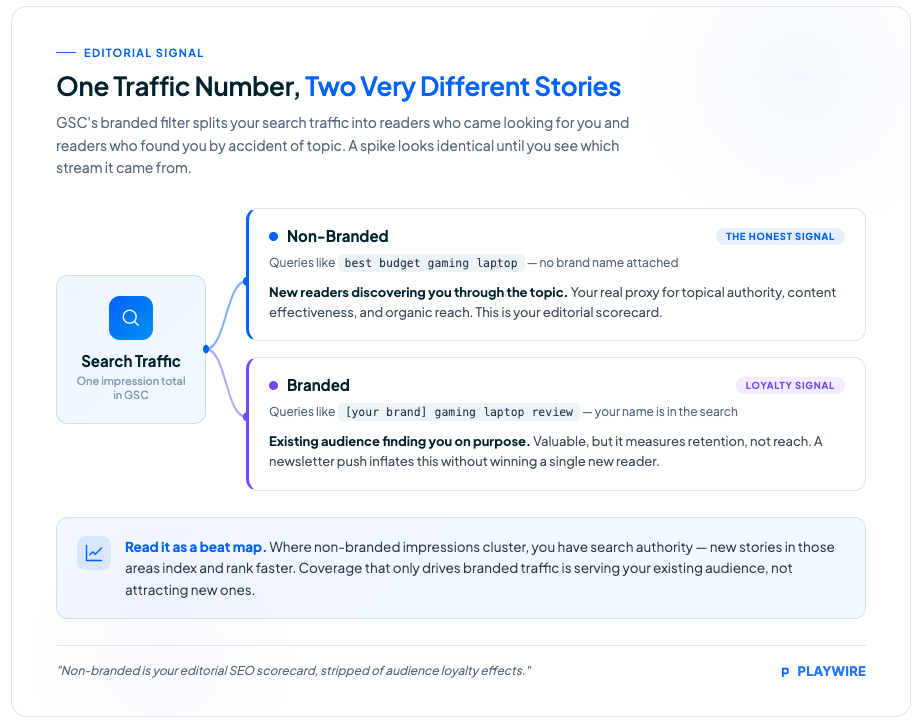
The branded/non-branded segmentation in GSC is underused by most news teams, and it's directly relevant to editorial strategy. The branded queries filter automatically differentiates between queries that include your brand name and those that don't.
For a news publisher, non-branded performance is the honest signal of whether your coverage is actually reaching new readers rather than serving existing audience loyalty. Non-branded performance remains the clearest proxy for topical authority, content effectiveness, and organic discovery and reach. When you separate these segments, you can see clearly whether a traffic increase came from a viral story (non-branded discovery) or from a newsletter push that sent existing readers to search for your site directly (branded).
Practically, this filter helps editorial teams make coverage prioritization decisions. If your non-branded impressions are concentrated in a few topic areas, those are the beats where you have search authority, meaning new stories in those areas will earn indexing and ranking faster. If certain coverage areas only drive branded traffic, that's a signal that you're serving your existing audience but not attracting new readers through search. For publishers thinking about answer engine optimization alongside traditional search, non-branded impressions are the right signal to watch here too.
A few operational constraints to know: the filter is only available for top-level domain properties, not subdomain or path-level properties, and sites with low impression volume may not qualify. Structure your GSC properties accordingly.
The Editorial GSC Cadence
Strategy needs a schedule. For news publishers, the GSC workflow looks different from a standard content team's monthly audit cycle.
- 24-hour view check after major publishes: Pull the Performance report on a new story within two to three hours of publishing. Look for impressions on the target queries. If you see none, run URL Inspection and confirm indexing.
- Daily query monitoring during active news cycles: During breaking news events, check the Performance report for emerging queries in your topic area. Rising impressions on adjacent queries signal follow-up story opportunities.
- Weekly Performance review: Compare week-over-week clicks and impressions to catch early signs of visibility drops before they compound into revenue problems.
- Post-migration indexing audit: Any time you make structural changes, whether AMP migration, URL restructuring, or CMS updates, run a Page Indexing report audit within 48 hours to catch any pages dropped from the index.
- Monthly non-branded segmentation review: Track whether non-branded impressions are growing, stable, or declining. This is your editorial SEO scorecard stripped of audience loyalty effects.
For the full revenue-focused workflow this cadence slots into, see our guide on how to use Google Search Console as a revenue-focused workflow for ad-supported publishers.
See It In Action:
- Brand Safety and Ad Quality for News Publishers: Protecting Revenue and Reputation: How news publishers navigate hard news monetization challenges, including keyword exclusion lists and advertiser brand safety signals.
- Best Ad Networks for News Publishers: A Technical Breakdown: A side-by-side comparison of ad network options for news publishers evaluating their monetization stack.
- News Publisher Guide: The complete resource guide for news publishers navigating ad monetization, audience growth, and editorial sustainability.
Frequently Asked Questions: News SEO and Google Search Console
What is news SEO and how is it different from regular SEO?
News SEO is the practice of optimizing content and site infrastructure so that articles appear in Google's news-specific surfaces: the Top Stories carousel, Google News, and Google Discover. It differs from traditional SEO in two fundamental ways. First, timing: a breaking news story has a search demand window measured in hours, not months, so speed of indexing and headline optimization matter more than link building. Second, surfaces: news publishers optimize for multiple distribution points beyond the main web index, each with their own eligibility signals and ranking factors.
How do I get my articles into Google Top Stories?
Google Top Stories eligibility requires meeting Google's content policies, having a crawlable and indexable site, using structured data (specifically the NewsArticle schema markup), and publishing original journalism with clear bylines and publication dates. Google does not require AMP for Top Stories on mobile. Standard mobile-optimized pages that meet Core Web Vitals thresholds qualify. In Google Search Console, filter the Performance report by the "News" search type to see whether your content is earning impressions on news surfaces.
How does Google News work for publishers in 2025?
Google News inclusion is now automatic rather than application-based. Google closed manual publisher submissions to Google News Publisher Center for new properties in April 2024. Publishers are now evaluated automatically based on their content quality, technical standards, and compliance with Google's content policies. You no longer need to apply, but you still need to meet the eligibility criteria Google uses to classify and surface news content.
Do I still need Google News Publisher Center?
Existing Publisher Center accounts remain active and useful for managing how your publication appears in Google News, including your publication logo, categories, and RSS feeds. For new publishers, manual submission is no longer available, but you should still claim your publication in Publisher Center if it appears in Google News to manage your profile. GSC's "News" search type filter is the primary tool for diagnosing news surface performance.
How do I use Google Search Console for news articles specifically?
Three GSC features matter most for news publishers. The Performance report filtered by "News" search type shows traffic from Google News surfaces. The URL Inspection tool lets you request indexing immediately after publishing a time-sensitive story. The 24-hour view in the Performance report shows impressions and clicks within a few hours of publication, giving editorial teams real-time feedback on whether a story is gaining search traction while the news cycle is still active.
How does AI Mode affect news publisher traffic?
AI Mode in Google Search is contributing to a pattern where search impressions rise but clicks don't keep pace, because AI-generated answers resolve queries without requiring a site visit. Traffic from AI Mode counts in GSC under the "Web" search type and can't yet be isolated separately. News publishers whose content depends heavily on organic search clicks are exposed to this dynamic. The most durable countermeasures are original reporting that requires citation, first-party audience relationships through newsletters and direct traffic, and building branded search volume so readers seek you out by name. For a broader strategic response, the AI search reckoning is worth reading before the next Google update lands.
What structured data do news publishers need?
NewsArticle schema is the primary structured data type for news content. It signals to Google that a page is a news article, includes metadata like headline, author, datePublished, and image, and supports eligibility for news-specific rich results. Article schema is a broader alternative. Publishers should also implement BreadcrumbList schema for site structure and ensure their sitelinks searchbox is configured. Google's Search Central documentation covers the current structured data requirements for news content.
How Playwire Amplifies the Traffic GSC Helps You Earn
GSC tells you whether your stories are reaching readers. What happens when those readers land on your pages is where monetization takes over, and that's the layer we optimize.
News traffic is irregular by nature. A breaking story can send 10x normal traffic in a matter of hours. Our infrastructure handles billions of impressions monthly, and our ad stack scales with your traffic spikes rather than choking on them. When your biggest story lands and the search traffic floods in, every one of those sessions needs to earn everything it can.
Here's what that looks like in practice:
- Yield analytics matched to content performance: Our real-time analytics show you which stories drive the most ad revenue, not just which ones drive traffic. That feedback loop lets editorial and ad ops teams make informed decisions together.
- 70%+ viewability on news-optimized layouts: Our news-specific ad layouts maintain strong viewability without the clutter that erodes reader trust. Readers who trust your presentation stay longer and generate more ad impressions per session.
- Direct sales access for news inventory: Our global direct sales team brings premium brand campaigns to your inventory, including advertisers who specifically want to reach engaged news audiences. News publishers who work with us typically see ad revenue double.
- The "hard news" problem, handled: Coverage of crime, tragedy, or controversy can trigger keyword exclusion lists that tank your CPMs for doing legitimate journalism. Our yield and partner success teams advocate for your inventory with demand partners who know the difference.
Search Console earns you the session. We make sure that session pays what it should.
Want to see how your current search traffic translates into maximum ad revenue? Apply to work with Playwire and we'll run the numbers.
