
-1.png?width=800&height=157&name=1-playwire-logo-primary-2021%20(1)-1.png)


July 22, 2026

Editorial Policy
All of our content is generated by subject matter experts with years of ad tech experience and structured by writers and educators for ease of use and digestibility. Learn more about our rigorous interview, content production and review process here.
Key Points
- SEO for publishers isn't the same discipline as SEO for lead-gen sites. High content velocity, category depth, and the evergreen-versus-trending split all require a distinct strategic framework.
- Google Search Console is the only tool that shows you real first-party data on how Google indexes and surfaces your content. It belongs in your editorial workflow, not just your analytics stack.
- Your content architecture. How you organize categories, hub pages, and internal links. Directly affects how Google distributes ranking authority across your site.
- Impressions in GSC are a leading indicator of pageview volume, and pageview volume is the input to every ad revenue metric you track. Watching the traffic layer is how you protect the revenue layer.
- The evergreen-versus-time-sensitive split isn't just a content calendar decision. It's a yield strategy, because each type earns differently and compounds differently over time.
Publishers have a specific problem with SEO that most generic advice completely ignores. You're not running a five-page lead-gen site with a single conversion goal. You're running a content operation that produces dozens or hundreds of pieces per month, across categories that span topics from trending news to decade-old reference material that still pulls steady traffic. The strategic challenge isn't getting one page to rank. It's building a system that makes your entire content model visible to Google and sustainable as a traffic source.
That distinction matters enormously for an ad-supported business. Your ad revenue is a direct function of pageviews, and your pageviews are a function of how well Google can find, understand, and surface your content. Get the strategy wrong at the architectural level, and no amount of tactical keyword optimization will fix it.

Why Publishing SEO Is Different from Every Other SEO Discipline
Most SEO advice is written for businesses that treat content as a supporting tool, a way to attract leads to a product or service. For those sites, SEO is a marketing channel. For ad-supported publishers, SEO is the business model. That distinction changes everything about how you should approach it.
The first difference is scale. A publisher pushing out ten articles per week has to make indexing, crawl efficiency, and site architecture decisions that a smaller site never thinks about. Google has a crawl budget for every domain, and if your site is large enough, Google won't crawl everything on every pass. Your architecture has to guide crawlers toward your highest-value content.
The second difference is content type complexity. Publishers deal with at least two distinct content categories that behave completely differently in search: evergreen content that compounds value over months and years, and time-sensitive content that spikes fast and decays. A strategy that works beautifully for one often works against the other.
The third difference is audience intent diversity. A SaaS company can build its entire content strategy around one or two commercial intent clusters. A news or entertainment publisher serves dozens of intent types simultaneously, research, entertainment, news, how-to, opinion. Often within the same category. Your SEO architecture has to accommodate that range without diluting your authority in any of them.

Content Architecture Is Your Foundation
Before keyword research, before on-page optimization, before any of the tactical work, you need a content architecture that tells Google what your site is actually about and how the pieces relate to each other. This is the layer most publishers underinvest in, because it's invisible. Nobody clicks on your information architecture. But Google sees it constantly.
The core principle is topical authority: Google rewards sites that demonstrate deep, organized expertise in a subject area. A publisher with 500 articles spread thinly across 80 unrelated topics will consistently underperform a publisher with 200 tightly organized articles across 10 well-structured categories. Breadth without depth signals a generalist, and generalists don't earn authority signals.
The structural tool for building topical authority is the hub-and-spoke model. You build a comprehensive hub page for each core topic area, covering the subject broadly and authoritatively. Then you produce spoke articles that go deep on individual subtopics, all linking back to the hub. The internal link structure tells Google that your hub page is the authoritative center of gravity for that topic on your site.
For a publisher, this maps directly onto your editorial categories. Each category page is a potential hub. Each article in that category is a potential spoke. The gap most publishers have is that their category pages are just pagination archives, lists of article thumbnails with no real content. A category page that does real SEO work introduces the topic, covers the major subtopics at a summary level, and links out to the depth articles. It gives Google something to index and rank on its own.
Internal linking is the mechanical expression of your architecture. Every new article you publish should link to at least one hub page and a handful of related spoke articles. This distributes ranking authority through your site rather than letting it pool in a few isolated high-performers. For a deeper look at how site structure drives revenue, our guide to building a content architecture that earns more ad revenue lays out the full framework.
The Evergreen-Versus-Time-Sensitive Split
Understanding the two modes your content operates in is essential to building a realistic SEO and publisher revenue strategy. They have different timelines, different optimization loops, and different revenue profiles.
Evergreen content is your compounding asset. A well-built article on a durable topic keeps accumulating backlinks, ranking improvements, and traffic over months and years. The initial traffic might be modest. The long-term traffic is where the value lives. For ad-supported publishers, evergreen content delivers your most reliable RPS, because it attracts readers with clear intent who are engaged with the topic.
Time-sensitive content, breaking news, trend pieces, event coverage. Operates on a completely different clock. The window for meaningful traffic is measured in hours or days. The SEO optimization goal isn't long-term ranking; it's indexing speed and initial visibility while the topic is still hot. Google Search Console's 24-hour view, which shows performance data with only a few hours of delay, is the right tool for monitoring this content type. Publishers working with time-sensitive content should also read our guide on using Google Search Console for timely content for specific workflows around breaking news. You need to know within hours whether a trending piece is getting search traction, not within days.
The strategic implication is that these two content types require different workflows, different success metrics, and different relationships with your SEO data. Here's how the comparison breaks down:
| Content Type | Primary SEO Goal | Key Metric to Watch | Optimization Timeline | Revenue Profile |
|---|---|---|---|---|
| Evergreen | Long-term ranking and authority | Average position improvement over months | Ongoing, iterative | Consistent, compounding RPS |
| Time-sensitive | Fast indexing and initial SERP visibility | Impressions in first 24-48 hours | Immediate, then minimal | Spike-and-decay traffic pattern |
| Evergreen (needs refresh) | Recapture declining rankings | CTR and position trends in GSC | Quarterly review cycle | Protects existing traffic baseline |
Most publishers underinvest in the third row: evergreen content that was once a strong performer but has gradually slipped. Comparing performance data across date ranges in GSC will surface these declines before they hit your revenue metrics. A piece that has dropped from position 4 to position 11 over six months isn't broken. It's due for a refresh, and updating it is almost always faster and cheaper than building a new asset from scratch.
Essential Background Reading:
- What Is Google Search Console? A Guide for Web Publishers: What GSC actually is, why it exists, and why every ad-supported publisher needs it in their stack before anything else.
- What Does Google Search Console Do? A Feature-by-Feature Breakdown: A precise walkthrough of every major GSC report and what each one tells you about your search visibility.
- How to Set Up Google Search Console: A Step-by-Step Guide for Publishers: Property setup, verification, and the configuration decisions that affect your data quality from day one.
- Why Content Creators Need to Prioritize SEO Before Monetization: The case for building search visibility first, and why reversing that order costs publishers real revenue.
The SEO-to-Ad-Revenue Causal Chain
Here's the connection most publisher SEO guides skip entirely. Your search visibility doesn't just affect traffic. It directly determines total ad revenue through a chain that runs like this: GSC impressions predict click volume, clicks become sessions on your site, sessions generate the pageviews that sit in the denominator of every revenue metric you track. Pageview RPM, session RPS, total ad revenue. Break any link in that chain and your revenue feels it, even if your monetization setup is flawless.
That's why GSC impressions are a leading indicator, not just a reporting metric. Rising impressions on non-branded queries forecast more sessions to monetize before they arrive. Falling impressions are advance notice of a traffic dip, often days before it shows up in your ad server. Your yield reports tell you how well you monetized the traffic you got. Google Search Console tells you whether that traffic was ever going to arrive.
The practical implication: publisher SEO strategy isn't about ranking for its own sake. It's about protecting and growing the input to your revenue model. Every position improvement, every indexing fix, every evergreen refresh feeds directly into that chain. Our complete guide to using GSC to protect ad revenue covers this pipeline in detail.

"The Great Decoupling" and What It Means for Publisher Revenue
The search landscape is shifting in a way that matters specifically to ad-supported publishers. GSC data since April 2025 shows impressions rising while clicks fall, a pattern emerging because Google's AI Overviews are answering queries directly in the SERP, reducing the click-through that previously flowed to publishers. More people are seeing your content referenced. Fewer are landing on your pages.
For an ad-supported business, this isn't just an SEO problem. It's a revenue problem. Fewer clicks mean fewer sessions, and fewer sessions mean fewer ad impressions regardless of how well your monetization stack performs. Our analysis of what AI search is doing to publisher traffic and what to do about it covers the tactical response in full.
Three responses are worth building into your publisher SEO strategy now:
- Build branded search depth: Readers who know your brand search for you directly. Branded queries are significantly more resistant to AI Overview absorption because the intent is navigational, not informational. Investing in audience development, newsletters, social, community. Builds the branded traffic base that doesn't get intercepted.
- Produce original research and proprietary data: AI Overviews and AI tools preferentially cite sources with original, verifiable data. A publisher who produces primary research, surveys, or exclusive datasets creates content that AI systems reference rather than replace. That citation traffic is meaningful and growing. For a detailed breakdown of what AI citation ranking factors actually determine visibility, we've covered the mechanics separately.
- Optimize for session depth, not just click volume: When clicks are harder to earn, each one has to work harder. Publishers who improve time-on-site, pages-per-session, and ad viewability protect their RPS even as raw click volume faces pressure. Our guide to session-based ad layout strategy shows how to structure your ad layout around this shift.
Traffic from Google's AI Mode search experience now appears in Search Console under the "Web" search type, though you can't yet filter exclusively for AI Mode results. Watch that category closely as Google's reporting evolves.
Related Content:
- Google Search Console Guide for Publishers: Traffic, Indexing, and Ad Revenue: How GSC's three core report areas map directly to the traffic-to-revenue pipeline ad-supported publishers depend on.
- The AI Search Reckoning: Why Publishers Need Strategy, Not Panic: A clear-eyed look at what the AI search transition actually means for publisher revenue, and how to respond without overreacting.
- Beyond Zero-Click Search: How Publishers Can Reclaim Their Audience: Strategies for converting search impressions into owned audience relationships that aren't subject to SERP algorithm shifts.
- How to Build a Content Marketing Strategy to Monetize Your Website More Effectively: Connecting editorial planning decisions to monetization outcomes. The strategy layer that sits above individual SEO tactics.
- Publisher Ad Revenue Maturity Model: Where Are You on the Revenue Curve? A framework for diagnosing where your operation sits on the revenue development curve and what the next stage requires.
How GSC Data Should Drive Editorial Decisions
Google Search Console belongs in your editorial workflow. Not as a monthly report your analytics team shares, but as an active input to content planning, prioritization, and refresh cycles. The data it provides is genuinely different from what any third-party tool can give you. GSC typically records far more keywords than any single third-party tool, because those tools miss long-tail queries that often make up a substantial share of real organic traffic. For a publisher, that long tail is a meaningful share of the pageviews that generate your ad impressions.
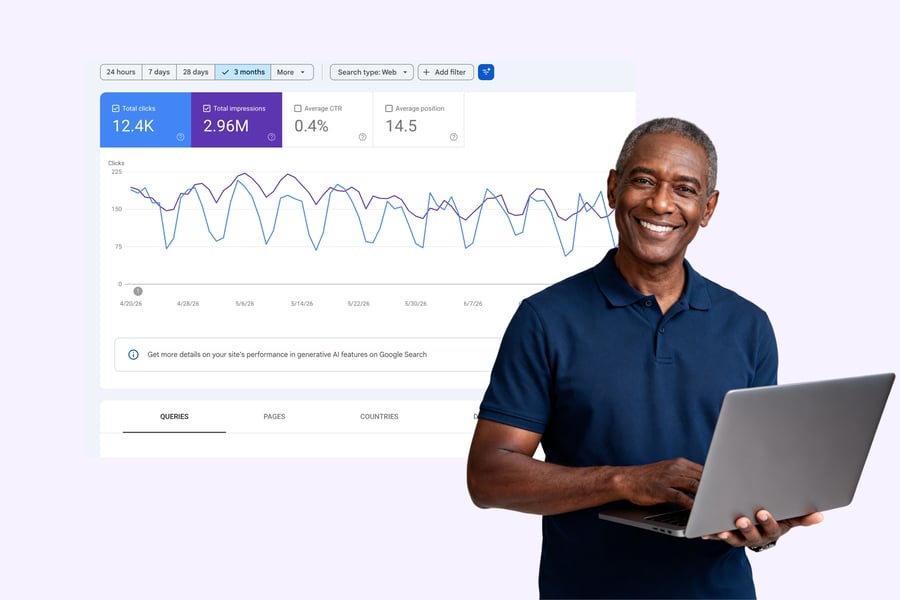
The Performance report is your primary editorial intelligence tool. It shows clicks, impressions, CTR, and average position, filterable by query, page, country, device, or date range up to 16 months. Here's how each metric maps to an editorial decision:
- Impressions with low CTR: Google is showing your content for this query, but searchers aren't clicking. This is a headline and meta description problem, not a ranking problem. Fixing it converts existing visibility into actual sessions without any additional content work.
- High position with declining impressions: Demand for this query is shrinking, or a SERP feature is absorbing clicks above you. Worth knowing before you invest in a deep refresh.
- Position 5-15 on high-volume queries: Cross-referencing average position with CTR to find near-breakthrough pages is one of the most reliable quick-win plays in publisher SEO. A targeted optimization push can move these pages onto page one, and page-one positions drive dramatically more sessions.
- Non-branded impressions: Non-branded performance is the clearest proxy for topical authority, content effectiveness, and organic discovery. Rising non-branded impressions mean new readers are finding you. That's the growth signal that matters most for an ad-supported model trying to expand its audience.
The Page Indexing report answers the question that comes before all of this: can Google actually see your content? A piece that isn't indexed cannot rank, cannot earn a pageview, and cannot serve a single ad impression. For high-volume publishers, the indexing report is your production-line quality check. Every article sitting in "Discovered - currently not indexed" status is content that cost editorial resources to produce and is currently earning nothing. Our guide to diagnosing and fixing coverage issues walks through each status category and what to do about it.
Schema Markup for Publishers: Getting Cited, Not Just Ranked
Structured data is where most publisher SEO guides stop at "add Article schema" and move on. That's not enough anymore, especially for publishers who want their content surfaced in AI Overviews and cited by AI tools.
The three schema types that matter most for ad-supported publishers:
- Article and NewsArticle schema: These tell Google the content type, publication date, author, and headline. NewsArticle schema specifically signals eligibility for Google News and Top Stories surfaces. If your content is news or current events, using the wrong schema type costs you distribution.
- FAQ schema: FAQ structured data improves eligibility for AI Overview extraction and rich results. One critical formatting note: questions must be marked up as proper H3 headings, not bold text. Every competitor in this space uses bold text for FAQ questions, which breaks schema eligibility. Use proper heading hierarchy, H3 for questions, prose for answers, and your FAQ sections become machine-readable in a way your competitors' aren't.
- Speakable schema: This markup identifies the most important sentences or sections of an article for voice search and AI assistants. For publishers producing content that AI tools might reference in audio or conversational contexts, Speakable schema increases the likelihood of attribution.
One formatting rule applies across all schema types: make your FAQ answers fully standalone. An answer that requires surrounding context to make sense won't be extracted by AI systems. Write every answer as if it might appear completely alone, without a headline or adjacent paragraph to support it.
Next Steps:
- How to Use Google Search Console to Improve SEO on Your Publishing Site: Tactical implementation of GSC insights. Turning report data into concrete optimizations that move rankings and traffic.
- SEO Publishing Best Practices: What the Data in Google Search Console Is Telling You: How to read GSC signals as editorial intelligence, not just reporting numbers.
- How to Use Google Search Console: A Revenue-Focused Workflow for Ad-Supported Publishers: The complete operational cadence. Weekly, monthly, and quarterly GSC workflows tied directly to revenue outcomes.
- AI Traffic Is the New SEO: How Publishers Can Optimize for AI Referrals: As AI systems become traffic sources in their own right, here's how to position your content to capture that referral volume.
- Schema and SEO for Publishers and Content Creators: A practical deep-dive into implementing structured data that improves search eligibility and AI citation rates.
Core Web Vitals and the Ad Load Tradeoff
Ad-supported publishers face a tension that pure-content sites don't: more ad units generally mean more revenue, but more ad units also add page weight, increase layout shift, and hurt the Core Web Vitals scores that affect your Google rankings. Getting this balance wrong costs you on both ends. Worse rankings reduce the traffic coming in, and a poor user experience reduces session depth for the traffic that does arrive.
The practical framework for managing this tradeoff:
- Lazy load everything below the fold: Ads that aren't in the viewport shouldn't load until the user scrolls to them. This protects your Largest Contentful Paint (LCP) score without sacrificing ad revenue from placements that get viewed.
- Control above-the-fold ad density: A high-density ad layout above the fold signals a poor user experience to Google and generates the kind of Cumulative Layout Shift (CLS) that tanks Core Web Vitals scores. Reserve the most premium placements for formats that don't push content below the fold.
- Target viewability in the 70-90% range: Chasing maximum ad density often produces low viewability, which both hurts CPMs (advertisers pay less for unseen ads) and signals to Google that your page layout isn't serving readers. Higher viewability at a reasonable density outperforms high density at low viewability on both the revenue and rankings side.
- Monitor CLS from ad slots specifically: Layout shift caused by ads loading asynchronously is one of the most common Core Web Vitals failures on publisher sites. Reserve ad slot space in your CSS before the ad loads so the page doesn't jump when the creative appears.
The publishers who get this right treat Core Web Vitals as a revenue optimization problem, not just a technical SEO checkbox. Better scores mean better rankings, better rankings mean more sessions, and more sessions with high viewability mean better RPS across the board. For a benchmark on what separates top-performing publishers from everyone else, the data on viewability and session depth is instructive.
Building an Operational SEO Cadence
Strategy without execution discipline falls apart. The publishers who consistently outperform their peers on organic traffic aren't doing more sophisticated SEO. They're running consistent operational rhythms that catch problems early and compound improvements over time.
The cadence for a content-forward publishing operation:
- Daily (for time-sensitive content): Check the 24-hour GSC view for recently published trending or news-driven pieces. Confirm they're gaining impressions while the topic is still hot.
- Weekly: Review the Performance report for click and impression trends. A meaningful drop in impressions is your advance warning of a coming traffic and revenue dip, often visible in GSC before it shows up in your ad server.
- Post-publish (every piece): Run the URL Inspection tool on high-value new articles. URL Inspection lets you check whether Google can access and index a page, and request indexing after important changes. If you want to accelerate that process, our guide on how to get Google to index your site faster covers every lever available. Don't wait for the natural crawl cycle on content you worked hard to produce.
- Monthly: Review your non-branded query split and your top-category hub pages. Are your pillar pages accumulating impressions and authority? Is your content architecture working, or are your spoke articles ranking in isolation without lifting the hub?
- Quarterly: Run a systematic refresh audit on evergreen content that has slipped in position over the past six months. These are your fastest revenue recovery opportunities.
One operational note: treat GSC data as provisional on any single day. Google Search Console has had periods where performance reports stopped updating for days at a time, and a logging error in mid-2025 caused impression misreporting. Anchor editorial decisions to trends across multiple weeks, not single-day snapshots. Export your data regularly, because GSC only maintains a rolling 16-month data window. Once data ages out of that window, it's gone.
For a full revenue-focused workflow built around this cadence, our guide on how to use Google Search Console as a revenue-focused workflow for ad-supported publishers puts all of it together in sequence.
See It In Action:
- What Separates the Top 10% of Website Publishers From Everyone Else: Data-Backed: Concrete, data-backed patterns from publishers who consistently outperform on traffic and revenue metrics.
- News Publisher Ad Revenue Monetization Strategy: When More Ads Won't Save You: A real-world look at why traffic quality and session depth beat raw ad density for news publishers under traffic pressure.
- Taking Control of Your Ad Strategy: A Guide for Health and Wellness Publishers: How a category-specific publisher rebuilt its monetization strategy around audience quality rather than impression volume.
- Google Search Console for Publishers: How to Use GSC to Protect Ad Revenue: The full GSC-to-revenue framework. How publishers use search visibility data to catch and fix revenue-threatening problems before they compound.
Search Visibility Is Where Ad Revenue Starts
Every optimization decision in this guide traces back to the same underlying logic. Your ad revenue lives downstream of your traffic, and your traffic lives downstream of how well Google can find and surface your content. GSC is the only tool that shows you that entire chain with first-party precision.
Publishers who treat SEO as a traffic function and monetization as a separate function are missing a closed feedback loop. When you know which content categories drive your highest session RPS, you can prioritize editorial investment in those categories. When you know which evergreen pieces are slipping in position, you can refresh them before the traffic loss reaches your revenue reports. When you know your non-branded impressions are growing, you have leading-edge evidence that your content model is reaching new audiences who will generate new ad impressions.
The search visibility layer and the revenue layer aren't separate systems. They're the same pipeline, viewed from different ends. For the full picture on what GSC data is telling you about your publishing SEO performance, that's the next read.
Frequently Asked Questions About SEO for Publishers
Publishers running ad-supported models tend to hit the same questions once the strategy conversation moves past the basics. Here are direct answers to the ones that come up most often.
How does SEO help publishers increase ad revenue?
SEO increases the volume of organic sessions a publisher receives, which directly increases the number of ad impressions served. More impressions at a stable or improving CPM means higher total revenue. SEO also improves content quality signals that support higher viewability rates, which advertisers pay more for. The causal chain runs from search visibility to sessions to pageviews to ad impressions to revenue.
Can too many ads hurt a publisher's SEO rankings?
Yes. Google evaluates page experience as a ranking factor, and a high ad density above the fold. Particularly when it pushes content down or causes layout shift. Is treated as a poor user experience signal. Ad units that load asynchronously and cause Cumulative Layout Shift (CLS) directly hurt Core Web Vitals scores. Publishers should target viewability in the 70-90% range and use lazy loading for below-the-fold placements to protect both rankings and CPMs.
What is the most important SEO factor for publishers?
Topical authority built through organized content architecture is the highest-leverage factor for most publishers. A well-structured hub-and-spoke model, with category pages that do real SEO work and internal linking that distributes ranking authority site-wide, creates a compounding foundation that individual article optimization can't replicate. Technical health, fast load times, clean indexing, proper schema. Is table stakes. Architecture is the differentiator.
How often should publishers update their SEO strategy?
Publishers should run quarterly reviews of their evergreen content to identify pieces that have slipped in rankings and need refreshing. Keyword and topic strategy should be reassessed twice a year or after any major Google algorithm update. GSC data should be reviewed weekly to catch traffic drops before they compound into revenue losses. The cadence matters more than the frequency: consistent monthly and quarterly reviews outperform reactive audits triggered by bad weeks.
What is Google Discover and how can publishers optimize for it?
Google Discover is a content feed that surfaces articles to users based on their interests, without a search query. It can drive substantial traffic to publishers, particularly for visually engaging content on trending topics. Optimization for Discover centers on high-quality images (at least 1200px wide enabled by max-image-preview:large), strong E-E-A-T signals, and content that aligns with demonstrated user interest patterns. Discover traffic is volatile and cannot be directly targeted with keywords, but publishers with strong topical authority and consistent publishing velocity tend to get more consistent Discover distribution.
How do AI Overviews affect publisher traffic and revenue?
AI Overviews appear at the top of Google search results and answer queries directly, reducing the click-through rate to publisher pages even when those pages rank highly. Publishers producing evergreen and informational content are most exposed to this shift. The strategic response includes developing branded search depth so navigational queries flow directly to your site, producing original research that AI systems cite rather than replace, and optimizing session depth so each click that does land earns more revenue than it previously did. What publishers with subscribers need to know about Google's AI Overviews update covers the subscriber-specific dimensions of this shift.
What schema markup should publishers use?
Ad-supported publishers should implement Article or NewsArticle schema (depending on content type), FAQ schema using proper H3 heading structure rather than bold text, and Speakable schema for content likely to be surfaced in AI or voice contexts. FAQ answers must be written as fully standalone statements that make sense without surrounding context, since that's how AI extraction and rich result systems read them.
How We Help Publishers Turn Search Traffic Into Revenue
We work with publishers across gaming, entertainment, sports, news, and education who have built strong search visibility and want to make sure every session that search sends them earns as much as possible.
Our RAMP platform connects your ad stack, demand relationships, and yield analytics in a single system, so the traffic your SEO strategy generates gets monetized through header bidding, direct demand, and high-impact formats without the operational overhead of managing it yourself. Our yield ops team monitors performance at the placement level, so a ranking improvement that drives more sessions to a specific content category actually shows up as more revenue, not just more pageviews.
If your content model is generating solid organic traffic and you want to understand what that traffic should be earning, we can run a side-by-side comparison on your current performance. The data tends to be clarifying.
